
You know that feeling around 2 PM when your brain just stops cooperating? Focus scatters, motivation drops, and no amount of coffee seems to fix it. This isn’t a personal failing. It’s a sign that your daily routine isn’t supporting your biology the way it should. The good news is that building a structured, research-backed workflow can change this completely. In this guide, you’ll learn exactly what habits, tools, and supplements to use, how to sequence them for maximum effect, and how to track whether they’re actually working for you.
Table of Contents
- What you need for a daily energy-support workflow
- How to execute a high-impact energy workflow step by step
- Personalizing your workflow: Tracking, data, and iteration
- Expected results and benchmarks: How to know it’s working
- What most guides miss about daily energy support
- Ready to optimize your daily energy?
- Frequently asked questions
Key Takeaways
| Point | Details |
|---|---|
| Daily structure is key | A repeatable morning-to-evening routine prevents energy crashes and optimizes focus. |
| Habits before supplements | Hydration, light, movement, and sleep yield the biggest energy gains before adding supplements. |
| Track and personalize | Use simple tools like HRV and subjective ratings to refine your routine for best results. |
| Benchmarks matter | Look for fewer afternoon slumps and more sustained mental clarity as signs your workflow is working. |
What you need for a daily energy-support workflow
Before you start stacking supplements or buying gadgets, it helps to understand what actually moves the needle. Most people skip the basics and jump straight to nootropics. That’s backwards. The real foundation of sustained energy is simpler than you think.
The non-negotiables first:
- Hydration: Drink 500 to 600ml of water within 15 minutes of waking. Your body is mildly dehydrated after 7 to 8 hours of sleep, and even mild dehydration tanks cognitive performance.
- Light exposure: Get outside or use a 10,000 lux light box within 30 minutes of waking. Five to thirty minutes is enough to set your circadian rhythm and cortisol awakening response (CAR) for the day.
- Movement: Even 10 minutes of walking or light exercise counts. It primes your nervous system and raises baseline alertness.
- Cold exposure: A cold shower or cold water splash on your face spikes norepinephrine, which sharpens focus fast.
As the biohacking productivity research makes clear, hydration, light, cold exposure, and movement are foundational for energy and come before supplements. This matters because no supplement can compensate for a dehydrated, light-deprived body.
Core supplements worth considering:
| Supplement | Primary benefit | When to take |
|---|---|---|
| AG1 (Athletic Greens) | Micronutrient baseline | Morning, with water |
| Omega-3 | Brain and cell membrane health | With breakfast |
| Creatine | Cognitive and physical output | Morning or pre-workout |
| NAD+ precursor (NMN) | Cellular energy production | Morning |
A daily brain health protocol confirms that supplements like AG1, Omega-3, Creatine, and NAD+ support vitality when layered on top of solid lifestyle habits. If you want to understand what NAD+ actually does at the cellular level, the NAD+ supplement details page breaks it down clearly.
Tracking tools (optional but useful):
- Oura Ring: tracks HRV, sleep stages, and readiness score
- Continuous glucose monitor (CGM): shows how food affects your energy in real time
- Simple energy journal: rate your focus and energy every 2 to 3 hours
Pro Tip: You don’t need all of these on day one. Start with hydration, light, and one or two supplements. Add tracking tools after you’ve built the habit.
How to execute a high-impact energy workflow step by step
With the essentials covered, here’s exactly how to sequence your day for best results. Order matters more than most people realize.
- Wake up and hydrate immediately. Before coffee, before your phone. Drink your 500 to 600ml of water. This is non-negotiable.
- Get light exposure within 30 minutes. Go outside if possible. If it’s dark or cloudy, use your light therapy box. This sets your cortisol curve for the day and improves alertness by mid-morning.
- Delay caffeine by 60 to 90 minutes. This feels counterintuitive, but delaying caffeine and using ultradian rhythms extends energy and prevents the early afternoon crash. Adenosine clears naturally first, so caffeine hits harder later.
- Take your morning supplements with breakfast. NAD+ precursors, Omega-3, and creatine all work well here.
- Do your most demanding cognitive work in the first 90-minute block. Your prefrontal cortex is sharpest in the late morning. Protect this window.
- Schedule a midday reset. A 10 to 20 minute walk, light stretching, or even a brief meditation resets your nervous system for the afternoon.
- Avoid high-glycemic foods at lunch. Blood sugar spikes are the number one cause of the 2 PM crash.
- Wind down intentionally. Two hours before bed, cut blue light exposure. Consider an adaptogen like ashwagandha in the evening to lower cortisol and improve sleep quality.
Daily energy timeline:
| Time | Action | Purpose |
|---|---|---|
| Wake + 0 min | Hydrate 500ml | Rehydration, cognitive prime |
| Wake + 15 min | Sunlight or light box | Circadian reset, CAR |
| Wake + 60 min | Caffeine + supplements | Sustained alertness |
| Morning | 90-min deep work block | Peak cognitive output |
| Midday | Movement reset | Norepinephrine, BDNF |
| Evening | Blue light off, adaptogen | Cortisol reduction, sleep prep |
Pro Tip: If you’re supporting NAD+ levels with an NMN-based supplement, take it in the morning. NAD+ metabolism is tied to circadian biology, so morning dosing aligns with your natural energy production cycle.
Personalizing your workflow: Tracking, data, and iteration
Once your workflow is in motion, personalization is where most of the long-term gains happen. A generic routine is a starting point. Your data turns it into something that actually fits your biology.
What to track:
- HRV (heart rate variability): A rising trend over weeks means your nervous system is recovering well. A drop signals stress or poor sleep.
- Oura readiness score: Combines HRV, resting heart rate, and sleep data into a daily number. Use it to decide whether to push hard or recover.
- Glucose (via CGM): Watch for post-meal spikes that correlate with energy crashes. Adjusting meal timing or composition here can be a game changer.
- Subjective energy log: Rate your energy and focus at 9 AM, 1 PM, and 5 PM on a 1 to 10 scale. Patterns emerge fast.
Tracking HRV, readiness scores, and subjective energy gives you the feedback loop you need to iterate your routine with real data, not guesswork.
Common pitfalls to avoid:
- Overdependence on nootropic stacks before fixing sleep and nutrition
- Ignoring chronotype: night owls shouldn’t force a 5 AM routine
- Adding too many supplements at once, making it impossible to know what’s working
“The 30 to 60 day rule” is something we stand by: give any new supplement or habit change at least 30 days before evaluating. Most people quit after two weeks, right before results would have shown up.
The biohacker community is pretty direct about this: supplements alone aren’t enough, and behaviors matter most. Your data will confirm this. When you track consistently, you’ll see that your sleep quality, meal timing, and stress levels predict your energy far more than any single supplement.
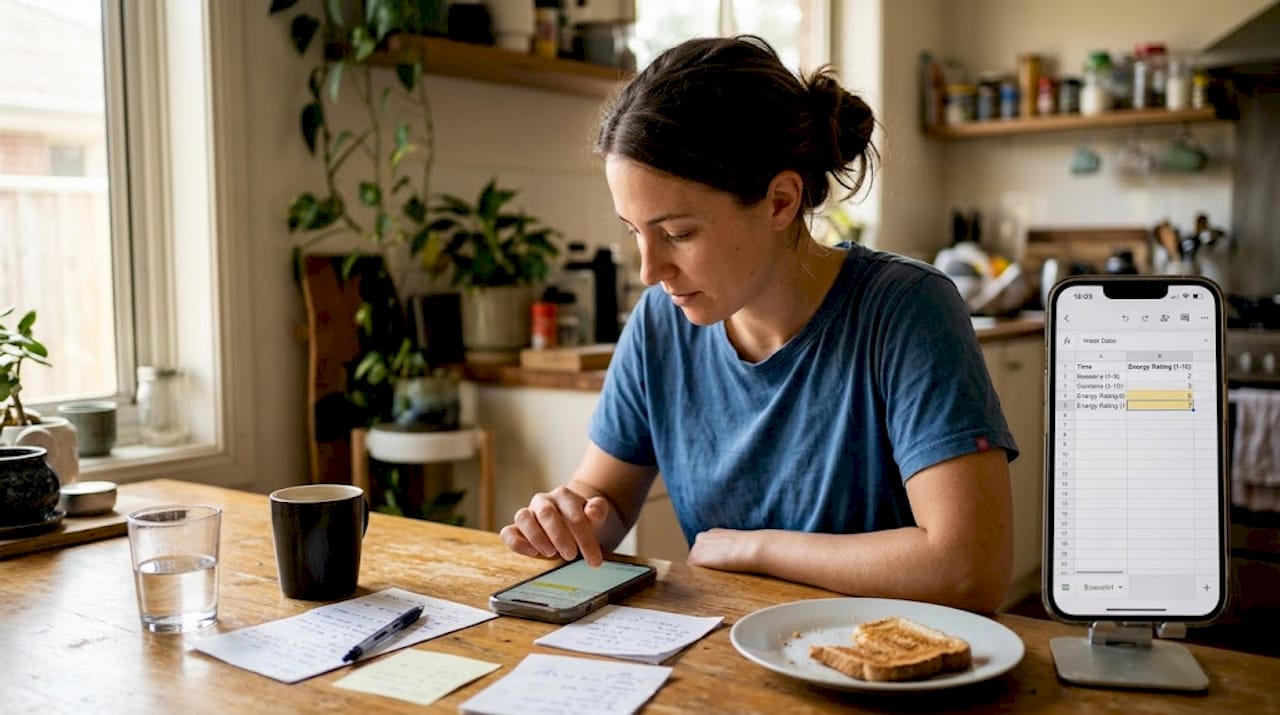
Pro Tip: Use a simple spreadsheet or app like Notion to log your daily readiness score, supplements taken, and energy ratings. After 30 days, you’ll have real insight into what’s actually moving the needle for you.
Expected results and benchmarks: How to know it’s working
With your daily workflow dialed in and personalized, what results should you realistically expect? Here’s what the research and real-world experience tell us.
Short-term wins (weeks 1 to 4):
- Fewer afternoon energy crashes
- Faster mental warm-up in the morning
- More consistent sleep quality
- Reduced brain fog after meals
Longer-term gains (months 2 to 6):
- Measurable HRV improvement
- Steadier glucose curves throughout the day
- Improved working memory and task-switching speed
- Greater stress resilience
Benchmark data to watch:
| Metric | Baseline | Target after 60 days |
|---|---|---|
| Afternoon energy (1-10) | 4 to 5 | 7 to 8 |
| HRV (ms) | Personal baseline | 5 to 15% increase |
| Post-lunch focus crash | Daily | Rare or absent |
| Morning alertness speed | 60+ min | Under 30 min |
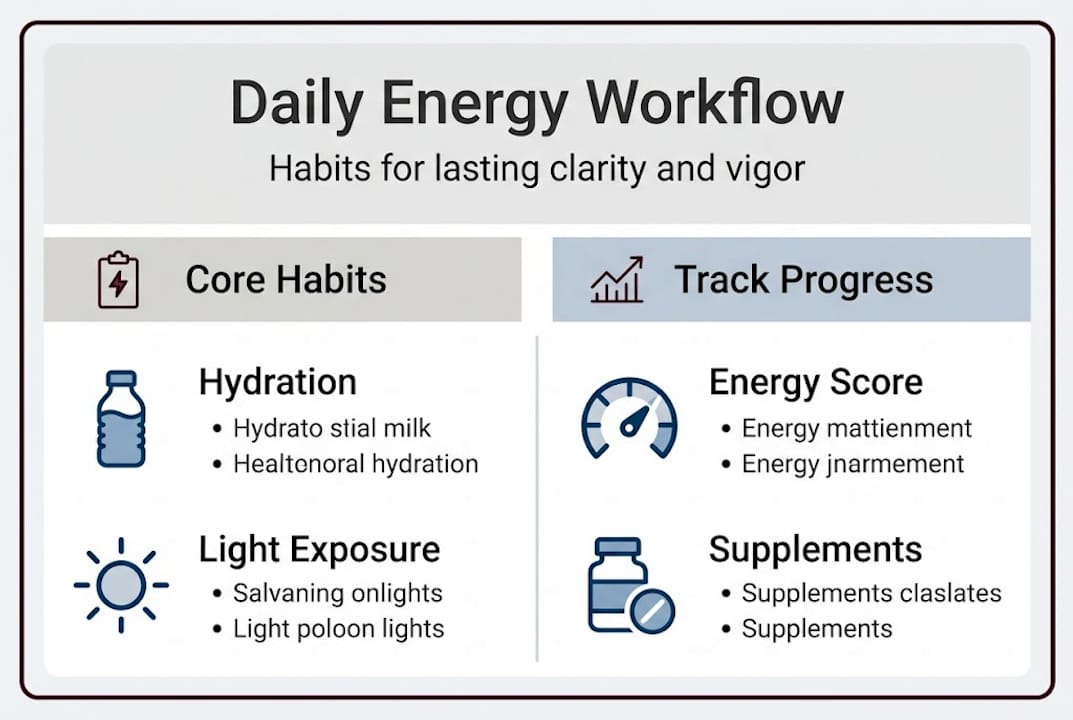
The numbers behind proper hydration and lifestyle habits are striking. Proper hydration alone can deliver a 10 to 15% cognitive boost, while consistent exercise is linked to 40% less afternoon fatigue and up to 2% hippocampal growth. These aren’t marginal improvements. They’re the kind of changes you actually feel.
When you add a well-designed NAD+ energy workflow on top of these lifestyle fundamentals, the cellular energy support compounds over time. NAD+ levels naturally decline with age, and replenishing them supports mitochondrial function, which is the engine behind everything you’re trying to optimize.
If your metrics aren’t trending in the right direction after 60 days, go back to basics. Check sleep consistency, meal quality, and hydration before adding anything new.
What most guides miss about daily energy support
Here’s the uncomfortable truth: most energy optimization guides are written to sell you something. They lead with the flashiest supplements and bury the boring stuff at the bottom. That’s backwards, and it’s why so many people spend a lot of money and still feel tired.
I’ve seen it firsthand. People build elaborate nootropic stacks but sleep six hours a night and eat garbage at lunch. The stack doesn’t stand a chance. The real gains come from sleep, exercise, and nutrition, and supplements optimize the last 5%.
The other trap is perfectionism. People design a perfect 12-step morning routine, follow it for four days, miss one day, and abandon the whole thing. Consistency with a simple routine beats perfection with a complex one every single time.
What actually works long-term is a short feedback loop: do the basics, track a few numbers, adjust one thing at a time, and repeat. That’s it. The biohackers who see real results aren’t the ones with the most expensive stacks. They’re the ones who show up every day, pay attention to their data, and make small, steady improvements.
Ready to optimize your daily energy?
You now have the framework: the right habits in the right order, the supplements worth taking, and the tracking methods to know what’s working. The next step is making sure your supplement choices are actually backed by real science and real quality standards.
CP-1’s NAD+ Advanced Supplement is built specifically to support the cellular energy production that makes this whole workflow click. If you want to understand what’s inside and why it works, check out the key ingredients and science behind the formula. No hype, no filler. Just ingredients that earn their place. Explore more at CP-1 and see how it fits into your daily routine.
Frequently asked questions
What’s the best time to take energy-support supplements?
Most energy-targeted supplements work best with or after breakfast, while adaptogens like ashwagandha are better taken in the evening. A morning protocol with delayed caffeine and L-theanine, paired with evening ashwagandha, is a well-supported approach.
Do I have to follow every step to notice results?
Not at all. Even starting with just hydration, light exposure, and regular movement produces measurable improvements. Hydration and sunlight alone improve both cognition and energy benchmarks meaningfully.
How do I know if my energy workflow is working?
If afternoon crashes are less frequent, mental clarity is sharper, and your tracked biometrics trend positive, your workflow is on target. Oura readiness scores and HRV are reliable benchmarks of real progress.
Are complex nootropic stacks necessary for energy support?
No. Most biohackers find that foundational habits and a few well-chosen supplements outperform complex stacks. Complex nootropic stacks often offer subtle or inconsistent benefit, especially when the basics aren’t in place first.