
For most healthy adults, the best time to take NMN is in the morning, either shortly after waking or with breakfast. That single sentence covers the majority of cases. The rest of this guide explains why, when to adjust, and how to build a protocol that actually works for your life.
- Default recommendation: Take 250–500 mg of NMN within 30–60 minutes of waking, with or without a light meal.
- If you get stomach upset: Take it with a small breakfast rather than on an empty stomach.
- If you’re sleep-sensitive: Avoid taking NMN after noon. Even though NMN isn’t a stimulant in the traditional sense, some people notice it affects sleep quality when taken late in the day.
- Who should check with a clinician first: Anyone who is pregnant, breastfeeding, managing liver disease, or taking prescription medications that affect metabolism or liver function.
Pro Tip: Anchor your NMN dose to an existing morning habit, like brewing coffee or taking other supplements, so you don’t have to think about it. Consistency matters more than hitting an exact clock time.
Key Takeaways
Morning dosing at 250–500 mg is the evidence-supported default for NMN supplementation, with 8–12 weeks as the realistic window for evaluating functional outcomes.
| Point | Details |
|---|---|
| Morning is the default | Take NMN shortly after waking or with breakfast to align with circadian NAMPT activity. |
| Start at 250 mg/day | Most trials begin here; increase to 300–600 mg only after assessing tolerance for 4 weeks. |
| Give it 8–12 weeks | Blood NAD+ rises in days, but functional improvements in trials appear at the 8–12 week mark. |
| Consult a clinician first | Pregnant, breastfeeding, liver disease, or prescription medication users should get professional guidance before starting. |
| CP-1 as a quality option | CP-1 NAD+ Advanced Supplement combines NMN with CoQ10 and mushroom extracts in a GMP-certified, third-party tested formula. |
Table of Contents
- Why does timing actually affect how NMN works?
- Morning vs. evening: which one is actually better for you?
- Should you take NMN with food or on an empty stomach?
- How often should you take NMN and at what dose?
- When should you take NMN around your workouts?
- What can you safely stack with NMN?
- Do you need to cycle NMN or take breaks?
- How long before you actually notice NMN working?
- What are the real side effects and safety considerations?
- How do you evaluate NMN product quality before buying?
- My honest take on NMN timing
- CP-1 NAD+ Advanced Supplement: a quality-first NMN option
- Sources
Why does timing actually affect how NMN works?
NMN, short for nicotinamide mononucleotide, is a direct precursor to NAD+ (nicotinamide adenine dinucleotide), a molecule your cells use for energy production, DNA repair, and metabolic regulation. The reason timing matters isn’t arbitrary. It’s rooted in how your body actually produces and uses NAD+ throughout the day.
The enzyme NAMPT (nicotinamide phosphoribosyltransferase) is the rate-limiting step in NAD+ biosynthesis, and NAMPT expression follows a circadian rhythm, peaking during your active, waking hours. When you take NMN in the morning, you’re feeding the biosynthesis pathway at the point when your body is already primed to convert it. Taking it at night doesn’t break anything, but you’re working against the natural rhythm rather than with it.

Human trials reinforce this convention. A review of NAD+ precursor biology and clinical trial evidence confirms that most human NMN studies used morning dosing protocols, which means the positive outcomes reported in those trials, including increased blood NAD+ levels and improved metabolic markers, were produced under morning-dosing conditions. That’s not proof that evening dosing fails, but it does mean the evidence base is built on morning use.
One specific example: an 8-week open-label trial in healthy middle-aged Japanese men used 250 mg taken before breakfast and reported measurable increases in PBMC (peripheral blood mononuclear cell) NAD+ levels alongside good general tolerability. The study was small and not placebo-controlled, so it doesn’t settle every question, but it illustrates the before-breakfast protocol that most practitioners now recommend as a starting point.
Statistic callout: Blood NAD+ levels can begin rising within days of starting NMN supplementation, but functional outcomes in clinical trials are typically measured at 8–12 weeks, which is the realistic window for noticing meaningful changes.
Pro Tip: Think of your NMN dose as aligning with your “active phase” rather than a fixed clock time. If you work night shifts, your morning is 7 PM. The biology cares about your circadian rhythm, not the number on the clock.
Morning vs. evening: which one is actually better for you?
The honest answer is that morning wins for most people, but it’s not a universal rule. Here’s how the trade-offs break down.
Why morning dosing makes sense for most people
- Aligns with the circadian peak of NAMPT activity, the enzyme driving NAD+ production
- Matches the dosing protocol used in the majority of human clinical trials
- Supports daytime energy and metabolic function when you actually need it
- Reduces the risk of sleep disruption from any stimulatory effect of increased cellular energy
- Easier to build into an existing morning routine, which improves long-term adherence
When evening or late-afternoon dosing might make sense
These findings are early-stage and come from small samples, so they don’t overturn the morning-first default. But they do mean evening dosing isn’t automatically wrong for everyone.
If you train in the evening and want to align NMN with your workout window, a late-afternoon dose (before 5 PM) is a reasonable experiment. The key caveat: if your sleep quality drops within the first two weeks, move the dose earlier. Practical guidance from health synthesis sources consistently recommends shifting to an earlier window as the first-line fix for sleep disruption, not stopping NMN altogether.
This is the core clinical rationale for morning dosing. It’s not that evening dosing is dangerous. It’s that the biology favors daytime, and the trial evidence was built on daytime protocols. When in doubt, morning is the safer, better-supported default.
Should you take NMN with food or on an empty stomach?
This is one of the most common practical questions, and the answer depends on your GI tolerance more than anything else.
Human trials have used both protocols. Some studies administered NMN before breakfast on an empty stomach; others used it with meals. Neither approach produced dramatically different NAD+ outcomes in the limited comparative data available. What does differ is tolerability.
- Empty stomach: Acceptable for most people and may allow slightly faster absorption. If you have a sensitive stomach, this is where nausea or mild GI discomfort is most likely to show up.
- With a light meal: The most practical choice if you experience any stomach upset. A small breakfast, not a heavy, high-fat meal, is ideal.
- Sublingual or liposomal formats: These are designed to bypass the digestive tract partially, so the food-timing question matters less. Follow the product’s specific instructions for these formats.
- Alcohol: Avoid combining NMN with alcohol. There’s no strong evidence that alcohol changes NAD+ outcomes directly, but it stresses the same metabolic pathways NMN is meant to support.
- Very high-fat meals: May slow gastric emptying and alter the absorption window, though this hasn’t been shown to meaningfully change NAD+ levels in human studies.
Pro Tip: Start with NMN on an empty stomach for the first week. If you notice any nausea or GI discomfort, simply shift to taking it with a light breakfast. Most people find that one adjustment solves the problem entirely.
How often should you take NMN and at what dose?
Most people do well with a single morning dose. Split dosing is worth considering only if you’re taking a higher total daily amount or have a specific reason to spread the dose across the day.
Clinical trials have used a range of doses. Starting at 250 mg/day is the most common recommendation in physician-oriented dosing guides, with many trials reporting positive NAD+ increases and good tolerability in the 250–600 mg/day range. Some short-duration trials have tested doses up to 900–1,200 mg/day, with tolerability generally maintained, though long-term safety data at those levels remains limited.
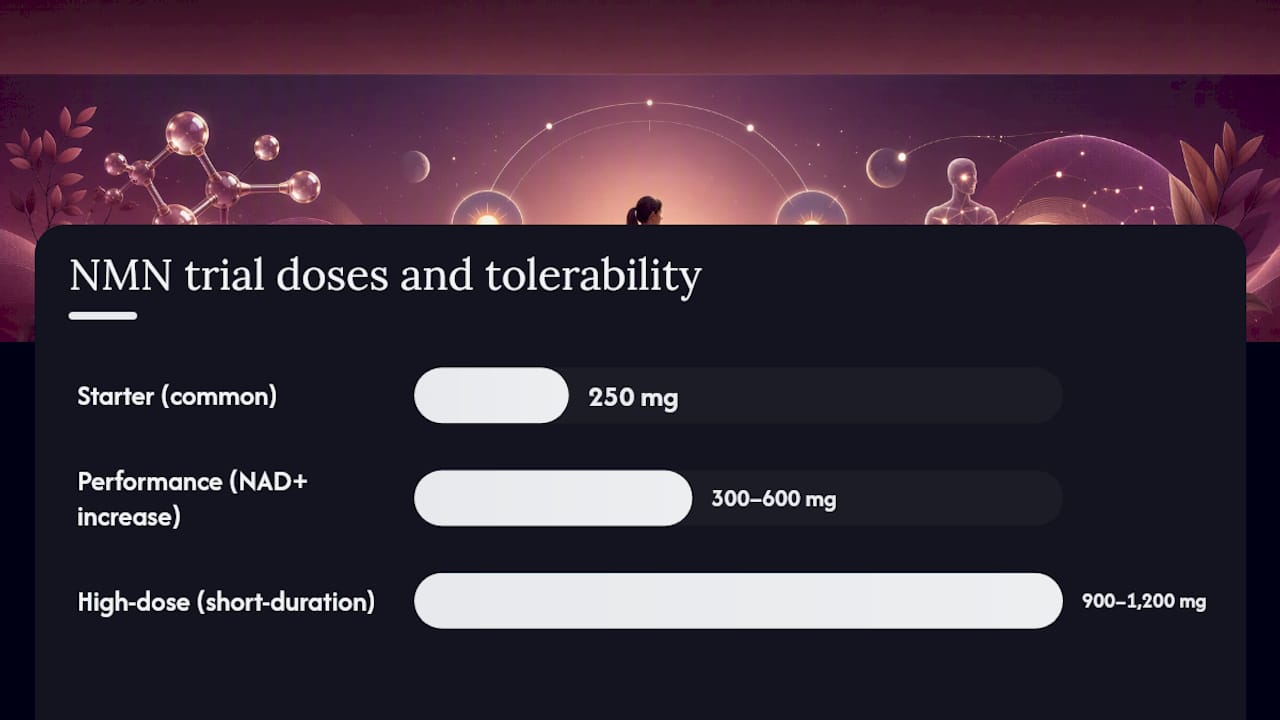
| Protocol | Dose | Timing | Who it fits | Caution |
|---|---|---|---|---|
| Starter | 250 mg/day | Morning, before or with breakfast | Most healthy adults new to NMN | Begin here; assess tolerance |
| Performance/therapeutic range | 300–600 mg/day | Morning, or split morning + early afternoon | Active adults, those targeting metabolic or endurance goals | Monitor GI tolerance and sleep quality |
| High-dose trials | 900–1,200 mg/day | Split across the day | Studied in short clinical trials only | Limited long-term data; discuss with a clinician |
Signs that your current schedule needs adjustment:
- Difficulty falling asleep or staying asleep
- GI discomfort, nausea, or loose stools
- Noticeable jitteriness or restlessness (rare but reported)
- No change in energy or endurance after 10–12 weeks at a given dose
If any of these appear, adjust timing before adjusting dose. Move the dose earlier, add food, or temporarily reduce to 250 mg before making any other changes.
When should you take NMN around your workouts?
NMN supports mitochondrial energy production, which makes workout timing a reasonable consideration. The practical logic is simple: take it during your active phase, ideally before the session where you want the energy support.
- Morning workout: Take NMN 30–60 minutes before training. This aligns with the circadian peak and gives the compound time to begin converting to NAD+ before you need it.
- Midday workout: Take NMN with breakfast and train 2–3 hours later. The dose is already in your system; you don’t need to time it precisely around the session.
- Evening workout: Take NMN in the morning rather than pre-workout. A late-day dose before an evening session risks sleep disruption, especially if you’re already sensitive to stimulatory compounds. The morning dose still supports recovery overnight.
Practical guidelines by workout timing:
- Morning trainer: NMN on waking, 30–90 minutes before the session
- Afternoon trainer: NMN with breakfast, no additional pre-workout dose needed
- Evening trainer: NMN in the morning only; avoid dosing within 6 hours of bedtime
- Rest days: same morning timing as training days; consistency matters more than workout-day precision
The NMN and longevity research on mitochondrial support suggests the benefits accumulate over time rather than acting acutely like caffeine. Don’t expect a pre-workout surge. Think of it as building a better engine, not adding fuel to a fire.
What can you safely stack with NMN?
NMN pairs well with several other compounds, and the combinations are common enough in longevity protocols that it’s worth addressing them directly.
- Resveratrol: Often taken alongside NMN because it activates sirtuins, the NAD±dependent proteins that NMN helps fuel. Take both in the morning. Resveratrol absorbs better with a fat-containing meal, so if you’re combining them, a small breakfast with some healthy fat makes sense.
- TMG (trimethylglycine): NMN metabolism can consume methyl groups. TMG replenishes them and is a common addition to NMN protocols, particularly at higher doses. Morning dosing alongside NMN works well.
- CoQ10: Supports mitochondrial energy production through a complementary pathway. Morning dosing with food is standard. CP-1’s formula includes CoQ10 alongside NMN, which reflects this rationale.
- Caffeine and coffee: Most people tolerate NMN alongside their morning coffee without issue. The combination isn’t contraindicated. That said, if you notice increased jitteriness or sleep disruption, separate them by 30–60 minutes and see if that helps.
Medication interactions require a direct conversation with your clinician, not a supplement guide. Drugs that affect liver metabolism (particularly CYP450 pathways), medications with narrow therapeutic windows, and anything that already modulates NAD+ or methylation pathways deserve professional review before you add NMN. For more on how NMN compares to other NAD+ strategies, clinical NAD+ approaches offer a useful reference point.
Do you need to cycle NMN or take breaks?
The short answer: no proven need to cycle. Most human trials used continuous daily dosing for 8–12 weeks, and that’s the convention the evidence is built on.
Dosing trial summaries note that functional endpoints, things like improved endurance, metabolic markers, or energy levels, were typically measured at the 8–12 week mark. That’s not because NMN stops working after 12 weeks. It’s simply the duration most trials ran. Long-term safety data beyond several months is limited but tolerability across that window has been reported without significant issues in the available literature.
Some people choose to take periodic breaks, a week off every few months, out of personal preference or to reassess whether they’re still noticing benefits. That’s a reasonable personal experiment, not a clinical requirement.
- Continuous daily dosing is the convention in human trials
- No evidence of tolerance buildup or diminishing returns requiring a formal cycle
- If you want to evaluate effectiveness, run a minimum 8–10 week trial before drawing conclusions
- Track at least two or three simple metrics from the start: energy levels, workout performance, and sleep quality
Pro Tip: Before you start NMN, write down three baseline notes: your typical afternoon energy level (1–10), your workout endurance, and your sleep quality. Check those same three things at week 8. That simple before-and-after comparison tells you more than any vague sense of “feeling better.”
How long before you actually notice NMN working?
Blood NAD+ levels can begin rising within days of starting supplementation. Functional outcomes, the things you actually feel, take longer.
In clinical trials, meaningful changes in energy, endurance, or metabolic markers were typically measured at 8–12 weeks. That timeline reflects how long it takes for elevated NAD+ to translate into downstream cellular changes that show up as functional improvements. Clinical and translational literature on NAD+ precursor effects supports this expectation window.
What you might notice at different points:
- Days 1–14: Possibly nothing, or mild GI adjustment. Some people report a subtle lift in energy, but this is highly variable and not universal.
- Weeks 2–6: Some users notice improved workout recovery or slightly more consistent daytime energy. These are early signals, not proof of efficacy.
- Weeks 8–12: The window where most trial-measured functional improvements appear. This is when it’s worth doing a genuine assessment.
Statistic callout: An 8-week trial in healthy middle-aged men using 250 mg/day before breakfast reported measurable increases in PBMC NAD+ levels, confirming that biochemical changes precede any subjective functional improvements you might notice.
One thing worth remembering: the absence of a dramatic subjective effect in the first few weeks doesn’t mean NMN isn’t working at the cellular level. NAD+ biochemistry doesn’t announce itself the way caffeine does. You’re building infrastructure, not flipping a switch. For a deeper look at what NMN benefits the research actually supports, the clinical evidence is more nuanced than most marketing copy suggests.
What are the real side effects and safety considerations?
NMN has a reasonable safety profile in the doses studied so far. That’s not the same as saying it’s risk-free for everyone.
Human trials at doses of 250–600 mg/day have generally reported good tolerability, with the most common complaints being mild GI symptoms: nausea, loose stools, or stomach discomfort. These are typically transient and often resolve by taking NMN with food. Healthline’s synthesis of NMN safety data notes tolerability up to approximately 1,200 mg in short trials, though long-term data at higher doses remains limited.
Statistic callout: A PMC-hosted review of NAD+ precursor evidence notes that while short-term human trials report good tolerability, the evidence base for long-term safety at higher doses is still developing. Treat that honestly rather than assuming unlimited safety.
Who should consult a clinician before starting:
- Pregnant or breastfeeding individuals
- Anyone with liver disease or a history of liver dysfunction
- People taking prescription medications that affect CYP450 liver enzymes
- Anyone on drugs with narrow therapeutic windows (anticoagulants, immunosuppressants)
- Those taking other supplements that affect methylation (high-dose B12, folate, SAMe)
What to tell your clinician:
- Your current medications and their dosing
- Any liver history or abnormal liver enzymes
- Planned surgeries (NAD+ pathways interact with cellular stress responses)
- Other supplements in your stack, especially anything affecting methylation
Stop NMN and contact your clinician if you experience unexplained fatigue, jaundice, significant GI distress, or any new symptoms that appear after starting supplementation.
How do you evaluate NMN product quality before buying?
Most NMN products on the market are not garbage, but enough of them are that you need a short checklist before handing over your money.
- Third-party testing: Look for a Certificate of Analysis (COA) from an independent lab confirming NMN content and purity. If a brand won’t share its COA, that’s a red flag.
- GMP manufacturing: Good Manufacturing Practice certification means the facility follows FDA-regulated quality standards. US-based GMP manufacturing is the baseline you should expect.
- Clear dosing per serving: The label should state exactly how many milligrams of NMN are in each serving. Proprietary blends that lump NMN with other ingredients without disclosing individual amounts are a problem because you have no idea what you’re actually getting.
- Vegan and non-GMO: Not a quality marker on its own, but it reflects the sourcing transparency that serious manufacturers tend to apply across the board.
- Format considerations: Capsules are the most studied format. Sublingual and liposomal forms claim higher bioavailability, and the rationale is plausible, but direct comparative human data is limited. Chewable gummies like CP-1’s formula offer a practical middle ground with good absorption characteristics and easier daily compliance.
CP-1’s NAD+ Advanced Supplement checks these boxes: US-manufactured, GMP practices, third-party tested, vegan, non-GMO, with NMN paired alongside CoQ10, Lion’s Mane, Reishi, and Turkey Tail in a transparent formulation. For a side-by-side look at how NMN compares to other NAD+ supplement strategies, the differences in bioavailability and delivery matter more than most buyers realize.
Pro Tip: When reviewing a COA, check three things: the NMN content matches the label claim, heavy metals are below detectable limits, and the test date is recent (within 12 months). If any of those are missing, ask customer support before buying.
My honest take on NMN timing
The supplement industry loves to overcomplicate timing. You’ll find guides insisting on precise 6 AM dosing windows, elaborate fasting protocols, and multi-compound stacks that read like a chemistry syllabus. Most of it is noise.

The actual evidence is simpler and more honest: take NMN in the morning, be consistent, start at 250 mg, and give it 8–12 weeks before you decide whether it’s working. The circadian biology is real, the trial evidence favors morning dosing, and the practical benefits of anchoring it to a morning habit are significant for long-term adherence. Beyond that, the individual variation is wide enough that your job is to run a clean personal trial, track a few simple metrics, and adjust based on what you actually observe.
What I’d push back on is the idea that you need to optimize every variable before you start. The people who get the most out of NMN are the ones who take it consistently for months, not the ones who spend three weeks debating sublingual vs. capsule timing. Start simple. Adjust as needed. Consult your clinician if you have any health conditions or take prescription medications. That’s the whole protocol.
CP-1 NAD+ Advanced Supplement: a quality-first NMN option
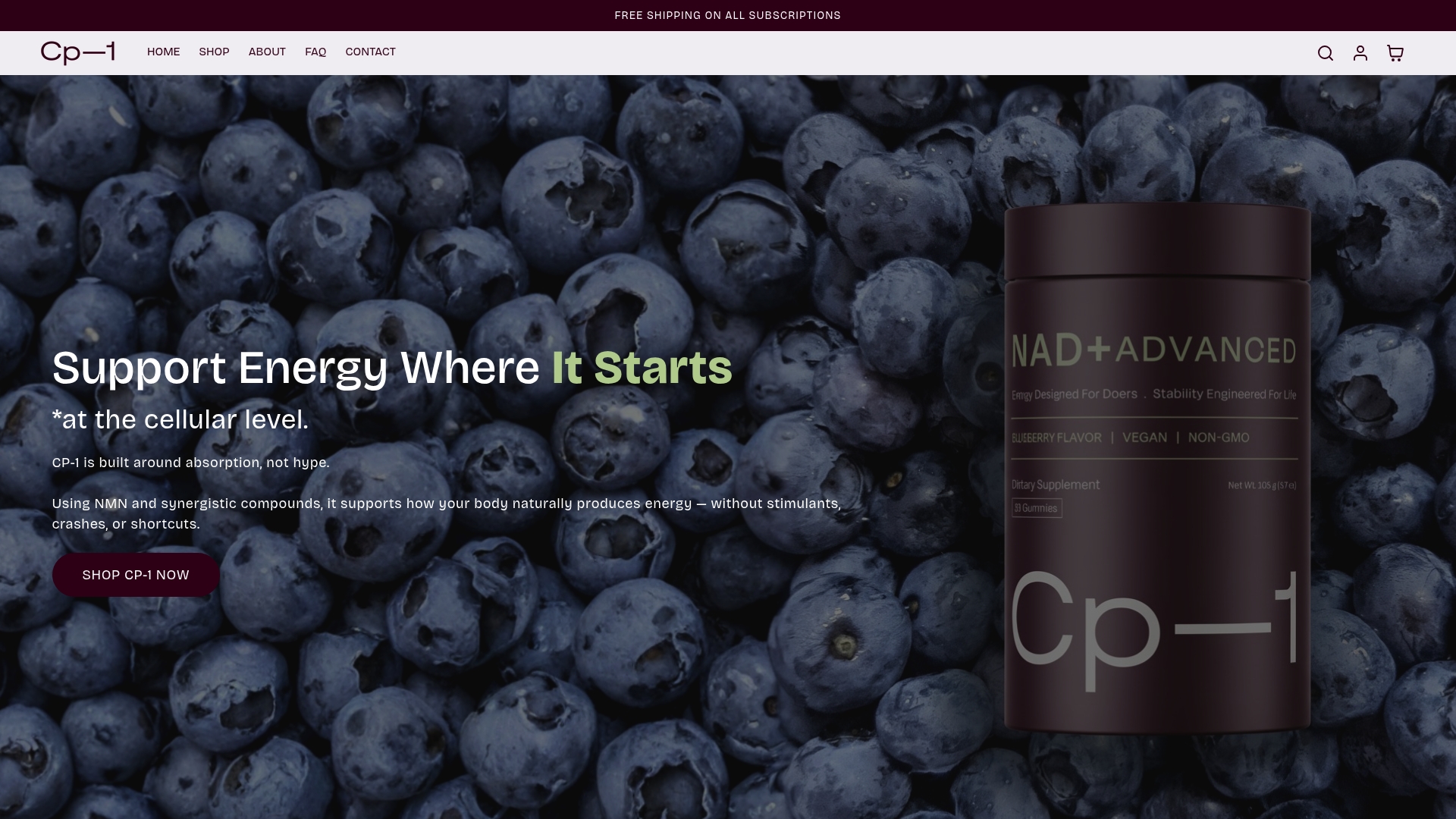
If you’ve read this far, you know what a quality NMN product needs to look like. CP-1’s NAD+ Advanced Supplement was built around exactly those standards: NMN paired with CoQ10, Lion’s Mane, Reishi, and Turkey Tail mushroom extracts in a chewable gummy format, manufactured in the US under GMP practices, third-party tested, vegan, and non-GMO. The formulation reflects the morning-first, mitochondrial-support rationale this guide is built on.
For readers who want a tested, direct-to-consumer NMN option that pairs naturally with the morning dosing protocol above, CP-1 NAD+ Advanced Supplement is worth a look. This is not medical advice. If you have health conditions or take prescription medications, discuss NMN supplementation with your clinician before starting.
Sources
The sources below are the primary references used to build this guide. Each one is worth opening if you want to go deeper on a specific question.
- Ncbi
- Pmc
- Safety and efficacy of long-term nicotinamide mononucleotide supplementation on metabolism, sleep, and nicotinamide adenine dinucleotide biosynthesis in healthy, middle-aged Japanese men
- NMN (Nicotinamide Mononucleotide): Benefits, Side Effects, and Dosage
This article is general information, not a substitute for advice from a qualified doctor. Consult a qualified healthcare professional about your own circumstances before acting on anything here.