
Most people treat fat loss and muscle gain as two separate goals you tackle one at a time. That thinking is wrong, and it’s costing you months of progress. Body recomposition, the process of losing fat and building muscle simultaneously, is real, it’s achievable, and it doesn’t require a perfect genetic profile or a professional athlete’s schedule. What it does require is a clear strategy around nutrition, training, and tracking. This guide covers exactly that, without the fluff or the oversimplified advice you’ve probably already read a dozen times.
Table of Contents
- Key takeaways
- The core principles of body recomposition
- How to track progress beyond the scale
- Nutrition strategies that actually move the needle
- Designing your resistance training plan
- My honest take on what actually works
- How Cp-1 supports your recomposition goals
- FAQ
Key takeaways
| Point | Details |
|---|---|
| Protein is non-negotiable | Aim for 1.6–2.4 g/kg of bodyweight daily to protect muscle while losing fat. |
| The scale will lie to you | Fat loss and muscle gain offset each other in weight, so use measurements and photos too. |
| Resistance training drives results | Progressive overload is the primary stimulus for muscle growth during a calorie deficit. |
| Mild deficit, not aggressive | A 100–200 calorie deficit supports fat loss without wrecking muscle retention. |
| Track multiple metrics | Combine training logs, tape measurements, and periodic DEXA scans for a real picture of progress. |
The core principles of body recomposition
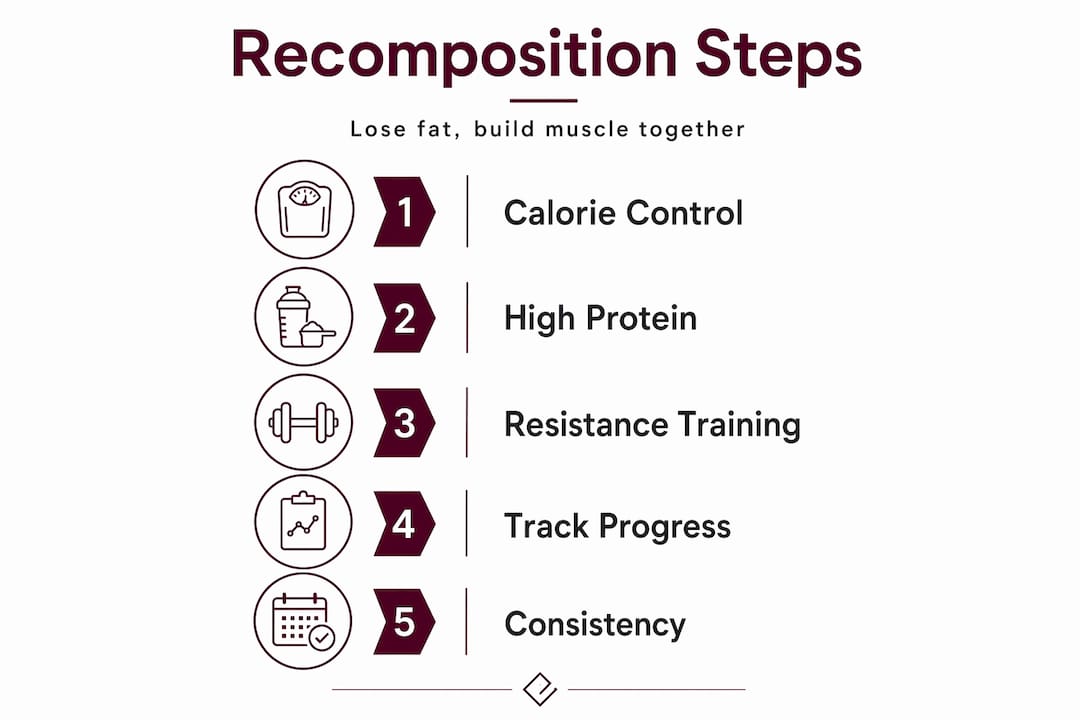
Body recomposition is defined as simultaneous fat loss and lean tissue gain, and it works best when you’re eating at or slightly below your maintenance calories while following a structured resistance training program. That last part matters more than most people realize. You don’t need a massive calorie deficit to lose fat. You need the right deficit combined with the right training stimulus.
Here’s what the foundational framework looks like in practice:
- Energy intake: Stay within 100–200 calories below your maintenance level. This is mild enough to preserve muscle tissue and keep training performance high, while still creating conditions for fat loss over time.
- Protein intake: Target 1.6–2.4 g/kg bodyweight daily. Protein is the most critical nutritional variable for muscle preservation and synthesis during a recomposition phase. If your progress stalls, it’s the first thing to audit.
- Resistance training: Lifting weights provides the mechanical stimulus your muscles need to grow, even in a slight deficit. Without it, fat loss will come partly at the expense of muscle tissue.
- Progressive overload: Gradually increasing the weight, reps, or total volume you lift over time is what drives continued muscle adaptation. Doing the same workout at the same weight for months will not produce the same results.
The reason aggressive calorie cuts hurt recomposition is straightforward. About 25% of weight lost during rapid dieting comes from muscle, not fat. Crash dieting destroys the lean tissue you’re working to build. Slow, controlled progress wins here every time.
One more thing worth understanding: the scale may not move much during a successful recomposition phase. That’s not failure. That’s fat and muscle changing in opposite directions at roughly the same rate. The number on the scale is one of the least useful metrics you can track during this process.
Pro Tip: If you’re new to resistance training or returning after a long break, you’ll likely see faster recomposition results. Beginners and detrained individuals respond to the muscle-building stimulus more readily, making simultaneous fat loss and muscle gain more pronounced in the early months.
How to track progress beyond the scale
This is where most people give up. They train hard, eat right, and then step on the scale after three weeks to find it hasn’t moved. They assume nothing is working and either quit or overcorrect with a more aggressive diet. Both are mistakes.
Scale weight is genuinely misleading during recomposition because fat loss and muscle gain offset each other in total body weight. You need a broader set of tools to see what’s actually happening.
Here’s a practical multi-metric tracking system:
- Training performance: Are you lifting heavier or completing more reps than last month? Strength progression is one of the clearest signs that muscle is being built.
- Tape measurements: Track waist circumference, hip circumference, and upper arm or thigh measurements monthly. A 1–2 cm reduction in waist size with stable or increasing arm measurements tells you exactly what’s happening.
- Progress photos: Take them every two to four weeks under consistent lighting and the same time of day. Visual changes often appear before any number changes.
- Weekly average weight: Weigh yourself daily and calculate the weekly average. This approach smooths out daily fluctuations from water retention, food volume, and hormonal shifts.
- DEXA scans: The gold standard for body composition tracking. Schedule scans every 8–12 weeks, aligned with your training blocks, for precise lean mass versus fat mass data.
| Tracking method | Cost | Frequency | Best for |
|---|---|---|---|
| Scale (weekly average) | Free | Daily weigh-in, weekly review | Trend monitoring |
| Tape measurements | Free | Monthly | Circumference changes |
| Progress photos | Free | Every 2–4 weeks | Visual body change |
| DEXA scan | $40–$150 per scan | Every 8–12 weeks | Precise fat vs. lean mass |
Pro Tip: Don’t rely on any single metric in isolation. A combination of training logs, measurements, and photos gives you a complete picture without requiring expensive technology every week.
Nutrition strategies that actually move the needle
Finding your maintenance calories is the starting point. You can use an online TDEE calculator as a rough estimate, then track your food intake and body weight for two to three weeks to see if your weight is stable. That’s your real maintenance. From there, subtract 100–200 calories to create a mild deficit.
Here are the nutrition priorities that matter most for body recomposition, in order:
- Hit your protein target every day. Spread your protein intake across three to four meals rather than loading it all at dinner. Research consistently shows that distributing protein across the day supports better muscle protein synthesis than eating the same total amount in one or two sittings.
- Fuel your workouts. Eat a protein and carbohydrate-containing meal two to three hours before training and prioritize protein within two hours after. Pre and post-workout nutrition doesn’t need to be complicated, but it does need to be consistent.
- Track calories with awareness, not obsession. Use a food tracking app for two to four weeks to calibrate your understanding of portion sizes and macros. After that, many people can maintain accuracy without logging every meal. The goal is awareness, not anxiety.
- Avoid the all-or-nothing trap. One high-calorie meal does not derail a week of solid nutrition. What derails progress is using that one meal as a reason to abandon the plan entirely. Flexibility within a consistent structure is more sustainable than rigid perfection.
- Revisit your protein first when progress stalls. Before adjusting calories, check whether your protein intake has slipped. It’s the most common hidden variable when recomposition results slow down.
A common mistake is cutting calories too aggressively in an attempt to speed things up. Severe calorie restriction increases muscle loss risk even when protein intake is adequate. The pace of loss matters. Slower progress with muscle retention beats fast weight loss that strips lean tissue.
Pro Tip: Treat your recomposition meal plan like a framework, not a rigid script. Protein and calorie targets are the non-negotiables. Everything else, including meal timing, food choices, and meal frequency, can flex around your real life.
Designing your resistance training plan
Cardio does not build muscle. That statement isn’t an argument against cardio. It’s a clarification of priority. Resistance training during a calorie deficit uniquely supports fat mass loss while increasing fat-free mass. In a 304-person study, resistance training produced greater reductions in abdominal circumference and increased lean mass by 0.8 kg while other groups lost lean tissue. Cardio helps with calorie burn and cardiovascular health, but it is secondary to lifting when your goal is body recomposition.
Here’s what an effective recomposition training plan looks like:
- Frequency: Train each muscle group two times per week. This frequency provides enough stimulus for muscle growth while allowing adequate recovery.
- Volume: Aim for 10–20 working sets per muscle group per week, spread across those sessions. Start at the lower end if you’re newer to structured training.
- Progressive overload: Log every session. When you can complete all prescribed reps with good form, add weight or an extra set the following week. This is the mechanism that drives muscle growth over time.
- Exercise selection: Prioritize compound movements like squats, deadlifts, bench press, rows, and overhead press. These recruit the most muscle mass and give you the best return on training time. Add isolation work like bicep curls or lateral raises as secondary exercises.
- Cardio: Two to three sessions of 20–30 minutes per week supports fat loss without interfering with recovery. Walking is underrated here. It burns calories without the recovery cost of high-intensity cardio.
| Training variable | Recomposition focus | What to avoid |
|---|---|---|
| Primary modality | Resistance training | Cardio-only programs |
| Weekly frequency | 3–5 days lifting | Training the same muscle daily |
| Overload method | Weight, reps, or volume increase | Staying at the same load indefinitely |
| Cardio role | Supportive (2–3x/week) | Using cardio to compensate for poor diet |
For exercise technique and lean muscle exercises that support upper body strength, compound pressing movements like dips are worth adding to your rotation. They hit the chest, triceps, and shoulders with significant load and are easy to progress with added weight over time.

My honest take on what actually works
I’ve watched a lot of people start a recomposition phase with real motivation and then quit after six weeks because the scale didn’t move. That’s the most frustrating pattern I see, because the scale not moving is often a sign the process is working, not failing.
In my experience, the biggest obstacle isn’t the training or even the nutrition. It’s the psychological weight of seeing a flat scale for weeks while putting in real effort. The people who push through that phase and keep tracking their measurements, their lifts, and their photos are the ones who eventually see the body change they were after.
I’ve also learned that perfectionism in nutrition kills more recomposition progress than any cheat meal ever could. The person who hits 90% of their protein target every day for six months will outperform the person who nails 100% for three weeks and then burns out. Consistency over perfection. Every time.
One more thing I’ll say plainly: if you’re an experienced lifter with years of training under your belt, recomposition will be slower for you than for a beginner. That’s not a reason to avoid it, but it is a reason to consider whether a dedicated bulk or cut phase might give you faster results at your level. For most people reading this, a structured recomposition approach is the right call. It’s sustainable, it doesn’t require extreme dieting, and it produces real, lasting changes.
— Hugo
How Cp-1 supports your recomposition goals
Getting your nutrition, training, and recovery dialed in is the foundation of any successful body recomposition effort. At Cp-1, we take the same evidence-first approach to supplementation that this guide applies to training and diet. No filler, no placebo ingredients, no formulas built for a marketing deck. If you want to go deeper on the nutrition side, our guide on sports nutrition that works breaks down which supplements have real evidence behind them and which ones are a waste of money. For those exploring safe supplementation to support lean muscle building, the bodybuilding supplements guide is worth your time. And when you’re ready to explore what Cp-1 offers for cellular energy, recovery, and overall optimization, start here.
FAQ
What is body recomposition?
Body recomposition is the process of losing fat and gaining muscle simultaneously, typically achieved by eating at or slightly below maintenance calories with high protein intake and consistent resistance training.
How much protein do I need for body recomposition?
Target 1.6–2.4 grams of protein per kilogram of bodyweight daily. This range supports muscle protein synthesis and preservation during a mild calorie deficit.
Why isn’t my weight changing during recomposition?
Fat loss and muscle gain offset each other in total body weight, so the scale often stays flat even when real changes are happening. Use tape measurements, progress photos, and training performance to track true progress.
How long does body recomposition take?
Visible changes typically appear within 8–12 weeks with consistent training and nutrition. Meaningful body composition shifts measured by DEXA scan are usually detectable within that same window.
Is cardio necessary for body recomposition?
Cardio is supportive but not the primary driver. Resistance training produces superior fat loss and lean mass gains during a calorie deficit. Two to three short cardio sessions per week are enough to support the process without compromising recovery.