
Creatine loading is one of the most talked about and most misunderstood protocols in sports supplementation. You want to saturate your muscles fast, get into peak performance mode, and start seeing results in under a week. But the confusion around dosing schedules, side effects, and safety concerns stops a lot of athletes from doing it right or doing it at all. This guide cuts through the noise. You’ll get the real science behind loading, a clear step-by-step protocol, honest answers about side effects, and the practical tools to make it work for your training without guessing.
Table of Contents
- What is the creatine loading phase?
- What you need before starting creatine loading
- How to do the creatine loading phase step by step
- What to expect: Results, side effects, and troubleshooting
- The truth about creatine loading: What experts and experience reveal
- Optimize your results with expert guidance
- Frequently asked questions
Key Takeaways
| Point | Details |
|---|---|
| Loading speeds results | Creatine loading saturates muscles faster compared to maintenance dosing. |
| Side effects are manageable | Splitting doses, taking with meals, and staying hydrated help reduce GI issues and water retention. |
| Healthy users are safe | Research shows no kidney or liver risks for healthy individuals following proper loading protocols. |
| Preparation matters | Gathering quality creatine, measuring tools, and planning your doses ensures better results. |
| Expert guidance helps | Having access to evidence-based support can enhance your creatine supplementation plan. |
What is the creatine loading phase?
Creatine loading is a short-term strategy where you consume a higher than normal amount of creatine over several days to rapidly saturate your muscle creatine stores. Think of it like filling a gas tank as fast as possible instead of trickling fuel in over weeks.
Your muscles store creatine as phosphocreatine (PCr), which is the immediate energy currency your body uses during short, intense bursts of effort like sprinting, heavy lifting, and explosive jumps. When your stores are fully saturated, you have more PCr available to regenerate ATP (adenosine triphosphate, your cells’ energy molecule) during those high-intensity moments. That means more power, better reps, and faster recovery between sets.
The standard loading protocol looks like this:
| Variable | Loading phase | Maintenance phase |
|---|---|---|
| Daily dose | 20g per day | 3 to 5g per day |
| Duration | 5 to 7 days | Ongoing |
| Frequency | 4 doses of 5g | 1 to 2 doses |
| Time to full saturation | 5 to 7 days | 3 to 4 weeks |
| Typical weight change | +2 to 5 lbs (water) | Minimal |
Here’s what the science actually shows. Acute loading of 20g per day for five days significantly increases fat-free mass without affecting blood pressure, plasma creatinine levels, CK (creatine kinase) activity, or handgrip strength in both men and women. That’s a clean bill of health on the short-term safety side.
Key facts about loading that most people get wrong:
- Loading is not mandatory. You can skip it and just take 3 to 5g per day and reach the same saturation after about three to four weeks.
- Loading just speeds things up. If you have a competition, an athletic event, or you simply want results faster, loading makes sense.
- Splitting doses matters. Taking all 20g at once is a recipe for GI distress. Four doses of 5g spread across the day is the protocol that actually works.
- Creatine monohydrate is the gold standard. Avoid fancy versions marketed with buzzwords unless they have real evidence behind them.
Loading is a tool. Use it when the speed of saturation actually benefits your goals.
What you need before starting creatine loading
Before you start ramping up your intake, let’s make sure you have everything you need and know who should consider skipping a loading phase entirely.
First, the health check. Creatine loading is safe for healthy adults. Research shows no evidence of kidney or liver harm in healthy individuals during creatine use. However, if you have pre-existing kidney disease, liver conditions, or are on medications that affect kidney function, talk to your doctor before starting. Creatine slightly elevates creatinine in your blood, which can look alarming on a standard lab test, but this is a well-documented false positive, not actual kidney damage. More on that shortly.
Here’s what you need to have ready before you begin:
- Creatine monohydrate (look for brands with third-party testing and no fillers)
- A digital food scale or accurate measuring spoon (5g portions need to be consistent)
- Large water bottle (you will need to drink significantly more water during loading)
- A meal schedule (you want to take creatine with food to reduce GI risk)
- A training log or app (track your performance changes so you can actually see the results)
Hydration is not optional. Creatine pulls water into your muscle cells through a process called osmosis. That’s part of why it works, and it’s also why your body needs more water than usual. Aim for at least three to four liters per day during the loading phase. Falling short on water is the most common reason people experience cramping or headaches during loading.
Comparison: Loading vs. skipping the loading phase
| Factor | With loading | Without loading |
|---|---|---|
| Time to full saturation | 5 to 7 days | 3 to 4 weeks |
| Daily dose | 20g | 3 to 5g |
| GI risk | Higher short-term | Lower |
| Water retention | 2 to 5 lbs initially | Gradual |
| Best for | Athletes with a near-term event | Sensitive GI systems, long-term users |
Some sources on the internet will scare you with stories about creatine destroying your kidneys. Here’s the truth. Reviews confirm no renal impact in healthy users. The elevated creatinine reading some people see on bloodwork is simply a byproduct of increased creatine metabolism, not a sign that anything is going wrong. If your doctor sees that number and raises an eyebrow, tell them you’re using creatine. A knowledgeable clinician will understand immediately.
Pro Tip: If you have a sensitive stomach, start with 3g doses five times per day instead of 5g four times. You get the same total volume with gentler delivery to your GI tract.
How to do the creatine loading phase step by step
Now that you’re set up and cleared to go, here’s exactly how to complete a safe and effective creatine loading phase.
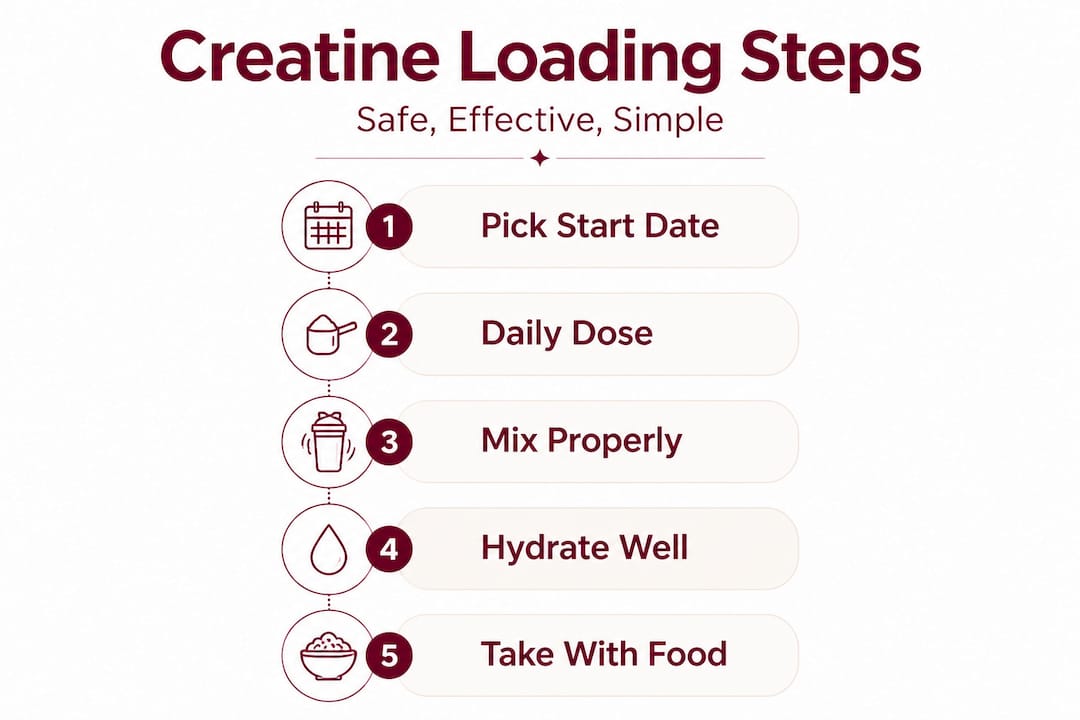
Step 1: Pick your start date Choose a day where you have five to seven consecutive days of consistent eating and training. Don’t start loading the day before a major competition. Give yourself time to adjust and observe how your body responds.
Step 2: Set your daily dose The protocol is 20g per day, split into four separate doses of 5g each. Space them roughly every four to five hours. A practical schedule looks like this: morning with breakfast, midday with lunch, pre-workout, and evening with dinner.

Step 3: Mix it properly Dissolve each 5g serving in at least 8 to 10 ounces of water or a beverage with simple carbohydrates (like juice). Carbs slightly enhance creatine uptake by triggering an insulin response, which helps transport creatine into muscle tissue more efficiently.
Step 4: Stay aggressively hydrated This is non-negotiable. Potential side effects of loading include GI distress such as bloating, cramps, and diarrhea in 10 to 25% of users, along with transient water retention of 2 to 5 lbs, mostly intramuscular. All of these are significantly reduced by proper hydration. Set a timer if you need to, but drink water consistently throughout the day.
Step 5: Take each dose with food Eating with your creatine dose reduces the likelihood of stomach discomfort. A full meal is ideal, but even a light snack works. Never take all 20g at once on an empty stomach.
Step 6: Limit excessive caffeine Moderate caffeine intake is fine, but stacking very high doses of caffeine on top of creatine loading has been associated with increased GI irritation in some users. Keep your coffee or pre-workout intake reasonable during the loading week.
Step 7: Track your performance Write down your lifts, your energy levels, and any side effects daily. You want to know if loading is working for you. Most athletes notice faster recovery between sets and improved endurance in rep ranges within five to seven days.
Your body will tell you something is off before any lab test does. If you’re cramping severely, feeling unusually fatigued, or experiencing persistent GI issues after adjusting your dose and hydration, stop and consult a healthcare provider. Don’t push through warning signs in the name of gains.
Pro Tip: Take creatine with a piece of fruit or a small amount of juice. The natural sugars provide a simple carbohydrate boost that supports creatine transport into muscle cells without requiring a full meal every time.
What to expect: Results, side effects, and troubleshooting
With your loading phase complete, here’s what you might experience and how to deal with common concerns, both positive and negative.
What you’ll likely notice:
- Days 1 to 3: Scale weight increases by 1 to 3 lbs. This is water being pulled into your muscle cells, not fat. It’s a sign the creatine is working.
- Days 3 to 5: You may feel more explosive during workouts. Sets that previously felt like a grind start to feel more manageable.
- Days 5 to 7: Full muscle saturation is typically achieved. Transient water retention of 2 to 5 lbs is primarily intramuscular, meaning it’s literally inside your muscle tissue, contributing to that fuller, more powerful look and feel.
Side effects and what to do about them:
GI effects are dose-dependent, with 10 to 25% of people experiencing some level of GI symptoms during loading. Here’s how to address each one:
- Bloating: Reduce dose per serving to 3g and increase frequency. Bloating usually decreases by day three.
- Cramping: Almost always a hydration issue. Increase water intake before adjusting anything else.
- Diarrhea: Cut back to lower individual doses immediately. If it persists beyond 48 hours of dose reduction, stop the loading phase and move to maintenance dosing.
- Headaches: Nearly always dehydration. Drink more water and add a small amount of electrolytes to your routine.
Understanding blood test results during loading: If you get bloodwork done while loading, your serum creatinine may appear elevated. This is not kidney damage. It’s a direct result of increased creatine metabolism. A trained physician familiar with supplement use will recognize this immediately. Always disclose supplement use before bloodwork interpretation.
When to stop loading: Stop immediately and speak with a doctor if you experience severe muscle pain unrelated to training, swelling, or reduced urine output. These are rare but should not be ignored.
The truth about creatine loading: What experts and experience reveal
Here’s what I genuinely believe most creatine articles miss, and what I’ve seen confirmed over and over again by both the research and real-world athletes.
The fear around creatine loading is almost entirely driven by gym rumors and outdated internet posts, not science. People hear “your kidneys will take a hit” and they either avoid creatine completely or use such small doses they never feel any benefit. That’s a real shame, because reviews consistently confirm no renal impact in healthy users, and the GI effects that do occur are dose-dependent and entirely manageable.
The single biggest mistake I see athletes make during loading isn’t taking too much creatine. It’s not splitting the dose and not drinking enough water. Those two factors alone account for nearly every bad experience people have with loading. Fix those, and loading becomes a clean, effective protocol.
There’s also a real case to be made for skipping loading entirely if you have a sensitive GI system or if you’re newer to creatine supplementation. Jumping straight to 20g per day when your gut isn’t used to it is asking for trouble. A smarter move for those athletes is starting at 5g per day and building from there. You get the same end result, just more gradually.
Reading the actual research is worth more than anything your training partner tells you in the locker room. The evidence on creatine is some of the most robust in all of sports science. Hundreds of studies over decades. The consensus is clear: creatine monohydrate works, it’s safe for healthy users, and loading is an effective strategy for rapid saturation when done correctly.
The key takeaway is this: loading is safe, it’s effective, and the risks are minimal when you follow a sensible protocol. But optimizing for your own context matters. If loading doesn’t fit your GI tolerance or your schedule, skip it and maintain. You’ll still get there.
Optimize your results with expert guidance
Ready to put your creatine loading plan into action? Having a solid foundation with your core supplementation is just the beginning.
If you’re serious about performance optimization, you know that creatine is one piece of the puzzle. Cellular energy, cognitive sharpness, and recovery all play a role in how well you train and how fast you progress. At CP-1, we focus on the science behind real, sustained results, and we’re here to support athletes who want evidence-based guidance, not hype. Whether you’re looking to stack smarter or just want personalized fitness support that goes beyond the basics, we’re built for people who take their performance seriously and want every decision backed by real data.
Frequently asked questions
How long does the creatine loading phase last?
The loading phase typically lasts 5 to 7 days using 20 grams per day, split into four smaller doses to maximize absorption and minimize side effects.
Is creatine loading necessary or can I just start with maintenance?
Loading is not required. You can begin with a daily maintenance dose of 3 to 5g, though loading achieves faster saturation within days rather than weeks, which matters if you have a performance goal on the horizon.
What are common side effects of creatine loading?
The most common side effects are water retention and GI symptoms like bloating or cramps. These are mitigated by splitting doses, taking creatine with meals, and staying well hydrated throughout the loading period.
Does creatine loading damage the kidneys?
No. In healthy individuals, no evidence of kidney damage has been found from proper creatine use, and peer-reviewed reviews confirm there is no renal impact in healthy users.
How do I avoid GI distress during loading?
Split your total daily dose into smaller portions taken with food, and drink at least three to four liters of water per day. Since GI effects are dose-dependent, reducing the per-serving size is the most effective fix if symptoms occur.