
NMN gummies can raise your blood NAD+ levels. That part is well established across multiple human randomized controlled trials. Whether that NAD+ increase translates into the longevity, energy, and metabolic benefits you’ve seen marketed? That’s where the evidence gets more complicated, and where most brands stop being honest with you.
Here’s the short version: NMN (nicotinamide mononucleotide) is a direct NAD+ precursor, and oral supplementation reliably increases blood NAD+ in humans. A multicenter double-blind RCT confirmed dose-dependent NAD+ increases at 300, 600, and 900 mg/day over 60 days with no serious adverse events. That’s a real, reproducible signal. What’s less certain is whether higher NAD+ consistently produces measurable improvements in energy, cognition, or metabolic health in healthy adults. Most trials are short (6–12 weeks), small (under 100 participants), and focused on narrow populations.
As of 2025, NMN is lawfully marketable as a dietary supplement in the U.S. after the FDA reversed its 2022 drug-exclusion action, subject to standard NDI notification rules. So the regulatory picture has cleared up, even if the clinical picture hasn’t fully.
Who might reasonably consider NMN gummies now: adults over 40 tracking NAD+ biomarkers, people with metabolic health goals, or anyone who wants to support cellular energy with an ingredient that has a plausible mechanism and a growing (if imperfect) human evidence base.
Who should talk to a clinician first: anyone on active cancer treatment, pregnant or breastfeeding people, or those taking drugs that affect NAD+ metabolism.
Key Takeaways
NMN gummies reliably raise blood NAD+ in humans, but converting that biomarker increase into consistent clinical outcomes remains the field’s central unresolved question.
| Point | Details |
|---|---|
| NAD+ increase is confirmed | Multiple human RCTs show dose-dependent blood NAD+ increases at 300–900 mg/day. |
| Clinical benefits are inconsistent | Metabolic, performance, and cognitive outcomes vary across trials; no large outcome RCT has confirmed them. |
| Gummy formulation requires scrutiny | Dose per serving, third-party COAs, and stability practices determine whether a gummy actually works. |
| Safety is short-term only | Trials up to 900 mg/day for 60 days show good tolerability; long-term safety data does not yet exist. |
| CP-1 combines NMN with CoQ10 and mushroom extracts | Transparent dosing, GMP-certified U.S. manufacturing, and third-party testing back the formula. |
Table of Contents
- How NMN increases NAD+ and why your cells care
- NMN gummy benefits mapped by evidence level
- Are NMN gummies actually effective as a delivery form?
- Safety, side effects, and who should be cautious
- What doses human trials actually used
- How to pick a quality NMN gummy
- What we still don’t know about NMN
- Why CP-1 includes NMN in our formula
- CP-1 NAD+ Advanced Supplement: what’s in it and who it’s for
- Sources
How NMN increases NAD+ and why your cells care
NMN is a nucleotide that your body uses as a direct building block for NAD+ (nicotinamide adenine dinucleotide). The pathway is straightforward: NMN is converted to NAD+ by an enzyme called NMNAT (nicotinamide mononucleotide adenylyltransferase). That’s it. No long conversion chain, no guesswork about whether the substrate gets used.
NAD+ itself is not a single-purpose molecule. It drives:
- Sirtuin activation: sirtuins (SIRT1–SIRT7) are proteins that regulate gene expression, DNA repair, and metabolic adaptation. They require NAD+ to function.
- PARP activity: poly(ADP-ribose) polymerases use NAD+ to detect and repair DNA strand breaks. As you age and accumulate more DNA damage, PARP demand increases, which accelerates NAD+ depletion.
- Mitochondrial energy production: NAD+ is a critical electron carrier in the electron transport chain. Lower NAD+ means less efficient ATP synthesis.
Blood NAD+ levels decline measurably with age, a pattern documented across multiple studies and summarized in a 2024 Frontiers review that covers NMN’s pharmacodynamics and therapeutic potential. The logic for supplementation follows directly: if NAD+ falls with age and NMN restores it, then NMN could plausibly support the biological processes that depend on it.
One important caveat: NAD+ assays vary. Whole-blood measurements and PBMC (peripheral blood mononuclear cell) measurements don’t always track together, which makes comparing results across trials tricky. Keep that in mind when you read study headlines.
Pro Tip: If you want to track your own NAD+ response to supplementation, ask your clinician about whole-blood NAD+ testing. It’s the most common assay used in human trials and gives you a comparable baseline. Measure before starting, then again at 8–12 weeks.
For a deeper look at how NAD+ decline connects to NMN’s role in energy and aging, the mechanism is worth understanding before you spend money on any supplement.

NMN gummy benefits mapped by evidence level
Not all claimed benefits of NMN gummies are equal. Some have human RCT support. Others exist only in animal models. Here’s an honest map.
| Outcome | Human evidence level | Key trial(s) / notes |
|---|---|---|
| Blood NAD+ increase | Strong (multiple RCTs) | 300–900 mg/day, multicenter RCT; consistent across trials |
| Muscle insulin sensitivity | Limited (single small RCT) | Yoshino 2021, N=25, prediabetic postmenopausal women, 250 mg/day |
| Physical performance (gait, grip) | Mixed / small samples | 12-week RCTs in older adults; heterogeneous results |
| Fatigue and sleep | Modest / inconsistent | Some 12-week trials show signal; not replicated consistently |
| Cardiovascular markers | Preliminary / animal-heavy | Human signals exist but no large outcome trials |
| Cognition | Mostly preclinical | Human data sparse; mechanism plausible via sirtuin/mitochondrial support |
| DNA repair / cellular resilience | Mechanistic / preclinical | Strong animal data; no direct human outcome RCTs |
Metabolic effects: The most cited human metabolic finding comes from a 10-week RCT in postmenopausal women with prediabetes (N=25), which reported roughly a 25% improvement in muscle insulin sensitivity at 250 mg/day. That’s a meaningful signal, but it’s one small trial in a specific population. Don’t generalize it to healthy adults without metabolic dysfunction.
Physical performance: Small RCTs in older adults have reported modest improvements in gait speed and grip strength in some subgroups. The results are heterogeneous. A systematic review covering approximately 10 RCTs (around 437 participants total) found that pooled functional outcomes like strength and endurance were inconsistent and often non-significant.
Cognition and sleep: Human data here is thin. Some 12-week trials report fatigue reduction or modest sleep improvements, but sample sizes are small and the findings haven’t been replicated at scale.
This is the core tension in the NMN space, and any brand that glosses over it is selling you a story, not a supplement. The meta-analytic evidence is clear: NAD+ goes up, but clinical endpoints don’t follow reliably.
- Raises blood NAD+: confirmed in humans
- Improves metabolic markers in at-risk populations: promising, single trial
- Boosts physical performance in healthy adults: not consistently shown
- Supports cognition: plausible mechanism, weak human data
- Extends lifespan: animal models only
Are NMN gummies actually effective as a delivery form?
Gummies can work. But the formulation details matter more than most brands admit.
NMN is chemically sensitive. It degrades with heat and humidity, which creates a real challenge for gummy manufacturers. A capsule in a sealed bottle has a more stable environment than a chewable gummy exposed to air every time you open the container. That doesn’t mean gummies are ineffective, but it does mean you need to verify that the manufacturer has addressed stability through packaging and storage protocols.

The absorption question is also more nuanced than “does NMN get into your blood?” First-in-human pharmacokinetic research showed that oral NMN is bioavailable enough to change blood metabolites, and subsequent RCTs confirm that whole-blood NAD+ rises after oral dosing. The debate is about whether NMN is absorbed intact or first hydrolyzed to NR (nicotinamide riboside) in the gut before conversion. For practical purposes, the outcome is the same: blood NAD+ increases. Gummies deliver NMN orally, so the same absorption pathway applies.
What actually determines whether a gummy works:
- NMN dose per serving: most human trials used 250–900 mg/day. A gummy delivering 50 mg per piece with a recommended serving of one piece is not going to get you to study doses without eating the whole bottle.
- Servings required to reach effective doses: check how many gummies you need per day to hit 300 mg or more. Some products obscure this.
- Co-ingredients: CoQ10 supports mitochondrial energy production and pairs logically with NMN. Mushroom extracts (Lion’s Mane, Reishi, Turkey Tail) add cognitive and immune support. These aren’t filler if they’re dosed meaningfully.
- Third-party Certificates of Analysis (COAs): independent testing confirms that what’s on the label is actually in the product. Independent analyses have documented variability in supplement ingredient content across the NMN category.
- Storage instructions: NMN gummies should be stored in a cool, dry place. If a brand doesn’t mention storage, that’s a gap.
Pro Tip: When you receive a COA from a brand, match the batch number on the document to the batch number printed on your product label. A COA for a different batch tells you nothing about what you’re actually taking.
A statistic worth knowing: independent supplement testing has found that marketing claims in the NMN category frequently outpace what the human evidence supports, and ingredient content can vary meaningfully between products. Verifying a COA from an accredited third-party lab isn’t optional if you’re serious about this.
Safety, side effects, and who should be cautious
The short safety verdict: NMN appears well tolerated in short-term human trials, but long-term safety data simply doesn’t exist yet.
The multicenter RCT testing 300–900 mg/day for 60 days reported no serious adverse events and no clinically significant changes in safety labs. That’s reassuring for short-term use. What we don’t have is data on years of continuous supplementation, which is exactly how most longevity-minded adults plan to take it.
Common side effects reported across trials are mild and GI-related: occasional nausea, loose stools, or stomach discomfort, particularly at higher doses. These tend to resolve on their own and are not universal.
Who should consult a clinician before starting NMN:
- People on active cancer treatment (NAD+ supports cellular proliferation, and the implications for cancer biology are not fully understood)
- Pregnant or breastfeeding individuals (no safety data in these populations)
- Anyone taking drugs that affect NAD+ metabolism, including PARP inhibitors (used in oncology) or niacin-based medications
- People with liver conditions (NAD+ metabolism is hepatic; no specific contraindication established, but monitoring is prudent)
Red-flag symptoms to stop and consult a doctor: persistent GI distress, unusual fatigue, skin flushing that doesn’t resolve, or any new symptom that correlates with starting supplementation.
For a broader look at evidence-based supplement dosing and safety, the principles that apply to NMN apply to most NAD+ precursors: start low, monitor, and don’t assume that “natural” means risk-free.
What doses human trials actually used
The doses used in human trials generally ranged from low to moderate milligram amounts per day. Here’s what the trial data shows:
| Dose | Trial type | Key finding |
|---|---|---|
| 250 mg/day | 10-week RCT, prediabetic postmenopausal women | Improved muscle insulin sensitivity (~25%) |
| 300–900 mg/day | 60-day multicenter RCT, healthy middle-aged adults | Dose-dependent blood NAD+ increase; no safety issues |
| 300–600 mg/day | Multiple 12-week RCTs | Modest functional signals in some populations; inconsistent |
The dose-response data from the multicenter trial suggests that 300 mg/day produces meaningful NAD+ increases, with 600 mg showing similar results to 900 mg in some outcomes. There’s a potential plateau: going from 600 to 900 mg/day may not add proportionally more benefit for blood NAD+ or physical performance markers.
Realistic timeline expectations:
- Biomarker changes (blood NAD+): typically measurable within 2–4 weeks of consistent dosing
- Subjective energy or fatigue changes: if they occur, usually reported at 4–8 weeks; not universal
- Metabolic or functional changes: 10–12 weeks minimum, and only in trials targeting specific populations
Some reports suggest afternoon dosing may improve muscle responsiveness compared to morning dosing, though this is based on limited data and individual responses vary.
Starting a regimen: a practical checklist:
- Get a baseline whole-blood NAD+ test before starting
- Begin at 300 mg/day for the first 4 weeks
- Increase to 600 mg/day if tolerated and you want to match the higher-dose trial range
- Retest NAD+ at 8–12 weeks to confirm your personal response
- Don’t exceed 900 mg/day without clinical guidance; the evidence doesn’t support additional benefit above that threshold
How to pick a quality NMN gummy
Most NMN gummies on the market are not garbage, but some are. The difference usually comes down to three things: dose transparency, third-party verification, and manufacturing standards.
Must-haves before you buy:
- Clear NMN milligrams per serving (not per container, not “proprietary blend”)
- Serving size that gets you to 300 mg or more per day without eating an unreasonable number of gummies
- A third-party COA from an accredited lab (not just “tested,” but a document you can actually read)
- GMP-certified manufacturing facility
- Vegan and non-GMO certification if those matter to your standards
- Storage instructions on the label
Red flags:
- “Proprietary blend” language that hides the NMN dose
- Claims about reversing aging, curing disease, or extending lifespan (no human trial supports these)
- No COA available or COA that doesn’t match the current batch
- Missing manufacturing location or facility certification
- Gummies with no stability or storage guidance
Pro Tip: Ask the brand directly for a current COA and check that the testing lab is accredited by an organization like ISO/IEC 17025. A brand that can’t produce this document within 24 hours is telling you something important about their quality controls.
For context on third-party testing standards for supplements, the same principles that apply to collagen and other supplement categories apply here: the COA is the floor, not the ceiling.
When comparing NMN gummies to other NAD+ precursors, NMN and NR (nicotinamide riboside) are the two most studied options. Both raise blood NAD+. NMN is a more direct precursor (one step closer to NAD+ than NR), but the clinical outcome data for both is similarly limited. For a detailed breakdown of how these compare, NMN vs. NAD+ supplement formats is worth reading before you decide.
What we still don’t know about NMN
The honest answer is: a lot. The human trial base for NMN is growing but still young.
The biggest gaps:
- Long-term safety: no trials beyond a few months in humans. We don’t know what happens with years of continuous use.
- Clinical outcome replication: the insulin sensitivity finding from Yoshino 2021 hasn’t been replicated in a larger trial. Single promising RCTs need confirmation.
- Standardized NAD+ assays: whole-blood vs. PBMC vs. tissue NAD+ measurements make cross-trial comparisons unreliable. The field needs a standard.
- Diverse demographics: most trials focus on older adults or specific metabolic populations. Data in younger healthy adults is sparse.
- Biological age endpoints: no large trial has used epigenetic clocks or other biological-age markers as primary endpoints.
A 2024 Frontiers review covering NMN’s clinical trials explicitly notes that long-term human outcome data remain limited, despite the plausible mechanisms. That’s not a reason to dismiss NMN, but it is a reason to be skeptical of any brand claiming certainty.
Trial types worth watching:
- Large multicenter RCTs with diverse demographics and clinical endpoints (not just biomarkers)
- Longer-duration safety studies (12+ months)
- Trials using biological-age markers as primary outcomes
- Head-to-head comparisons of NMN vs. NR in matched populations
Most registered NMN human trials to date are small and short. Systematic reviews covering roughly 10 RCTs with around 437 participants total reflect how early-stage this evidence base still is. ClinicalTrials.gov is the best place to track new registrations as the field matures.
Why CP-1 includes NMN in our formula
We built CP-1 around NMN because the mechanism is real and the human biomarker evidence is solid. We’re not going to tell you NMN reverses aging. No honest brand should. What we can tell you is that NAD+ decline with age is documented, NMN raises NAD+ in humans across multiple trials, and we formulated around that signal with ingredients that complement it rather than dilute it.
Our product design choices reflect the evidence directly. The NMN dose is transparent and meaningful. We added CoQ10 because mitochondrial energy production is where NAD+ does much of its work. Lion’s Mane, Reishi, and Turkey Tail bring cognitive support, stress resilience, and immune function to the formula because cellular health isn’t one-dimensional.
Every batch is third-party tested. We manufacture in the U.S. under GMP-certified conditions. The product is vegan and non-GMO. These aren’t marketing checkboxes. They’re the minimum standard we’d demand if we were buying someone else’s supplement.
Including NMN in our line is a bet on a plausible, evidence-supported mechanism, not a claim that the science is settled.
CP-1 NAD+ Advanced Supplement: what’s in it and who it’s for
CP-1 NAD+ Advanced Supplement is a chewable gummy that combines NMN with Lion’s Mane, Reishi, Turkey Tail mushroom extracts, and CoQ10. The formula targets cellular energy production, NAD+ support, cognitive function, immune health, and stress resilience in a single daily serving.
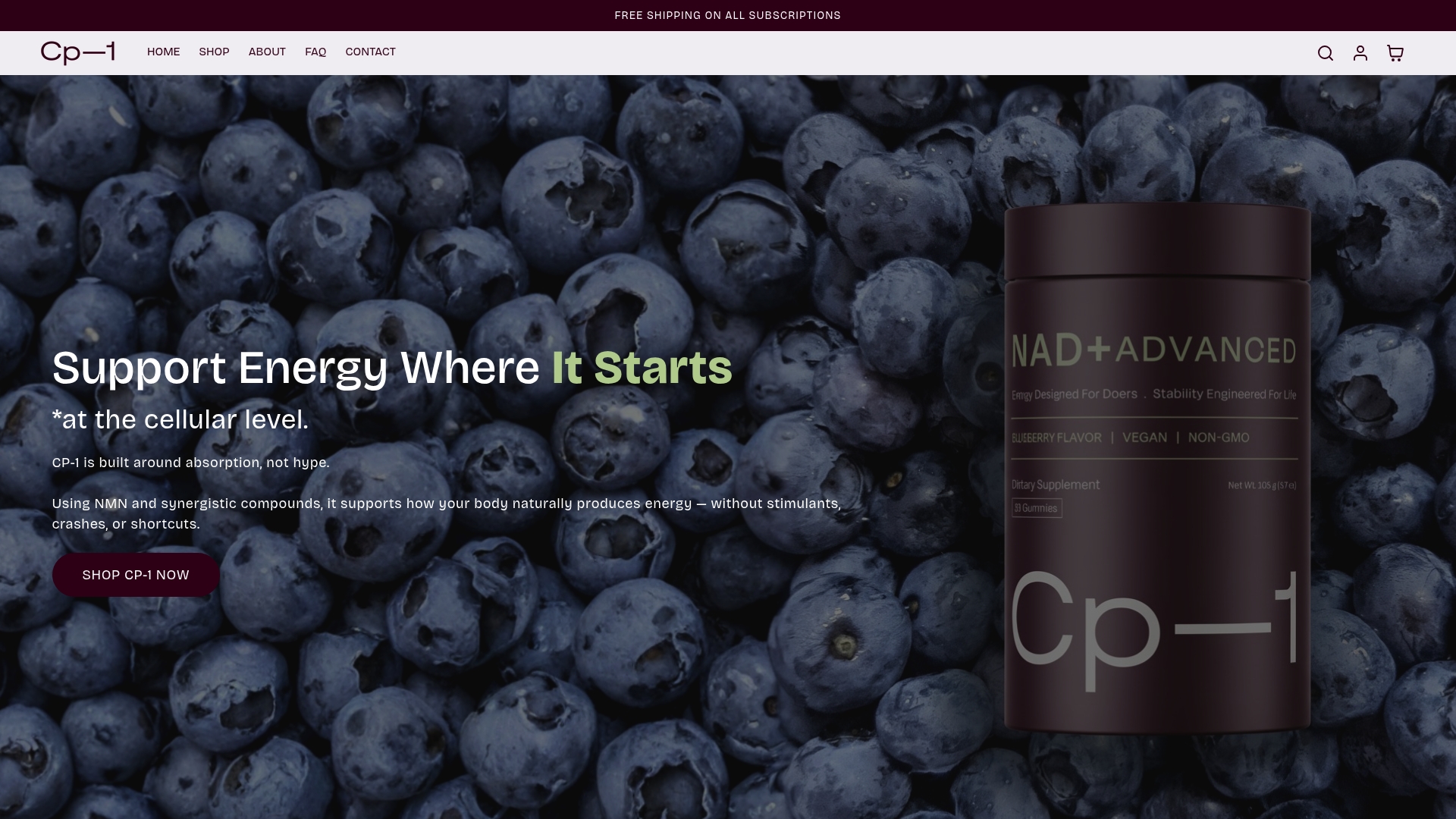
This product is built for health-conscious adults who want more than a single-ingredient NAD+ pill. If you’re tracking biomarkers, managing energy without stimulants, or building a longevity-focused supplement stack, the combination of NMN with functional mushrooms and CoQ10 covers more ground than NMN alone.
Trust signals: third-party tested, GMP-certified U.S. manufacturing, vegan, non-GMO, and transparent per-serving dosing. No proprietary blends hiding the NMN content.
Subscription purchasing is available, which makes consistent daily dosing more practical and cost-effective over the 8–12 week window where trial data shows the most meaningful changes.
Ready to see the full formula and current pricing? Visit the CP-1 product page and check whether a one-time or subscription order fits your routine.
Sources
- Frontiers | The versatile multi-functional substance NMN: its unique characteristics, metabolic properties, pharmacodynamic effects, clinical trials, and diverse applications
- Pmc
- NMN: Real Human Evidence and FDA Status
This article is general information, not a substitute for advice from a qualified doctor. Consult a qualified healthcare professional about your own circumstances before acting on anything here.