
Most NMN supplements cost between $9 and $88 a month, and the format you choose decides where you land in that range far more than the brand name on the label. Bulk powder sits at the floor, liposomal and all-in-one gummy stacks sit at the ceiling. The only number that actually matters for comparison shopping is cost per gram at a dose you’ll actually take, usually 250 mg or 500 mg a day.
TL;DR:
- Bulk powder offers the lowest cost per gram, around $0.80 to $0.86, but requires DIY dosing and is less stable once open.
- Capsules typically cost $2.00 to $4.00 per gram, with costs rising for higher doses and specialty formats like enteric-coated or liposomal.
- Most buyers should expect to pay between $30 and $70 per month for a standard 250 to 500 mg daily NMN routine, depending on format and brand.
- Verified products with third-party testing, batch-specific COAs, and GMP certification tend to justify higher prices over cheaper, unverified options.
- Combining NMN with ingredients like mushroom extracts and CoQ10 significantly increases the price, but only if the added ingredients and testing justify the premium.
Table of Contents
- What “Cheap” and “Premium” NMN Actually Look Like
- Why Format Changes the Price So Much
- How to Compare Any NMN Listing Like a Buyer, Not a Shopper
- When a Higher Price Actually Buys Something Real
- How CP-1 Prices and Tests What Goes in the Bottle
- What the Price Debate Gets Wrong
- Get Tested NMN Without Guessing at the Math
- Where These Numbers Come From
- Sources
What “Cheap” and “Premium” NMN Actually Look Like
I’ve watched people get burned by two mistakes over and over: paying $70 for a 30-count bottle that delivers barely 3 grams of actual NMN, or assuming the $12 tub from an unknown seller is a steal because the sticker price looks small. Neither instinct holds up once you do the math.
The market splits into rough tiers. Bulk powder runs about $0.80 to $0.86 per gram, based on pricing sampled across major sellers, while capsules typically land between $2.00 and $4.00 per gram once you account for fillers, encapsulation, and brand markup. That spread alone explains most of the $9 to $88 monthly range you’ll see quoted across price guides.
Here’s what that translates to in practice:
- A 250 mg/day habit using bulk powder at about $0.80 to $0.86 per gram costs a low monthly amount in raw material.
- The same 250 mg/day dose in a mid-tier capsule costs moderately more per month.
- Bump the dose to 500 mg/day and monthly costs roughly double depending on format.
- Premium liposomal or combination formulas can push monthly costs significantly higher due to added ingredients and delivery claims.
Market overviews from mid-2026 put the realistic center of gravity for most buyers at $30 to $70 a month for a standard 250 to 500 mg/day routine, which tracks with what I see across the category. The trap isn’t the high end. It’s the deceptively low sticker price on a 30-capsule bottle that only lasts two weeks at your actual dose, or a “value size” powder tub that’s mostly filler. Always check total grams of active NMN per container before you compare a single dollar figure.
Why Format Changes the Price So Much
The molecule is identical no matter how it’s packaged. What you’re actually paying for when the price climbs is processing, delivery technology, and convenience, not a different ingredient.
Bulk powder: the value floor
Powder is the cheapest way to buy NMN because you’re skipping encapsulation, coating, and portion packaging entirely. At $0.80 to $0.86 per gram, a 100-gram tub can cost as little as $80 upfront but deliver over 200 servings at 500 mg, working out to under $0.40 a day. The catch is real: you’re measuring doses yourself with a scale or scoop, NMN powder is moisture-sensitive and degrades faster once opened, and there’s no built-in dosing consistency. For a price-first buyer who doesn’t mind a little DIY, powder is genuinely the best value in the category.
Standard capsules: paying for convenience
Capsules add cost because someone has to measure, fill, and seal each dose consistently. That labor and packaging typically pushes the per-gram price to $2.00 to $4.00. Bottle counts matter enormously here. A 60-capsule bottle at 250 mg per capsule gives you a month’s supply at that dose, but a 30-capsule bottle at the same dosage only covers two weeks, so the “per bottle” price you see advertised can be misleading unless you divide by days of actual coverage.
Enteric-coated: a modest premium for a delivery claim
Enteric coating is meant to protect NMN from stomach acid so more of it survives to be absorbed. The coating process adds a small manufacturing step, which usually shows up as a modest bump over standard capsules rather than a dramatic one. Whether that premium is worth it depends on how much you trust the underlying absorption claim, since independent human data on enteric-specific NMN absorption is still thin.
Liposomal: the biggest jump in per-gram cost
Liposomal encapsulation wraps NMN in lipid spheres designed to help it cross cell membranes more efficiently. It’s genuinely more complex to manufacture, and that complexity is why liposomal NMN commands some of the highest per-gram prices in the category. It can be worth the premium if you’ve tried standard capsules and want to test whether absorption technology changes how you feel, but it’s not the place to start if you’re mainly trying to keep monthly costs low.
Gummies and all-in-one stacks: convenience and complexity stack the price
Combination formulas that blend NMN with other ingredients, mushroom extracts, CoQ10, resveratrol, or similar, tend to sit at the top of the price ladder. Some of that cost is genuinely added ingredients. Some of it is flavoring, chewable texture, and shelf stability engineering that has nothing to do with NMN itself. This is also where per-gram NMN pricing gets hardest to see, because the label emphasizes the blend rather than the milligram count of any single ingredient.
How to Compare Any NMN Listing Like a Buyer, Not a Shopper
Once you know the formula, you can price-check any bottle in under a minute, and it strips away almost every marketing angle a brand tries to use on you.
- Find grams of NMN per bottle. Check the supplement facts panel, not the front label, for total NMN content across all servings.
- Divide bottle price by total grams. That gives you cost per gram, the only number that lets you compare a powder tub to a capsule bottle honestly.
- Multiply cost per gram by your daily dose in grams. A 500 mg dose is 0.5 grams, so cost per day equals cost per gram times 0.5.
- Multiply cost per day by 30. That’s your real monthly cost, independent of whatever bottle size the seller chose to advertise.
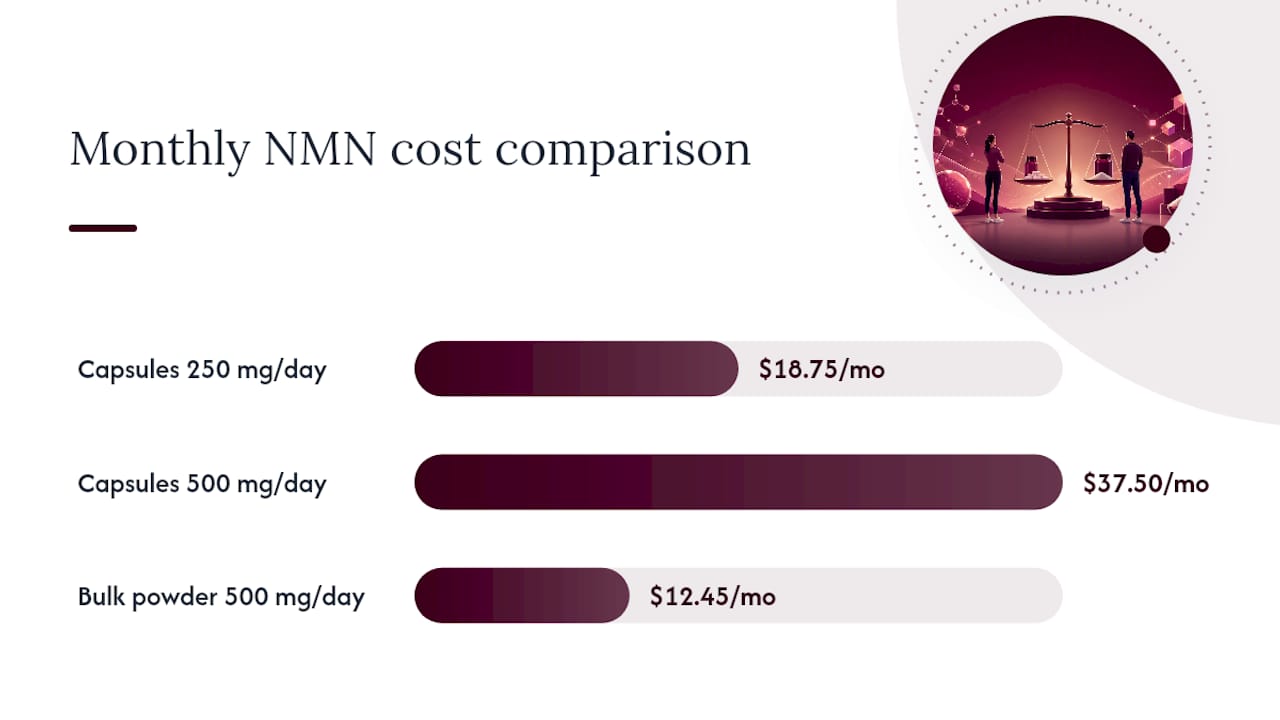
Here are two worked examples using representative mid-market pricing. At $2.50 per gram, a 250 mg/day dose costs $0.625 a day, or about $18.75 a month. Push that same $2.50/gram product to 500 mg/day and you’re at $1.25 a day, roughly $37.50 a month. Compare that against a bulk powder at $0.83/gram: the same 500 mg/day dose costs about $12.45 a month, less than a third of the capsule price for identical NMN content.
Statistic Callout: Subscription pricing commonly saves buyers 20 to 30 percent off list price, which can flip a marginal-value bottle into a genuinely good deal, but only if you’d have bought it monthly anyway. A discount on a product you’d otherwise abandon after one bottle isn’t savings.
Watch for four red flags that inflate real cost without showing up in the sticker price: undisclosed potency (the label lists a proprietary blend weight instead of milligrams of NMN specifically), no certificate of analysis available on request, bottles with suspiciously low total gram counts relative to the advertised serving size, and combination formulas that bury the NMN dose behind a longer ingredient list. Any one of these makes cost-per-gram math impossible to verify, which should give you pause regardless of price.
When a Higher Price Actually Buys Something Real
A higher price tag sometimes reflects genuine quality controls, and sometimes it’s just better marketing. The difference shows up in documentation, not in adjectives on the label.
Look for these verifiable signals before you accept a premium price:
- A batch-specific certificate of analysis (COA) from a third-party lab, not a generic one pulled from the brand’s website.
- HPLC testing results confirming actual NMN potency matches label claims.
- Manufacturing in a GMP-certified facility, ideally disclosed by name or registration number.
- Clear allergen, vegan, and non-GMO statements rather than vague “clean label” language.
On the regulatory side, NMN’s status in the US has shifted. A 2025 FDA reversal changed the landscape around NMN’s availability as a dietary supplement, which is worth understanding before you commit to a subscription with any brand. Human trials on NMN and NAD+ largely track surrogate biomarkers rather than proven longevity outcomes, so treat aggressive anti-aging claims with the same skepticism you’d apply to the price tag.
Pro Tip: If a listing has no COA available and won’t provide one on request, treat that silence as your answer. A brand confident in its testing links the document directly on the product page.
How CP-1 Prices and Tests What Goes in the Bottle
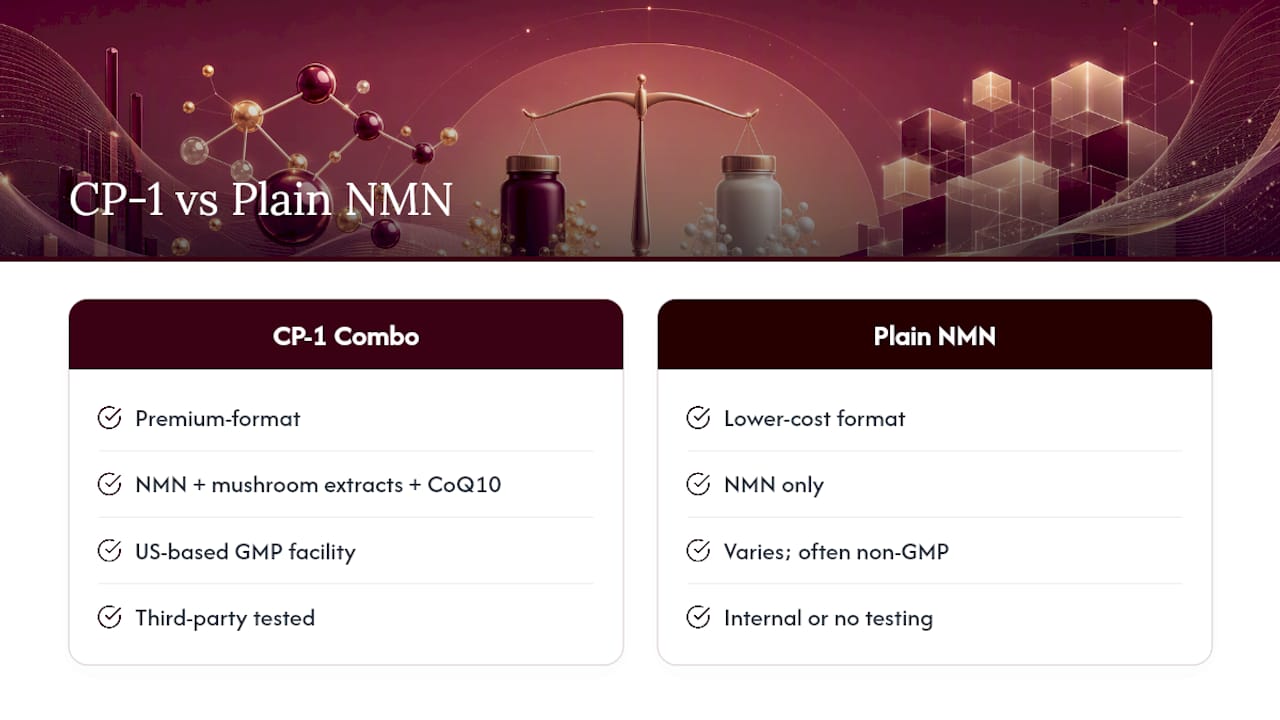
CP-1 doesn’t sell NMN alone. Each gummy combines NMN with lion’s mane, reishi, and turkey tail mushroom extracts plus CoQ10, built around cellular energy support, immune health, and mental clarity rather than a single-ingredient approach. That combination pricing sits closer to the premium end of the format ladder described above, and it should, because you’re not paying for NMN capacity alone.
What justifies that position on the value ladder is documentation, not adjectives. CP-1 is manufactured in a US-based, GMP-certified facility, uses vegan and non-GMO ingredients, and undergoes third-party testing rather than relying on internal quality claims alone. If you’ve read the format breakdown above, you already know combination formulas naturally cost more per gram than bulk powder or plain capsules. The question worth asking isn’t whether CP-1’s price matches bulk NMN powder. It’s whether the mushroom extracts and CoQ14 justify the gap over a plain capsule, and whether the testing behind it is real rather than asserted. Compare it against a plain NMN capsule on those specific terms, not just the sticker price.
What the Price Debate Gets Wrong
Most price comparisons treat NMN like a commodity where the cheapest gram wins, and that’s a mistake. The molecule is the same, but what surrounds it, testing rigor, delivery format, co-ingredients, isn’t interchangeable, and price is a reasonable (if imperfect) proxy for some of that difference.
The conventional advice, “just find the lowest cost per gram,” ignores that a bottle with no COA at $0.80/gram isn’t actually cheaper than a tested product at $2/gram if the cheap one delivers 60% of its labeled potency. I’d rather see readers spend an extra five minutes checking for third-party testing than saving three dollars a month on an unverified powder.
What should come first isn’t the lowest number on the page. It’s confirming the gram count is real, then comparing verified products against each other on cost per gram. Price discipline without quality verification just means you’re overpaying for nothing, only at a lower price point.
— Hugo
Get Tested NMN Without Guessing at the Math
If you’ve made it this far, you already know how to normalize any listing to cost per gram, and that puts you ahead of most shoppers in this category. CP-1 is built for exactly the buyer this guide describes: someone who wants NMN backed by a batch-specific COA and GMP-certified US manufacturing, not just a low sticker price with no documentation behind it.
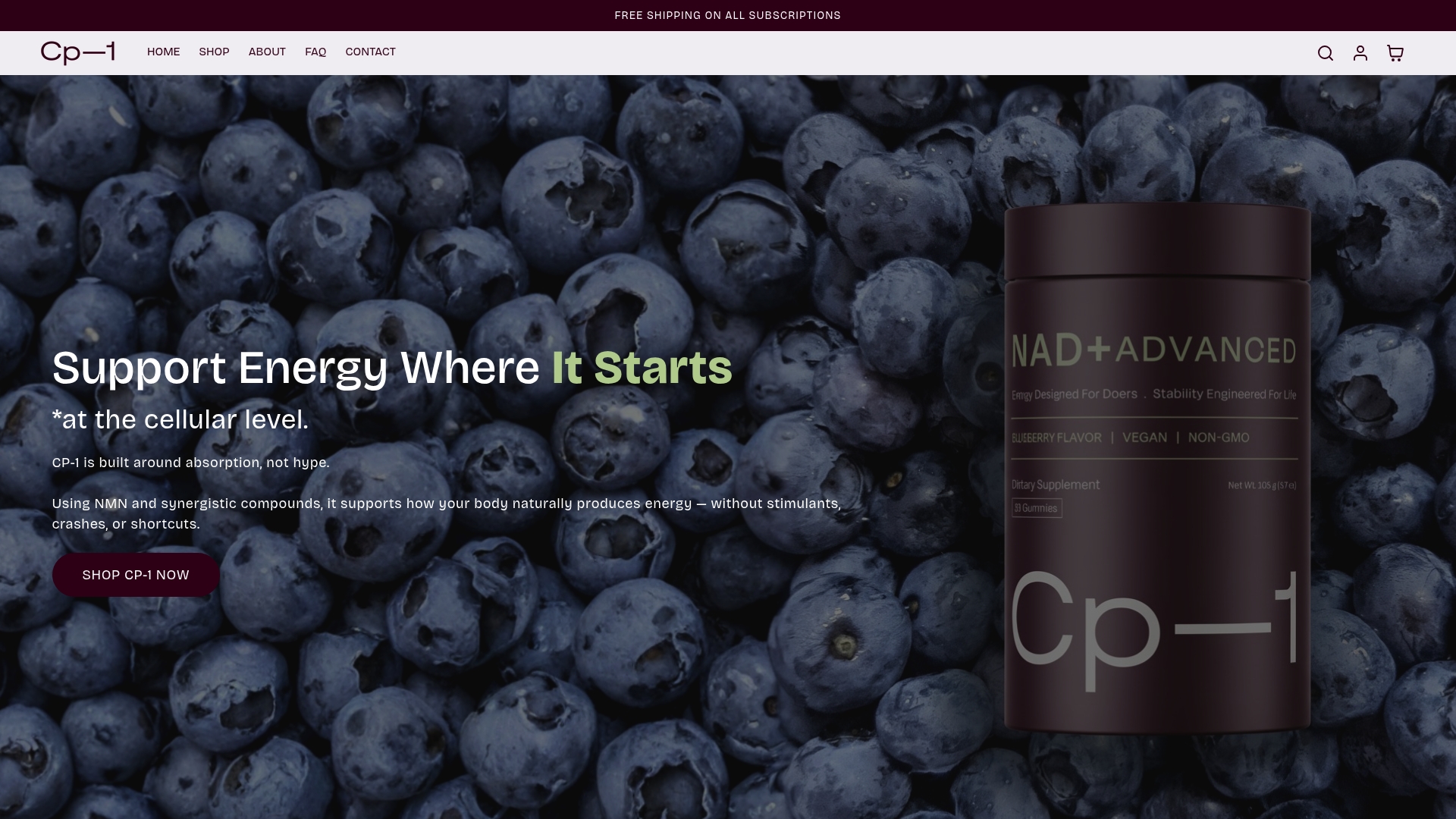
CP-1 combines NMN with lion’s mane, reishi, turkey tail, and CoQ10 in a single daily gummy, and subscription orders reduce the per-bottle price compared to one-time purchases, which matters most once you calculate your real monthly cost the way this guide walks through. Check current pricing and subscription savings, then decide for yourself whether the combination formula earns its place over a plain capsule. Visit CP-1 to see current bottle pricing and start your first order.
Where These Numbers Come From
The monthly price bands cited here draw from Lifespan Vault’s 2026 cost breakdown and BetterNewLives’ per-gram price guide, both of which sample pricing across major sellers. Subscription savings figures come from Innerbody’s NMN value analysis, and regulatory context reflects Aminoscope’s 2026 market overview. Evidence framing on NAD+ outcomes references peer-reviewed literature on NAD+ precursors.
This article is general information, not a substitute for advice from a qualified doctor. Consult a qualified healthcare professional about your own circumstances before acting on anything here.