
Sealed, high-purity NMN powder typically stays potent for 6 to 24 months, while liquid or dissolved NMN degrades in days to weeks even refrigerated. The single move that matters most: keep it cold, dry, and sealed. Refrigerate for several weeks to a few months of storage, or freeze it if you’re buying in bulk and want maximum shelf life.
TL;DR:
- NMN powder remains stable for 6 to 24 months if stored in a cool, dry, sealed environment, but liquids degrade in just days to weeks even when refrigerated.
- Temperature, moisture, light, oxygen, and pH extremes all accelerate NMN degradation, with heat being the most significant factor.
- Proper storage includes using opaque, sealed containers, refrigerating a few months, and freezing for long-term shelf life; avoid temperature swings and humidity.
- Degradation mainly produces nicotinamide, which is less effective for NAD+ support, but typically non-toxic at supplement doses, unless visible contamination occurs.
- NMN’s quality and shelf life heavily depend on synthesis method and manufacturing controls, making third-party testing and GMP standards essential for reliable potency.
Table of Contents
- What Causes NMN to Break Down in the First Place
- Realistic NMN Shelf-Life Estimates by Form and Storage Condition
- Your NMN Storage Checklist From Delivery to Daily Use
- Signs Your NMN Has Degraded (and When to Stop Guessing)
- Why Synthesis Method Quietly Determines Shelf Life
- Is It Safe to Use NMN Past Its Prime?
- What CP-1’s Quality Process Looks Like in Practice
- Get NMN That’s Actually Built to Last
- Sources
What Causes NMN to Break Down in the First Place
NMN doesn’t degrade randomly. It breaks down through specific chemical pathways, and once you understand them, storage stops feeling like guesswork.
Temperature is the biggest lever by far. Chemical reactions speed up as heat rises, and NMN follows this pattern closely, with a Q10 value around 2 to 3, meaning every 10°C drop in temperature can slow degradation by two to three times. Leave a bottle on a sunny windowsill in summer and you’re accelerating the exact reactions that ruin it.
Moisture is the second culprit. NMN is hygroscopic, meaning it pulls water from the air, and that water drives hydrolysis, a reaction that literally breaks the molecule apart. This is why powder generally outlasts liquid: less water means fewer opportunities for that reaction to happen. pH plays a supporting role too. NMN holds up best in neutral to mildly acidic environments, while strong acids or bases speed the breakdown along.
Light and oxygen round out the list. Both can trigger degradation through photochemical and oxidative pathways, which is one reason quality suppliers use opaque packaging instead of clear jars.
The degradation product to know: when NMN breaks down, it converts primarily into nicotinamide (NAM). NAM isn’t dangerous, but it isn’t NMN either. It won’t support NAD+ production the same way, so a supplement that’s degraded significantly is quietly turning into a much weaker product with each passing month.
Four factors drive this breakdown:
- Heat exposure, which accelerates chemical reactions
- Humidity and moisture absorption, which triggers hydrolysis
- Light and oxygen exposure, which cause oxidative damage
- pH extremes, which destabilize the molecule’s structure
Realistic NMN Shelf-Life Estimates by Form and Storage Condition
Numbers matter here, so let’s get specific instead of vague.
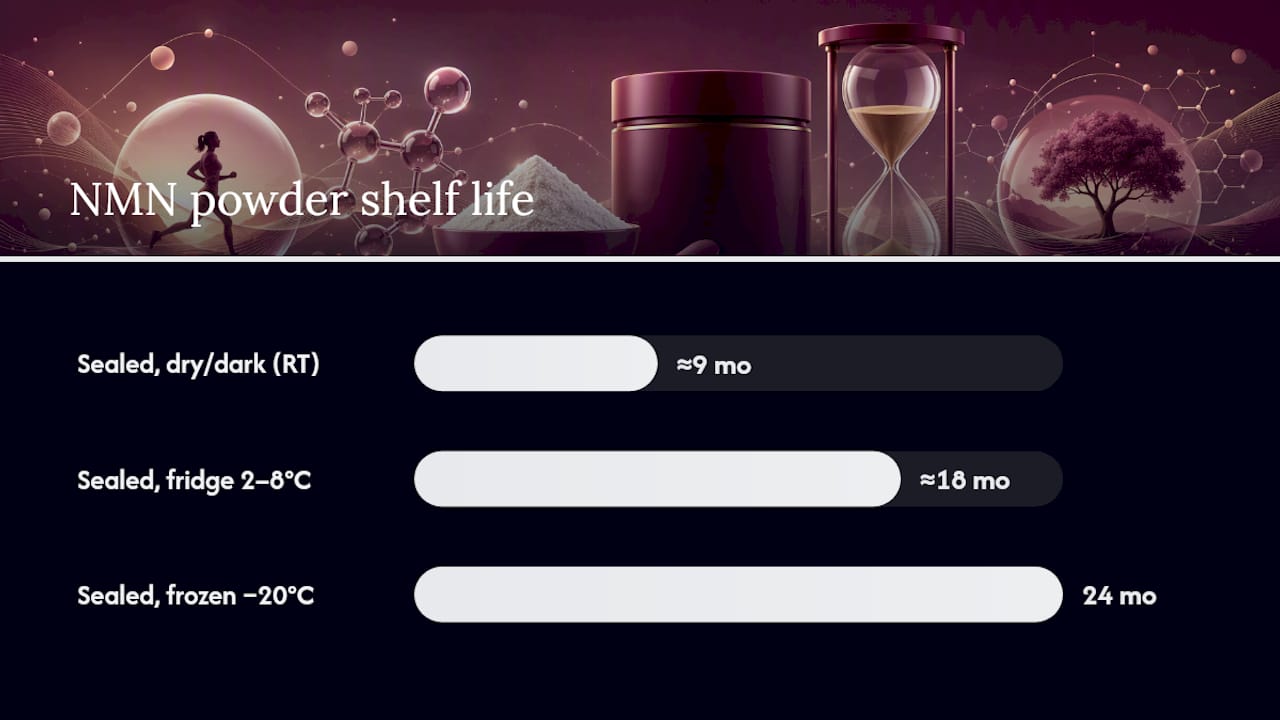
Sealed, high-purity NMN powder commonly carries supplier-backed claims of up to 24 months of shelf life when stored correctly in moisture and light-resistant packaging. That’s the ceiling, not a guarantee. A bottle sitting in a hot, humid bathroom for a year won’t hit that mark.
Room temperature storage works fine for well-packaged powder kept in a dry, dark cabinet. Push it into a warm, humid kitchen, though, and that window shrinks considerably. Refrigeration at 2 to 8°C extends usable life meaningfully, and freezing at negative 20°C is the gold standard for long-term storage, since cold essentially puts the degradation clock on pause.
Liquid formulations tell a different story entirely. One peer-reviewed study found NMN stayed 93% to 99% intact in drinking water for 7 to 10 days at room temperature, which sounds reassuring until you realize that’s the upper end of aqueous stability. Kinetic modeling using HPLC analysis shows NMN degradation in aqueous solution follows first-order kinetics, with a calculated half-life around 860 hours at room temperature, or roughly 36 days under those specific lab conditions. Real-world liquid products, unbuffered and exposed to more heat swings, often fall well short of that.
Quick reference for common storage conditions:
- Sealed powder, room temperature (below 25°C): several months to about a year
- Sealed powder, refrigerated (2 to 8°C): approaching the 12 to 24 month range
- Sealed powder, frozen (negative 20°C): longest practical shelf life
- Liquid or dissolved NMN, refrigerated: days to a few weeks without stabilizers
One caveat worth flagging: accelerated stability tests, where manufacturers store samples at elevated heat and humidity to simulate months of aging in weeks, are useful predictive tools, not precise clocks. They estimate a range. Your actual bottle’s fate depends on how it was handled between the factory and your cabinet.
Your NMN Storage Checklist From Delivery to Daily Use
Good storage habits aren’t complicated, but they do need to be consistent. Skip a step here and there, and you’re slowly cutting into the shelf life you paid for.
- Check the packaging on arrival. Look for opaque or foil-lined pouches, nitrogen-flushed seals, or bottles with desiccant packs. These aren’t marketing flourishes. They’re doing real chemistry work to block moisture, light, and oxygen.
- Store it somewhere cool and dry immediately. A pantry or bedroom drawer beats a bathroom cabinet or kitchen shelf near the stove every time. Humidity from showers and cooking is the enemy.
- Reseal tightly after every use. Every time a container is left open longer than necessary, it invites moisture in.
- Refrigerate for extended storage. If you buy in bulk or won’t finish a bottle within a couple of months, the fridge extends your usable window considerably.
- Freeze for long-term stockpiling. Splitting a large supply into smaller sealed portions and freezing what you’re not using yet protects potency for the long haul.
- Avoid repeated temperature swings. Pulling a bottle in and out of the fridge repeatedly introduces condensation, which reintroduces the moisture problem you were trying to avoid.
- Travel smart. Use an insulated bag for transport, and never leave NMN in a hot car, even for a quick errand.
- Read the label carefully before buying. Look for a certificate of analysis (COA), clear storage instructions, and legible lot and expiration dates.
Pro Tip: If you’re portioning powder into a travel container, use a small dry bowl and work quickly. Every extra second the main container sits open in humid air is potency you’re giving away.
Signs Your NMN Has Degraded (and When to Stop Guessing)
Some warning signs are easy to catch at home. Clumping, visible discoloration, a change in texture, or condensation inside the packaging all suggest moisture got in and degradation is underway. Any odor that wasn’t there before, or visible contamination of any kind, is an automatic discard, no debate needed.
Here’s the catch: most chemical degradation is invisible. NMN converting to nicotinamide doesn’t change color or smell. It just quietly reduces effectiveness while looking completely normal.
- Clumping or texture changes signal moisture exposure
- Discoloration or unusual odor means discard immediately
- A visibly intact powder can still have lost significant potency
- HPLC lab testing is the only reliable way to confirm actual purity
If you genuinely need certainty, the reliable method is HPLC analysis, the same technique researchers use in stability studies. Ask your supplier for a current certificate of analysis, or request they test a sample batch if you’re buying in bulk.
Why Synthesis Method Quietly Determines Shelf Life
Here’s something most shoppers never think to ask: not all NMN is made the same way, and the method changes how long it lasts.
A 2025 multi-technique analysis compared NMN produced via two different enzymatic pathways and found that NAMPT-derived NMN achieved higher purity, more consistent batch quality, and meaningfully better thermal stability than NRK-derived NMN. The same study confirmed nicotinamide as the dominant degradation product under heat and humidity stress, reinforcing that purity at the source directly affects how gracefully a product ages.
The synthesis pathway isn’t a footnote on a spec sheet. It’s the difference between a powder that holds its potency for two years and one that starts degrading meaningfully within months, even in identical storage conditions.
What should you actually ask a supplier for?
- Purity percentage, ideally 99% or higher with documentation
- Moisture content data, since lower moisture means slower hydrolysis
- Stability or HPLC testing results, not just a shelf-life claim
- Third-party COA availability, not an in-house-only test
GMP manufacturing and independent lab verification aren’t checkbox marketing terms. They’re what separates a supplier who controls variability from one who’s hoping for the best.
Is It Safe to Use NMN Past Its Prime?
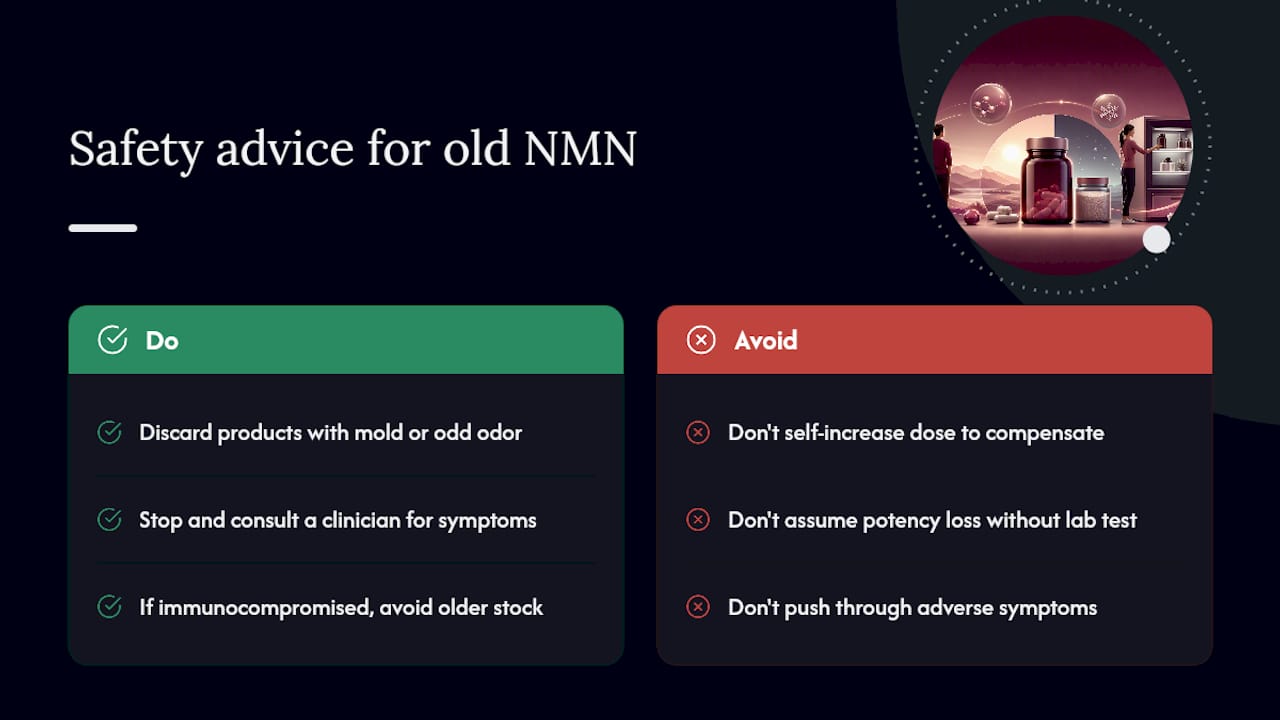
Degraded NMN converts mainly into nicotinamide, which isn’t considered acutely toxic at supplement-level amounts. The real issue is effectiveness, not danger. You’re likely getting a weaker dose than the label promises, not a harmful one.
That said, some situations call for real caution. Never use a product showing visible mold, unusual odor, or any sign of microbial contamination. If you’re immunocompromised, or you notice any adverse symptoms after taking older stock, stop immediately and talk to a clinician rather than pushing through it. And resist the urge to self-increase your dose to compensate for suspected degradation. Without lab testing confirming actual potency loss, you’re guessing at a number nobody can verify, and that’s not a risk worth taking on your own.
What CP-1’s Quality Process Looks Like in Practice
I’ve watched too many supplement brands treat storage as an afterthought, so we didn’t. CP-1 is manufactured in the US under GMP-certified conditions, third-party tested batch by batch, and formulated with vegan, non-GMO ingredients with a current COA available on request.
Our household advice mirrors everything above: keep the container sealed, store it somewhere cool and dry, and avoid leaving it near heat or humidity once you’ve opened it. It’s the same discipline we’d want from any supplement claiming to support NAD+ production, applied consistently rather than left to chance.
Get NMN That’s Actually Built to Last
Everything in this guide points to one conclusion: shelf life isn’t just about how you store NMN at home. It starts with how it was made and packaged before it ever reached your door.
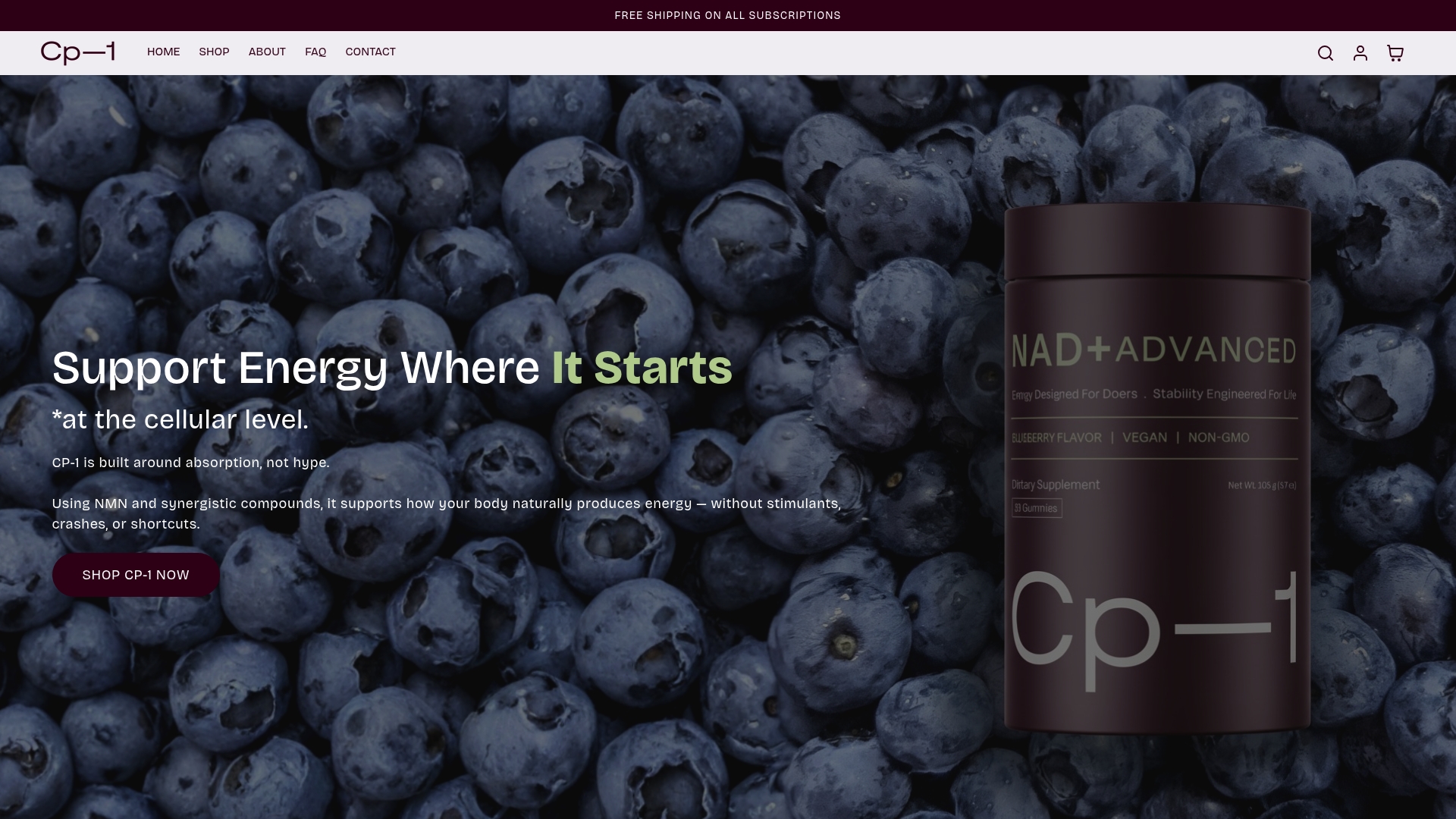
CP-1 was built around that exact principle. Every batch goes through third-party testing, US-based GMP manufacturing, and packaging designed to block the moisture and light that quietly wreck potency over time. You’re not left guessing whether your supply is still doing what the label promises.
- Third-party tested for purity and potency, batch by batch
- Manufactured in the US under GMP-certified conditions
- Packaged to protect against moisture and light exposure
Once your CP-1 order arrives, keep it sealed and stored in a cool, dry spot, and refrigerate it if you won’t finish the bottle within a couple of months. If you’re weighing options like Pure Blue’s Quantum Vitality NAD+ Booster alongside other NAD+ support formulas, it’s worth comparing packaging and testing transparency, not just price. Ready to see the full formula and current lab results? Check out CP-1’s NAD+ Advanced Supplement and read the certificate of analysis for yourself before you order.
This article is general information, not a substitute for advice from a qualified doctor. Consult a qualified healthcare professional about your own circumstances before acting on anything here.
Sources
- The Science Behind NMN–A Stable, Reliable NAD+Activator and Anti-Aging Molecule — PMC
- Degradation kinetics of β-nicotinamide mononucleotide based on reliable HPLC quantitative method — DOI
- At What Temperature Does NMN Degrade? — Guanjie Biotech
- Does NMN Powder Expire? Shelf Life & Stability Guide — Botanical Suppliers