
Functional mushrooms are everywhere right now. Wellness influencers swear by them, supplement brands slap them on every label, and your favorite podcast host probably has a discount code for a mushroom coffee blend. But here’s the honest truth: most of the hype outruns the science by a wide margin. That doesn’t mean functional mushrooms are useless. Far from it. The real, research-backed case for certain mushrooms is genuinely compelling, especially for people focused on cognitive clarity, steady energy, mood support, and immune resilience. This guide cuts through the noise and gives you what actually matters: the mechanisms, the evidence, the limits, and how to use them wisely.
Table of Contents
- What makes a mushroom functional?
- Science-backed benefits: Cognition, energy, and mood
- Evidence gaps, risks, and real limitations
- How to use functional mushrooms safely and effectively
- Our perspective: Cutting through the mushroom hype
- Take the next step with trusted supplements
- Frequently asked questions
Key Takeaways
| Point | Details |
|---|---|
| Science supports subtle benefits | Functional mushrooms offer modest gains in cognition, mood, and energy when used consistently according to current research. |
| Not a miracle solution | Hype exceeds the data; mushrooms work best as part of a holistic wellness approach, not quick fixes. |
| Safety and sourcing matter | Most people tolerate them well, but always choose reputable brands and consult your doctor if you use other medications. |
| Consider practical integration | Incorporate mushrooms gradually and monitor your response for the best experience. |
What makes a mushroom functional?
Not every mushroom earns the label “functional.” The term refers to mushroom species that contain bioactive compounds shown to produce measurable effects on human physiology beyond basic nutrition. Your grocery store button mushrooms are nutritious, sure. But they don’t carry the same concentration of neuroactive or immune-modulating compounds found in functional varieties.
Here are the four most studied and widely used functional mushrooms:
- Lion’s Mane (Hericium erinaceus): Best known for cognitive support. Contains erinacines and hericenones, compounds that stimulate Nerve Growth Factor (NGF) production in the brain.
- Cordyceps (Cordyceps militaris): Primarily used for energy and endurance. Supports ATP production and oxygen utilization in cells.
- Reishi (Ganoderma lucidum): Often called the “mushroom of immortality” in traditional medicine. Rich in triterpenes and beta-glucans, used for stress resilience and immune support.
- Chaga (Inonotus obliquus): High in antioxidants, particularly ergothioneine. Used for immune defense and reducing oxidative stress.
The key bioactive compounds across these species include:
| Compound | Found in | Primary effect |
|---|---|---|
| Beta-glucans | Most functional mushrooms | Immune modulation, anti-fatigue |
| Erinacines / Hericenones | Lion’s Mane | NGF stimulation, cognitive support |
| Ergothioneine | Chaga, others | Antioxidant, neuroprotection |
| Triterpenes | Reishi | Stress adaptation, anti-inflammatory |
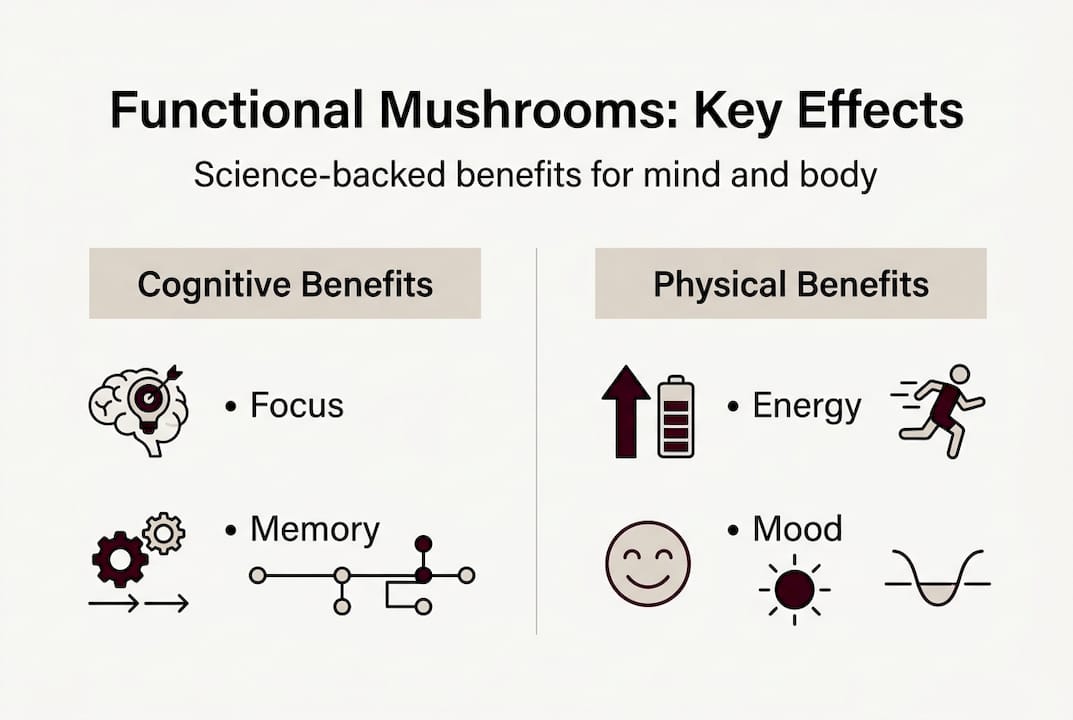
What separates functional mushrooms from stimulants is critical. There’s no caffeine. No adrenal spike. No crash two hours later. Non-stimulant energy options work through fundamentally different pathways, supporting cellular processes rather than forcing your nervous system into overdrive. That’s a meaningful distinction for anyone who’s tired of jittery energy that burns out before lunch.
Functional mushrooms offer science-backed support for natural cognitive enhancement and energy via specific compounds, not marketing buzzwords. That’s the foundation worth building on.
Science-backed benefits: Cognition, energy, and mood
With a basic understanding of functional mushrooms, let’s look at the most compelling science behind their claimed benefits. And yes, there is real science here, though it comes with important caveats we’ll address in the next section.
Lion’s Mane and cognitive function
Lion’s Mane stimulates NGF and improves cognitive scores in randomized controlled trials (RCTs). NGF is a protein your brain needs to grow, maintain, and repair neurons. When NGF production drops, cognitive decline accelerates. Lion’s Mane’s erinacines and hericenones cross the blood-brain barrier and directly stimulate NGF synthesis. That’s not a vague “brain boost” claim. It’s a specific, measurable mechanism.

Beyond cognition, Lion’s Mane also shows promise for mood. Several studies report reductions in anxiety and depressive symptoms, likely tied to NGF’s role in hippocampal neurogenesis.
Beta-glucans and fatigue reduction
“Beta-glucans from functional mushrooms reduce fatigue and improve mood and vigor markers in human trials.”
Beta-glucans reduce fatigue and improve mood and vigor in clinical research. These polysaccharides modulate the immune system by activating macrophages and natural killer cells. The downstream effect isn’t just immune strength. It’s a reduction in the kind of low-grade systemic inflammation that drags your energy and mood down over time.
Cordyceps and endurance
Cordyceps improves endurance and aerobic capacity in human studies. One mechanism involves increasing ATP synthesis and improving oxygen utilization at the cellular level. In practical terms, athletes and active individuals report better stamina and faster recovery. For people using functional mushrooms for energy without stimulants, Cordyceps is often the most relevant option.
| Mushroom | Primary benefit | Mechanism |
|---|---|---|
| Lion’s Mane | Cognition, mood | NGF stimulation |
| Cordyceps | Energy, endurance | ATP production, VO2 max |
| Reishi | Stress, immunity | Triterpenes, beta-glucans |
| Chaga | Antioxidant defense | Ergothioneine, polyphenols |
The science is real. It’s also still developing. Keep that context in mind as we look at the limitations.
Evidence gaps, risks, and real limitations
The science is impressive, but it’s critical to separate well-grounded facts from overhyped promises. This is where most wellness content fails you, by glossing over the limitations to keep the narrative clean.
What the research actually shows
Evidence is promising but limited: most studies are small, short-term, and often conducted in animals or cell cultures. Human RCTs exist, but they’re not as large or as long as the trials we’d want for definitive conclusions. The FDA has not approved any functional mushroom for the treatment or prevention of any disease. That matters.
For healthy individuals without specific deficiencies or conditions, effects may be subtle. You’re not going to take Lion’s Mane and wake up feeling like a different person tomorrow. That’s not how these compounds work.
“Functional mushrooms are not magic pills. They’re tools. Used consistently and correctly, they can support your biology. Used as a shortcut, they’ll disappoint you.”
Safety profile
Generally well-tolerated, functional mushrooms have a strong safety record for most adults. But rare side effects do exist:
- Mild digestive discomfort, especially at higher doses
- Allergic reactions in people sensitive to mold or fungi
- Potential interactions with blood thinners (Reishi in particular)
- Possible immune modulation concerns for those on immunosuppressants
Who should be cautious:
- Pregnant or breastfeeding individuals (insufficient safety data)
- Anyone on prescription medications that affect immune function or clotting
- People with known mushroom or mold allergies
Pro Tip: Always check supplement sourcing and purity before buying. Mushrooms are bioaccumulators, meaning they absorb heavy metals and contaminants from their growing environment. Third-party testing is not optional. It’s essential.
How to use functional mushrooms safely and effectively
To maximize any potential from functional mushrooms, here’s how to use them wisely and safely.
1. Choose the right form
Not all mushroom products are equal. Whole dried mushroom powders contain fiber and some bioactives, but extracts are generally more concentrated and bioavailable. Dual-extraction products (using both water and alcohol extraction) capture both water-soluble beta-glucans and fat-soluble compounds like triterpenes. Capsules offer convenience and consistent dosing.
2. Start low and build gradually
Begin with the lower end of suggested ranges, typically 500mg to 1,000mg per day for most extracts. Give your body two to four weeks before adjusting. Functional mushrooms are not acute supplements. They build effect over time.
3. Stack thoughtfully
Functional mushrooms pair well with other evidence-backed compounds. Ergothioneine acts as a neuroprotective compound, reducing oxidative stress, and is naturally present in several mushroom species. Combining mushrooms with NAD+ precursors like NMN or mitochondrial support compounds like CoQ10 can create a more complete cellular energy and neuroprotection stack.
4. Set realistic timelines
Most users notice subtle but real changes after four to eight weeks of consistent daily use. Better focus, slightly improved stamina, steadier mood. Not a dramatic transformation. A quiet, cumulative shift.
5. Vet your brands hard
Look for:
- Verified beta-glucan content (not just mushroom powder weight)
- Third-party testing certificates
- Clear sourcing information (fruiting body vs. mycelium matters)
- No fillers, artificial additives, or undisclosed ingredients
Pro Tip: Keep a simple health journal for the first 30 days. Note energy levels, focus quality, and sleep. Subtle effects are easy to miss without a baseline to compare against. This practice also helps you identify any adverse reactions early.
Our perspective: Cutting through the mushroom hype
With practical tips in hand, it’s worth stepping back and saying something that most wellness content won’t: functional mushrooms are not a category you chase for quick wins.
We’ve watched the supplement industry turn every promising ingredient into a miracle cure within months of the first decent study. Functional mushrooms are getting the same treatment right now. The reality is slower and more honest. These compounds support your biology steadily, over weeks and months, as part of a broader routine that includes sleep, movement, and real nutrition.
The people who get the most from functional mushrooms aren’t the ones who take them for two weeks and quit. They’re the ones who build sustainable energy routines and treat mushrooms as one reliable layer in a larger strategy.
We’d rather you have that honest expectation than buy into the hype and feel let down. Steady, subtle improvements in how you think, feel, and perform over months? That’s actually remarkable. It just doesn’t make for a flashy headline.
Take the next step with trusted supplements
If functional mushrooms have earned your attention, the next question is where to find a formula that actually delivers on the science. Most products on the market are underdosed, poorly sourced, or built for a marketing deck rather than for the person taking them.
CP-1 was built differently. It combines lion’s mane mushroom extract, reishi mushroom extract, and turkey tail mushroom extract alongside NMN and CoQ10, creating a formula designed for real cellular energy and cognitive support. Every batch is third-party tested, vegan, non-GMO, and made in the US. You can review the full CP-1 NAD+ Advanced Supplement and explore the ingredients and science behind every ingredient before you decide. That transparency is intentional.
Frequently asked questions
What are the most popular types of functional mushrooms?
Lion’s Mane, Cordyceps, Reishi, and Chaga are the most widely used functional mushrooms, each with distinct benefits for cognition, energy, and immune support.
How long does it take to notice benefits from functional mushrooms?
Benefits are more evident with ongoing use rather than acute doses; most users notice subtle changes after four to eight weeks of consistent daily supplementation.
Are functional mushrooms safe for daily use?
Generally well-tolerated for most healthy adults, but rare side effects like digestive discomfort or allergic reactions can occur, so consult your doctor if you take prescription medications.
Can functional mushrooms replace medications or other supplements?
No. Functional mushrooms are not a substitute for prescribed medications; they may complement your existing routine with your doctor’s approval, but the FDA has not approved any health claims for these products.
What should I look for when buying a mushroom supplement?
Prioritize products with verified beta-glucan content, third-party testing certificates, transparent sourcing, and clear ingredient labels that distinguish fruiting body from mycelium.