
Gummy vitamins absorb comparably to tablets for most nutrients, and for vitamin D3, clinical trials show gummies actually deliver higher blood levels than tablets do. That’s the honest answer. The real problem with gummies isn’t absorption at the molecular level. It’s what manufacturers leave out, how badly heat and moisture can degrade a batch before you ever open the bottle, and whether you’ll actually take the thing every day.
TL;DR:
- Gummy vitamins produce higher blood levels of vitamin D3 than tablets, but their shelf stability depends on proper storage and manufacturing standards.
- Chewing gummies accelerates absorption by early breakdown in the mouth, giving them an advantage in reaching peak blood concentrations faster.
- Gummy formulations effectively deliver vitamin D, B12, and vitamin E, but often omit minerals like iron, calcium, and magnesium due to formulation challenges.
- Environmental factors such as heat, moisture, and light significantly degrade gummy potency before consumption, making third-party testing and proper storage essential.
- Consistent daily intake and choosing brands with GMP certification and verified testing are more important for absorption than minor differences in formulation.
Table of Contents
- How Well Do Gummy Vitamins Actually Absorb?
- Why Does Chewing Change How Vitamins Absorb?
- Which Vitamins Work Well in Gummy Form, and Which Don’t?
- What Actually Ruins a Gummy Vitamin Before You Take It?
- How Should You Pick and Take Gummy Vitamins?
- What Manufacturing Standards Actually Protect Absorption?
- What The Research Actually Means for Your Daily Routine
- Where CP-1 Fits Into the Absorption Question
- Sources
- FAQ
How Well Do Gummy Vitamins Actually Absorb?
The best data we have on gummy vitamins absorption comes from a 2019 crossover trial that put vitamin D3 gummies head to head against tablets in the same group of healthy adults. The gummies won, and not by a small margin. Gummy takers showed a mean area under the curve (AUC) of 1,474 ng·h/mL compared to 774 ng·h/mL for tablets, and a peak blood concentration (Cmax) of 47.3 ng/mL versus 23.4 ng/mL for tablets. The difference was statistically significant, with a p-value under 0.0001.
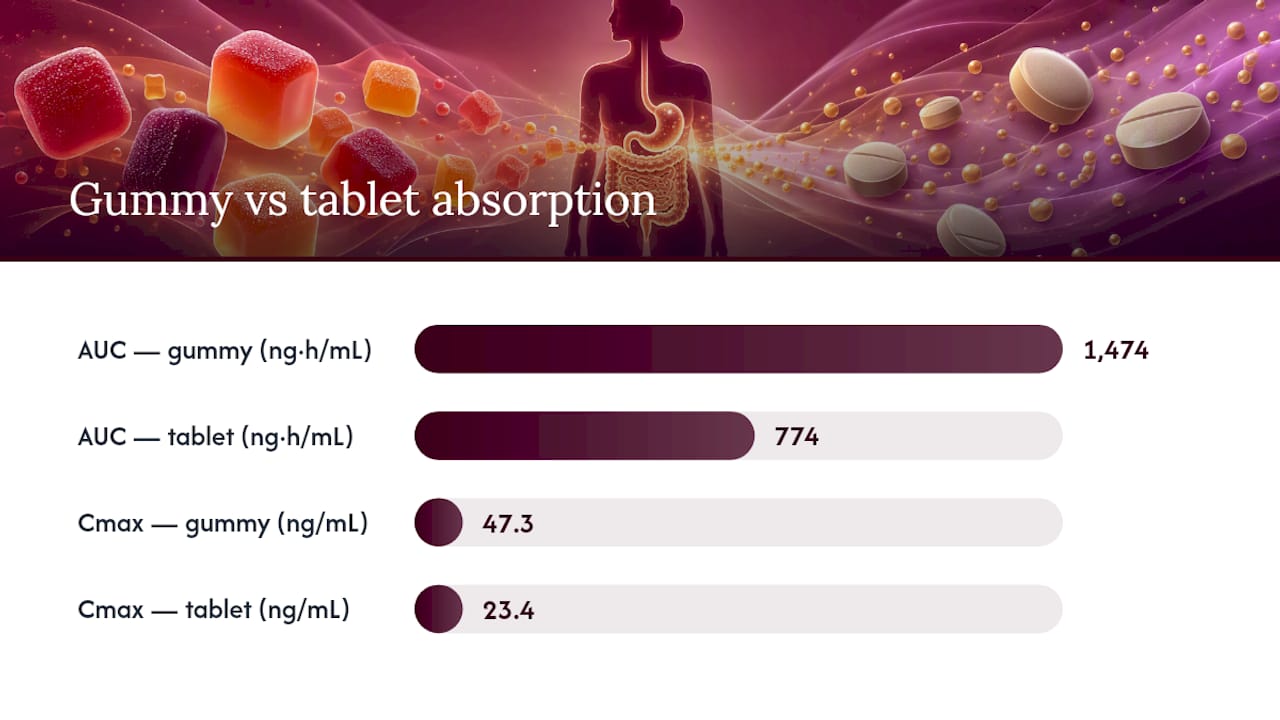
For readers who don’t spend their weekends reading pharmacokinetics papers: AUC measures total drug exposure over time, and Cmax measures the highest concentration reached in the blood. Higher numbers on both, in this case, mean the body pulled more vitamin D out of the gummy and did it faster.
A second, smaller 2020 pilot study looked at a multivitamin gummy against a multivitamin tablet, tracking vitamin E, B12, and folate. The results were more mixed and more interesting.
- Vitamin E and B12 showed comparable absorption between gummy and tablet forms.
- Folate reached its peak concentration much earlier in the gummy group, with a Tmax of 1.59 hours versus 4.08 hours for tablets.
- Total absorption (AUC) for folate wasn’t dramatically different, just the timing.
Statistic to remember: Vitamin D3 gummies produced substantially higher peak blood concentrations than tablets in a controlled crossover trial, as shown in the 2019 bioequivalence study.
Now, the caveats, because every good study has them. Both trials were small, single-dose designs. That means researchers gave people one dose and tracked it, rather than measuring what happens after weeks of daily use. Neither trial tells you what happens with chronic dosing, or how results might shift with age, gut health, or medication use. Some of this research also involved manufacturer funding or disclosed industry ties, which doesn’t invalidate the numbers but does mean you should treat them as a strong signal rather than a courtroom verdict. Still, two independent crossover trials showing comparable or better bioavailability for gummies is a meaningfully different starting point than the “gummies are just candy” assumption a lot of people carry around.
Why Does Chewing Change How Vitamins Absorb?
The mechanism behind these numbers isn’t mysterious once you think about what a gummy actually does in your mouth. You chew it. Saliva starts breaking it down immediately. A tablet, by contrast, often travels to your stomach mostly intact and has to disintegrate before your body can access anything inside it.
That head start matters. Researchers behind the vitamin D crossover trial suggest that early mechanical breakdown and dissolution in the mouth and upper gut may explain why gummies hit a higher Cmax faster than tablets do, based on the mechanistic discussion in the original study. Less time waiting to dissolve means less time before the vitamin can cross into your bloodstream.
Fat solubility complicates the picture for certain nutrients. Vitamins A, D, E, and K don’t dissolve in water. They need bile acids and dietary fat to form tiny transport structures called micelles before your intestine can absorb them. A gummy that hits your gut during or right after a meal with some fat in it has a real mechanical advantage, because the fat is already there to help build those micelles.
A few practical points worth holding onto:
- Chewing accelerates dissolution, which can shift both how much vitamin gets absorbed and how fast it peaks in the blood.
- Fat-soluble vitamins benefit from a fatty meal, gummy or not, because absorption depends on micelle formation.
- The gummy matrix itself, the gel and sugar base, affects release speed, and different manufacturers formulate that matrix differently.
- Sublingual absorption, meaning uptake through tissue under the tongue, is theoretically possible but isn’t the main route for most vitamins. Gummies aren’t designed or held in the mouth long enough for it to matter much.
None of this means every gummy on the shelf performs like the ones in these trials. The formula matters. So does what’s inside it.
Which Vitamins Work Well in Gummy Form, and Which Don’t?
Vitamin D is the clearest win for gummy form. The clinical data isn’t subtle. Gummy vitamin D3 outperformed tablets on both AUC and Cmax in a controlled trial, and that’s a rare thing to say about a supplement delivery format with this much confidence.
Vitamin B12 and vitamin E come out roughly even. The pilot study found similar absorption for both nutrients, regardless of whether they came from a gummy or a tablet, so the format itself isn’t the deciding factor for these two.
Folate is the interesting middle case. Gummy folate peaked in about 1.6 hours; tablet folate took roughly 4 hours to hit its peak. Total exposure looked similar between the two, so this is a timing quirk more than an efficacy gap, but it’s worth knowing if you’re taking folate for a specific reason, like early pregnancy planning, where consistent blood levels matter.
Where gummies fall short, consistently, is minerals. Iron, calcium, and magnesium are common casualties in gummy formulations, and it’s not an accident.
- Iron has a metallic taste that’s hard to mask, even with heavy flavoring, so many gummy multivitamins simply leave it out.
- Calcium and magnesium require large doses to be clinically useful, and cramming that much mineral into a gummy without making it chalky or bitter is a genuine manufacturing headache.
- Hospital-system nutrition guidance points out that gummies “may not include all minerals” and that whole foods still outperform most supplements for overall nutrient absorption.
The takeaway isn’t “avoid gummies.” It’s “read the label before you assume a gummy multivitamin covers what a tablet multivitamin covers.” They frequently don’t cover the same ground.
What Actually Ruins a Gummy Vitamin Before You Take It?
Absorption science tells you what happens once the vitamin gets into your body. It says nothing about what happened to that vitamin in the three months it sat in a warehouse, a delivery truck, or your bathroom cabinet. That’s where gummies run into their real vulnerability.
Gummies are, chemically speaking, a soft, semi-hydrated gel. That makes them far more sensitive to moisture, heat, and light than a compressed, dry tablet. University Hospitals’ clinical team notes plainly that gummies are more susceptible to environmental degradation than harder supplement forms, which shortens effective shelf life and can quietly erode potency long before the expiration date arrives.
Dose uniformity is the other issue nobody talks about enough. Getting the exact same amount of active ingredient into every single gummy in a batch of thousands is a genuine manufacturing challenge. It’s solvable with tight mixing controls, in-process testing, and batch verification, but it’s a manufacturing discipline problem, not something inherent to gummies as a format.
Here’s what tends to degrade a gummy’s real-world potency, roughly in order of how much damage they do:
- Heat exposure during shipping or storage, which accelerates chemical breakdown of active ingredients.
- Moisture absorption, since gummies are semi-hydrated to begin with and humid air makes it worse.
- Light exposure, particularly for light-sensitive nutrients like certain B vitamins.
- Inconsistent mixing during manufacturing, which creates dose variability between gummies in the same bottle.
- Added sugars and fillers that stabilize texture but add nothing nutritionally and sometimes trade shelf stability for taste.
Pro Tip: Ask for the Certificate of Analysis (COA) before you buy, or check if the brand posts it. A COA is third-party lab testing that confirms what’s actually in the bottle matches what’s on the label. The FDA specifically recommends checking labels and third-party testing since dietary supplements aren’t pre-approved before they hit shelves.
Store gummies somewhere cool, dark, and dry, not in a steamy bathroom cabinet where every shower sends a wave of humidity straight at the bottle. A kitchen pantry shelf away from the stove beats a medicine cabinet nearly every time.

How Should You Pick and Take Gummy Vitamins?
Getting good gummy vitamin efficacy comes down to what you check before purchase and how you take them afterward, not luck. Here’s the checklist that actually matters:
- Check the active ingredient form. Vitamin D should list D3 (cholecalciferol), not the weaker D2 form. A closer look at what to verify on a supplement label can save you from a formulation that underperforms before you even open the bottle.
- Confirm the dose per serving, and note whether “per serving” means one gummy or three. Some labels bury this.
- Look for what’s missing, especially iron, calcium, and magnesium, if you’re relying on the gummy as a full multivitamin replacement.
- Verify third-party testing or a COA statement somewhere on the label or the brand’s website.
- Take fat-soluble vitamins (A, D, E, K) with a meal containing some fat, since that’s when micelle formation, and therefore absorption, works best.
- Store away from heat and humidity, which means not on a sunny windowsill and not in the bathroom.
The single biggest factor in whether any vitamin form works for you isn’t a Cmax number in a research paper. It’s whether you take it. Experts interviewed on the format debate consistently point out that adherence outweighs marginal bioavailability differences between forms. A tablet with perfect pharmacokinetics does nothing sitting unopened in a drawer.
What Manufacturing Standards Actually Protect Absorption?
Everything covered so far points to one conclusion: absorption science only matters if the manufacturing behind it holds up. A perfectly designed gummy formula means nothing if a factory can’t hit consistent doses batch after batch.
Dose uniformity is a manufacturing discipline, not an unavoidable weakness of gummies, and it depends on mixing controls, in-process checks, and batch-level verification that catches problems before a bottle ships. US-based production under GMP (Good Manufacturing Practice) standards, combined with third-party lab testing, gives you a paper trail you can actually check rather than a marketing claim you have to take on faith. Vegan and non-GMO certifications add another layer of verification, confirming that what’s on the ingredient list is what’s actually in the gummy. None of this replaces clinical data on absorption, but it’s what stands between a well-designed formula on paper and a well-delivered dose in your bloodstream.
What The Research Actually Means for Your Daily Routine
The clinical picture is more reassuring than the “gummies are just sugar” skeptics want to admit, but it’s not a blank check either. Small trials on a handful of nutrients don’t prove every gummy on a shelf performs identically, and formulation quality plus storage conditions decide whether a labeled dose survives to become a delivered dose. My honest read: prioritize brands that publish third-party testing, take your supplement at the same time daily, and talk to a doctor before using any supplement to manage a diagnosed deficiency.
— Hugo
Where CP-1 Fits Into the Absorption Question
Everything in this article points to the same conclusion: formulation and manufacturing discipline decide whether a gummy delivers what its label promises. That’s the exact problem CP-1 was built around. Some supplements use NMN as a precursor that your cells convert into NAD+ internally, rather than relying on oral NAD+ that gets broken down in the gut before it does much good. Some supplement formulas exclude fillers and sucralose, and include ingredients at doses intended to have an effect rather than just look good on a label.
Some supplements are produced under GMP-certified conditions, with third-party testing, and use ingredients that are vegan and non-GMO throughout. Before you buy anything, gummy or otherwise, check the Certificate of Analysis if one’s available. It’s the single best habit from this entire article. If you want to see the full formulation, including NMN, lion’s mane, reishi, turkey tail, and CoQ10, the CP-1 product collection has the details on dosing and sourcing.
This article is general information, not a substitute for advice from a qualified doctor. Consult a qualified healthcare professional about your own circumstances before acting on anything here.
Sources
- Bioequivalence Studies of Vitamin D Gummies and Tablets in Healthy Adults: Results of a Cross-Over Study
- Bioequivalence of vitamins E, B12 and folate in a single oral dose multivitamin gummies vs. tablets (pilot)
- Are Gummy Vitamins as Good as the Real Thing? | University Hospitals
- Questions and answers on dietary supplements | FDA
FAQ
Does Your Body Actually Absorb Gummy Vitamins?
Yes. Clinical crossover trials show your body absorbs gummy vitamins comparably to tablets for nutrients like B12 and E, and gummy vitamin D3 actually showed higher absorption than tablets in a controlled study. The bigger question isn’t absorption, it’s whether the specific gummy you bought contains what its label claims, which is why third-party testing matters.
How Long Does It Take for Gummy Vitamins to Absorb?
It depends on the nutrient, but gummies generally start dissolving faster than tablets because chewing kicks off the process immediately. In the multivitamin pilot study, gummy folate peaked in about 1.59 hours compared to roughly 4.08 hours for the tablet version.
What Is the Hardest Vitamin to Absorb?
Fat-soluble vitamins, particularly D and E, are generally the trickiest because they require dietary fat and micelle formation to cross into the bloodstream. Iron is also notoriously difficult to absorb in any form and is frequently left out of gummy multivitamins entirely because of its taste and dosing challenges.
Which Is Better for Absorption, Gummies or Pills?
Neither format wins across the board. Gummies show an edge for vitamin D3 in clinical trials, come out roughly even for B12 and vitamin E, and often fall short on minerals like iron, calcium, and magnesium that are hard to formulate into a palatable gummy. A well-manufactured, third-party tested gummy like CP-1 can match or beat a tablet for specific nutrients, but always check the label for what’s included and what’s missing.