
Start at 250 mg per day. Most people who benefit from NMN land somewhere in the 250 to 600 mg range, and clinical trials have pushed short-term doses as high as 900 to 1,200 mg without serious safety signals. That said, no supplement replaces a conversation with your doctor, especially if you’re pregnant, managing active cancer, or juggling a complex medication list.
TL;DR:
- Doses of 250 to 600 mg per day are supported by research as effective for NAD+ elevation and metabolic benefits, with 600 mg often being sufficient.
- Clinical trial data shows no serious adverse effects at doses up to 1,200 mg for short periods, but long-term safety remains unproven.
- Morning dosing aligns with natural circadian rhythms, but consistency in intake timing is more important than whether you take NMN in the morning or at night.
- Standard capsules have the most robust evidence base, while sublingual and liposomal forms may offer faster absorption but lack long-term efficacy data.
- A practical introduction involves starting at 250 mg daily, tracking effects over 8 to 12 weeks, then adjusting under medical supervision if needed.
Table of Contents
- How Much NMN Should You Take? A Practical Dosing Summary
- What the Clinical Trials Actually Show About Dose and Safety
- Should You Take NMN in the Morning or at Night?
- Capsules, Sublingual, or Liposomal NMN: Does Form Matter?
- Is NMN Safe? Side Effects and When to Check With a Doctor
- A Starter Protocol: How to Introduce NMN the Right Way
- Where CP-1 Fits Into the Evidence
- A Straight Answer on NMN Dosing
- Ready to Try NMN? Here’s a Straightforward Option
- Sources
How Much NMN Should You Take? A Practical Dosing Summary
I get asked this constantly, and I get why the confusion exists. Half the internet says 1,000 mg is the “real” dose. The other half whispers that anything over 250 mg is a waste of money. Neither camp is reading the trial data closely enough.
Here’s what the dose-response research actually supports:
- 250 mg/day is a sensible starting point for general maintenance, and it’s the dose used in the insulin-sensitivity trial that showed measurable metabolic benefit in postmenopausal women over 10 weeks.
- 250 to 500 mg/day is where most long-term users settle once they’ve confirmed tolerability.
- 500 to 600 mg/day shows up repeatedly as the sweet spot in dose-response trials, the dose where NAD+ elevation and physical performance gains plateau.
- 900 to 1,200 mg/day appears in athletic performance studies and short trials, but the extra NAD+ boost above 600 mg tends to be marginal for people who aren’t chasing elite performance metrics.
Most of the human data behind these numbers comes from trials lasting 4 to 12 weeks. Nobody has published a controlled trial tracking NMN use for a year or longer, so if someone tells you they know exactly what happens at 1,000 mg/day for five straight years, they’re guessing. We built our understanding of NMN’s role in energy and aging around what the evidence actually shows, not around what sounds impressive on a label.
What the Clinical Trials Actually Show About Dose and Safety
The most useful piece of evidence for anyone building an NMN dosage guide around real data is a multicenter, randomized, double-blind trial that tested 300 mg, 600 mg, and 900 mg doses against a placebo over 60 days. All three treated groups saw blood NAD+ levels rise. The 600 mg group posted significantly higher NAD+ than the 300 mg group. The 900 mg group, though? Barely distinguishable from 600 mg. That’s the plateau effect showing up in a controlled setting, and it’s the strongest single piece of evidence behind the “600 mg is often enough” recommendation.
| Trial | Doses tested | Duration | Key finding |
|---|---|---|---|
| Multicenter RCT [PMC11365583] | 300 / 600 / 900 mg | 60 days | NAD+ rose in all groups; 600 mg beat 300 mg; 900 mg showed no meaningful gain over 600 mg |
| Yoshino et al. insulin-sensitivity trial | 250 mg | 10 weeks | Improved muscle insulin sensitivity in postmenopausal women |
| Runner performance trial | 300 / 600 / 1,200 mg | 60 days | Dose-dependent aerobic capacity gains up to 1,200 mg |
A broader look across NMN trials, covering roughly 437 participants and dosages from 150 to 1,200 mg/day, found no serious adverse effects reported at any tested dose. That’s reassuring. It’s also not the same as proof of long-term safety. The average follow-up across these studies runs under 10 weeks, and the Clinicaltrials shows most active NMN trials are still working within that same short window. Nobody has the data yet to tell you what daily NMN use looks like at year three.
Should You Take NMN in the Morning or at Night?
Your body’s NAD+ machinery, particularly the enzyme NAMPT, runs on a circadian rhythm that tends to favor morning dosing for energy-related outcomes. That’s the biological argument for taking NMN with breakfast rather than before bed.
But here’s the honest answer: the trial evidence on timing is thinner than the evidence on dosage. What actually seems to matter more than morning versus night is consistency.
- Morning dosing aligns with natural NAMPT activity and pairs well with the energy support most people are chasing.
- Evening dosing has theoretical appeal for cellular repair cycles, though it’s not well-tested head-to-head against morning use.
- Split dosing (say, 250 mg twice a day) can smooth out plasma levels and may reduce mild stomach upset in people sensitive to a single larger dose.
Pro Tip: Pick one time, stick with it for the full evaluation window, and don’t switch things up every few days. Our guide on timing walks through this in more detail if you want the deeper mechanics.
Capsules, Sublingual, or Liposomal NMN: Does Form Matter?
Nearly every trial behind the dosing numbers in this guide used standard oral capsules. That’s the form with the deepest evidence base, full stop.
Sublingual and liposomal formulations show promise in early pharmacokinetic work. Some comparative PK data suggests these forms produce faster, sometimes higher plasma increases than standard capsules, particularly for people with digestive issues that limit absorption.
- Capsules: best-studied, most affordable, the format nearly every clinical trial relied on.
- Sublingual: faster onset in early studies, useful if you suspect absorption problems, generally pricier.
- Liposomal: higher plasma levels in some comparisons, but backed by far less long-term efficacy data than capsules.
Whichever form you choose, third-party testing matters more than the delivery method. A liposomal product with no batch testing is a bigger gamble than a well-tested capsule.
Is NMN Safe? Side Effects and When to Check With a Doctor
Across the trials I mentioned earlier, tolerability held up well even at 900 to 1,200 mg/day for short stretches. That’s genuinely good news. It doesn’t mean NMN is risk-free for everyone, and it doesn’t mean the safety story is finished being written.
Here’s what to keep in mind:
- Mild side effects reported in trials included occasional headache, mild nausea, or digestive discomfort, usually at higher doses.
- No serious adverse events turned up in the pooled trial data covering roughly 437 participants across multiple studies.
- Long-term risk remains unknown. The studies backing this guide run 4 to 12 weeks. Nobody has published safety data on years of continuous use.
- Talk to your doctor first if you take prescription medications, have active cancer, are pregnant or breastfeeding, or manage a significant metabolic condition.
- Stop and seek medical review if you notice new, unexplained symptoms after starting NMN, especially anything affecting digestion, sleep, or energy in a way that feels off.
None of the reviewed trials reported serious adverse events even at the highest tested doses, but that safety data comes from short windows, not years. A clinician may want to check baseline metabolic labs, like HOMA-IR, before you start and again after your evaluation period, since NAD+ itself isn’t something routine bloodwork measures directly yet.
A Starter Protocol: How to Introduce NMN the Right Way
You don’t need a complicated plan. You need a consistent one.
- Before you start, write down any medications you take, note your baseline energy and sleep patterns, and consider asking your doctor for baseline metabolic labs if you have any risk factors.
- Weeks 1 through 8 to 12, take 250 mg/day, same time daily, and track how you feel using simple notes rather than guesswork.
- At the 8 to 12 week mark, if you’ve noticed no meaningful change and no side effects, talk to your clinician about moving to 500 to 600 mg/day.
- Reserve doses above 600 mg for short-term, goal-specific situations, and only with clinical input.
Pro Tip: Give any dose a full 8 to 12 weeks before deciding it “doesn’t work.” NAD+ changes and downstream effects like energy or metabolic markers take time to show up, and judging too early is the most common mistake I see. If you want the fuller picture on what these outcomes look like in practice, our page on NMN’s functional benefits breaks it down further.
Where CP-1 Fits Into the Evidence
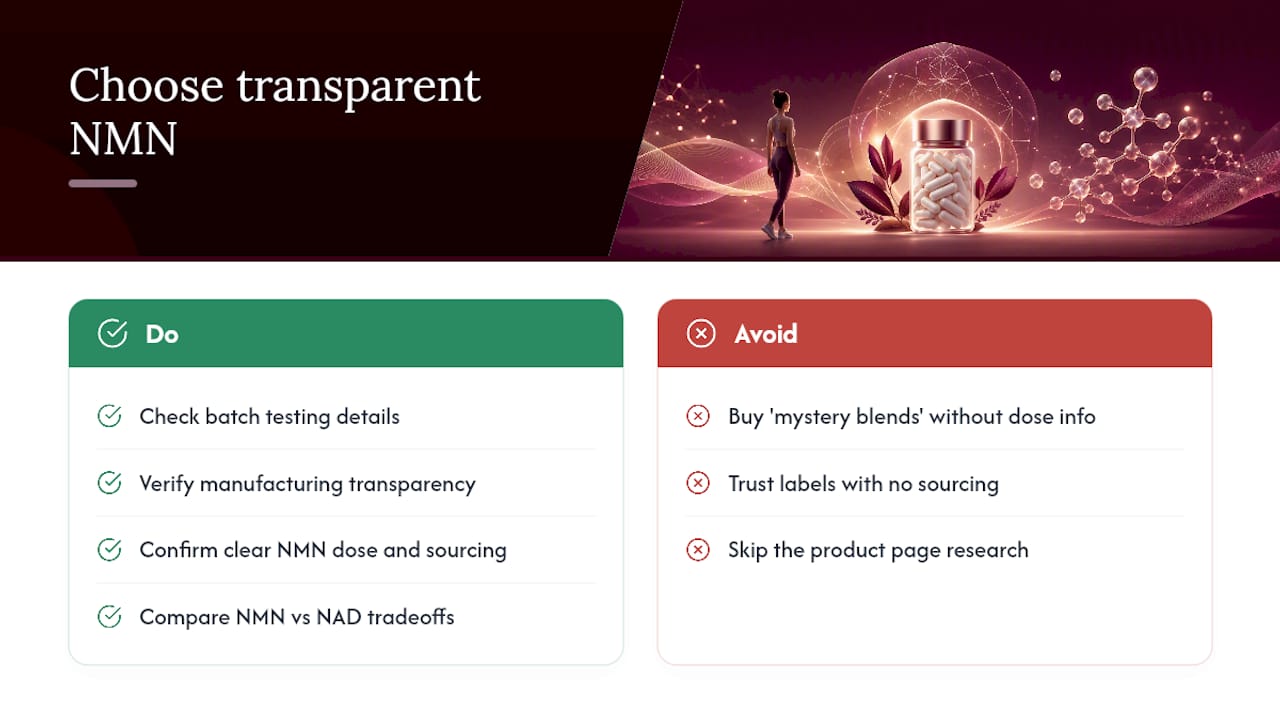
There are supplements combining NMN with lion’s mane, reishi, turkey tail, and CoQ10 in chewable gummy form that emphasis manufacturing standards and ingredient quality. We built it because most supplement labels tell you almost nothing useful about dose or sourcing. You deserve better than a mystery blend.
If you want to understand how NMN stacks up against other NAD+ approaches before deciding on a product, our comparison of NMN versus NAD supplementation walks through the tradeoffs. Check any product’s page for batch testing details and manufacturing transparency before you buy, from us or anyone else.
A Straight Answer on NMN Dosing
I’ll say the thing most wellness content won’t: there is no universal “best” NMN dose, and anyone promising one is oversimplifying real trial data. What the evidence supports is a range, a starting point, and a plateau around 600 mg where most people stop seeing added benefit. Your job isn’t to find the “biohacker max.” It’s to find your effective dose, give it a full 8 to 12 weeks, and loop in a clinician if you’re on medication or managing a health condition. Realistic expectations and a little patience beat chasing the highest number on a bottle every time.
— Hugo
Ready to Try NMN? Here’s a Straightforward Option
If you’ve made it this far, you already know NMN dosing isn’t about guessing your way to the highest number, it’s about picking a well-tested product and giving it a fair evaluation window. This philosophy is embodied by products that combine NMN with lion’s mane, reishi, turkey tail, and CoQ10, emphasize US manufacturing, third-party testing, and transparent ingredient lists without vague “proprietary blend” language.
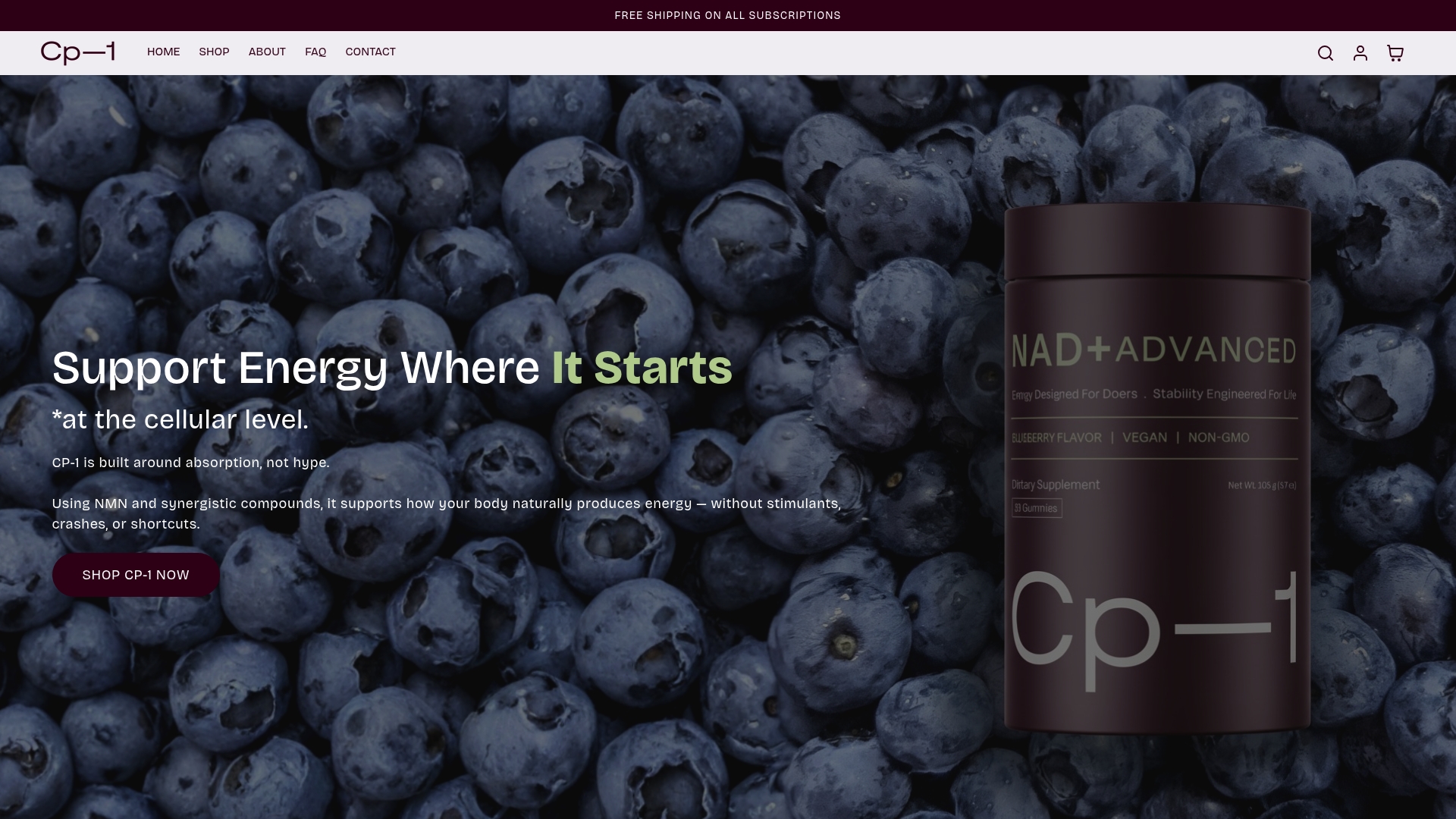
We’d rather you check the batch testing and ingredient breakdown yourself than take our word for it. Visit the CP-1 product page to review current testing documentation, see the full ingredient list, and decide whether it fits the starter protocol outlined above. If you’re ready to start your own 8 to 12 week evaluation window, that’s the place to do it.
This article is general information, not a substitute for advice from a qualified doctor. Consult a qualified healthcare professional about your own circumstances before acting on anything here.