

What Do Dips Workout? Muscles, Form, and Gains
Dips are a compound bodyweight exercise that simultaneously targets the pectoralis major, triceps brachii, and anterior deltoids, making them one of the most efficient upper-body movements you can do. Unlike isolated exercises that hit one muscle at a time, dips engage at least three major muscle groups in a single rep. Secondary stabilizers, including the core, rhomboids, latissimus dorsi, and serratus anterior, fire throughout the movement to keep your body controlled. That combination of primary movers and stabilizers is exactly what makes dips worth your time. This guide covers what muscles dips workout, how to adjust your form for different goals, and how to progress safely from beginner to weighted variations.
What do dips workout: primary and secondary muscles
Dips are a multi-joint exercise, meaning they load more than one joint at once. The shoulder joint, elbow joint, and wrist all work together during every rep. That multi-joint demand is why dips build functional upper-body strength more efficiently than single-joint movements like triceps pushdowns or cable flyes.
The three primary muscles dips target are:
- Pectoralis major: The large chest muscle that drives horizontal pressing force, especially when you lean your torso forward.
- Triceps brachii: The three-headed muscle on the back of your upper arm, responsible for elbow extension and lockout at the top of each rep.
- Anterior deltoids: The front portion of your shoulder, which assists in pressing and stabilizes the joint throughout the movement.
Secondary muscles that activate during dips include the core, which braces to prevent your hips from swinging, and the rhomboids and serratus anterior, which stabilize your shoulder blades. The latissimus dorsi also contributes, particularly during the lowering phase. These secondary muscles do not get the same load as the primary three, but their activation is what makes dips a genuinely functional exercise rather than just a chest or triceps move.
How torso angle and grip change which muscles dips target

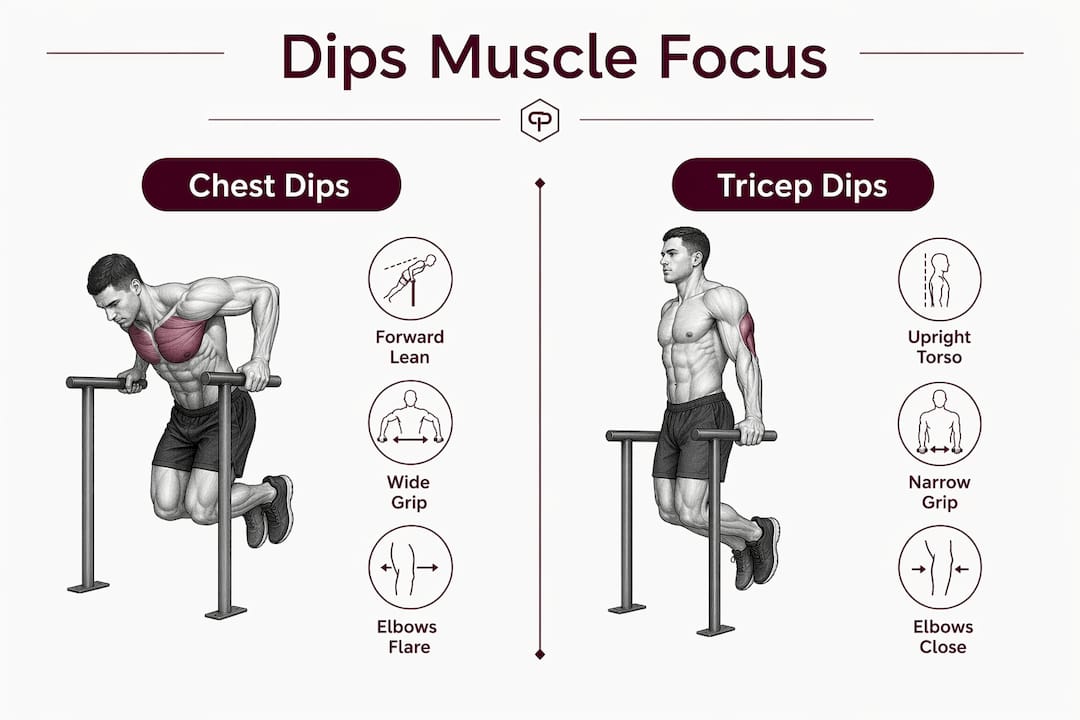
The single most important variable in a dips workout is your torso angle. Leaning your torso forward shifts your hips behind your hands and places the pectoralis major under greater stretch and load. Staying upright with your elbows tucked close to your sides redirects the work to the triceps brachii. This is not a minor difference. Changing your lean by even 20 to 30 degrees meaningfully shifts which muscle group carries the most tension.
Grip width compounds this effect:
- Wide grip: Increases chest activation by widening the base and mimicking a wider pressing angle.
- Narrow grip: Keeps the elbows closer to the torso, maximizing triceps engagement throughout the rep.
- Neutral grip (parallel bars): The standard setup, which allows you to control emphasis through torso angle rather than hand position alone.
Chest dips use a forward lean with a slightly wider grip and allow the elbows to flare outward. Tricep dips use an upright torso, narrow grip, and elbows tracking straight back. Both are valid. The mistake most people make is using a random torso angle without knowing which muscle they are actually targeting.
Pro Tip: Before each set, decide whether you are training chest or triceps. Set your torso angle and grip deliberately, then stick to it for the entire set. Mixing angles mid-set reduces the training stimulus for both muscle groups.
How to do dips properly: form, depth, and safety
Proper dip technique protects your shoulders and maximizes muscle activation. Sloppy form, especially at the shoulder, is the fastest way to develop an overuse injury that sidelines you for weeks.
Follow these steps for safe, effective dips:
- Grip the bars firmly. Your hands should be roughly shoulder-width apart on parallel bars. Wrap your fingers fully around the bar for a secure grip.
- Depress and retract your shoulder blades. Keeping your shoulder blades pulled down and back prevents shoulder impingement and protects the rotator cuff. Never let your shoulders shrug toward your ears at the bottom of the rep.
- Lower with control. Use a controlled 2–3 second descent on the way down. Dropping fast removes tension from the muscles and loads the joints instead.
- Stop at 90 degrees. The optimal elbow angle is 90 degrees. Going deeper than parallel increases shear stress on the shoulder joint without adding meaningful muscle activation.
- Press to full lockout. At the top, fully extend your elbows to stimulate all three heads of the triceps. Stopping short of lockout leaves gains on the table.
- Avoid bouncing. At the bottom of the rep, do not use momentum to spring back up. Pause briefly, then press.
The two most common mistakes are shrugging the shoulders at the bottom and going too deep. Both increase injury risk without improving results. Shoulder impingement from dips is almost always caused by one of these two errors, not by the exercise itself.
Pro Tip: If you feel pinching or pain in the front of your shoulder during dips, check your shoulder blade position first. Actively pulling your shoulder blades down before you lower yourself often eliminates the problem immediately.
What are the main dip variations and which muscles do they target?
Different dip variations suit different fitness levels and training goals. Knowing which variation to use prevents plateaus and keeps your training progressing.
| Variation | Primary Muscles | Best For |
|---|---|---|
| Parallel bar dips | Chest, triceps, anterior deltoids | Intermediate to advanced trainees |
| Bench dips | Triceps, anterior deltoids | Beginners building baseline strength |
| Band-assisted dips | Chest, triceps (reduced load) | Beginners or those returning from injury |
| Weighted dips | Chest, triceps (overloaded) | Advanced trainees building max strength |
| Ring dips | Chest, triceps, stabilizers | Advanced trainees adding instability |
Here is how each variation fits into a real training plan:
- Bench dips are the entry point for a dips workout for beginners. You place your hands on a bench behind you and your feet on the floor, which reduces the load to a fraction of your bodyweight.
- Band-assisted dips use a resistance band looped around the parallel bars to support part of your weight. This is the most effective beginner progression because it mimics the full parallel bar movement.
- Weighted dips use a dip belt, weighted vest, or a dumbbell held between the knees to add external load. This is the primary tool for advanced strength and hypertrophy once bodyweight reps are fully controlled.
- Ring dips require the rings to stay stable throughout the movement, which recruits far more stabilizer muscle activity than fixed parallel bars. They are not a beginner exercise.
The benefits of including multiple dip variations in your routine are real. Rotating between chest-focused and triceps-focused variations prevents overuse patterns and ensures balanced upper-body development.
How to progress your dips workout from beginner to advanced
Beginners often underestimate how scalable dips are. With the right progressions, virtually anyone can work up to full parallel bar dips and eventually weighted dips. The key is building neuromuscular control before adding load.
- Start with bench dips or band-assisted dips. Build to 3 sets of 12–15 clean reps before moving on. Clean means full range of motion, no bouncing, and shoulder blades controlled throughout.
- Move to bodyweight parallel bar dips. Once you can do 3 sets of 12–15 reps with strict form, you have the baseline strength for parallel bars.
- Build volume before adding weight. Work up to 3–4 sets of 10–12 reps on parallel bars with perfect technique. Mastery of movement control matters more than adding weight at this stage.
- Introduce external load gradually. Add 5–10 pounds using a dip belt or weighted vest. Keep reps in the 6–10 range when training for strength, or 10–15 for hypertrophy.
- Prioritize time under tension. Slowing the eccentric phase to 3 seconds and pausing at the bottom builds more muscle than rushing through reps with heavier weight.
- Rotate variations to avoid plateaus. Every 4–6 weeks, shift emphasis between chest dips and tricep dips, or introduce ring dips to challenge your stabilizers.
High-repetition dips correlate with strong neuromuscular control. That control is what protects your shoulders long-term and allows you to keep adding load without breaking down.
Key takeaways
Dips are the most efficient compound bodyweight exercise for building chest, triceps, and shoulder strength when performed with controlled technique and deliberate torso positioning.
| Point | Details |
|---|---|
| Primary muscles targeted | Dips work the pectoralis major, triceps brachii, and anterior deltoids simultaneously. |
| Torso angle controls emphasis | Lean forward for chest focus; stay upright with elbows tucked for triceps. |
| Safe depth is 90 degrees | Lowering past 90 degrees increases shoulder joint stress without adding muscle benefit. |
| Progression before load | Build to 3 sets of 12–15 clean reps before adding external weight. |
| Shoulder blade position is critical | Depressing and retracting the shoulder blades prevents impingement on every rep. |
Why dips are the most underrated upper-body exercise
I have trained for years, and dips are still the movement I come back to when I want real upper-body strength. Not the kind that looks good on a program sheet. The kind that transfers to pressing, pushing, and carrying in real life.
The thing most people get wrong is treating dips like a triceps finisher. They throw them in at the end of a chest day, bang out a few sloppy reps, and wonder why their shoulders hurt. Dips are a primary movement. They deserve to be programmed early in your session when you are fresh, with the same attention to setup and form you would give a bench press.
What I have found is that the people who struggle with dips are almost always fighting their shoulder blade position. They let their shoulders creep up toward their ears the moment the movement gets hard. Fix that one thing, and most shoulder pain from dips disappears. The muscle recovery demands from heavy dip sessions are real, so do not skip your recovery work either.
If you are a beginner, do not let the parallel bars intimidate you. Start with bench dips. Build the pattern. The scalability of this exercise is one of its best features. And if you want to understand exactly which muscles dips target and how to build a full upper-body program around them, that depth of knowledge pays off fast.
— Hugo
Fuel your dips workout with the right support
Training hard is only half the equation. Recovery, energy, and cellular function determine how well your body responds to the work you put in.

Cp-1 is built for people who take their training seriously and want their body to actually keep up. The formula includes NMN to support NAD+ production, coenzyme Q10 for mitochondrial energy, and lion’s mane mushroom extract for mental clarity during and after hard sessions. These are not marketing ingredients. They are compounds with real mechanisms behind them. If you want to train consistently and recover properly, visit the Cp-1 website to see what genuine cellular energy support looks like.
FAQ
What muscles do dips primarily work?
Dips primarily work the pectoralis major, triceps brachii, and anterior deltoids. Secondary stabilizers including the core, rhomboids, and serratus anterior also activate throughout the movement.
Can dips build muscle effectively?
Yes. Dips are a compound movement that loads multiple large muscle groups under tension, which is the core requirement for muscle growth. Adding a slow eccentric phase and progressing to weighted dips accelerates hypertrophy.
How deep should you go during dips?
The optimal depth is an elbow angle of 90 degrees. Going deeper than parallel increases shear stress on the shoulder joint and raises injury risk without improving muscle activation.
Are dips good for beginners?
Dips are scalable for beginners using bench dips or band-assisted dips. The goal is to build to 3 sets of 12–15 reps with clean form before progressing to full parallel bar dips.
What is the difference between chest dips and tricep dips?
Chest dips use a forward torso lean and slightly wider grip to emphasize the pectoralis major. Tricep dips use an upright torso and narrow grip with elbows tracking straight back to maximize triceps activation.