
Lean muscle is defined as skeletal muscle tissue built with minimal accompanying fat, achieved through a precise balance of training, nutrition, and recovery. It is the standard goal for fitness enthusiasts and bodybuilders who want strength and definition without unnecessary fat gain. The updated 2026 American College of Sports Medicine (ACSM) guidelines, lean bulking protocols, and body recomposition research have sharpened what we know about building lean muscle efficiently. This guide cuts through the noise and gives you exactly what works.
What does science say about building lean muscle?
The 2026 ACSM guidelines are the clearest picture we have of what actually drives muscle hypertrophy. The updated ACSM position states that training all major muscle groups at least twice per week, targeting roughly 10 sets per muscle group weekly, is the foundation of lean muscle growth. Working to muscle fatigue drives hypertrophy more than any specific equipment, exercise order, or periodization scheme. That is a direct challenge to the idea that you need a complex program to see results.
Beginners see measurable changes in 6–10 weeks of consistent training. More significant gains appear by 4–6 months. The ACSM 2026 findings confirm that the best program is the one you actually follow consistently. Fancy periodization models and failure training have less impact than simply showing up and hitting your volume targets week after week.
Nutrition is the other half of the equation. Muscle protein synthesis requires both adequate protein and sufficient total energy. Without enough energy availability, training intensity drops and muscle growth stalls. Think of food as fuel first, then as raw material for tissue repair.
Key training principles for lean muscle hypertrophy:
- Volume: Aim for approximately 10 working sets per muscle group per week
- Frequency: Train each major muscle group at least twice weekly
- Intensity: Work close to or at muscle fatigue on most sets
- Consistency: Show up regularly; program complexity matters far less than effort
- Recovery: Build in rest days so muscle repair can actually happen
Pro Tip: Track your weekly set count per muscle group in a simple spreadsheet or app like Strong. If you are not hitting 8–10 sets per muscle group, that is the first thing to fix before changing anything else.
Lean bulking vs. traditional bulking: which builds more muscle?
Lean bulking is defined as eating at a 5–10% calorie surplus above your maintenance intake while gaining weight slowly and steadily. The goal is to give your body just enough extra energy to build muscle without flooding it with excess calories that get stored as fat. Traditional bulking, by contrast, involves a much larger surplus, often 20–30% above maintenance, with the assumption that more food equals more muscle.
The problem with traditional bulking is biological. Muscle protein synthesis has a strict ceiling; your body can only build so much muscle tissue in a given period. Calories beyond that ceiling are stored as fat, not converted into muscle. Rapid scale weight gain during a traditional bulk almost always includes significant fat gain.
Here is how the two approaches compare directly:
| Parameter | Lean Bulking | Traditional Bulking |
|---|---|---|
| Calorie surplus | 5–10% above maintenance | 20–30% above maintenance |
| Weekly weight gain | 0.25–0.5% of body weight | 0.5–1%+ of body weight |
| Fat gain risk | Low to moderate | High |
| Best for | All experience levels | Beginners with very low body fat |
| Cut phase needed | Shorter or minimal | Longer and more demanding |
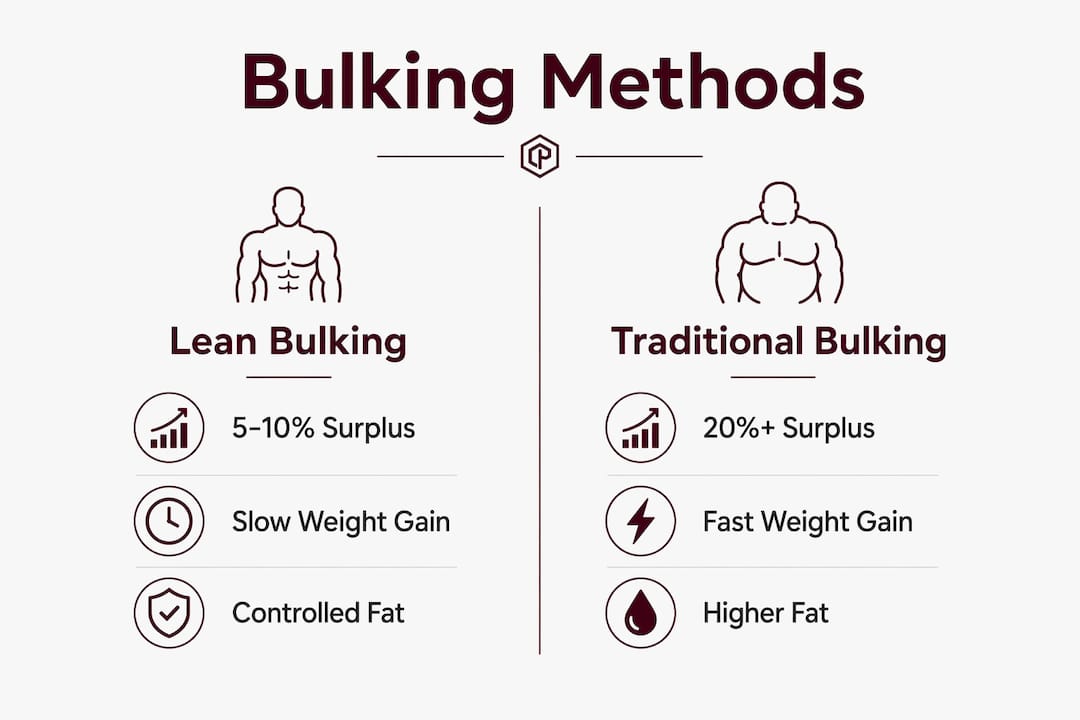
For beginners, an 8–12% surplus is a reasonable starting point. Advanced lifters should keep the surplus tighter, around 3–5%, because their rate of muscle gain is slower and excess calories have nowhere to go but fat stores. Controlling your surplus tightly is the single most practical thing you can do to minimize fat gain during a muscle-building phase.
Pro Tip: Calculate your maintenance calories using the Mifflin-St Jeor equation, then add 200–300 calories per day as your starting surplus. Adjust every two weeks based on your weekly average weight trend.
Can you build muscle and lose fat at the same time?
Body recomposition, the process of simultaneously gaining muscle and losing fat, is real but not universal. Research shows that young overweight men gained approximately 1.2 kg of lean mass while losing 4.8 kg of fat in just four weeks under a 40% calorie deficit combined with high protein intake and intense resistance training. That result is striking. It also comes with important context.
Body recomposition works best under specific conditions:
- Beginners: New lifters respond strongly to resistance training stimulus even in a calorie deficit
- Individuals with excess body fat: Higher fat stores provide energy to fuel muscle synthesis
- High protein intake: Approximately 2.4 g per kg of body weight protects lean mass during a deficit
- Intense training: Resistance training combined with interval cardio maximizes the recomposition signal
- Consistent sleep and recovery: Without adequate recovery, the muscle-building signal weakens regardless of training and diet
Advanced and already-lean athletes face a harder road. Their bodies have less fat to mobilize as energy, and their muscle-building rate is already slower. For this group, a dedicated lean bulk phase followed by a controlled cut is typically more effective than trying to recompose. For a deeper breakdown of the evidence, the body recomposition guide at Cp-1 covers the research in detail.
High protein intake is the non-negotiable variable in recomposition. Without it, a calorie deficit eats into muscle tissue, not just fat.
What training, nutrition, and recovery strategies maximize gains?
Building lean muscle efficiently comes down to executing the basics at a high level, consistently. There is no shortcut, but there is a clear order of operations.
Training for lean muscle
- Set your weekly volume first. Hit 10 sets per muscle group per week before worrying about exercise selection or rep ranges.
- Train each muscle group twice weekly. Monday/Thursday or Tuesday/Friday splits work well for most people.
- Use compound movements as your base. Squats, deadlifts, bench press, rows, and overhead press build the most muscle per unit of effort. The dip exercise is a strong addition for chest and tricep development.
- Add isolation work as a supplement. Curls, lateral raises, and leg extensions fill in gaps after your compound sets.
- Progress the load over time. Add weight or reps when your current load feels manageable for all sets.
Lean muscle nutrition targets
Protein is the priority. Aim for 1.6–2.2 g per kg of body weight daily as a baseline for muscle growth. During a recomposition phase, push that closer to 2.4 g/kg. For a detailed breakdown of how much protein your body can actually use per meal, the protein absorption guide at Cp-1 is worth reading.
Carbohydrates are not the enemy. They fuel your training sessions, and pre-workout nutrition directly affects workout intensity. Low-carb approaches often lead to underfueled sessions, which limits the hypertrophy stimulus. For practical guidance on eating to support muscle growth, the natural muscle growth nutrition guide is a solid external resource.

Recovery and supplements
Sleep is where muscle repair happens. Seven to nine hours per night is not optional if you are serious about building lean muscle. Chronic sleep deprivation raises cortisol, suppresses testosterone, and directly impairs muscle protein synthesis.
On supplements: creatine offers modest, real benefits and is the most evidence-backed option available. It improves strength output and training volume over time. Everything else in the supplement aisle requires much more skepticism. For guidance on using it correctly, the creatine usage guide at Cp-1 covers dosing and timing clearly.
Pro Tip: Track your progress using three metrics: weekly average scale weight, waist circumference, and your working weight on two or three key lifts. Scale weight alone is deceptive because water fluctuations mask real tissue changes. Stalled strength with rising weight usually means fat gain, not muscle.
Key takeaways
Building lean muscle requires controlled calorie surplus, consistent training volume, adequate protein, and disciplined recovery, not complex programs or aggressive bulking.
| Point | Details |
|---|---|
| Training volume drives hypertrophy | Hit approximately 10 sets per muscle group per week and train each group twice weekly. |
| Lean bulking beats traditional bulking | A 5–10% calorie surplus minimizes fat gain while still providing energy for muscle growth. |
| Recomposition is real but conditional | Beginners and those with excess fat can gain muscle and lose fat simultaneously with high protein and intense training. |
| Protein is non-negotiable | Target 1.6–2.4 g per kg of body weight daily depending on your phase and experience level. |
| Track more than the scale | Monitor waist circumference and strength progression alongside weight to accurately assess lean muscle gains. |
The myth that kills most muscle-building efforts
I have watched a lot of people spin their wheels on lean muscle goals, and the pattern is almost always the same. They chase the perfect program, obsess over supplements, and eat in a massive surplus because they think more food means more muscle. Then they wonder why they are getting softer instead of harder.
Here is what I have found to be true: the biological ceiling on muscle protein synthesis is real and it is not that high. Your body can only build so much muscle tissue per week regardless of how many calories you throw at it. Eating beyond that ceiling does not speed up muscle growth. It just adds fat you will have to cut later.
The ACSM’s 2026 position on this is refreshing because it says what experienced coaches have known for years. Consistency and volume beat complexity every time. You do not need a 12-week periodization model. You need to show up, hit your sets, eat enough protein, and sleep. That is the actual formula.
I am also skeptical of the supplement industry’s promises around muscle gain. Creatine works. A few other things have modest evidence behind them. Most of the rest is marketing. At Cp-1, we focus on cellular energy and recovery support because those are the real bottlenecks for most people training hard. When your mitochondria are running well and your recovery is dialed in, your training quality goes up. That is where the real gains come from.
Track multiple metrics. Be patient. The people who build the best physiques are not the ones who found the perfect program. They are the ones who stayed consistent for years.
— Hugo
Support your training with the right foundation
If you are serious about building lean muscle, the training and nutrition fundamentals in this article are your starting point. But training hard also demands that your body has the cellular energy to perform and recover at a high level.
Cp-1 is built for people who take their health and performance seriously. The formula includes NMN for NAD+ support, lion’s mane and reishi mushroom extracts for cognitive and immune resilience, and CoQ10 for mitochondrial energy production. These are not muscle-building supplements. They are recovery and energy support tools that help you train harder and recover faster. Third-party tested, vegan, non-GMO, and made in the US. Explore the full Cp-1 supplement formula and see how cellular energy support fits into your lean muscle plan.
FAQ
What is lean muscle exactly?
Lean muscle refers to skeletal muscle tissue built with minimal accompanying body fat. It is the result of consistent resistance training, controlled nutrition, and adequate recovery rather than aggressive calorie surpluses.
How many sets per week do you need to build lean muscle?
The 2026 ACSM guidelines recommend approximately 10 sets per muscle group per week, with each major muscle group trained at least twice weekly. Working to muscle fatigue on most sets drives hypertrophy more than any specific exercise or equipment choice.
How much protein do you need to build lean muscle?
Target 1.6–2.2 g of protein per kg of body weight daily for muscle growth. During a body recomposition phase or calorie deficit, increase that to approximately 2.4 g/kg to protect lean mass.
Does creatine help with lean muscle growth?
Creatine offers modest but real benefits for lean muscle development by improving strength output and training volume over time. It works best as a complement to sound training and nutrition, not as a replacement for either.
Can beginners build muscle and lose fat at the same time?
Yes. Beginners and individuals with excess body fat can achieve body recomposition simultaneously gaining muscle and losing fat with high protein intake around 2.4 g/kg and intense resistance training, even in a calorie deficit.