
You’ve hit a wall. Your lifts have stalled, your energy feels flat, and you’ve heard creatine might be the answer but the internet gives you seventeen different opinions on how to start. Loading or no loading? Morning or evening? With food or without? It’s enough to make you skip it entirely. Here’s the truth: creatine is safe for healthy adults with clear, well-established guidelines for starting and using it effectively. This guide cuts through the noise and gives you an honest, step-by-step process to start creatine the right way.
Table of Contents
- What to know before you start: Creatine basics and safety
- What you’ll need: Tools, dosage options, and preparation checklist
- Step-by-step: Starting your creatine routine the right way
- Troubleshooting and optimizing: Common mistakes and best practices
- What to expect: Results, timeline, and ongoing benefits
- Our perspective: Why simple, consistent routines outperform fads with creatine
- Next steps: Elevate your wellness journey
- Frequently asked questions
Key Takeaways
| Point | Details |
|---|---|
| Start with safety | Check for medical restrictions and choose certified creatine before beginning supplementation. |
| Choose your protocol | Both loading and no-loading methods work, so select the approach that fits your needs and preferences. |
| Stay hydrated daily | Drink at least 2.7 liters of water per day for optimal results and to minimize side effects. |
| Build a routine | Taking creatine at the same time each day with food helps maximize absorption and build the habit. |
| Expect steady gains | Most people notice benefits in muscle, energy, and possible mood and brain support within a few weeks. |
What to know before you start: Creatine basics and safety
Creatine is not a mystery compound. It’s a naturally occurring molecule your body already makes, primarily stored in your muscles, where it helps produce rapid energy during high-intensity efforts like lifting, sprinting, or any explosive movement. When you supplement with creatine, you saturate those stores beyond what diet alone can provide. The result is more available energy during your hardest sets, better recovery between sessions, and over time, measurable gains in strength and muscle.
That said, knowing what creatine is matters less than knowing whether it’s right for you specifically. The safety profile is excellent for most people, but there are real exceptions. Consult your doctor before starting if you have kidney disease, take prescription medications that affect the kidneys, or are pregnant. This is not a legal disclaimer. It’s practical advice. Creatine raises creatinine levels in blood tests, which can look alarming to a doctor who doesn’t know you’re supplementing.
Who should avoid or delay creatine:
- People with chronic kidney disease or a history of kidney problems
- Individuals on diuretics or nephrotoxic medications
- Pregnant or breastfeeding women
- Anyone under 18 without explicit guidance from a physician
- People with rare metabolic disorders affecting creatine synthesis
Beyond eligibility, quality is the next filter. The supplement industry is flooded with products that cut corners on purity and testing. Look for creatine monohydrate that carries third-party certifications from NSF International or USP. These organizations independently verify that what’s on the label is actually in the product and that no dangerous contaminants are present. It sounds basic, but most people skip this step entirely. When it comes to choosing high-quality supplements, manufacturing standards and third-party verification are not optional extras. They’re the baseline.
“The most important thing you can do before starting any supplement is confirm it’s appropriate for your health situation and that the product you’re buying is actually what it claims to be.”
Common misconceptions worth clearing up: creatine is not a steroid, it does not damage the kidneys in healthy users, and it does not cause hair loss in any way that current evidence supports as a real concern for most people. Those myths persist because people confuse creatine with anabolic steroids, which are an entirely different class of compounds with entirely different mechanisms and risks.
What you’ll need: Tools, dosage options, and preparation checklist
Once you’ve established that creatine is appropriate for you, the next step is practical setup. Creatine monohydrate is the only form you need. It’s the most studied, the most affordable, and the most effective. Creatine ethyl ester, buffered creatine, and other newer forms have not consistently outperformed standard monohydrate in controlled trials. Don’t let marketing language talk you into paying more for less reliable results.
Your preparation checklist:
- Creatine monohydrate powder (micronized dissolves better)
- A digital food scale or a reliable measuring scoop (5g per serving)
- A large water bottle (at least 1 liter capacity)
- A habit tracker or phone reminder for daily dosing
- Optional: a protein shake or carbohydrate-containing meal to pair with your dose
The most important dosing decision you’ll make upfront is whether to use a loading protocol or start with a maintenance dose. Both approaches are valid and backed by research. The standard loading protocol is 20 grams per day split into four 5-gram doses for five to seven days, followed by 3 to 5 grams per day for maintenance. The no-loading approach is simply 3 to 5 grams daily from day one.
| Protocol | Daily dose | Duration to full effect | GI risk | Best for |
|---|---|---|---|---|
| Loading | 20g (4 x 5g) | 5 to 7 days | Slightly higher | People wanting fast results |
| No loading | 3 to 5g | 3 to 4 weeks | Very low | Most beginners, sensitive stomachs |
Both methods end up at the same place. Loading just gets you there faster. If your stomach is sensitive or you’ve had GI issues with supplements before, skip loading and go straight to a daily maintenance dose. The difference in outcome over a few months is negligible.
Hydration is non-negotiable with creatine. Your muscles draw in more water as creatine stores fill up. Aim for at least 2.7 liters of water per day, and more on training days. This isn’t arbitrary. It’s how creatine works at the cellular level. Cutting corners on water intake will blunt your results and increase the likelihood of cramping or discomfort.

Pro Tip: If you’re exploring other safe supplement options alongside creatine, confirm that they don’t already contain creatine to avoid accidentally exceeding your target dose.
Step-by-step: Starting your creatine routine the right way
With everything ready, here is the exact process for starting safely and building a consistent routine.
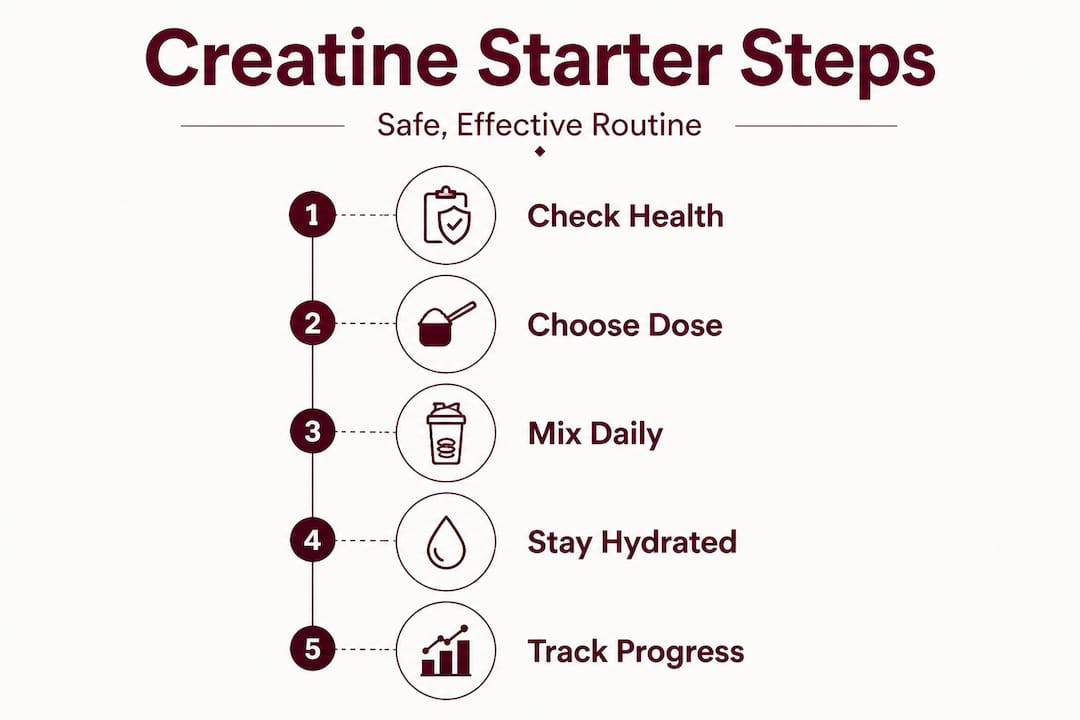
- Choose your protocol. Decide between loading and no-loading based on your tolerance and goals. When in doubt, no-loading is the smarter starting point.
- Measure your dose accurately. Use a digital scale or a verified 5g scoop. Eyeballing powder leads to inconsistent dosing.
- Mix it into water, juice, or a protein shake. Micronized creatine monohydrate dissolves well in liquid. If you’re loading, spread your doses evenly across the day.
- Take your dose with a meal or with carbs and protein. Pairing creatine with food or macronutrients improves uptake. Timing within the day is flexible. Consistency is what matters.
- Drink your full daily water quota. Stay well-hydrated at minimum 2.7 liters per day and monitor your urine color. Pale yellow is your target.
- Log your dose and repeat daily. Miss a day? Just take your regular dose the next day. Don’t double up.
- Track your training performance starting from week two. Log your sets, reps, and perceived effort so you have real data on how creatine is working for you.
| Phase | Loading protocol | No-loading protocol |
|---|---|---|
| Days 1 to 7 | 20g/day (4 doses of 5g) | 3 to 5g once daily |
| Days 8 onward | 3 to 5g/day maintenance | 3 to 5g once daily (same) |
| Full saturation | Day 7 to 8 | Week 3 to 4 |
| Expected feel | Faster strength/fullness | Gradual, steady improvement |
Building this as a daily habit is genuinely where most people fail. They start with motivation, get inconsistent in week two, and then wonder why creatine “didn’t work.” Pick one specific time of day, ideally with a meal you never skip, and pair the dose with that meal every single time. Attach it to an existing habit. That’s how you get results. Supporting wellness and performance with supplements always comes down to this: consistency over perfection.
Pro Tip: Set a recurring phone reminder labeled “creatine with lunch” or whatever meal you choose. The reminder isn’t for motivation. It’s to remove the decision entirely.
Troubleshooting and optimizing: Common mistakes and best practices
Even a solid plan hits some bumps early on. The most common thing people notice when starting creatine is a temporary increase in body weight. This is water. Not fat. Not inflammation. Creatine pulls water into your muscle cells, and that adds 1 to 5 pounds initially on the scale for most people. It levels off after the first week or two, and it actually contributes to the fuller, harder muscle appearance that many people are after.
“The weight you see in week one isn’t fat gain. It’s intramuscular water, which supports muscle function and is a sign that creatine is working.”
GI upset is less common than most people expect, but it does happen. It’s almost always linked to taking large single doses on an empty stomach. Splitting doses, avoiding loading, and always taking creatine with food eliminates this for the vast majority of users.
Common mistakes and how to fix them:
- Taking a full 20g dose at once: split it across four equal doses throughout the day
- Skipping water: if you’re cramping or feeling sluggish, hydration is almost always the culprit
- Expecting results in 48 hours: give yourself at least two weeks before evaluating
- Stopping creatine because the scale went up: that weight is water and muscle volume, not fat
- Stacking too many new supplements at once: introduce creatine alone first so you can track its actual effect
When to pause and seek advice: if you experience unusual fatigue, significant changes in urination, or any other symptoms you can’t explain, stop supplementing and talk to your doctor. These reactions are rare in healthy users, but they matter and you should take them seriously. Exploring brain and mood support supplements alongside creatine is something many users do, but always approach stacking methodically rather than throwing everything in at once.
What to expect: Results, timeline, and ongoing benefits
Real expectations save people from quitting too early or expecting miracles. Here is what the evidence actually says.
Loading protocol timeline:
- Days 1 to 3: muscles begin retaining more water, slight fullness
- Days 4 to 7: noticeable improvements in training volume and power output
- Week 2 onward: measurable strength gains begin compounding
No-loading protocol timeline:
- Weeks 1 to 2: subtle increase in workout capacity, possibly hard to notice
- Weeks 3 to 4: creatine stores fully saturated, performance gains more apparent
- Month 2 and beyond: strength and muscle gains become clearly measurable
One of the most underappreciated facts about creatine is how broadly it benefits different populations. Women and older adults see similar muscle and strength benefits to men, and research is increasingly pointing toward meaningful cognitive and mood benefits as well. Creatine supports brain energy metabolism, and some studies suggest it may help with mental fatigue, memory, and mood stability, especially in people who don’t eat much red meat.
Who benefits most from creatine:
- Strength athletes and bodybuilders
- Endurance athletes doing interval or high-intensity work
- Women focused on lean muscle and bone density
- Adults over 50 looking to preserve strength and function
- Anyone experiencing mental fatigue or looking to support supplement routine for overall wellness
Creatine is not a short-term fix. The gains compound over months, and many users report that year two looks noticeably different from year one purely because they stayed consistent.
Our perspective: Why simple, consistent routines outperform fads with creatine
I’ve watched a lot of people approach creatine the wrong way, and I’ve done it myself. The temptation is to layer it into a complicated stack, buy the most expensive form, and run an elaborate timing protocol that requires a spreadsheet to track. I’ve been there. And almost none of it made a meaningful difference compared to what I got from simply taking 5 grams of plain creatine monohydrate every single day.
The honest frustration I have with the fitness supplement space is the same one that drove us to build a different kind of company. Too many products are formulated for a marketing deck, not for the person swallowing them. Creatine is one of the few compounds where the science is genuinely clear, the price is low, and the barrier to starting is minimal. Yet the industry manages to overcomplicate it into something intimidating.
What I’ve seen work, consistently, is this: people who stop overthinking and just stick to the basics outperform people who spend hours optimizing timing, stacking, and cycling. Creatine doesn’t reward complexity. It rewards showing up daily. That’s a lesson that applies far beyond this one supplement.
The other piece that most people miss entirely is the cognitive angle. Yes, creatine helps you lift more. But it also supports brain energy. I’ve noticed real differences in mental clarity and fatigue resistance on days when I don’t skip my dose. That’s not placebo. That’s creatine doing what it does at the cellular level, keeping energy production running efficiently. Understanding simplicity in supplement routines is what separates people who make lasting progress from those who cycle through products every few months looking for the next thing.
Go slow. Stay steady. Build the fundamentals. Everything else follows from there.
Next steps: Elevate your wellness journey
Starting creatine is a strong foundation, but it’s just the beginning of building a well-rounded, performance-focused supplement routine.
At CP-1, we believe every supplement in your stack should earn its place through real science and transparent manufacturing. If you want to keep building on the momentum you’ve started here, dig into how antioxidant benefits can support your recovery, energy production, and long-term wellness alongside creatine. Our product CP-1 is built around clinically relevant ingredients like NMN, CoQ10, and mushroom extracts that support cellular energy and cognitive clarity. Third-party tested, vegan, non-GMO, and made in the US. No fluff, just ingredients that work. Visit cp-1.com to learn more and take the next step in your wellness routine.
Frequently asked questions
Is creatine safe for daily long-term use?
Yes. No evidence shows kidney or liver damage in healthy adults using recommended doses daily over extended periods.
Do I need to cycle on and off creatine?
No cycling is required. Research confirms no need to cycle creatine for either effectiveness or safety in healthy adults.
How soon will I feel the benefits after starting creatine?
With loading, you’ll typically notice effects within one week. Without loading, full saturation takes three to four weeks for most people.
Can women and older adults benefit from creatine?
Absolutely. Both groups experience similar muscle and strength benefits, plus emerging evidence supports cognitive and mood advantages.
What should I do if I experience bloating or stomach discomfort?
Try splitting your dose into smaller portions across the day and skip the loading phase entirely, as splitting doses reduces GI side effects for most users.