

Natural Muscle Growth: Your 2026 Science-Based Guide
Natural muscle is defined as muscle size and strength built entirely without performance-enhancing drugs, relying instead on training stimulus, nutrition, and recovery. This approach, known in exercise science as drug-free hypertrophy, produces results that are slower than enhanced methods but fully sustainable and health-preserving. According to Harvard Health, men lose 3%–5% of muscle mass per decade after age 30, which makes building and maintaining natural muscle one of the most important long-term health investments you can make. This guide covers realistic timelines, training protocols, nutrition targets, and supplement guidance grounded in current research.
How much natural muscle can you actually gain?
The honest answer is less than most fitness marketing suggests, and that is not a bad thing. RitFitSports reports that a dedicated man can realistically gain 10–20 pounds of muscle in the first year of training. That is a meaningful transformation. The problem starts when people expect year-one results to continue indefinitely.
After year one, gains drop by roughly half annually. By year five, most natural lifters are adding only 1–2 pounds of muscle per year. That number sounds discouraging until you understand what it means: by year five, most natural lifters have already realized approximately 90% of their achievable muscle mass. You are not failing. You are approaching your genetic ceiling.
“The body does not care about your timeline. It responds to consistent, progressive stimulus. Period.”
This concept is called “newbie gains,” and it refers to the accelerated muscle growth beginners experience because their neuromuscular system and muscle fibers are responding to training for the first time. Once that adaptation plateaus, growth requires more precision and patience, not more volume or more supplements.
Pro Tip: Track your lifts in a notebook or app like Strong or Hevy. If your numbers are not going up over a 4–6 week period, your program or recovery needs adjustment, not your supplement stack.
How should natural lifters structure training for growth?
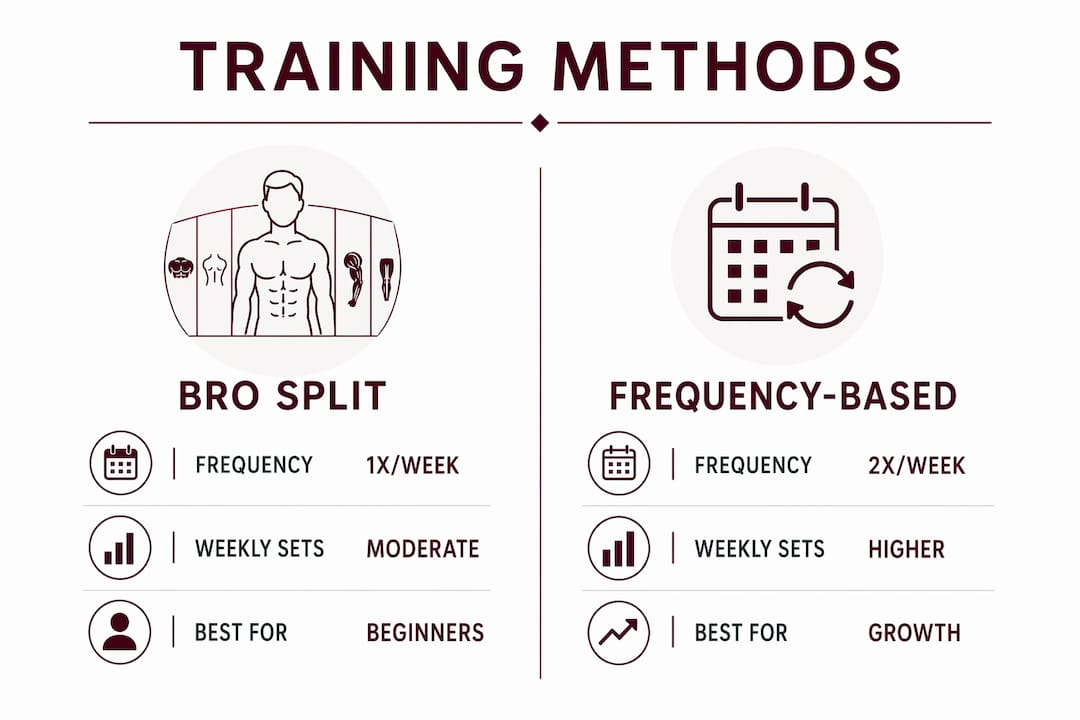
Training volume and frequency are the two variables natural lifters most often get wrong. PoinT GO Research identifies the optimal weekly range as 10–20 hard sets per muscle group per week, divided across at least two sessions. Training each muscle twice weekly produces approximately 6.8% more hypertrophy than training it once. That difference compounds significantly over months and years.

The classic “bro split,” where you train chest on Monday and do not touch it again until the following Monday, is less effective for natural lifters. Enhanced athletes can get away with once-weekly frequency because their protein synthesis window stays elevated for 72–96 hours. Natural lifters have a protein synthesis window of 36–48 hours. That means if you only train a muscle once a week, you are leaving several days of potential growth stimulus on the table.
Bro split vs. frequency-based training
| Training Style | Frequency per Muscle | Weekly Sets | Best For |
|---|---|---|---|
| Bro Split | 1x per week | 12–16 | Enhanced lifters |
| Upper/Lower Split | 2x per week | 10–20 | Natural lifters |
| Push/Pull/Legs (2x) | 2x per week | 10–18 | Intermediate naturals |
| Full Body | 3x per week | 9–15 | Beginners and naturals |
Start at the lower end of volume. PoinT GO Research recommends beginning at a Minimum Effective Volume of around 8–10 sets per muscle per week and adding sets only when progress stalls and recovery remains solid. Going straight to 20 sets is a common mistake that creates fatigue without proportional growth.
Pro Tip: Progressive overload is the single most important driver of muscle growth. Add weight, reps, or sets over time. If none of those are moving, nothing else matters.
Autoregulation is another tool worth using. Velocity-based training or simple subjective readiness scales let you match your training intensity to how recovered you actually are on a given day. PoinT GO Research highlights autoregulation as especially valuable for natural lifters who cannot rely on drug-enhanced recovery to push through poor readiness days.
What does nutrition look like for natural muscle gain?
Nutrition is where most natural lifters either leave gains on the table or sabotage their progress entirely. The protein target is clear: 1.6 to 2.2 grams per kilogram of bodyweight daily, spread across 3–5 meals. For a 180-pound (82 kg) man, that translates to roughly 130–180 grams of protein per day.
Distributing protein across multiple meals matters because muscle protein synthesis responds to each feeding independently. Eating 150 grams of protein in two meals is less effective than spreading the same amount across four meals. Each meal becomes a separate anabolic signal.
High-quality natural muscle-building foods
- Chicken breast: 31 grams of protein per 100 grams, low fat, highly versatile
- Eggs: Complete amino acid profile, with roughly 6 grams of protein per egg
- Greek yogurt: 10 grams of protein per 100 grams, plus gut-supporting probiotics
- Salmon: Rich in protein and omega-3 fatty acids that reduce exercise-induced inflammation
- Lentils: 9 grams of protein per 100 grams, plus fiber and slow-digesting carbohydrates
- Cottage cheese: High in casein protein, making it ideal before sleep for overnight recovery
- Quinoa: A complete plant protein with all essential amino acids
Beyond protein, a modest calorie surplus of 200–300 calories above your daily maintenance level provides the energy needed for muscle synthesis without excessive fat gain. Eating at maintenance or below will limit your ability to build muscle, regardless of how well you train.
Pre-workout fueling has a bigger impact on performance and muscle growth than post-workout protein timing. Getting a solid meal with carbohydrates and protein 60–90 minutes before training consistently outperforms obsessing over your post-workout shake window.
Pro Tip: Total daily calories and protein are the variables that move the needle. If you hit your protein target and calorie surplus consistently, meal timing becomes a minor detail, not a priority.
Which supplements actually work for natural lifters?
The supplement industry sells a lot of hope. Most of it is not backed by meaningful evidence. Men’s Health confirms that creatine monohydrate is the gold standard: it consistently produces small but reliable improvements in strength and muscle gain. Every other supplement category requires much more skepticism.
Here is a realistic breakdown of common natural muscle supplements:
- Creatine monohydrate: The most researched and effective supplement for natural lifters. Increases phosphocreatine stores, improving high-intensity performance and recovery between sets.
- Whey or plant-based protein powder: Useful for hitting daily protein targets when whole food intake falls short. Not a muscle-builder on its own.
- Caffeine: Improves workout performance and focus. Not a muscle-building supplement, but a performance aid. If you want stimulant-free options, check out non-caffeine pre-workout alternatives.
- Beta-alanine: May reduce muscular fatigue during high-rep training. Evidence is moderate.
- BCAAs: Largely redundant if you are already hitting your daily protein target from whole foods or protein powder.
The honest truth is that supplements are support tools, not shortcuts. The biggest levers remain training stimulus, caloric balance, and recovery quality. If you want a deeper breakdown of what is worth your money, the Cp-1 guide on sports nutrition supplements cuts through the noise with evidence-based analysis. For gut health considerations when choosing supplements, this guide from DietingWell is worth reading alongside your supplement research.
Why recovery is the natural lifter’s biggest advantage or weakness
Recovery is where natural muscle growth either happens or stalls. Two lifters can follow the exact same program and produce dramatically different results based on sleep quality, stress levels, and active recovery habits. PoinT GO Research confirms that identical training routines can yield twice the progress depending on recovery quality. That is not a small variable.
Natural lifters do not have the drug-enhanced recovery that allows some athletes to train six days a week at high intensity and bounce back. Your recovery window is real and finite. Ignoring it does not make you tougher. It makes you slower.
Signs you are under-recovering include persistent soreness lasting more than 72 hours, declining performance across multiple sessions, disrupted sleep, and low motivation to train. These are not signs of weakness. They are data points telling you to adjust.
Practical recovery strategies that actually work:
- Sleep 7–9 hours per night. Growth hormone release peaks during deep sleep. Cutting sleep short cuts your gains short.
- Schedule deload weeks every 6–8 weeks. Reducing volume by half for 7–8 days allows accumulated fatigue to clear and lets you return stronger.
- Manage chronic stress. Elevated cortisol suppresses testosterone and impairs muscle protein synthesis. Stress is not just a mental problem. It is a physiological one.
- Use active recovery. Light walking, swimming, or mobility work on rest days increases blood flow without adding training stress.
Pro Tip: If you are not sleeping well, no training program or supplement stack will compensate. Fix sleep first. Everything else is secondary.
Key takeaways
Building natural muscle requires consistent application of training, nutrition, and recovery principles over years, not weeks.
| Point | Details |
|---|---|
| Realistic gain timeline | Expect 10–20 pounds in year one, dropping to 1–2 pounds annually by year five. |
| Train each muscle twice weekly | Higher frequency produces 6.8% more hypertrophy than once-weekly training for natural lifters. |
| Hit your protein target | Consume 1.6–2.2 g/kg of bodyweight daily, spread across 3–5 meals. |
| Creatine is the only must-have supplement | All other supplements offer modest or unproven benefits for natural muscle gain. |
| Recovery drives growth | Sleep, stress management, and deload weeks determine how much of your training effort converts to actual muscle. |
What i have learned after years of watching natural lifters succeed and fail
I have seen a lot of people spin their wheels chasing complexity when the basics were never actually in place. The most common pattern is someone who trains hard but sleeps six hours, eats inconsistently, and rotates through a new program every six weeks. They wonder why they are not growing. The answer is never the program.
The natural lifters I have seen make the best progress share one trait: they are boring. They do the same compound movements, hit their protein, sleep eight hours, and add weight to the bar every few weeks. That is it. No exotic protocols, no stacks of supplements, no biohacking gadgets.
I also think the supplement industry has done real damage to how people think about natural muscle gain. When someone spends $200 a month on pre-workouts, amino acids, and fat burners, they feel like they are doing something. They are not. Creatine and a solid protein source cover 95% of what supplements can realistically do for a natural lifter. The rest is marketing.
The other thing I want to say directly: if you are over 30, the age-related muscle loss research should motivate you, not discourage you. Resistance training with adequate protein intake can reverse or significantly slow that decline. You are not fighting a losing battle. You are fighting a winnable one, as long as you show up consistently.
— Hugo
How Cp-1 supports your natural muscle goals
At Cp-1, we are not in the business of selling you things you do not need. We built our products around ingredients with real research behind them, including NMN, lion’s mane mushroom extract, and coenzyme Q10, because cellular energy and recovery are foundational to every training goal. If your mitochondria are running on empty, your workouts suffer and your recovery stalls. That is not a theory. It is biology. If you want to understand which supplements are genuinely worth your time and money as a natural lifter, start with our breakdown of what actually works safely. And if you are working on body composition alongside muscle gain, our body recomposition guide gives you a practical framework grounded in the same science this article covers.
FAQ
How fast can a natural lifter build muscle?
A dedicated natural lifter can gain 10–20 pounds of muscle in the first year of training, with gains slowing to roughly 1–2 pounds per year by year five as they approach their genetic ceiling.
How much protein do natural lifters need per day?
The research-backed target is 1.6–2.2 grams of protein per kilogram of bodyweight daily, ideally distributed across 3–5 meals to maximize muscle protein synthesis throughout the day.
Is creatine safe for natural muscle building?
Creatine monohydrate is the most researched supplement in sports nutrition and is considered safe for healthy adults. It consistently produces small but reliable improvements in strength and muscle gain for natural lifters.
How often should natural lifters train each muscle group?
Training each muscle group at least twice per week produces approximately 6.8% more hypertrophy than once-weekly training. Upper/lower splits and push/pull/legs programs done twice weekly are the most practical formats.
Do natural lifters need deload weeks?
Yes. Reducing training volume by half for 7–8 days every 6–8 weeks allows accumulated fatigue to clear and lets natural lifters return to training stronger, reducing overtraining risk.