

5 x 5 x 5 Explained: Math, Puzzles, and Your Mind
What does 5 x 5 x 5 actually mean?
The expression 5 x 5 x 5 has one clean mathematical answer: 125. Multiply five by itself three times and you get 125 cubic units, written in power notation as 5³. That single calculation shows up in geometry classrooms, shipping warehouses, and the hands of anyone who has ever picked up a Rubik’s cube.
Three contexts matter most:
- Volume calculation: A cube with sides of 5 units has a volume of 125 cubic units using the formula V = s³.
- Puzzle dimensions: The 5x5x5 Rubik’s cube, officially called the Professor’s Cube, is one of the most complex mechanical puzzles ever mass-produced.
- Mathematical notation: 5 x 5 x 5 is equivalent to 5³, a foundational example of exponentiation.
Understanding which context you are working in changes everything about how you use the number.
Table of Contents
- How the 5x5x5 Rubik’s Cube actually gets solved
- Common mistakes people make with 5x5x5 volume calculations
- Advanced mathematical insights about the 5x5x5 structure
- How puzzle-solving logic connects to cognitive wellness
- The correct way to calculate 5 x 5 x 5
- Where 5 x 5 x 5 shows up in the real world
- Where the 5x5x5 cube came from
- How the 5x5x5 compares to other cube sizes
- Key Takeaways
How the 5x5x5 Rubik’s Cube actually gets solved
The Professor’s Cube is not just a bigger 3x3x3. Its structure includes 8 corner pieces, 36 edge pieces, and 48 center pieces, and unlike the 4x4x4, its center pieces are fixed reference points. That distinction matters because solvers can always orient the cube correctly from the start.
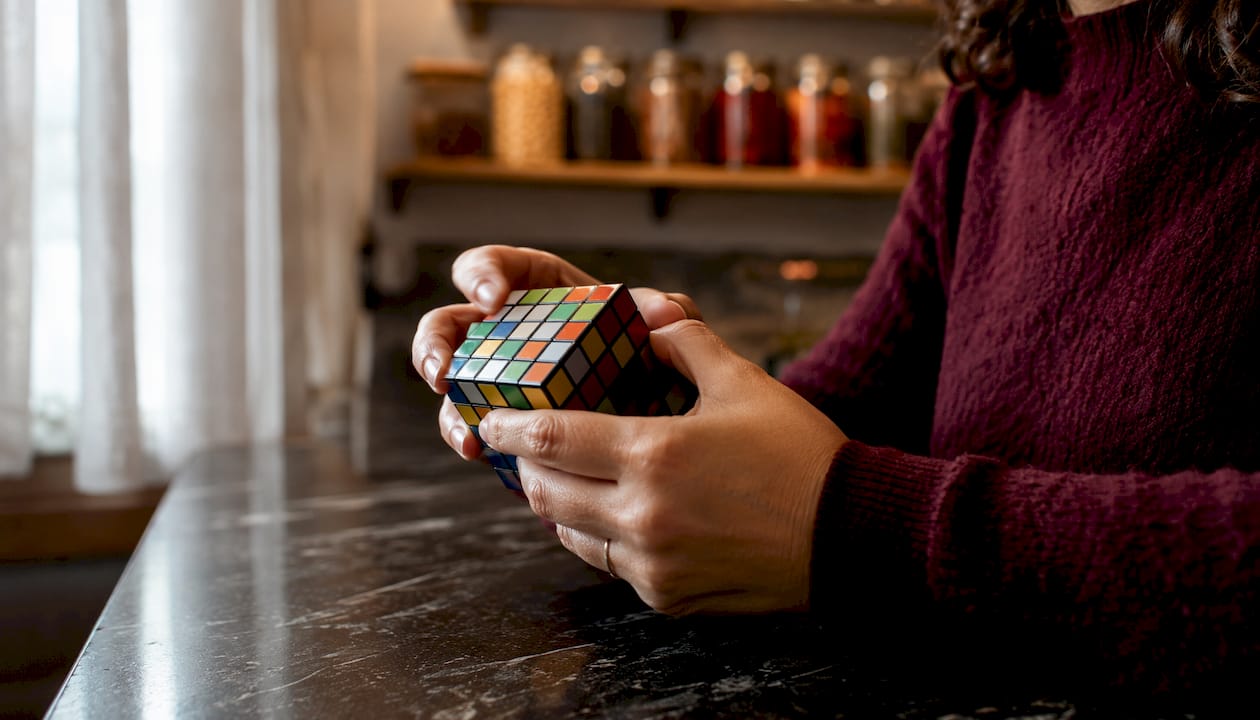
The possible permutations reach a number so large it dwarfs the estimated atoms in the observable universe. No one memorizes a path through all of them. Instead, solvers use a heuristic approach that breaks the problem into manageable stages.
The core solving phases look like this:
- Phase 1 (Centers): Solve all six center faces first, treating the puzzle like a 3x3x3 for orientation.
- Phase 2 (Edges): Pair up edge pieces by matching colors, joining them into complete triple sets.
- Phase 3 (Final solve): Apply standard 3x3x3 algorithms using face moves only.
This heuristic method averages around 79 moves to reach a solution. Breaking a massive problem into ordered subsets is exactly the kind of structured thinking that transfers well beyond puzzles.
Common mistakes people make with 5x5x5 volume calculations
The formula V = s³ is simple. The mistakes people make with it are not always obvious.
The most frequent error is mixing units before calculating. If one dimension is measured in inches and another in centimeters, the resulting number is mathematically meaningless. You have to convert everything to the same unit first, every time, without exception.
A second common mistake is applying the cube formula to shapes that are not cubes. V = s³ only works when all three dimensions are equal. A box measuring 5 × 5 × 7 is a cuboid, and its volume requires V = L × W × H, not s³.
Common misconceptions worth correcting:
- Assuming any rectangular box can use s³ (it cannot unless all sides match).
- Forgetting that cubic units (cm³, ft³, m³) are the correct output, not square units.
- Treating 5 x 5 x 5 as addition (5 + 5 + 5 = 15) rather than multiplication.
- Ignoring unit conversion when working across measurement systems.
Pro Tip: Before you cube any measurement, write the unit next to every number. If the units do not all match, stop and convert. One mismatched unit ruins the entire calculation.
Advanced mathematical insights about the 5x5x5 structure
The group theory underlying the 5x5x5 puzzle is significantly more complex than for the 3x3x3, and much of it remains less formally documented. The puzzle’s Full Group and Visual Group behave differently depending on whether you treat center pieces as distinguishable, which changes the permutation count from 2.8 × 10⁷⁴ to approximately 2.58 × 10⁹⁰.
Statistic callout: The 5x5x5 cube has an extremely large number of possible positions that increases significantly depending on how center pieces are treated.
Geometry adds another layer. Adding a physical layer of 1×1×1 unit cubes to each face of a 5x5x5 structure increases each dimension by 2, producing a 7x7x7 cube with a volume of 343 cubic units. That jump from 125 to 343 illustrates how sensitive volume is to even small dimensional changes.
Advanced insights for practitioners:
- Permutation counts shift dramatically based on whether identical pieces are treated as distinguishable.
- Volume scales with the cube of the side length, so a 20% increase in side length produces roughly a 73% increase in volume.
- Spatial layering problems require tracking both the original structure and the added shell separately.
How puzzle-solving logic connects to cognitive wellness
Solving a 5x5x5 cube trains something real: the ability to hold a complex system in your head, break it into parts, and work through each part without losing sight of the whole. That kind of heuristic problem-solving builds mental agility and sustained focus, two things that matter enormously if you care about long-term brain health.
The parallel to cognitive wellness is direct. Structured mental challenges, whether puzzles or learning new skills, support the same neural pathways that supplements like those in Cp-1’s formula target. Ingredients such as lion’s mane mushroom extract are studied for their role in nerve growth factor support, while NMN feeds the NAD+ pathways that keep cellular energy production running. The intersection of AI tools and health optimization shows how structured, systems-based thinking is reshaping wellness strategies across the board.
Cognitive strategies worth building into your routine:
- Tackle one complex puzzle or mental challenge daily to reinforce working memory.
- Use the “solve centers first” principle in real life: anchor your priorities before addressing details.
- Pair mental training with cellular support; focus without energy is a short game.
Pro Tip: Think of your supplement routine the way a cube solver thinks about phases. Nail the foundation first (sleep, hydration, nutrition), then layer in targeted support like Cp-1 for sustained cognitive energy.
The correct way to calculate 5 x 5 x 5
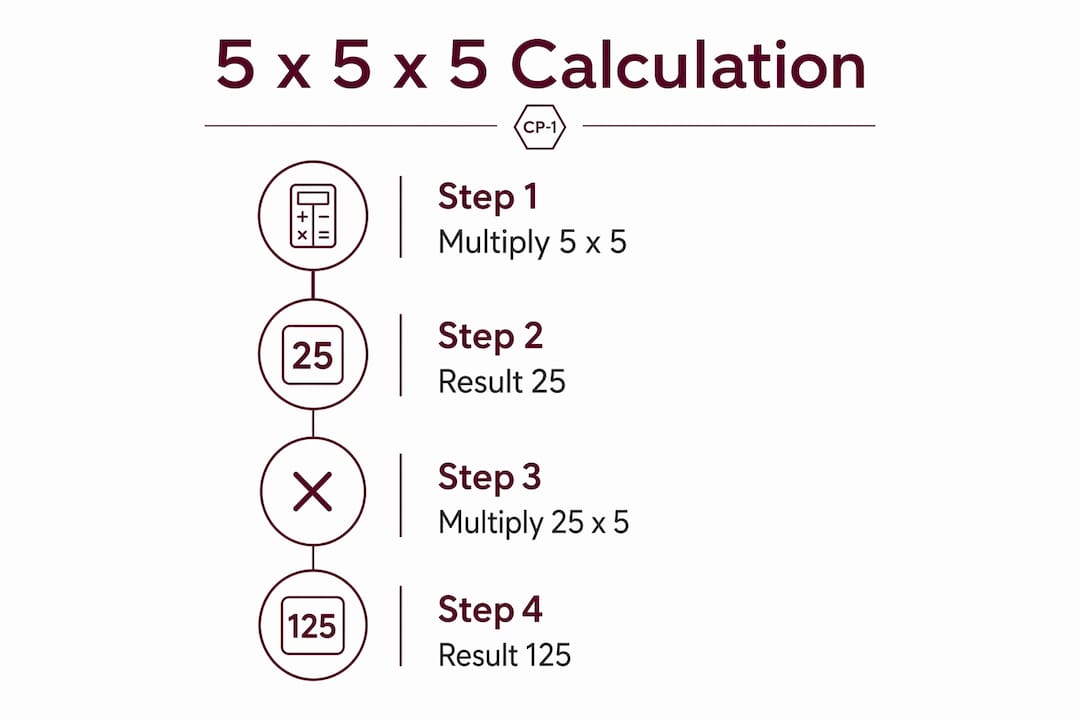
Five cubic units means multiplying 5 × 5 × 5 in sequence. First, 5 × 5 = 25. Then 25 × 5 = 125. The result is always 125, expressed as 5³ in exponential form. The unit attached to that 125 depends entirely on your input: five centimeters per side gives 125 cm³, five feet gives 125 ft³, five meters gives 125 m³. The math does not change. The unit does.
Where 5 x 5 x 5 shows up in the real world
A cube with 5-foot sides holds 125 cubic feet of space, roughly the volume of a large storage unit section or a compact shipping crate. In biology, the 5 cm × 5 cm × 5 cm cube is a standard teaching model for surface area to volume ratio, a concept central to cell biology and drug absorption research. Construction teams use cubic measurements to estimate concrete pours, and logistics professionals use them to calculate cargo space. The 5x5x5 volume equation is not abstract. It is the math behind everyday decisions.
Where the 5x5x5 cube came from
The first mass-produced 5×5×5 cube mechanism was patented by Udo Krell on July 15, 1986, under US patent 4,600,199. Before that, the 3×3×3 Rubik’s Cube had already become a global phenomenon after its 1980 international release, and puzzle designers were racing to push the concept further. The 5×5×5 represented the outer edge of what mechanical manufacturing could reliably produce at the time. In mathematics, the expression 5 x 5 x 5 as a volume descriptor predates the puzzle by centuries, rooted in Euclidean geometry’s treatment of cubic solids.
How the 5x5x5 compares to other cube sizes
| Cube Size | Volume (cubic units) | Puzzle Permutations | Complexity Level |
|---|---|---|---|
| 3×3×3 | 125 | — | Beginner to intermediate |
| 4×4×4 | — | — | Intermediate |
| 5×5×5 | 125 | ~2.8 × 10⁷⁴ | Advanced |
| 7×7×7 | 343 | Far greater | Expert |
The volume difference between a 3×3×3 and a 5×5×5 is 98 cubic units, but the puzzle complexity gap is incomparably larger. Each step up in cube size multiplies permutations by factors that dwarf the volumetric increase. For practical measurement, a 5×5×5 cube holds nearly five times the volume of a 3×3×3 cube of the same unit. For puzzle solving, the jump is orders of magnitude harder.
Key Takeaways
5 x 5 x 5 equals 125 cubic units using the formula V = s³, and this same dimensional structure defines both real-world volume calculations and the complexity of the Professor’s Cube puzzle.
| Point | Details |
|---|---|
| Core calculation | 5 × 5 × 5 = 125; written as 5³, the result is always 125 cubic units. |
| Puzzle permutations | The 5x5x5 Professor’s Cube has approximately 2.8 × 10⁷⁴ possible positions. |
| Unit consistency | All dimensions must share the same unit before applying V = s³ or results are invalid. |
| Solving strategy | The heuristic approach solves centers first, then edges, then applies 3x3x3 algorithms. |
| Cognitive connection | Structured puzzle-solving builds the same mental agility that cognitive wellness routines support. |