Short answer: CoQ10 can reduce fatigue and support cellular energy production for certain people, but it will not hit you like caffeine. A recent systematic review through November 2025 confirms that supplementation reliably raises blood CoQ10 levels, though the performance and energy benefits it delivers are modest and depend heavily on who is taking it and for how long.
This is not a stimulant. It is a slow-burn mitochondrial nutrient. If you take it consistently for weeks to months, especially if you fall into a group prone to CoQ10 depletion, you have a real shot at feeling less drained.
- Best evidence: reliably raises blood levels; fatigue reduction is the most consistent benefit
- Weakest evidence: acute, single-dose “energy boost” claims
- Best candidates: adults over 50, statin users, people with diagnosed depletion
- Timeline: expect weeks to months, not hours
Key Takeaways
CoQ10 raises blood levels reliably and reduces fatigue modestly over weeks of consistent use, but it does not work like a stimulant.
| Point | Details |
|---|---|
| Not a quick fix | CoQ10 supports mitochondrial energy production gradually, with effects showing up over weeks, not hours. |
| Fatigue is the strongest signal | Meta-analyses show a statistically significant fatigue reduction, more consistent than exercise performance gains. |
| Best candidates self-select | Adults over 50, statin users, and people with heart or migraine conditions see the most benefit. |
| Absorption matters | Take with a fat-containing meal and consider ubiquinol for higher bioavailability. |
| CP-1 offers a formulated option | CP-1’s NAD+ Advanced Supplement includes CoQ10 alongside NMN and mushroom extracts for broader cellular energy support. |
Table of Contents
- How CoQ10 Supports Cellular Energy Production
- What Does the Clinical Research Actually Show?
- Who Is Most Likely to Notice More Energy From CoQ10?
- Ubiquinone vs Ubiquinol: Which Form and Dose Actually Work?
- Is CoQ10 Safe, and Does It Interact With Medications?
- How Should You Actually Try CoQ10 for Energy?
- Why We Put CoQ10 in CP-1
- Sources
How CoQ10 Supports Cellular Energy Production
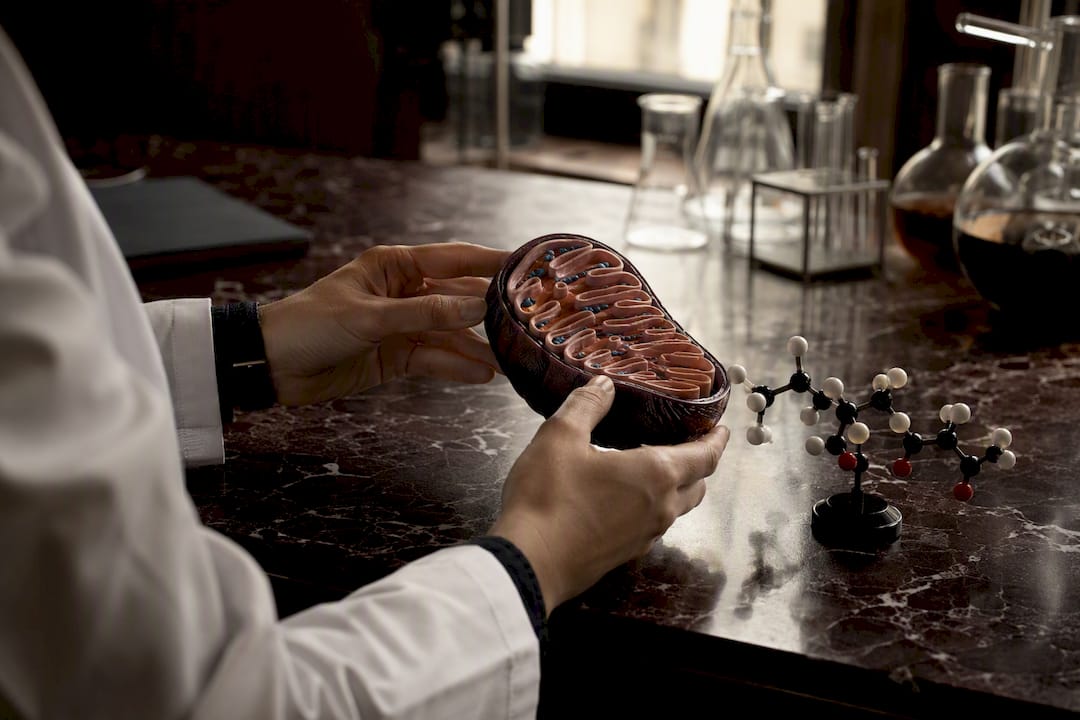
CoQ10 is a mitochondrial electron carrier, and without it, your cells cannot finish making ATP, the molecule that actually powers muscle contraction, brain signaling, and basically everything else your body does. Think of it as a shuttle bus running inside the electron transport chain, the assembly line inside mitochondria that converts food and oxygen into usable energy.
The shuttle picks up electrons at one stop and drops them off at the next, and if the shuttle runs low, the whole line slows down. CoQ10 also cycles between two forms, ubiquinone and ubiquinol, acting as an antioxidant that protects mitochondrial membranes from oxidative damage while it works. The Linus Pauling Institute describes this dual role in mitochondrial ATP synthesis and antioxidant defense as central to why CoQ10 matters at the cellular level.
Concentration is not even across your body. It clusters in the heart, liver, kidney, and pancreas, the tissues with the highest energy demand and the most mitochondria packed per cell.
- Heart and liver: highest CoQ10 concentration, highest energy turnover
- Kidney and pancreas: also dense with mitochondria, also affected by decline
- Skin and less active tissue: lower baseline need, less noticeable effect
Statistic callout: Supplementation is biochemically responsive. The same systematic review found that CoQ10 consistently and reliably raises circulating blood levels across nearly every trial reviewed, even when the downstream performance benefit was small.
What Does the Clinical Research Actually Show?
The evidence says CoQ10 reliably raises circulating levels but produces limited, inconsistent gains in exercise performance. Fatigue reduction, not athletic performance, is the most consistent signal across the research.
That November 2025 review pooled several studies and found chronic, sustained use produced small but real benefits, while single-dose or short-term use showed no advantage at all. A separate 2022 meta-analysis of 13 randomized controlled trials covering a moderate number of participants found a statistically significant fatigue reduction versus placebo, and meta-regression tied higher daily dose and longer treatment duration to bigger improvements.
That is not a small distinction. It means the people who saw the least benefit in these trials were often the ones who took the lowest dose for the shortest stretch.
Fatigue reduction shows up consistently across trials, but exercise performance gains are small, inconsistent, and highly sensitive to dose, duration, and study design.
Both reviews flag real limits. Heterogeneity across formulations, doses, and trial lengths drags down certainty, and the Europe PMC record for the exercise performance review notes moderate-to-high risk of bias with results that shift when outlier studies get excluded.
- Fatigue: the most consistent positive finding across trials
- Exercise performance: small and inconsistent, especially with acute dosing
- Certainty: rated low to very low in the largest recent review
Pro Tip: If a trial used a low dose for two weeks and found nothing, that tells you almost nothing about whether CoQ10 works. Duration and dose matter as much as the ingredient itself.
Who Is Most Likely to Notice More Energy From CoQ10?

People starting from a depleted baseline are the ones who tend to notice a difference. If your CoQ10 levels are already normal, adding more gives your mitochondria little extra to work with.
Four groups stand out. Adults over roughly 50 experience age-related decline in tissue CoQ10. Statin users face a well-documented drop in CoQ10 synthesis, since statins block a pathway CoQ10 shares with cholesterol production. People with certain heart conditions or migraines are also frequently studied populations, and some individuals with chronic fatigue patterns report benefit, though this group has thinner evidence behind it.
- Adults 50 and older: natural decline in tissue concentration
- Statin users: medication-driven depletion, a well-established interaction
- Heart disease or migraine patients: studied populations with documented benefit
- Chronic fatigue presentations: mixed, less robust evidence
Expect weeks to a couple of months before you notice anything, and expect subjective fatigue to shift before raw performance numbers do.
Ubiquinone vs Ubiquinol: Which Form and Dose Actually Work?
Trials use a range of doses and durations, and formulation changes how much of it your body actually absorbs. There is no single ideal dose established across the research, since migraine trials often run higher than general fatigue trials, which is exactly why personalizing your approach with a clinician matters more than chasing one universal number.
Ubiquinone is the oxidized form and the one most commonly sold. Ubiquinol is the reduced, active form, and it tends to show higher bioavailability, meaning more of it ends up in your bloodstream per milligram taken. Because CoQ10 is fat soluble, taking it alongside a meal containing fat meaningfully improves absorption regardless of which form you choose.
- Take with a fat-containing meal, not on an empty stomach
- Consider ubiquinol if absorption is a specific concern
- Favor formulations with third-party testing behind their bioavailability claims
These are trial contexts, not medical prescriptions. For a deeper breakdown of dosing logic, see this guide on CoQ10 dosage.
Is CoQ10 Safe, and Does It Interact With Medications?
CoQ10 is generally well tolerated. Across the trial pool, the most common adverse events are minor gastrointestinal complaints, like mild stomach upset, rather than anything serious.
The interaction worth knowing is with statins, and it cuts both ways. Statins deplete natural CoQ10 production, which is exactly why statin users are one of the groups most likely to benefit from supplementing, but that same overlap is a reason to loop in a clinician rather than guess. CoQ10 may also interact with blood thinners like warfarin, so anyone on anticoagulants should discuss it with a doctor before starting.
CoQ10’s safety profile is reassuring in trials, but the statin connection means the people most likely to benefit are often the same people who most need a clinician in the loop.
- Most common side effect: mild gastrointestinal discomfort
- Key interaction: statins (depletion risk plus a reason to consider supplementing)
- Second interaction: blood thinners like warfarin
- When to test: if you have major chronic disease, ask before self-dosing
How Should You Actually Try CoQ10 for Energy?
If you decide to try it, commit to a sustained regimen for at least six to twelve weeks and track your fatigue honestly, not just how you feel on a good day.
Pick a reputable formulation, lean toward ubiquinol if absorption is a concern, and always take it with a fat-containing meal. Set your evaluation window before you start, and track something concrete, whether that’s a simple fatigue scale or how many workouts you complete without dragging.
- Choose a tested formulation, ubiquinone or ubiquinol
- Take with dietary fat every time
- Give it 6 to 12 weeks minimum before judging results
- Track fatigue or performance markers, not just vibes
Pro Tip: CoQ10 works best stacked with the basics, sleep, resistance training, and healthy dietary fats, that already support mitochondrial health. It supports the system, it doesn’t replace it.
Why We Put CoQ10 in CP-1
I built CP-1 because I got tired of supplement labels that hide behind vague blends and mystery doses. CoQ10 belongs in a real cellular energy formula because the evidence, imperfect as it is, points the same direction every time: it supports the mitochondria that keep your cells running.
CP-1 pairs CoQ10 with NMN, lion’s mane, reishi, and turkey tail, ingredients chosen for how they work together on cellular energy, NAD+ support, and mental clarity, not because they sounded good on a marketing deck. Every batch is made in the US under GMP-certified manufacturing, third-party tested, and formulated vegan and non-GMO. I take it every single day, and I built it to be the product I wanted to exist when I went looking and couldn’t find one that took absorption and honest dosing seriously.
- Ingredients: NMN, CoQ10, lion’s mane, reishi, turkey tail mushroom extracts
- Manufacturing: US-based, GMP-certified, third-party tested
- Formulation: vegan, non-GMO, built for absorption over hype
- Best for: people who want mitochondrial and cognitive support without stimulant crashes
If you want a CoQ10-inclusive formula built around real cellular energy science rather than a caffeine spike, check out the CP-1 NAD+ Advanced Supplement and see if it fits your routine.
Sources
- Coenzyme Q10 supplementation increases blood concentrations but shows limited and inconsistent effects on exercise performance: a systematic review and meta-analysis.
- Effectiveness of Coenzyme Q10 Supplementation for Reducing Fatigue: A Systematic Review and Meta-Analysis of Randomized Controlled Trials
- CoQ10: What It Is, Benefits and Side Effects — Cleveland Clinic
- Coenzyme Q10 | Linus Pauling Institute
This article is general information, not a substitute for advice from a qualified doctor. Consult a qualified healthcare professional about your own circumstances before acting on anything here.