
Human trials on lion’s mane have used doses ranging from roughly 750 mg to 3.2 grams of dried fruiting-body equivalent daily, with one pilot study showing measurable cognitive effects at 1.8 grams within an hour of taking it. The catch: those milligram numbers only mean something if you know what form of lion’s mane you’re taking and what percentage of it is actual active compound, not filler. Check your product’s certificate of analysis for beta-glucan content before you compare your bottle to any study, and talk to a doctor first if you’re on medication or managing a health condition.
TL;DR:
- Effective doses for cognitive benefits generally range from 750 mg to 3.2 grams of fruiting-body equivalent daily, with longer trials showing improvements in older adults.
- Products with undisclosed beta-glucan content or grown on grain substrates may deliver less active compound, making dosage comparison unreliable without third-party analysis.
- Starting with around 750 mg daily for one to two weeks and gradually increasing to 1.8–3.2 grams is recommended, with a full evaluation after 8 to 12 weeks.
- Higher doses, such as 10 grams daily, have shown no additional benefits in young, healthy subjects, indicating more isn’t always better.
- Consult a healthcare professional before use, especially if taking blood thinners, immunomodulators, or diabetes medication, due to potential interactions.
Table of Contents
- What Do Human Studies Say About Lion’s Mane Dosage?
- How Do You Translate Label Milligrams Into a Real Dose?
- What Did the Key Clinical Trials Actually Measure?
- How Should You Choose Your Starting Dose?
- What Does a Realistic Daily Schedule Look Like?
- What Side Effects and Drug Interactions Should You Know?
- CP-1’s Perspective on Evidence-Based Dosing
- Where CP-1 Fits Into Your Dosing Plan
- Sources
- FAQ
What Do Human Studies Say About Lion’s Mane Dosage?
Most of what we know about lion’s mane dosage comes from a small handful of trials, not decades of consistent replication. That matters, because it means the “right” dose is still more of an evidence-informed estimate than a settled number.
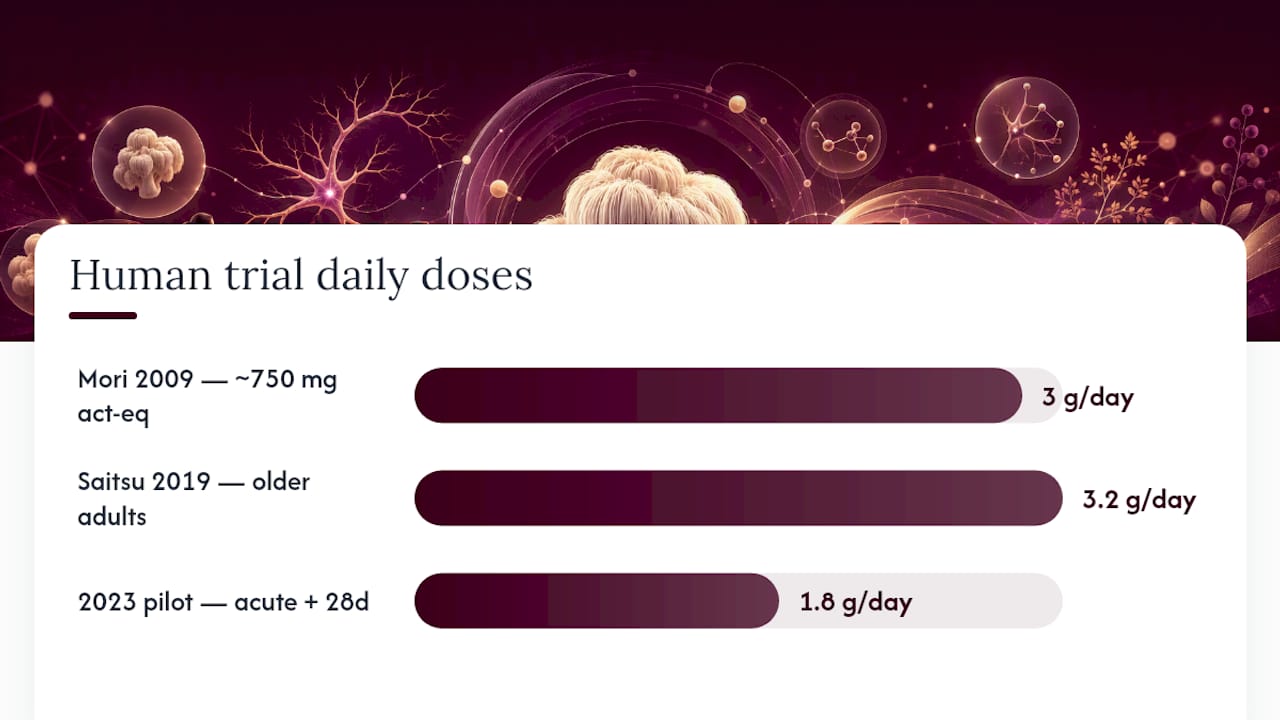
The clearest data point comes from Mori et al. (2009), a randomized controlled trial in older adults with mild cognitive impairment. Participants took dried fruiting-body tablets totaling about 3 grams per day, reported as roughly 750 mg of active-equivalent material, for 16 weeks. Cognitive scores improved compared to placebo, and the effect faded after supplementation stopped, which is itself a useful clue: this doesn’t look like a one-time fix, it looks like something you maintain.
A decade later, Saitsu et al. (2019) pushed the dose higher. Older adults took 3.2 grams per day of dried fruiting body powder for 12 weeks and showed improvements on a test measuring attention and processing speed. That’s the highest dose in the reputable trial pool, and it worked in a population similar to Mori’s study: older adults, not students or biohackers.
Then there’s the 2023 randomized double-blind pilot that shifted the conversation toward younger, healthy adults. At 1.8 grams daily, participants performed faster on a cognitive task just 60 minutes after dosing, and after 28 days showed a trend toward lower subjective stress. This is the study most cited when people ask about faster-acting effects, because it’s the only one that tested a single acute dose alongside a short chronic phase.
Not every trial lines up neatly. A study using a much higher dose, 10 grams daily for four weeks in college-age students, failed to show cognitive benefits. That result is worth sitting with. More is not automatically better, and a dose that works in a 60-something adult with mild cognitive decline may do nothing measurable in a 20-year-old with a healthy brain to begin with.
Here’s how the trial doses stack up:
- Mori 2009: ~750 mg active-equivalent/day, 16 weeks, older adults with mild cognitive impairment, cognitive improvement observed.
- Saitsu 2019: 3.2 g/day dried fruiting body powder, 12 weeks, older adults, improved attention and processing speed.
- 2023 pilot: 1.8 g/day, acute effect at 60 minutes plus 28-day trend, healthy younger adults.
- High-dose trial: 10 g/day, 4 weeks, college-age students, no measurable cognitive effect.
Clinical reviews summarizing this research put the practical range at roughly 750 mg to 3,000+ mg of dried fruiting-body equivalent, often split into three or four smaller doses across the day. No trial has nailed down one universal optimal number, and honestly, given how different these populations and formulas are, that shouldn’t surprise you.
How Do You Translate Label Milligrams Into a Real Dose?
This is where most people get lion’s mane dosage wrong, and it’s not really their fault. A label that says “2,000 mg” tells you almost nothing on its own, because 2,000 mg of one product form can deliver a fraction of the active compound found in 2,000 mg of another.
Fruiting body powder or extract is the material used in every major trial referenced above. When a product is concentrated and standardized to a specific beta-glucan percentage, the label’s milligram count comes reasonably close to what researchers actually tested.
Mycelium-on-grain products are a different animal. These are often grown on rice or oat substrate, and a large share of that “lion’s mane” weight on the label can be leftover grain, not fungal material with meaningful beta-glucan content. Without a disclosed beta-glucan percentage on the certificate of analysis, that milligram figure isn’t comparable to the fruiting-body doses used in trials, no matter how big the number looks on the bottle.

Tinctures concentrate compounds through alcohol or water extraction, but potency swings wildly by brand and extraction ratio, so a “dropperful” is nearly impossible to map to a gram-based trial dose without the manufacturer’s own testing data.
Here’s a simple way to set your target once you know your product’s form:
- Maintenance or general wellness: aim for the lower end of the range, around 750 mg to 1 g of fruiting-body equivalent daily.
- Cognitive-function goals matching the trial evidence: target 1.8 g to 3.2 g daily, ideally split into two or three doses.
- Short-term or acute use for a single mentally demanding day: the 1.8 g single-dose protocol from the 2023 pilot is the closest evidence-backed model.
Pro Tip: Pull up the certificate of analysis before you buy. If beta-glucan content isn’t listed anywhere, that absence is itself the answer: you have no way to know what you’re actually dosing, regardless of what the front label promises.
What Did the Key Clinical Trials Actually Measure?
The details matter more than the headline dose, because two studies using similar amounts can produce different results depending on how long they ran and who was in the room.
Mori’s 2009 trial ran 16 weeks, the longest duration in the core evidence base, at roughly 750 mg active-equivalent daily. Cognitive scores climbed steadily through the treatment period in adults with mild cognitive impairment, then dropped back toward baseline after the supplement stopped. That washout effect is a meaningful data point: benefits appeared tied to ongoing use, not a permanent shift.
Saitsu’s 2019 trial used the highest dose among the well-regarded studies, 3.2 grams daily, over a shorter 12-week window, and still produced measurable improvement in attention and processing speed among older adults.
By the numbers: Trial doses supporting cognitive benefits ranged from ~750 mg to 3.2 g of dried fruiting-body equivalent daily, run for 12 to 16 weeks in older-adult populations, while a 1.8 g dose produced acute effects within 60 minutes in a younger, healthy cohort.
The 2023 pilot broke from that pattern by testing an acute, single-dose response instead of only a long maintenance window. Participants improved on a cognitive task an hour after taking 1.8 grams, and a 28-day follow-up phase showed a trend toward lower subjective stress, though not every outcome measure moved.
Then there’s the outlier. The 10-gram, four-week trial in college students found nothing. Three variables likely explain the mismatch: the population was young and cognitively healthy at baseline, giving less room to show improvement; the duration was shorter than Mori’s or Saitsu’s; and the dose, despite being the largest tested, didn’t necessarily translate into more usable active compound if the product form or extraction wasn’t comparable. Bigger numbers on a label don’t guarantee a bigger effect.
How Should You Choose Your Starting Dose?
Pick a number off a bottle and hope it’s right, and you’re basically guessing. A better approach follows the same logic researchers use: start with what you know, adjust deliberately, and give it real time before judging results.
- Confirm the product form and pull the COA. Know whether you’re holding fruiting-body extract, mycelium-on-grain, or a tincture, and check for a disclosed beta-glucan percentage.
- Set a fruiting-body-equivalent target based on your goal: roughly 750 mg to 1 g for general wellness, 1.8 g to 3.2 g if you’re chasing the cognitive outcomes seen in trials.
- Start at the low end for the first one to two weeks, especially if you’ve never taken a medicinal mushroom supplement before.
- Escalate gradually toward your target dose only if you’re tolerating it well, watching for any digestive discomfort.
- Hold that dose for 8 to 12 weeks before deciding whether it’s working, since that’s roughly the window practitioners use to judge cognitive-endpoint changes and it lines up with the duration of the strongest trials.
Splitting your daily dose into two or three smaller servings, rather than one large one, mirrors how most of the successful trials were structured. Taking it with food tends to reduce mild stomach upset, though the acute-dose pilot suggests a single dose on an empty stomach can still work when you need a faster effect on a specific day.
Pro Tip: Keep a simple weekly note, just a line or two, on mood, focus, and sleep. Eight weeks feels short in the moment but long in retrospect, and without notes you’ll forget what week two actually felt like.
Stop and contact a clinician if you notice unusual bruising, digestive symptoms that don’t resolve, or a skin rash. Those aren’t common, but they’re the specific red flags worth taking seriously.
What Does a Realistic Daily Schedule Look Like?
A dosing plan only works if it’s simple enough to stick with for two or three months straight. Here are three models drawn directly from the trial designs above.
- Starting protocol (weeks 1 to 2): 750 mg once daily with breakfast, to gauge basic tolerance.
- Clinical-trial-style regimen (weeks 3 onward): split into two doses, roughly 900 mg to 1.6 g each, taken with morning and midday meals, mirroring the multi-gram daily totals used by Mori and Saitsu.
- Acute single-dose schedule: 1.8 g taken as one dose on a specific demanding day, following the pilot study’s protocol.
During your 8 to 12 week evaluation, track subjective mood and mental clarity weekly, note sleep quality, and flag any GI symptoms early rather than pushing through them. If you’re stacking lion’s mane with other supplements, space stimulant-containing products by a few hours to avoid confusing jitteriness or restlessness with an actual reaction to the mushroom itself.
What Side Effects and Drug Interactions Should You Know?
Tolerability across small trials has generally been described as acceptable, though reported adverse events include mild gastrointestinal upset and, less commonly, skin rash. Larger, longer safety studies simply don’t exist yet, so “generally well tolerated” comes with an asterisk.
- Watch for digestive discomfort, especially when starting at higher doses.
- Discontinue and seek medical advice if you notice a skin rash or unusual bruising.
- Use particular caution combining lion’s mane with anticoagulants, immunomodulators, or diabetes medications, since interaction data in humans is limited.
- Keep your product’s batch number and COA on hand if you ever need to report a reaction to a clinician.
The FDA does not pre-approve supplements for safety or effectiveness before they reach store shelves, which means label claims are the manufacturer’s own statements, not government-verified facts. That’s exactly why the FDA recommends talking to a health care provider before starting any new supplement, particularly if you’re managing a chronic condition or taking prescription medication already.
CP-1’s Perspective on Evidence-Based Dosing
We recommend applying the same standard to any lion’s mane product: check the actual evidence, then check the label against it. Some formulas include lion’s mane extract alongside NMN, reishi, turkey tail, and CoQ10, and are manufactured under GMP-certified conditions, third-party tested, and made with vegan, non-GMO ingredients. If a brand doesn’t show a COA with beta-glucan content disclosed, that’s a real gap, not a technicality.
For deeper reading on side effects and label checks specific to the 1.8 g trial dose, see our lion’s mane side effects breakdown, and for a step-by-step approach to reading any supplement label, our label reading checklist walks through exactly what to look for.
— Hugo
Where CP-1 Fits Into Your Dosing Plan
Most lion’s mane products on shelves don’t provide enough information to compare them to any single trial discussed. Some chewable gummies blend lion’s mane extract with NMN, reishi, turkey tail, and CoQ10 and may be manufactured under certain conditions, third-party tested, and formulated vegan and non-GMO, with labels designed to be checked.
Before you buy anything, hold its label next to the ranges in this guide. Look for a disclosed beta-glucan percentage, and if you can’t find one, ask the brand directly for a certificate of analysis. That single step separates a product you can actually dose with confidence from one you’re just guessing about. Curious what functional beverages built on similar mushroom science look like from a different angle? Neurofuel’s overview of lion’s mane benefits is worth a look for context.
Ready to see how CP-1 stacks up against the dosing guidance in this article? Visit the CP-1 product page to review the current label and COA before you order.
This article is general information, not a substitute for advice from a qualified doctor. Consult a qualified healthcare professional about your own circumstances before acting on anything here.
Sources
- Examine
- The acute and chronic effects of Lion’s Mane on cognitive function, stress and mood — PMC
- PubMed: Mori 2009 lion’s mane RCT
- FDA — Dietary supplements
FAQ
What Is a Good Starting Lion’s Mane Dosage for Beginners?
Start around 750 mg of fruiting-body equivalent daily for one to two weeks to check tolerance, then increase toward 1.8 g to 3.2 g if you’re targeting the cognitive benefits seen in clinical trials.
How Much Lion’s Mane Should You Take for Cognitive Function?
Trials showing cognitive improvement used doses between 750 mg and 3.2 grams of dried fruiting-body equivalent daily, taken for 12 to 16 weeks, with a 1.8 g dose producing effects within 60 minutes in one pilot study.
How Long Does It Take for Lion’s Mane to Work?
Most evidence-based protocols recommend an 8 to 12 week evaluation window before judging cognitive effects, though the 2023 pilot study found some acute effects within an hour of a single 1.8 g dose.
Can You Take Too Much Lion’s Mane?
A trial using 10 grams daily for four weeks in college-age students showed no cognitive benefit, suggesting higher doses don’t automatically improve results and may simply exceed what’s useful for a given person.
Does Lion’s Mane Interact With Medications?
Potential interactions with anticoagulants, immunomodulators, and diabetes medications have been raised, and since the FDA does not pre-approve supplements for safety, anyone on these medications should consult a clinician before starting lion’s mane.