
Most people who take lion’s mane never notice a problem. When side effects do show up, they’re almost always mild and digestive: nausea, bloating, or a headache in the first few days. A systematic review also flagged one severe case involving acute respiratory distress syndrome, tied to long-term use in a single patient with other health factors at play. The takeaway isn’t “avoid it.” It’s “know what you’re watching for.”
TL;DR:
- Most side effects of lion’s mane are mild digestive issues that typically occur within the first few days and resolve quickly.
- Severe reactions are extremely rare, with one documented case of lung distress likely due to allergy, but most adverse events remain mild and self-limiting.
- Those with mushroom or mold allergies, respiratory issues, pregnancy, or immune conditions should consult their doctor before use due to limited safety data.
- Starting with low doses, taking the supplement with food, and tracking symptoms for two weeks help reduce the risk of mild side effects.
- Purchasing products with transparent sourcing, standardized extracts, and third-party testing minimizes the risk of variability and unexpected reactions.
Table of Contents
- What Are the Common, Mild Lion’s Mane Side Effects?
- How Serious Are the Rare Adverse Events Linked to Lion’s Mane?
- Who Should Avoid or Be Cautious With Lion’s Mane?
- What Dosage Ranges Have Clinical Trials Actually Used?
- How Strong Is the Safety Evidence Behind These Claims?
- What Should You Do If You Experience Side Effects?
- What Should You Look for on a Product Label?
- What’s the Real Takeaway on Lion’s Mane Safety?
- Where CP-1 Fits if You Want Lion’s Mane Done Right
- Sources
What Are the Common, Mild Lion’s Mane Side Effects?
Digestive upset tops the list. Across the trials reviewed in that systematic analysis of Hericium erinaceus research, the most frequently reported complaints were stomach discomfort, headache, and occasional diarrhea. None of it sounds dramatic, and it usually isn’t. But if you’ve ever started a new supplement and felt slightly off for a few days, this is the same pattern.
Timing matters here. Most people who notice something feel it within the first week, often in the first 48 to 72 hours, while the body adjusts to a new compound moving through the gut. A pilot randomized controlled trial that gave 41 healthy adults 1.8 grams per day for 28 days recorded a low incidence of adverse events overall, which lines up with what most users report anecdotally: mild, early, and fading fast.
Skin reactions show up less often but are worth naming specifically. A mild rash or localized irritation can appear, particularly in people with any history of mold or fungal sensitivity, since lion’s mane is, after all, a mushroom. If you’ve ever reacted to other fungi (edible or otherwise), your skin is a reasonable early warning system.
Here’s what tends to drive whether someone experiences these mild effects or skates through without noticing anything:
- Product form. Mycelium-based powders and fruiting body extracts don’t behave identically in the gut, and tolerability can shift depending on which one you’re taking.
- Dose. Jumping straight to a higher dose (say, 3 grams a day) instead of easing in raises your odds of stomach upset.
- Empty stomach timing. Taking any mushroom extract without food concentrates the compound’s contact with your gut lining, which is a common trigger for nausea.
- Extraction quality. Poorly standardized extracts can carry more plant material and residual compounds that irritate a sensitive gut.
- Individual gut sensitivity. People with pre-existing IBS or a generally reactive digestive system report a higher rate of mild symptoms across most supplement categories, not just mushrooms.
None of this means you need to overthink your morning routine. It means a few small habits go a long way.
Take it with food. This single change resolves a meaningful share of the nausea complaints people bring up. Fat and fiber in a meal slow absorption and buffer the stomach lining, which is exactly what you want when introducing a new compound.
Start low, then build. If your product allows it, begin at the lower end of the studied range (closer to 1 gram per day) rather than diving straight into 3 grams. Give your body a week to register whether it’s tolerating the dose before increasing.
Track the pattern, not just the symptom. A headache that shows up once and disappears is very different from one that recurs every time you take your dose. The second pattern is a real signal that this product, or this dose, isn’t sitting right with you.
Pro Tip: Keep a simple three-line log for the first two weeks: date, dose, and how you felt within six hours. It takes thirty seconds a day and gives you (and any clinician you talk to) something concrete instead of a vague “I think it upset my stomach.”
If symptoms persist beyond a week or two despite taking it with food and starting low, that’s your cue to stop and reassess rather than push through. Persistent diarrhea, a rash that spreads instead of staying localized, or a headache that intensifies rather than fades are all reasons to pause the supplement and talk to a clinician, especially if you’re also managing another condition or taking prescription medication. Mild and self-limiting is the expected pattern. Anything that trends the other direction deserves attention, not stubbornness.
How Serious Are the Rare Adverse Events Linked to Lion’s Mane?
The most cited severe case involves a 63-year-old man who developed acute respiratory distress syndrome after prolonged lion’s mane supplement use. Researchers who published the case report noted a positive lymphocyte reaction test to the extract, cough, difficulty breathing, and diffuse lung infiltrates on imaging, findings consistent with an allergic or immune-driven lung reaction rather than a toxic one.
That single case matters, but it needs context most headlines skip. One patient, with his own health background and possible confounding factors, does not establish how often this happens across millions of lion’s mane users worldwide. Case reports work like smoke detectors: they tell you a fire is possible, not how frequently fires actually start. The authors themselves were careful to say they couldn’t definitively prove lion’s mane caused the reaction, only that the timing and immune markers made it a plausible cause worth documenting.
A single case report signals biological plausibility, not statistical frequency. It tells clinicians “watch for this,” not “expect this.” Confusing the two is how one alarming story turns into an inflated fear that doesn’t match the actual risk most users face.
Rare doesn’t mean irrelevant, though. It means you should know the warning signs well enough to act fast if your body ever sends them. The broader systematic review covering Hericium erinaceus research found that outside of that one case, severe reactions were essentially absent from the trial data, which keeps this squarely in “rare but real” territory rather than “common risk.”
Watch for these signs, particularly in the days and weeks after starting or increasing your dose:
- Difficulty breathing, shortness of breath, or a persistent new cough
- Swelling of the face, lips, tongue, or throat
- Widespread hives or a rash that spreads rapidly rather than staying in one spot
- Dizziness or a rapid drop in blood pressure alongside any of the above
- Chest tightness that doesn’t resolve with rest
If any of these show up, especially breathing difficulty or facial swelling, this is not a “wait and see” situation. Stop the supplement immediately and seek emergency medical care the same way you would for any suspected anaphylactic reaction. Bring the product packaging with you if you can. It helps the treating clinician identify exactly what you took and at what concentration, which speeds up appropriate care.
Who Should Avoid or Be Cautious With Lion’s Mane?
Certain groups face meaningfully higher risk, and knowing which category you fall into is the fastest way to decide whether lion’s mane deserves a conversation with your doctor before it earns a spot in your routine.
- You have a known mushroom or mold allergy. Lion’s mane is a fungus, and cross-reactivity with other mold or mushroom allergies is a real concern. If you’ve ever had a reaction to mushrooms in food or noticed mold sensitivity on an allergy panel, this puts you at elevated risk for the kind of allergic response described in the ARDS case report.
- You’re pregnant or breastfeeding. There’s simply no reliable safety data for either group. That absence of data isn’t proof of danger, but it’s not proof of safety either, and this is exactly the situation where “we don’t know” should default to caution. Most clinical guidance recommends avoiding it during pregnancy and lactation until better data exists.
- You have asthma or a history of respiratory issues. Given that the documented severe case presented as a lung reaction, anyone with pre-existing airway sensitivity has a lower margin for error. This doesn’t mean lion’s mane is off the table, but it does mean this conversation belongs in your next appointment, not after symptoms start.
- You’re immunocompromised or managing liver or kidney disease. Cancer center resources that track supplement interactions for patients specifically flag the need for clinician consultation in people managing complex medical conditions, since organ function and immune status change how any compound is processed and tolerated.
- You take anticoagulants or immune-modulating medications. The evidence on direct drug interactions with lion’s mane is genuinely thin, but the mechanisms are plausible. Compounds that influence immune signaling could theoretically interact with drugs designed to suppress or modulate that same system, and anything with blood-thinning properties deserves scrutiny alongside prescription anticoagulants.
If you fall into more than one category on this list, the case for a clinician conversation gets stronger, not weaker. The interaction risks compound rather than cancel out.
The most useful thing you can do before that appointment is show up prepared. Write down every supplement and medication you currently take, including dose and frequency, and bring it with you rather than trying to recall it from memory in the exam room. A drug interaction checker can help you flag potential conflicts worth asking about in advance, though it’s a starting point for the conversation, not a substitute for it.
What Dosage Ranges Have Clinical Trials Actually Used?
Clinical trials have used lion’s mane doses ranging from roughly 1.05 grams to 3 grams per day, according to a detailed dosage review of the available research. There is no single, agreed-upon “correct” dose the way there is for something like vitamin D. What exists instead is a range that different research teams have tested for different endpoints, cognitive, mood-related, or general wellness outcomes.
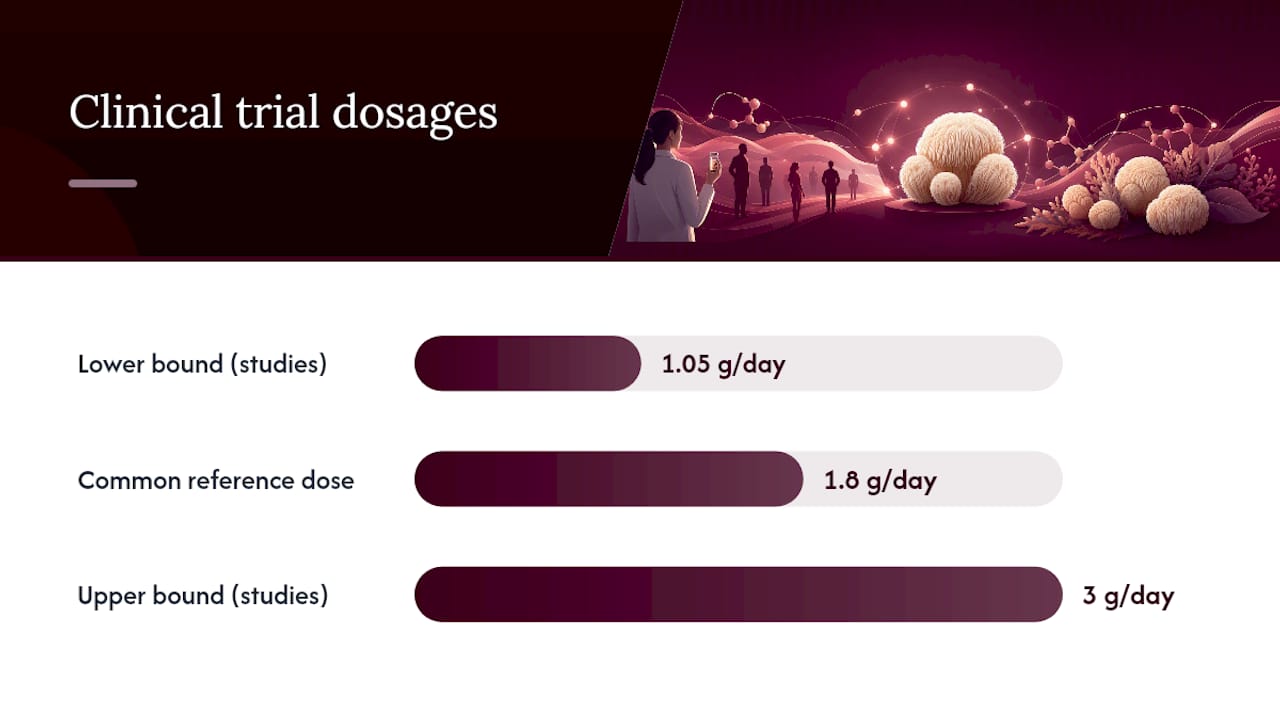
One trial dose shows up more than any other: 1.8 grams per day. That’s the amount used in the 28-day pilot RCT that measured cognitive task speed and stress trends in 41 healthy young adults, and it’s become something of a reference point for researchers designing follow-up studies. If you’re comparing a product’s label dose against “what the science actually tested,” 1.8 grams a day is the number worth anchoring to.
Product form changes the picture in ways that matter for tolerability, not just effectiveness. Lion’s mane supplements come from two different parts of the organism, and they’re not interchangeable:
- Fruiting body extracts concentrate hericenones, compounds associated with the mushroom’s studied cognitive effects, and tend to reflect what most human trials actually used.
- Mycelium-based products concentrate erinacines instead, and because mycelium is often grown on a grain substrate, poorly filtered products can carry more starch filler than active compound.
- Standardized extracts state a specific percentage of active compound (look for language naming erinacine or hericenone content directly on the label) rather than a vague “proprietary blend.”
- Powders versus capsules or gummies affect how consistently you’re actually getting the labeled dose, since powders are more prone to variation in extraction quality between batches.
This distinction isn’t academic. Mechanistic research on Hericium erinaceus extraction points out that different extraction methods and different parts of the mushroom produce meaningfully different erinacine and hericenone profiles, which can affect both how well the product works and how your gut or immune system responds to it. A poorly standardized mycelium product grown on excess grain substrate isn’t the same experience as a clean fruiting body extract, even if both say “lion’s mane” on the front label.
When you’re evaluating a product, run through this quick checklist before you buy:
- Does the label specify fruiting body, mycelium, or a blend of both?
- Is there a stated percentage of standardized active compound (erinacine or hericenone content)?
- Does the daily serving fall somewhere in the 1 to 3 gram range studied in trials, or is it vague about total mushroom content?
- Is there any mention of third-party testing or a certificate of analysis?
A product that answers all four questions clearly is giving you real information to work with. One that answers none of them is asking you to trust a black box.
How Strong Is the Safety Evidence Behind These Claims?
The honest answer: encouraging, but thin. Most of what’s known about lion’s mane safety comes from small trials, pilot studies, and one systematic review pulling that research together, not from the kind of large, long-term studies that back safety claims for, say, ibuprofen or common blood pressure medications.
| Evidence type | Typical scale | What it tells us | Key limitation |
|---|---|---|---|
| Systematic review | Pools multiple smaller studies | Identifies recurring mild effects (stomach discomfort, headache) and flags the one ARDS case report | Quality depends entirely on the studies it pools; inconsistent reporting standards across them |
| Pilot RCT (28 days) | 41 healthy adults, 1.8 g/day | Low incidence of adverse events in a controlled, short-term setting | Small sample, short duration, healthy population only, not generalizable to at-risk groups |
| Case report | Single patient | Documents a plausible severe allergic/immune reaction (ARDS) | One person; cannot establish frequency or rule out confounding health factors |
| Cross-study safety commentary | Multiple trial abstracts | Notes that adverse events are infrequently and inconsistently reported across trials | Heterogeneous products make it hard to compare “lion’s mane” across studies as if it were one substance |
The systematic review anchoring most of this discussion did exactly what good reviews do: it pulled together the available RCTs and case data rather than relying on a single study’s word. What it found was reassuring in aggregate, mostly mild effects, but it didn’t shy away from including the ARDS case, which is precisely why that review carries more weight than marketing copy that mentions safety in passing.
The gaps are real, and worth naming plainly rather than glossing over. Cross-study safety commentary on lion’s mane trials points out that adverse events are inconsistently reported across the literature, some trials track them carefully, others barely mention them, which makes pooled conclusions more tentative than a casual reader might assume. Add in the product heterogeneity discussed earlier (fruiting body versus mycelium, varying extraction methods) and you get a research landscape where “lion’s mane is safe” is a reasonable summary, not an ironclad guarantee.
What does this mean for different people? For a healthy adult without allergies, respiratory issues, or a complicating medical condition, the current evidence supports cautious confidence: side effects are typically mild, severe reactions are rare, and short-term trials haven’t raised major red flags. For anyone in a higher-risk category outlined earlier, the evidence simply hasn’t been generated yet. Absence of proven danger is not the same as proof of safety, and that distinction should guide how cautiously you approach the supplement if you fall into one of those groups.
What Should You Do If You Experience Side Effects?
Your response should match the severity of what you’re feeling, not a one-size-fits-all instinct to either panic or ignore it.
- For mild symptoms (mild nausea, bloating, a dull headache): reduce your dose or pause entirely for a few days. Try reintroducing it with food at a lower amount once symptoms clear. Track how you feel for one to two weeks before deciding whether to continue.
- For symptoms that don’t improve after a week of lower dosing and food pairing: stop the supplement and talk to a clinician, particularly if you’re also managing another condition or taking regular medication.
- For severe symptoms (difficulty breathing, facial or throat swelling, widespread hives, dizziness with breathing trouble): treat this as an emergency. Call emergency services immediately rather than waiting to see if it passes.
- Document what happened. Note the product name, brand, dose, how long you’d been taking it, and the exact timeline of symptoms. This is the same information a clinician needs and the same information required for a formal safety report.
- Report it. Adverse events tied to dietary supplements can be reported directly to the FDA’s MedWatch program through safetyreporting.hhs.gov. This step matters more than most people realize: supplement safety data depends heavily on voluntary reporting, since there’s no mandatory tracking system like there is for prescription drugs.
Pro Tip: Photograph the product label and lot number before you report anything or head to urgent care. If the issue turns out to be batch-specific rather than ingredient-specific, that detail becomes valuable to both your clinician and any regulatory follow-up.
What Should You Look for on a Product Label?
Manufacturing quality is where a lot of the “unpredictable side effects” narrative actually gets resolved, or made worse. A product with inconsistent sourcing and no testing behind it is simply more likely to vary batch to batch, which means your body’s reaction one month might not predict the next.
GMP certification means the facility follows the FDA’s Good Manufacturing Practice standards for identity, purity, and consistency, a baseline, not a luxury feature.
Third-party testing and batch certificates of analysis confirm what’s actually in the bottle matches what’s on the label, catching contamination or potency drift before it reaches you.
Sourcing transparency (fruiting body versus mycelium, stated extraction method) lets you match the product to what’s actually been studied. Mechanistic research on Hericium erinaceus extraction makes clear that these production choices genuinely change the compound profile you’re consuming.
A few habits protect you regardless of brand:
- Choose products that name their extraction method and mushroom part on the front label, not buried in fine print.
- Favor brands that publish or offer batch-specific testing results on request.
- Check for vegan and non-GMO certification if that matters to your broader supplement standards.
- Cross-reference the labeled dose against the 1 to 3 gram range used in clinical trials.
Readers digging deeper into allergy risk specifically should look at research on mold sensitization and mushroom allergy, and anyone curious about extraction differences can go further with a breakdown of how mushroom extracts are made.
What’s the Real Takeaway on Lion’s Mane Safety?
Here’s what I think gets lost in most coverage of this topic: people either treat lion’s mane like a miracle nootropic with zero downside, or they see one case report and decide it’s dangerous. Both reactions skip the actual work of reading the evidence carefully.
The realistic picture sits in the middle. For most healthy adults, lion’s mane is well tolerated, and the side effects you’re most likely to encounter are the boring, forgettable kind: a little stomach upset, maybe a headache, usually gone within a week. That’s not a low bar to clear. Plenty of supplements with much bigger marketing budgets can’t say the same.
Where I’d push back on the conventional wisdom is the tendency to treat “well tolerated in trials” as equivalent to “safe for everyone.” It isn’t, and the research itself doesn’t claim it is. If you have a mushroom allergy, asthma, you’re pregnant, or you’re managing a condition that affects your immune system, the absence of long-term safety data should carry real weight in your decision, not get waved off because most people do fine.
My practical advice: start at the low end of the studied range, take it with food, and give your body a real trial period, not a single dose, before judging how you tolerate it. Keep a simple log. If anything with breathing or swelling shows up, that’s not a “monitor it” moment; that’s an emergency room moment. And if you notice anything worth flagging, report it. The FDA’s MedWatch system only works because people who have odd reactions bother to say so. For readers who want more on how mushroom supplements interact with the body generally, the broader research on functional mushroom benefits is worth your time.
— Hugo
Where CP-1 Fits if You Want Lion’s Mane Done Right
Everything above points to the same conclusion: your risk with lion’s mane drops sharply when the product itself is transparent about sourcing, dose, and testing. That’s the exact gap CP-1 was built to close. Some supplements are formulated with lion’s mane extract alongside other ingredients such as NMN, reishi, turkey tail, and CoQ10, manufactured under certain standards and sometimes backed by third-party testing to help ensure dose consistency.

Some products may carry vegan and non-GMO certifications, which can be important to consumers seeking transparency in supplement labels. Instead of a vague “proprietary mushroom blend,” you get ingredient sourcing you can actually check against the concerns raised throughout this piece: allergy risk, dose consistency, extraction quality. If you’ve read this far because you want the cognitive and cellular energy benefits of lion’s mane without rolling the dice on an untested product, check out CP-1’s full ingredient breakdown and see whether it fits the low, steady starting approach this article recommends.