
NAD (nicotinamide adenine dinucleotide) is one of the most talked-about molecules in longevity science right now, and the claims flying around it are enormous. Anti-aging. Brain clarity. All-day energy. You’ve probably seen the IV infusion clinics charging hundreds of dollars per session, or the supplement stacks promising to reverse cellular decline. Some of those claims are real. Many are not. This guide cuts through the noise to explain what NAD actually does in your body, which supplements genuinely raise NAD+ levels, what the science currently supports, and what you can do today to protect your own cellular health without wasting money on unproven therapies.
Table of Contents
- Key Takeaways
- What NAD is and why your cells need it
- NAD+ precursors: NR, NMN, and nicotinamide compared
- What the science actually says about NAD+ therapy
- Practical ways to support healthy NAD+ levels
- My honest take on NAD+ hype and reality
- Support your NAD+ levels the smart way
- FAQ
Key Takeaways
| Point | Details |
|---|---|
| NAD+ declines with age | NAD+ levels drop roughly 50% by age 60, affecting energy and DNA repair. |
| NR and NMN are the best precursors | Both raise blood NAD+ levels within 14 days; plain nicotinamide does not produce sustained increases. |
| IV infusions are expensive and unproven | Sessions cost $200 to $1,000 with no strong clinical evidence for anti-aging benefits in healthy adults. |
| Lifestyle choices matter | Exercise, fasting, and quality sleep all support natural NAD+ production without a price tag. |
| Supplements are safe but not magic | NR and NMN are generally well-tolerated, though long-term safety data remains incomplete. |
What NAD is and why your cells need it
NAD is a coenzyme found in every living cell in your body. It exists in two forms: NAD+ (oxidized) and NADH (reduced). Together they drive the redox reactions your mitochondria depend on to produce ATP, the actual energy currency your body runs on. Without adequate NAD+, your cells cannot efficiently convert food into usable energy.
That’s the first thing to understand. NAD+ is not a trendy wellness ingredient. It’s a fundamental molecule your body has always needed. The conversation around it has heated up because of what happens to it over time.
Here’s the biology that matters for anyone thinking about NAD and energy production:
- DNA repair: NAD+ is a required substrate for PARP enzymes, which detect and repair DNA strand breaks. This process accelerates with age-related DNA damage.
- Sirtuin activation: Sirtuins are a family of proteins linked to longevity and metabolic regulation. They consume NAD+ to function. No NAD+, no sirtuin activity.
- Mitochondrial function: The NAD+/NADH ratio directly controls the efficiency of oxidative phosphorylation inside your mitochondria. A poor ratio means sluggish energy output.
- Circadian rhythm regulation: NAD+ levels naturally oscillate throughout the day. Disrupted sleep patterns blunt this cycle, which may compound metabolic issues over time.
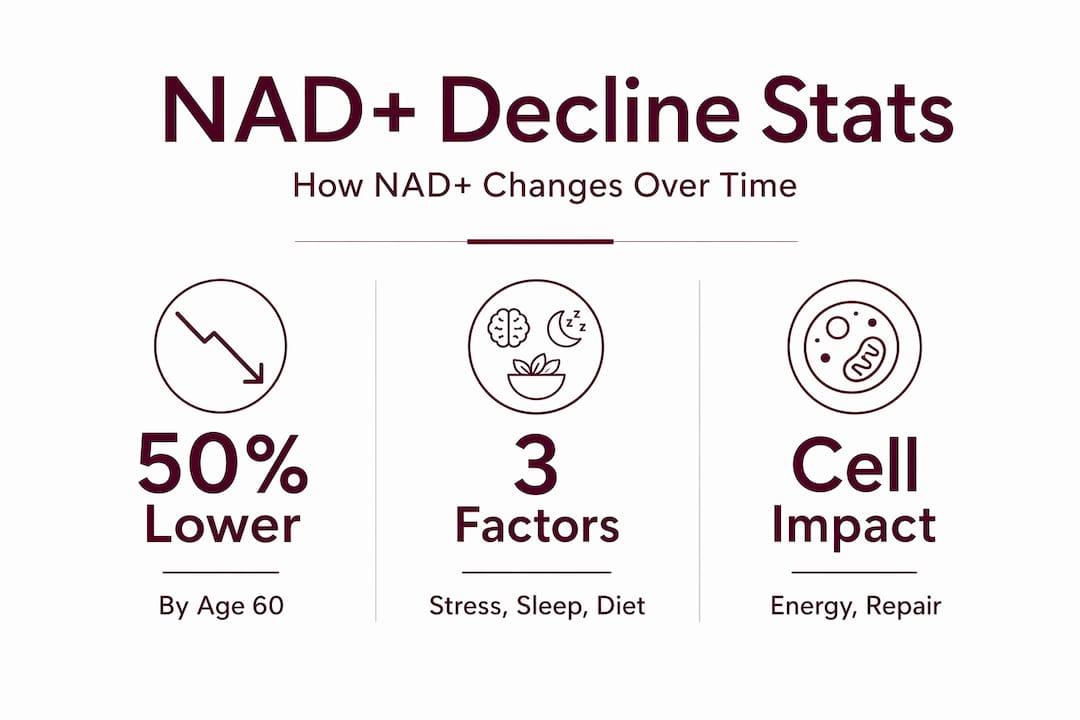
NAD+ levels decline roughly 50% by age 60, and several factors speed this up: chronic stress, alcohol, poor sleep, obesity, and inflammatory conditions all deplete NAD+ faster than your body can replenish it. A 2026 study published in Nature Metabolism found that blood NAD+ levels remain more stable with age than previously assumed, which complicates some of the simpler “just replenish it” narratives. The picture is more nuanced than most marketing will tell you.
Pro Tip: NAD+ and NADH are not interchangeable supplements. NADH is the reduced form and functions differently in the cell. When people talk about “raising NAD+ levels,” they mean shifting the NAD+/NADH ratio toward more NAD+, not simply increasing total NAD in blood.
NAD+ precursors: NR, NMN, and nicotinamide compared
You cannot simply swallow NAD+ and expect your cells to absorb it directly. The molecule is too large to readily enter cells, which is one reason IV infusions are scientifically questionable despite their price tag. Your body needs precursor molecules that it can convert into NAD+ through existing metabolic pathways.
The three main precursors are nicotinamide riboside (NR), nicotinamide mononucleotide (NMN), and nicotinamide (Nam). They are not equal.

| Precursor | Pathway Used | Raises NAD+? | Notes |
|---|---|---|---|
| NMN | Preiss-Handler / gut microbiota | Yes, within 14 days | Requires gut microbiota for conversion |
| NR | Preiss-Handler / gut microbiota | Yes, within 14 days | Well-studied in human trials |
| Nicotinamide (Nam) | Salvage pathway | Not sustained | Cheaper but less effective |
| Direct NAD+ | None (too large) | Unlikely | Poor cellular bioavailability |
A clinical trial involving 65 participants showed that NR and NMN both raise blood NAD+ comparably within 14 days of supplementation. Nicotinamide, which is the form found in most cheap B-vitamin formulas, does not produce sustained increases. That’s a critical distinction if you’re scanning supplement labels.
NR and NMN both work via the Preiss-Handler pathway with meaningful involvement from gut microbiota. This is why gut health can influence how well your body uses these precursors. Nicotinamide takes the salvage pathway, which is a shorter route but reaches a ceiling quickly and doesn’t translate to meaningfully higher NAD+ over time.
For a deeper look at how NMN specifically compares on energy and brain outcomes, the NMN science guide breaks this down well.
Pro Tip: If you’re comparing supplements, check whether the product uses NMN or NR specifically. Products listing “niacin” or “niacinamide” as their NAD+ precursor are relying on the salvage pathway and are unlikely to produce the same increases seen in NR and NMN clinical trials.
What the science actually says about NAD+ therapy
This is where I’m going to be blunt, because the wellness industry is not.
NAD+ IV infusions cost $200 to $1,000 per session, and the clinical evidence for anti-aging benefits in healthy adults is close to nonexistent at those price points. The science in humans is still early, results from existing studies are inconsistent, and the data remains preliminary compared to what marketing materials imply.
That doesn’t mean NAD+ supplements have no value. It means you should understand what they’ve actually been shown to do.
Here’s an honest breakdown of where the evidence stands:
- Blood NAD+ increases: Clearly demonstrated with NR and NMN in multiple human trials. This is real and reproducible.
- Energy and fatigue: Some users report genuine improvements. Clinical trial results are mixed, and placebo effects are real in this category.
- Cognitive function: Promising in animal models and early human observations. Not yet confirmed in large-scale controlled trials.
- Lifespan extension: Shown in yeast, worms, and mice. Not proven in humans. Significantly, supplementing NAD+ has not been proven to slow aging or extend lifespan in humans.
- Side effects: NR and NMN are generally safe but long-term data are lacking. Some people report flushing, nausea, or digestive upset, particularly at higher doses.
“The commercial marketing of NAD+ products has far outpaced scientific validation.” — NPR, 2026
Influencer culture has made this problem significantly worse. When someone with millions of followers films their IV drip session and says they feel 20 years younger, that’s not data. It’s an anecdote dressed up as evidence. Skepticism here is not pessimism. It’s what protects you from spending real money on therapies that haven’t earned it yet.
The Cleveland Clinic notes that NAD+ supplements are advised with professional guidance, particularly if you’re taking medications or managing chronic conditions. That’s reasonable advice regardless of the hype level.
Practical ways to support healthy NAD+ levels
You don’t need a thousand-dollar infusion to support your NAD+ biology. The most evidence-backed strategies are also the most accessible ones.
-
Exercise regularly. Both resistance and aerobic training have been shown to stimulate NAD+ production pathways. High-intensity intervals appear particularly effective at activating the PGC-1 alpha pathway, which upregulates NAMPT, the enzyme that controls NAD+ synthesis. Exercise, fasting, and quality sleep are among the most supported natural strategies.
-
Practice time-restricted eating or intermittent fasting. Fasting activates sirtuins and AMPK pathways, both of which increase demand for NAD+ and stimulate its production. Even a 16-hour eating window can influence this.
-
Prioritize sleep quality. NAD+ levels oscillate with your circadian rhythm. Chronic sleep disruption flattens this oscillation, and the compounding metabolic effect is real over months and years.
-
Eat foods with NAD+ precursors. Chicken, tuna, salmon, and whole-grain products contain tryptophan and niacin, which the body can convert to NAD+. No food raises NAD+ dramatically, but your dietary baseline matters.
-
Supplement with NMN or NR. If you’re going to supplement, use a precursor with actual human trial evidence. Typical studied doses range from 250mg to 500mg daily for NR and 250mg to 600mg daily for NMN. Neither has shown toxicity at these levels in current trials, though monitoring long-term data is still warranted.
-
Avoid what depletes NAD+. Alcohol, chronic stress, excess calories, and inflammatory lifestyle patterns all accelerate NAD+ depletion. You can take the best supplement on the market and undo most of it with consistently poor lifestyle choices.
If you’re interested in non-stimulant approaches to energy and mental clarity that work through NAD+ related pathways, the non-stimulant energy guide is worth your time. It covers why this approach outperforms caffeine dependence for sustainable performance.
Pro Tip: Set realistic expectations. Most people taking NMN or NR notice changes over weeks, not days. If you expect a dramatic jolt in 24 hours, you’ll dismiss something that’s actually working slowly and consistently at the cellular level.
My honest take on NAD+ hype and reality
I’ve spent years looking at the supplement industry from the inside, and NAD+ is a perfect case study in how real science gets stretched into magical claims.
The underlying biology is genuinely exciting. NAD+ is central to aging, energy, and cellular repair. That part is not hype. But somewhere between the lab bench and the wellness spa, “involved in aging biology” became “reverses aging.” Those are not the same sentence.
What I’ve observed is that people who do well with NAD+ supplements are typically those who pair them with disciplined lifestyle habits. Exercise, sleep, and clean nutrition form the foundation. NMN or NR supplementation appears to add something real on top of that foundation, particularly for people over 40 who are already doing the basics right.
What I’ve seen fail is using NAD+ supplements as a shortcut to avoid addressing sleep debt, chronic stress, or poor metabolic health. The molecule can’t fix what your lifestyle is actively breaking.
My take: skip the IV clinics for now unless you have a specific clinical reason. The science does not justify the cost for healthy adults. Invest in quality NMN or NR, get your sleep right, move consistently, and view NAD+ supplementation as part of a broader metabolic support approach, not a standalone fix. That’s not the exciting message, but it’s the honest one.
— Hugo
Support your NAD+ levels the smart way
If you’ve made it this far, you understand the difference between NAD+ marketing and NAD+ science. Cp-1 was built for exactly that kind of person. The CP-1 NAD+ Advanced Supplement uses NMN as its core precursor, the form with the strongest human trial data for raising cellular NAD+ levels. It combines that with lion’s mane, reishi, turkey tail mushroom extracts, and coenzyme Q10 for mitochondrial and cognitive support without stimulants. Every batch is third-party tested, vegan, non-GMO, and manufactured in the US. If you want to support your NAD+ biology without overpaying for unproven infusions, this is where to start. As always, consult your healthcare provider before starting any new supplement regimen.
FAQ
What does NAD actually do in the body?
NAD (nicotinamide adenine dinucleotide) is a coenzyme that powers mitochondrial energy production, supports DNA repair, and activates sirtuins, proteins linked to longevity and metabolic regulation.
What is the best way to boost NAD+ levels?
NMN and NR supplements are the most evidence-backed options for raising blood NAD+ levels, with studies showing measurable increases within 14 days. Combining supplementation with exercise, fasting, and quality sleep gives the most consistent results.
Are NAD+ IV infusions worth the cost?
Current evidence does not support IV infusions for anti-aging benefits in healthy adults. Sessions cost $200 to $1,000 each, and clinical data remains preliminary and inconsistent compared to what most clinics imply.
Is NAD+ supplementation safe?
NMN and NR are generally considered safe at commonly studied doses, though long-term human safety data is still being gathered. Consult a healthcare professional before starting, especially if you take medications or have existing health conditions.
Does NAD+ actually reverse aging?
No. While NAD+ levels decline with age and replenishing them has benefits in animal models, supplementing NAD+ has not been proven to slow aging or extend lifespan in humans. The biology is promising, but the proof in humans is not there yet.