

NAD+: Your cellular energy powerhouse explained
If you’ve been researching energy supplements or cognitive boosters lately, you’ve almost certainly run into NAD+. It shows up in longevity discussions, nootropic stacks, and anti-aging research with a frequency that makes it hard to ignore. But most explanations either drown you in biochemistry or oversimplify it to the point of being useless. NAD+, or nicotinamide adenine dinucleotide, is a coenzyme present in essentially every living cell and sits at the center of how your body generates and uses energy. This guide cuts through the noise and gives you the real picture.
Table of Contents
- What is nicotinamide adenine dinucleotide (NAD+)?
- How does NAD+ work? The science in plain language
- Why biohackers and researchers care: NAD+ beyond energy
- How does the body make and maintain NAD+?
- NAD+ supplementation: Promise and limitations
- What most NAD+ guides miss: Context, caution, and customization
- Explore NAD+ support solutions
- Frequently asked questions
Key Takeaways
| Point | Details |
|---|---|
| NAD+ powers cell energy | It is essential for turning nutrients into ATP and keeping your cells energized. |
| More than just energy | NAD+ also supports DNA repair, cellular maintenance, and healthy aging processes. |
| Supplements use NAD+ precursors | Because NAD+ is hard to absorb directly, most supplements use forms like NR or NMN. |
| Evidence is still emerging | Some benefits are well-supported at a cellular level, but cognitive boost claims need more human data. |
| Personal biology matters | How you respond to NAD+ boosters can depend on gut health, diet, and genetics. |
What is nicotinamide adenine dinucleotide (NAD+)?
NAD+ stands for nicotinamide adenine dinucleotide. It’s a coenzyme, which means it’s a small molecule that works alongside enzymes to make chemical reactions happen inside your cells. Without it, your cells can’t do much of anything useful.
Here’s the part that matters most to you as someone optimizing for performance and longevity: NAD+ is the central player in cellular respiration. That’s the process by which your cells convert the food you eat into ATP (adenosine triphosphate), which is the actual currency your body uses for energy. Every time you think clearly, lift something heavy, or recover from a hard workout, ATP is what’s powering that process. And NAD+ is what makes ATP production possible.
NAD+ participates in electron transfer reactions that enable cells to convert nutrients into usable energy, including in mitochondrial oxidative phosphorylation. That last part is important. Mitochondria are your cellular power plants, and NAD+ is essentially the fuel delivery system feeding them.
Here’s a quick breakdown of NAD+'s direct roles in the cell:
- Electron carrier: Shuttles electrons during energy metabolism
- ATP production enabler: Drives the mitochondrial machinery that produces ATP
- Mitochondrial health support: Maintains the efficiency of oxidative phosphorylation
- Enzyme cofactor: Activates enzymes involved in metabolism and repair
“NAD+ is not a fringe molecule. It is one of the most fundamental coenzymes in biology, present in every living cell and essential to life itself.”
Understanding this foundation changes how you evaluate supplement impact on cognition. When a supplement claims to support brain energy, the question you should be asking is whether it actually supports the NAD+ pathway, not just whether it contains caffeine or adaptogens.
How does NAD+ work? The science in plain language
Now that you have a foundation, let’s get into the mechanics. NAD+ doesn’t just sit in your cells doing one thing. It cycles between two forms, and that cycling is what makes energy metabolism work.

NAD+ mainly cycles between two interconvertible redox forms: NAD+ and NADH. Think of it like a shuttle bus. NAD+ is the empty bus, ready to pick up passengers (electrons). When it picks them up, it becomes NADH. NADH then delivers those electrons to the mitochondria, where they’re used to generate ATP. Once the electrons are dropped off, NADH converts back to NAD+, ready to pick up more.
Here’s a simple comparison to keep the two forms straight:
| Feature | NAD+ | NADH |
|---|---|---|
| Form | Oxidized (electron-free) | Reduced (electron-carrying) |
| Primary function | Accepts electrons from metabolism | Donates electrons to produce ATP |
| When it peaks | During fasting, exercise, caloric restriction | After eating, during energy production |
| Supplement target | Yes, precursors raise this form | Indirect result of NAD+ activity |
The stepwise process of how NAD+ converts food into energy looks like this:
- You eat food, and your body breaks it down into glucose, fatty acids, and amino acids.
- These molecules enter metabolic pathways like glycolysis and the citric acid cycle.
- During these reactions, NAD+ picks up electrons and becomes NADH.
- NADH carries electrons to the mitochondria’s electron transport chain.
- The electron transport chain uses those electrons to pump protons across the mitochondrial membrane.
- The proton gradient drives ATP synthase, producing ATP.
- NAD+ is regenerated and the cycle repeats.
This is why NAD+ is so central to energy. It’s not a stimulant. It doesn’t give you a jolt. It supports the machinery that produces real, sustained cellular energy.
Pro Tip: A common mistake people make is assuming all NAD+ supplements work the same way. They don’t. Absorption and bioavailability vary significantly between forms. Understanding NAD+ vs NMN differences is essential before you spend money on a supplement stack. And if you want a broader view of what actually works, the cellular energy strategies guide is worth your time.
Why biohackers and researchers care: NAD+ beyond energy
Once you see how NAD+ powers cellular energy, it’s natural to ask what else it does. This is where things get genuinely interesting for anyone focused on longevity and cognitive optimization.
NAD+ isn’t just an energy molecule. It’s also a critical substrate for two major classes of enzymes: sirtuins and PARP enzymes (poly ADP-ribose polymerases). Both of these enzyme families consume NAD+ to do their jobs, and their jobs are significant.
NAD+ supports multiple cellular maintenance functions including DNA repair and epigenetic regulation. In practical terms, that means NAD+ is involved in:
- DNA repair: PARP enzymes use NAD+ to detect and fix DNA strand breaks, which happen constantly from oxidative stress, UV exposure, and normal cellular activity
- Epigenetic programming: Sirtuins use NAD+ to regulate gene expression, influencing how your cells respond to stress and aging signals
- Cellular stress response: NAD+ helps cells adapt to metabolic stress, including caloric restriction and exercise
- Inflammation regulation: Sirtuin activity, which depends on NAD+, plays a role in modulating inflammatory pathways
Here’s the statistic that gets researchers excited: as NAD+ levels decline with age (and they do decline, significantly), the activity of both sirtuins and PARP enzymes drops with them. This creates a compounding problem where aging cells have less NAD+, which means less DNA repair, which means more cellular damage accumulating over time.
For cognitive optimizers, this matters because the brain is one of the most metabolically active organs in the body. It has high energy demands, high oxidative stress, and a strong dependence on mitochondrial function. Checking in on your mitochondrial health checklist is a smart move if you’re serious about brain performance. And if you’re looking for approaches that don’t rely on stimulants, the research on non-stimulant cognition boosters is directly relevant here.
How does the body make and maintain NAD+?
Here’s something the supplement industry rarely explains clearly: you can’t just swallow NAD+ and expect it to work. The body doesn’t absorb it well that way. So why is the supplement aisle full of NAD+ products? Because they’re actually selling precursors, not NAD+ itself.
NAD+ in the body is generated via multiple biosynthetic routes, with the salvage pathway being the predominant one in mammals. There are three main pathways:
| Pathway | Main input | How it works |
|---|---|---|
| De novo synthesis | Tryptophan (amino acid) | Converts dietary tryptophan through a long enzymatic chain to produce NAD+ from scratch |
| Preiss-Handler pathway | Niacin (vitamin B3/NA) | Converts nicotinic acid through a three-step process to produce NAD+ |
| Salvage pathway | NR, NMN, nicotinamide | Recycles NAD+ breakdown products back into usable NAD+; most efficient route in adults |
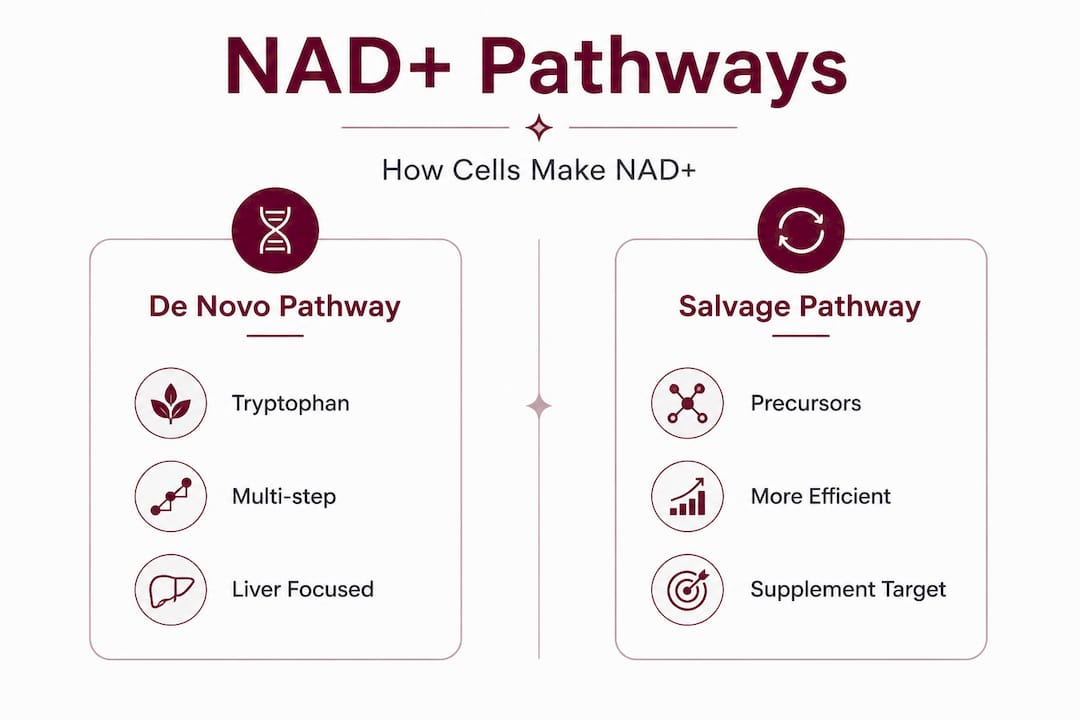
The salvage pathway is the one that matters most for supplementation. It takes precursor molecules like nicotinamide riboside (NR) and nicotinamide mononucleotide (NMN) and converts them efficiently into NAD+. This is why you see NR and NMN dominating the supplement market.
NAD+ is difficult for the body to absorb directly, so products use NAD+ precursors such as niacin-derived forms including nicotinamide, nicotinamide riboside (NR), and nicotinamide mononucleotide (NMN). The precursor approach isn’t a workaround. It’s actually the correct biological strategy, because these molecules enter the salvage pathway and get converted efficiently inside the cell where they’re needed.
Pro Tip: Not all precursors raise NAD+ equally, and your gut biology plays a bigger role than most people realize. NMN, for example, may be absorbed through a specific intestinal transporter, while NR follows a different route. If you want to understand the full science behind one of the most studied precursors, the NMN supplement science breakdown is one of the more thorough resources available.
NAD+ supplementation: Promise and limitations
You know the biology. Now let’s talk about what the research actually shows when people take NAD+ precursor supplements. This is where I want to be straight with you, because the hype often runs ahead of the evidence.
Here’s what the research does support about NAD+ precursor supplementation:
- NAD+ levels do increase: Multiple human studies confirm that NR and NMN supplementation raises blood NAD+ levels measurably
- Mitochondrial markers improve in some populations: Older adults and people with metabolic conditions show more consistent responses than healthy young adults
- Mechanistic pathways are well-established: The biology connecting NAD+ to energy, DNA repair, and sirtuin activity is solid science
- Safety profile is generally favorable: Short-term studies show NR and NMN are well-tolerated at common doses
But here’s the honest part: clinical data for NAD+ supplementation is limited and inconclusive, with ongoing research needed. The mechanistic evidence is strong. The felt cognitive and energy benefits in healthy, well-nourished adults? Less certain.
“The gap between what NAD+ does in a cell and what a supplement does for a healthy person is real. That gap deserves honest acknowledgment, not marketing spin.”
This doesn’t mean NAD+ precursors are useless. It means you should evaluate them with realistic expectations. The people most likely to notice a meaningful difference are those with genuinely depleted NAD+ levels, which tends to correlate with aging, poor sleep, high stress, or metabolic dysfunction. If you’re already sleeping well, eating clean, and training consistently, the effect may be subtler.
For a broader look at energy support without stimulants, the non-stimulant energy boosters guide covers a lot of useful ground. And if you’re interested in how antioxidants interact with cellular energy systems, antioxidant benefits for cognition and longevity is worth reading alongside this.
What most NAD+ guides miss: Context, caution, and customization
Here’s my honest take after spending years looking at this research and formulating around it. Most NAD+ guides fall into one of two traps: they either oversell the molecule as a miracle fix, or they dismiss it entirely because the clinical trials aren’t definitive yet. Both positions miss the point.
The real issue is that most discussions completely ignore individual variation. Two people can take the same NMN dose and have completely different outcomes based on their age, gut microbiome composition, baseline NAD+ levels, diet, and sleep quality. That’s not a flaw in the science. That’s just human biology. But the supplement industry has zero incentive to tell you that, because “results may vary based on your individual metabolic profile” doesn’t sell products.
What I’ve seen consistently is that NAD+ precursors work best as part of a broader strategy, not as a standalone fix. Exercise, particularly high-intensity interval training, activates many of the same sirtuin and PARP pathways that NAD+ supports. Caloric restriction and time-restricted eating also influence NAD+ metabolism. Good sleep restores NAD+ levels that get depleted during the day’s metabolic activity. When you stack a quality NMN supplement on top of those foundations, you’re giving it something real to work with.
The other thing most guides skip is the importance of stacking intelligently. NAD+ precursors work better alongside coenzyme Q10 (CoQ10), which supports the mitochondrial electron transport chain that NAD+ feeds into. Mushroom extracts like lion’s mane support the neuronal health that benefits from improved cellular energy. These aren’t random combinations. They’re built around how the underlying biology actually works.
Pro Tip: Use the science to inform your decisions, but track your own response. Give any new supplement at least 6 to 8 weeks before evaluating. Keep the variables consistent. And look at advanced cognition guide resources that help you evaluate stacking strategies critically, not just enthusiastically.
Explore NAD+ support solutions
If you’ve made it this far, you’re clearly not looking for hype. You want to understand the science and make smart decisions about what you put in your body. That’s exactly the kind of thinking we built CP-1 around.
CP-1 combines NMN with lion’s mane, reishi, turkey tail mushroom extracts, and CoQ10, ingredients chosen specifically because they work together at the cellular level. Every batch is third-party tested, vegan, non-GMO, and manufactured in the US. If you’re ready to move from understanding NAD+ to actually supporting it, explore CP-1 and the science behind it and see whether it fits your stack. No fluff, no filler. Just real ingredients at real doses.
Frequently asked questions
Is it better to supplement with NAD+ directly or with precursors?
Precursors are the better choice. NAD+ is poorly absorbed directly, so forms like NMN and NR, which enter the salvage pathway inside your cells, are the more effective and well-studied approach.
Does boosting NAD+ improve cognitive performance?
The mechanistic case is strong, but clinical evidence remains limited and inconclusive, particularly in healthy young adults. Benefits appear most reliable in older adults or those with metabolic stress.
What are the safest ways to raise NAD+ naturally?
Exercise, quality sleep, and consuming vitamin B3-rich foods all support NAD+ maintenance because the salvage pathway recycles B3 precursors continuously to keep NAD+ levels stable.
How do NAD+ precursors like NMN and NR compare?
Both NR and NMN effectively raise NAD+ levels in humans, while plain nicotinamide shows more variable results. The differences in absorption routes and tissue distribution may make one a better fit depending on your biology and goals.