
Most people assume that taking NAD+ directly is the fastest route to more energy, sharper thinking, and slower aging. It sounds logical. But the science tells a more complicated story, and if you’ve been spending money on direct NAD+ supplements without understanding how your body actually absorbs them, you may not be getting what you paid for. New research increasingly points to NMN (nicotinamide mononucleotide) as the smarter oral strategy for raising NAD+ levels where it counts, inside your cells.
Table of Contents
- What is NAD+ and why does it matter?
- NMN vs NAD+ supplements: Mechanisms and bioavailability
- Human studies: Benefits and limitations of NMN and NAD+ supplementation
- Safety, side effects, and who should avoid these supplements
- How to choose and use NMN or NAD+ supplements
- Our take: Why NMN, not NAD+, is usually the smarter choice
- Ready to optimize your energy and cognition?
- Frequently asked questions
Key Takeaways
| Point | Details |
|---|---|
| NMN boosts NAD+ best | Clinical evidence shows NMN increases blood NAD+ much more effectively than direct NAD+ supplements. |
| Benefits are modest | Human studies show small improvements in insulin sensitivity and strength, but no proven effect on longevity. |
| Safety is generally high | Supplementing up to 1200mg/day is well-tolerated with mostly mild side effects. |
| Smart dosing matters | Start with 250–500mg NMN daily and consider stacking with TMG or resveratrol for a potential boost. |
| Consult your doctor | Those with cancer history should seek medical advice before using NAD+ boosters. |
What is NAD+ and why does it matter?
NAD+ stands for nicotinamide adenine dinucleotide. It’s a coenzyme found in every cell of your body, and it plays a central role in how your cells produce energy, repair DNA, and respond to stress. Without adequate NAD+, your mitochondria (the energy-producing structures inside cells) simply can’t function at full capacity.
The problem is that NAD+ levels decline significantly as you age. By the time you’re in your 50s, your NAD+ levels may be roughly half of what they were in your 20s. That drop correlates with the kind of fatigue, brain fog, and reduced physical resilience that most people chalk up to “just getting older.” It’s not inevitable. It’s biochemical.
Here’s why this matters for anyone optimizing their health:
- Energy production: NAD+ is essential for converting nutrients into ATP (adenosine triphosphate), your cell’s primary energy currency.
- DNA repair: NAD+ activates sirtuins and PARP enzymes that fix damaged DNA, which accumulates faster as you age.
- Cognitive function: Neurons are energy-hungry cells. Low NAD+ means less fuel for focus, memory, and mental stamina.
- Metabolic health: NAD+ regulates insulin sensitivity and mitochondrial efficiency, both critical for body composition and long-term metabolic function.
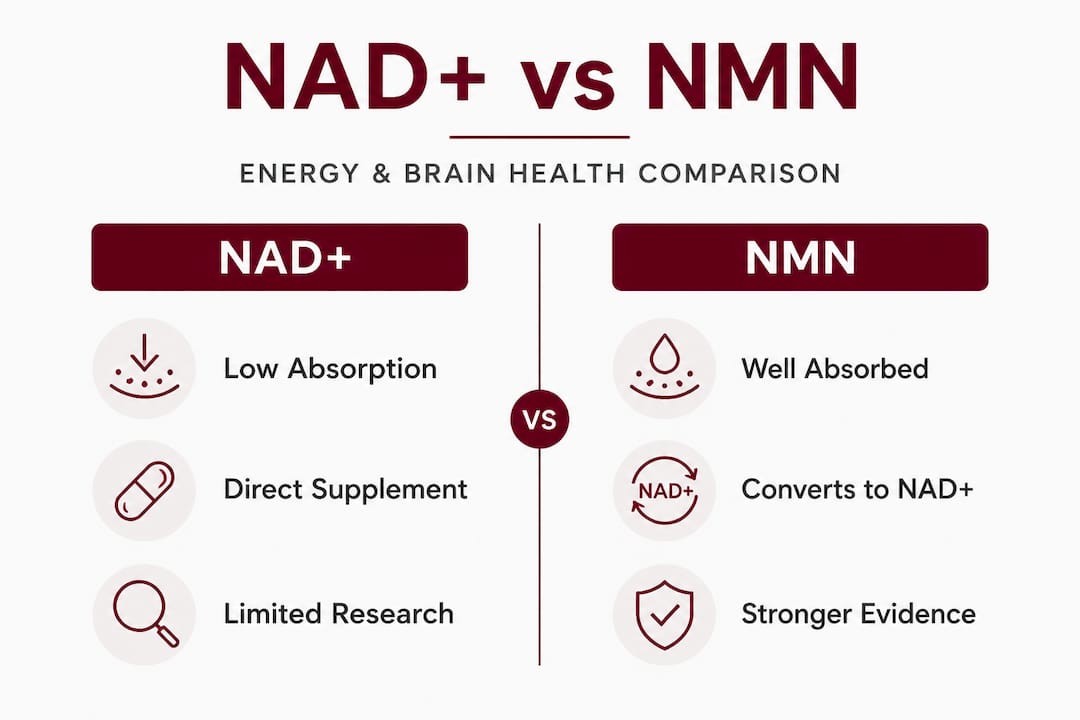
The goal of supplementation is simple: raise NAD+ levels back toward youthful ranges. But how you do that matters enormously. Direct oral NAD+ supplements show low bioavailability of 10 to 20%, meaning most of what you swallow never reaches your cells. That’s a real problem, and it’s why understanding what is NMN and how it works as a precursor is so important before you spend another dollar.
NMN vs NAD+ supplements: Mechanisms and bioavailability
Now that you understand the goal, let’s look at how these two supplement strategies actually work inside your body.
Direct NAD+ supplementation sounds straightforward. Take NAD+, raise NAD+. But the molecule itself is large and doesn’t cross cell membranes easily. When you swallow an NAD+ capsule, most of it gets broken down in the gut before it ever reaches the bloodstream, let alone your cells. That 10 to 20% bioavailability figure is not a rounding error. It means 80 to 90% of a typical dose is wasted.
NMN (nicotinamide mononucleotide) takes a different route. It’s a direct precursor to NAD+, meaning your body uses it as a building block to synthesize NAD+ inside cells. NMN is smaller and more readily absorbed in the small intestine, and recent research suggests it can enter cells via a dedicated transporter protein called Slc12a8. This gives NMN a meaningful absorption advantage over direct NAD+.

Here’s a side-by-side look at how the two compare:
| Feature | NAD+ supplement | NMN supplement |
|---|---|---|
| Bioavailability (oral) | 10 to 20% | Significantly higher |
| Absorption route | Gut breakdown, poor uptake | Small intestine transporter |
| Intracellular NAD+ increase | Modest without delivery tech | Consistent 40 to 60% increase |
| Research in humans | Limited | Multiple RCTs published |
| Cost-effectiveness | Lower due to poor absorption | Better value per effective dose |
There’s also an interesting gut microbiome angle. Research published in Nature Metabolism shows that NMN may act via gut microbiota conversion to nicotinic acid (NA), then raising NAD+ through the Preiss-Handler pathway. This means your gut health isn’t just a side consideration. It may actually influence how well your NMN supplement works.
“Precursors like NMN are preferable for oral use. Liposomal NAD+ may improve uptake, but NMN remains the more evidence-backed oral option for most people.”
One exception worth noting: liposomal NAD+ delivery systems wrap the NAD+ molecule in a fat-based carrier to improve absorption. One study found a 64% increase in intracellular NAD+ with liposomal NAD+. That’s promising, but this technology is newer, less standardized, and more expensive. For most people optimizing their mitochondrial health, NMN remains the more practical and reliable choice.
Pro Tip: If you’re comparing NMN products, look for stabilized forms stored away from heat and light. NMN can degrade, and a poorly stored product may deliver far less than the label claims.
Human studies: Benefits and limitations of NMN and NAD+ supplementation
Animal studies on NAD+ precursors are impressive. Mice live longer, run faster, and show better metabolic markers. But you’re not a mouse, so let’s talk about what the human data actually shows.
Multiple randomized controlled trials (RCTs) have tested NMN in humans, with doses typically ranging from 250 to 900mg per day. The results are genuinely encouraging, though not without caveats.
What human trials have shown:
- NMN raises blood NAD+ by 40 to 60% in most participants, which is a consistent and meaningful increase.
- Improved muscle insulin sensitivity in older adults, a key marker for metabolic health and healthy aging.
- Better walking speed and grip strength in some trials, suggesting real-world functional improvements.
- Modest improvements in antioxidant and longevity markers in several studies.
What hasn’t been proven yet:
- No human study has shown that NMN or NAD+ supplementation extends lifespan. That’s a hard fact, and anyone telling you otherwise is overselling the science.
- Cognitive benefits in humans are less consistent than physical ones. Some participants report better focus and mental clarity, but the controlled data is mixed.
- Empirical data shows consistent NAD+ elevation but functional benefits vary significantly between individuals.
This doesn’t mean NMN isn’t worth taking. It means you should take it with realistic expectations. The evidence for energy, metabolic function, and physical performance is solid. The evidence for dramatic cognitive transformation or life extension is not there yet. If you want to support cellular energy through a well-studied mechanism, NMN is a reasonable and evidence-backed choice.
| Outcome | Evidence level | Notes |
|---|---|---|
| Blood NAD+ increase | Strong | Consistent across multiple RCTs |
| Insulin sensitivity | Moderate | Particularly in older adults |
| Physical performance | Moderate | Walking speed, grip strength |
| Cognitive function | Weak to moderate | Mixed results in human trials |
| Longevity extension | Not proven | No human RCT data yet |
The honest summary: NMN does what it says on the label. It raises NAD+. Whether that translates into the specific outcomes you’re chasing depends on your baseline, your lifestyle, and your overall supplement stack. You can also explore the NMN science guide for a deeper breakdown of the research.
Safety, side effects, and who should avoid these supplements
One of the things I respect about the NMN and NAD+ research base is that safety has been studied reasonably well for a supplement category. You’re not flying blind here.
General safety profile:
Both NMN and NAD+ precursors are well-tolerated in trials up to 1200mg per day, with no serious adverse events reported in published studies. That’s reassuring. Most people who experience any side effects describe them as mild and short-lived.
Common side effects include:
- Nausea: Affects roughly 5 to 15% of users, typically at higher doses or when taken on an empty stomach.
- GI upset: Bloating or loose stools, usually resolving within the first week of use.
- Headache: Less common, often linked to the initial increase in cellular metabolism.
- Flushing: More commonly associated with niacin (a related compound) but occasionally reported with NMN at high doses.
Most of these effects are dose-dependent. Starting low and building up gradually reduces the likelihood of experiencing them.
Pro Tip: Take NMN with food, especially if you have a sensitive stomach. Starting at 250mg per day for the first two weeks before increasing your dose is a practical way to assess your tolerance.
Who should be cautious:
- Cancer patients or survivors: NAD+ supports cellular energy production broadly, which theoretically could fuel rapidly dividing cancer cells. No human study has confirmed this risk, but the precautionary principle applies. Always consult your physician before starting NAD+ precursors if you have a cancer history.
- Pregnant or breastfeeding individuals: Safety data in these populations is essentially nonexistent. Avoid until more is known.
- People on medications: NMN may interact with certain drugs that affect metabolism. Check with your doctor if you’re on prescription medications.
For most healthy adults looking at supplement alternatives and safety, NMN is a low-risk addition to a thoughtful wellness stack. If you want a product that combines NMN with complementary ingredients in a well-formulated dose, the NAD+ advanced supplement is worth looking at.
How to choose and use NMN or NAD+ supplements
Alright, you’ve got the science. Now let’s talk about what to actually do with it.
-
Start with NMN, not direct NAD+. Given the bioavailability data, NMN is the more logical oral supplement for raising intracellular NAD+. Unless you’re using a high-quality liposomal NAD+ product, direct NAD+ is likely giving you a fraction of the benefit you’re paying for.
-
Dose at 250 to 500mg per day to start. This is the evidence-backed starting dose supported by multiple human trials. Some biohackers go higher, but the marginal benefit above 500mg per day isn’t clearly established. More isn’t always better.
-
Take it in the morning. NAD+ is involved in circadian rhythm regulation. Morning dosing aligns with your body’s natural NAD+ fluctuation patterns and may support better sleep quality compared to evening dosing.
-
Consider stacking with TMG (trimethylglycine). NMN conversion to NAD+ consumes methyl groups. TMG replenishes these, preventing potential methyl depletion with long-term use. This is a practical and inexpensive addition to your stack.
-
Prioritize third-party tested products. The supplement industry has a quality problem. A product that claims 500mg NMN per capsule may deliver far less if it’s not independently verified. Look for certificates of analysis (COAs) from third-party labs. This is non-negotiable for anything you’re putting in your body daily.
-
Be patient. NAD+ levels don’t spike overnight. Most studies show meaningful increases after four to eight weeks of consistent supplementation. Track how you feel over time, not day to day.
For a broader view of how NMN fits into a wellness and cognitive performance strategy, it’s worth thinking about the full picture, not just one molecule.
Our take: Why NMN, not NAD+, is usually the smarter choice
Here’s my honest perspective after going deep on this research.
The supplement industry loves a simple story. “Take NAD+, get more NAD+.” It’s clean, it’s marketable, and it’s mostly wrong for oral supplementation. Most people don’t realize that the NAD+ molecule itself is too large and too fragile to survive the gut intact in meaningful quantities. So they buy expensive direct NAD+ products, feel a vague sense that something is happening, and never question whether the delivery method actually works.
NMN is the superior oral supplement for boosting NAD+ levels, and the evidence for that is now fairly clear. It’s not hype. It’s biochemistry. NMN gets into your cells more efficiently, converts to NAD+ where it’s actually needed, and has the human trial data to back up the mechanism.
What frustrates me is that this information isn’t hard to find, but most supplement companies don’t explain it clearly because direct NAD+ products often carry higher margins. That’s formulas designed for a marketing deck, not for the person swallowing them.
The nuanced truth is this: NMN isn’t magic. It raises NAD+. What you do with that elevated NAD+ still depends on sleep, exercise, diet, and stress management. Supplements work best when they support a solid foundation, not replace one. But if you’re going to add an NAD+ precursor to your stack, choose the one that actually gets absorbed. For advanced supplements that boost cognition without stimulants, NMN combined with the right co-factors is where the real leverage is.
Ready to optimize your energy and cognition?
If you’ve made it this far, you’re already thinking more clearly about NAD+ supplementation than most people who’ve been taking supplements for years. That’s the point. Understanding the science means you can make real choices, not just respond to marketing.
At CP-1, we’ve built our formulas around this exact principle: ingredients that work at the cellular level, dosed at evidence-backed amounts, and verified by third-party testing. Our NAD+ Advanced Supplement is designed for people who want more than a label claim. It’s for people who want to actually feel the difference in their energy, focus, and long-term resilience. Vegan, non-GMO, and manufactured to the standards you deserve.
Frequently asked questions
Is NMN more effective than NAD+ for boosting NAD+ levels?
Yes, research consistently shows NMN raises blood NAD+ more effectively than direct oral NAD+ supplements because direct oral NAD+ shows low bioavailability of only 10 to 20%, making NMN precursors the preferable oral option.
Can NMN or NAD+ supplements really improve cognitive function?
They may modestly support cognition by boosting cellular energy, but current human trials show mixed functional benefits with more consistent results in physical performance markers like insulin sensitivity and muscle strength than in cognitive outcomes.
What are the main side effects of NMN and NAD+ supplements?
Most people tolerate them well, but mild digestive discomfort, nausea, or headache can occur, particularly at higher doses. Both NMN and NAD+ precursors are well-tolerated up to 1200mg per day with no serious adverse events reported in published trials.
Should cancer patients use NMN or NAD+ supplements?
People with current or past cancer diagnoses should consult their physician before using NAD+ precursors, as long-term safety data remains limited and theoretical concerns about cellular energy support in cancer contexts warrant medical guidance.
Are liposomal NAD+ supplements worth considering?
Liposomal formulations may significantly improve NAD+ absorption, with one study showing a 64% increase in intracellular NAD+, but more standardized data is needed and NMN remains the more widely studied and reliable oral option for most people.