

NAD Versus NMN: Which Supplement Actually Works?
NAD+ is defined as the coenzyme your cells use to convert food into energy, repair DNA, and regulate aging at the molecular level. NMN, or Nicotinamide Mononucleotide, is a direct precursor that your body converts into NAD+ inside the cell. The nad versus nmn debate has moved from fringe biohacker forums into serious clinical research, and the answer is more nuanced than most supplement brands will tell you. Both compounds raise NAD+ levels. The real question is which precursor gets you there more reliably, safely, and at a formulation quality worth paying for.
What is the biochemical difference between NAD+ and NMN?
NAD+ and NMN are not interchangeable molecules. They sit at different points on the same biosynthetic pathway, and that distinction matters enormously for how you supplement.
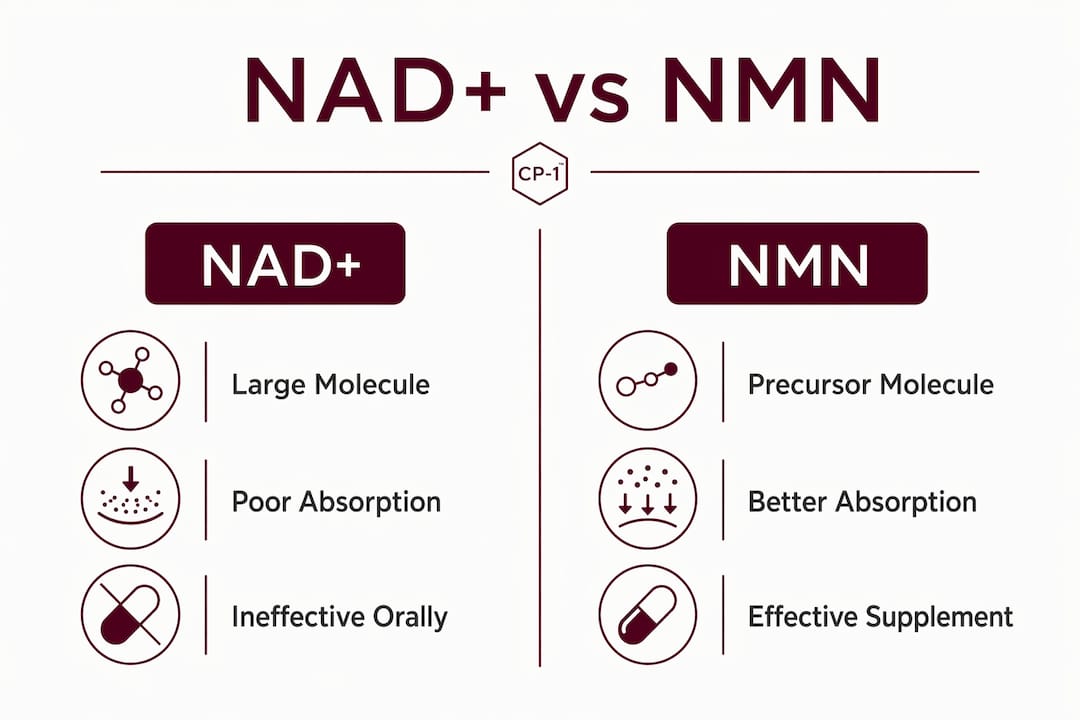
NAD+ itself is a large molecule. Oral NAD is poorly absorbed and broken down during digestion before it can reach your cells intact. Swallowing a NAD+ capsule does not meaningfully raise intracellular NAD+ levels. This is why precursors exist.

NMN sits one biosynthetic step away from NAD+. The enzyme NMNAT converts NMN directly into NAD+ inside the cell. More specifically, NMN uses a dedicated transporter called SLC12A8 for direct cell entry in certain tissues, which distinguishes it from NR (Nicotinamide Riboside). NR relies on nucleoside transporters and requires two enzymatic steps to reach NAD+. That makes NMN biochemically closer to the target.
Here is what that means practically:
- NAD+ taken orally is largely wasted. It does not survive digestion in a form your cells can use.
- NMN enters certain cells directly via SLC12A8 and converts to NAD+ in one step via NMNAT.
- NR converts to NMN first, then to NAD+, adding one extra enzymatic step.
Pro Tip: If you are comparing NAD vs NMN supplements on a store shelf, ignore any product selling oral NAD+ as a primary active ingredient. The precursor route is the only one with meaningful absorption evidence behind it.
How do NMN and NR compare at raising NAD+ levels?
This is where the NAD and NMN comparison gets genuinely interesting, because 2026 delivered the most direct head-to-head data yet.
A 2026 randomized trial in 65 adults compared NMN and NR directly in a placebo-controlled, open-label design. After 14 days, both precursors produced comparable increases in circulatory NAD+ levels. Neither showed clear superiority on the primary endpoint. That result is significant because it tells you the biochemical advantage NMN holds on paper does not automatically translate into a measurable clinical edge over NR at standard doses.
NR has the longer track record. NR’s human safety and efficacy trials date back to 2016, and NR holds both FDA GRAS status and EFSA clearance. NMN’s human trial database is smaller but growing fast. The 2026 trial adds meaningful weight to NMN’s evidence base.
| Factor | NMN | NR |
|---|---|---|
| Biosynthetic steps to NAD+ | 1 (via NMNAT) | 2 (via NMN intermediate) |
| Dedicated cell transporter | Yes (SLC12A8) | No |
| Human trial depth | Growing (2026 RCT) | Extensive (since 2016) |
| Regulatory status (US) | Lawful dietary supplement (2025) | FDA GRAS approved |
| 14-day NAD+ increase vs. placebo | Comparable to NR | Comparable to NMN |
Pro Tip: Do not choose between NMN and NR based on theoretical pathway advantages alone. The 2026 trial shows they perform similarly in practice. Focus instead on the regulatory clarity and formulation quality of the specific product you are buying.
What practical factors should drive your supplement choice?
The NAD vs NMN supplements decision is not purely a science question. Regulatory status, formulation quality, and consistency of use shape real-world outcomes more than most people realize.
On the regulatory front, NMN had a complicated few years in the US. The FDA initially restricted NMN’s dietary supplement status in 2022. That changed when the FDA confirmed NMN is lawful as a dietary supplement as of September 2025, based on evidence that NMN was marketed prior to any new drug investigation authorization. This matters because it directly affects which products can legally be sold and how manufacturers can label them.
Formulation quality is where most supplements fail. NMN is sensitive to heat, moisture, and light. A product that was not manufactured under controlled conditions or tested for potency at the time of consumption may deliver far less active NMN than the label claims. Third-party testing, US-based manufacturing, and transparent certificates of analysis are not marketing extras. They are the baseline for a product worth taking.
Consistency beats precursor selection every time. Successful NAD+ precursor supplementation depends on consistent daily use and formulation integrity more than which precursor you choose. A high-quality NR product taken daily will outperform a degraded NMN product taken sporadically.
When evaluating any NAD or NMN for energy supplement, ask these questions:
- Does the manufacturer publish third-party certificates of analysis?
- Is the product manufactured in a cGMP-certified US facility?
- Does the label specify the form of NMN or NR and the dose per serving?
- Is the packaging designed to protect against moisture and light degradation?
What does current research say about NAD+ for longevity and cognition?
The honest answer is that the science is promising but not yet definitive. NAD+ plays a documented role in energy metabolism, DNA repair, and mitochondrial function. The Cleveland Clinic notes that while these mechanisms are real, no established longevity outcomes in humans have been confirmed. That gap between mechanism and outcome is where most of the supplement industry’s overclaiming lives.
The 2026 media coverage around NAD+ supplements is instructive. Experts are clear that current excitement is based on preliminary NAD+ elevation data and mechanistic biomarker research, not proven lifespan extension. Marketers are running well ahead of the evidence, and that should make any serious biohacker skeptical of dramatic claims.
What the research does support, with reasonable confidence:
- NAD+ levels decline with age, and precursor supplementation raises circulating NAD+ in humans.
- Short-term NMN supplementation shows early signals for improved endurance and metabolic markers.
- Multiple health authorities recommend treating NAD+ precursors as biomarker enhancers, not proven anti-aging drugs, pending larger trials.
- Cognitive enhancement data from NMN is preliminary. The mechanistic case is plausible, but human cognitive outcome trials are still limited.
The realistic use case for a biohacker in 2026 is this: you are investing in a well-supported mechanism with a growing evidence base, not a proven longevity drug. That is a reasonable bet. It is not a guarantee.
How can biohackers optimize NAD+ precursor supplementation?
Getting real value from NMN or NR supplementation requires more than buying a bottle and hoping for the best. Here is a practical framework worth following.
-
Test your baseline NAD+ blood levels before starting. Baseline NAD+ levels vary significantly between individuals, and your starting point determines how much room for improvement exists. Without a baseline, you cannot know whether a supplement is working.
-
Run a defined supplementation window of 8 to 12 weeks. Short-term exposure with re-testing gives you actual data on your personal response. Some people are strong responders. Others see minimal NAD+ elevation. You need to know which category you fall into before committing long-term.
-
Evaluate your supplier’s transparency rigorously. Check for third-party testing, lot-specific certificates of analysis, and clear manufacturing disclosures. A supplement with no verifiable quality documentation is a gamble, not a protocol.
-
Stack NAD+ precursors with lifestyle factors that support mitochondrial health. Exercise, particularly resistance training and high-intensity intervals, independently raises NAD+ levels. Sleep quality, caloric restriction, and avoiding chronic alcohol use all protect NAD+ metabolism. Supplementation works best as part of a system, not as a standalone fix.
Pro Tip: If you want to understand the role of NMN in aging more deeply before committing to a protocol, read the mechanistic research first. Knowing why something works helps you use it smarter.
Key takeaways
NMN and NR both raise NAD+ levels comparably in humans, and the choice between them should be driven by formulation quality, regulatory clarity, and consistent daily use rather than theoretical biochemical advantages.
| Point | Details |
|---|---|
| NAD+ oral supplements are ineffective | Oral NAD+ is broken down in digestion and cannot reach cells intact; precursors are required. |
| NMN and NR perform comparably | A 2026 RCT in 65 adults showed no clear winner between NMN and NR on NAD+ elevation after 14 days. |
| NMN is now legally clear in the US | The FDA confirmed NMN’s lawful dietary supplement status in September 2025, resolving prior regulatory uncertainty. |
| Formulation quality determines real-world results | Third-party testing, cGMP manufacturing, and proper packaging matter more than which precursor is on the label. |
| Longevity claims remain preliminary | Current evidence supports NAD+ elevation as a biomarker benefit, not proven lifespan extension in humans. |
My honest read on the NMN versus NAD debate
I have spent a lot of time in this space, and the thing that frustrates me most is how confidently brands talk about NAD+ and longevity when the human outcomes data simply does not support that level of certainty yet. The mechanism is real. The biochemistry is solid. But “this raises your NAD+ levels” and “this extends your life” are two very different claims, and most marketing blurs that line deliberately.
What I have found is that individual variability is the most underappreciated factor in this whole conversation. Two people on the same NMN dose from the same bottle will have meaningfully different NAD+ responses. That is not a product failure. It is biology. The biohackers I respect most treat supplementation as an experiment with a hypothesis, a measurement, and an honest assessment of results. They test before and after. They adjust doses. They switch precursors if the data suggests it.
The 2026 head-to-head trial showing NMN and NR perform comparably is actually reassuring, not disappointing. It means you are not locked into one precursor. You can choose based on regulatory clarity, product quality, and your own tested response. That is a more honest and useful framework than any brand claiming their specific molecule is categorically superior.
My advice: pick a well-formulated product from a transparent manufacturer, test your NAD+ levels, run a real protocol, and let your own data guide the next decision. Cautious optimism, grounded in evidence, is the right posture here.
— Hugo
Why Cp-1 is worth your attention for NAD+ support
If you are serious about NAD+ precursor supplementation, the product you choose matters as much as the precursor you select. Cp-1 is built around exactly this principle. The formula includes NMN alongside coenzyme Q10, lion’s mane mushroom extract, reishi mushroom extract, and turkey tail mushroom extract. These are not filler ingredients. Each one supports a distinct aspect of cellular energy, mitochondrial function, or cognitive resilience.
Cp-1 is manufactured in the US, third-party tested, vegan, and non-GMO certified. If you want to understand the full science behind what you are taking, the Cp-1 NAD+ science guide breaks down the evidence clearly. And if you are ready to explore a supplement built for real NAD+ support, Cp-1 is the place to start.
FAQ
What is the main difference between NAD+ and NMN?
NAD+ is the active coenzyme your cells use for energy and DNA repair, while NMN is a direct precursor that converts into NAD+ inside the cell via the NMNAT enzyme. Oral NAD+ supplements are poorly absorbed, making NMN the more practical supplementation route.
Which is better, NAD or NMN, for raising cellular NAD+ levels?
NMN is the better supplementation choice because oral NAD+ cannot survive digestion intact. A 2026 randomized trial showed NMN and NR both raise circulatory NAD+ comparably after 14 days, with neither showing clear superiority.
Is NMN legal to buy in the United States?
Yes. The FDA confirmed NMN’s lawful status as a dietary supplement in September 2025, reversing its 2022 restriction. NMN can now be legally sold and purchased as a supplement in the US.
What is a realistic NAD+ and NMN dosage for biohackers?
Most human trials use NMN doses ranging from 250 mg to 1,000 mg per day. Testing your baseline NAD+ blood levels before starting and re-testing after 8 to 12 weeks gives you the data needed to determine your personal effective dose.
Can NMN supplements improve cognitive function?
Preliminary data suggests NMN may support cognitive function through NAD+ elevation and mitochondrial energy support, but definitive human cognitive outcome trials are still limited. The Cleveland Clinic classifies current NAD+ research as developing rather than conclusive.