A short, step-by-step daily program of micro-practices can increase your stress resilience within weeks. You don’t need a therapist, a retreat, or a two-hour morning routine. You need a repeatable sequence you can actually stick to, starting today.
Here’s the quick blueprint:
- Morning baseline (5 minutes): One minute of slow breathing, two minutes of journaling three things you can control today, two minutes of light movement.
- Micro-practices during the day (60–90 seconds each): A brief downshift after every major transition — meeting ends, lunch break, commute.
- In-the-moment resets: When stress spikes, use a 30-second physiological sigh or the 5-4-3-2-1 grounding technique.
- Evening discharge (10 minutes): Write down what went well, name one stressor you’re setting aside until tomorrow, and do a short body scan.
- Weekly progressive challenge: Each week, add one small voluntary stressor (a hard conversation, a new task) to expand your tolerance range.
Quick-action checklist — do these right now:
- Set a consistent wake time for tomorrow morning.
- Pick one transition in your day where you’ll add a 60-second breathing reset.
Pro Tip: Don’t try to install all five steps at once. Pick Step 1 only for the first week. Adding too much too fast is the single most common reason people abandon resilience programs before they see results.
Key Takeaways
Building stress resilience step by step means starting with one small daily anchor, adding practices incrementally each week, and using fast in-the-moment tools when stress spikes.
| Point | Details |
|---|---|
| Start with one step | Install the morning baseline only in Week 1 before adding midday or evening practices. |
| Track three wins per week | Measure consistency, not perfection — three completed practices per week is the target metric. |
| Use fast resets immediately | The physiological sigh and 5-4-3-2-1 grounding work in under 90 seconds when stress spikes. |
| Seek help at clear thresholds | If function declines for two or more weeks, contact 988 or use the SAMHSA treatment locator. |
| Cp-1 as cellular support | Cp-1’s NMN, Lion’s Mane, and CoQ10 formula supports the energy and clarity that resilience practices depend on. |
Table of Contents
- What is stress resilience, and why does it matter for adults?
- How to build stress resilience step by step
- Daily foundations that make resilience possible
- How to change your thinking under pressure
- Quick resets you can use in under two minutes
- How to build and use social support
- When is it time to get professional help?
- What the evidence actually says about this program
- A note on pace, limits, and self-compassion
- What Cp-1 offers as a complementary support
- Sources
What is stress resilience, and why does it matter for adults?
Resilience is not a personality trait you either have or don’t. The American Psychological Association defines it as a process of adapting well in the face of adversity, trauma, or significant stress — and critically, it’s a capacity that can be developed over time through intentional self-care like sleep, nutrition, and regular exercise.
That framing matters. You’re not trying to become a different person. You’re training a set of skills, the same way you’d train a muscle. Skip the gym for two weeks and you lose some strength. Train consistently and you get stronger. Resilience works the same way.
The NIH’s Office of Research on Women’s Health outlines seven practical steps for managing stress and building resilience, all of which are grounded in recognizing your signals, prioritizing self-care, and staying connected. None of them require a dramatic life overhaul. That’s the point.
How to build stress resilience step by step
This is the core program. It’s organized by time of day and by week so you always know exactly what to do next.
The five-step daily program
-
Recognize your signals. Before you can regulate stress, you need to notice it. Tight shoulders, shallow breathing, irritability, or a racing mind are all early signals. Spend one week just naming them without trying to fix anything.
-
Morning baseline (5 minutes). Start each day with a brief anchor: one minute of slow breathing (four counts in, six counts out), two minutes writing three things within your control today, and two minutes of movement — a short walk, stretching, or jumping jacks.
-
Midday micro-practices (60–90 seconds). After every major transition — a meeting, a difficult call, lunch — take 60–90 seconds to downshift. This signals safety to your nervous system so your brain can return to flexible thinking rather than staying stuck in threat mode.
-
In-the-moment resets. When stress spikes unexpectedly, use a fast tool from the toolkit below. The physiological sigh (double inhale through the nose, long exhale through the mouth) works in under 30 seconds.
-
Evening discharge (10 minutes). Before bed, write down three things that went well today, name one stressor you’re consciously setting aside until tomorrow, and do a brief body scan from head to feet. This prevents stress from accumulating overnight and protects long-term cognitive function.
Weekly progression timeline
| Week | Focus | Simple metric |
|---|---|---|
| Week 1 | Morning baseline only | Did it 5 of 7 days? |
| Week 2 | Add midday micro-practices | 3 transitions downshifted per day |
| Week 3 | Add evening discharge | Completed 5 of 7 evenings |
| Week 4 | Add one voluntary stressor | One small challenge attempted |
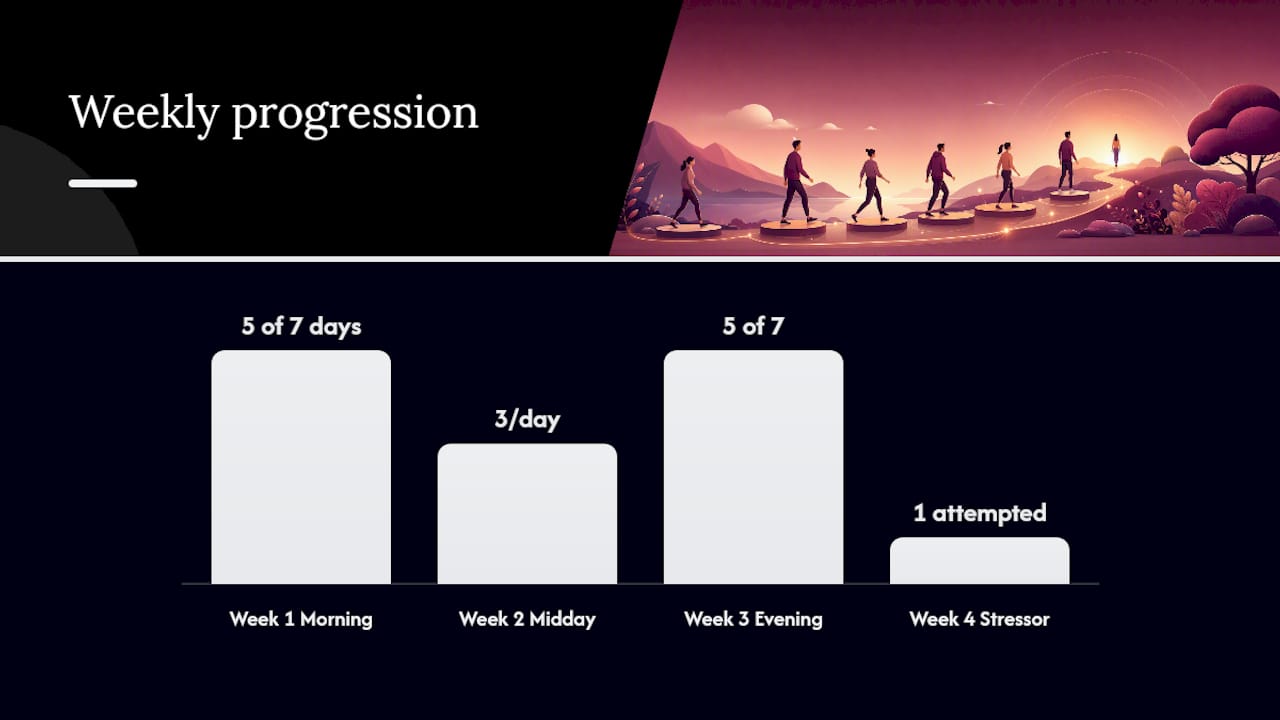
Track three small wins per week. Not perfect execution — three wins. That’s the bar.
Daily checklist (copy this):
- Morning breathing: done / skipped
- Three controllables written: done / skipped
- Midday downshift: done / skipped
- Evening discharge: done / skipped
Pro Tip: If you miss a day, don’t restart the week. Just pick up where you left off. Resilience training is not a streak — it’s a practice.
Daily foundations that make resilience possible
The micro-practices above only work if your baseline capacity is solid. Think of sleep, nutrition, movement, and hydration as the floor. Without them, even the best techniques feel like pushing through mud.
Sleep
Go to bed and wake up at the same time every day, including weekends. Start a 30–60 minute wind-down before bed: dim the lights, put the phone down, and do something low-stimulation. Consistent sleep timing is one of the most reliable ways to regulate the stress-response system.
Nutrition and hydration
Eat protein at every meal. Skipping it causes blood sugar swings that amplify stress reactivity. Drink water before coffee in the morning. A simple rule: if you feel irritable or foggy before noon, drink a glass of water before assuming it’s stress.
Movement
Aim for some daily moderate movement. It doesn’t have to be a gym session. A brisk walk, cycling, or a brief dance break counts. If your schedule is tight, micro-movement works: stand and stretch for two minutes every hour. Natural energy support routines that pair movement with consistent sleep timing tend to compound over time.

Sample daily schedule
| Time | Action | Duration |
|---|---|---|
| — | Wake, water, morning baseline | brief |
| — | Post-meeting downshift | brief |
| 12:00 PM | Lunch away from screen | moderate |
| 3 PM | Micro-movement break | brief |
| 9 PM | Wind-down begins | extended |
| — | Evening discharge | brief |
Dos and don’ts:
- Do set a phone alarm for your wind-down start time.
- Do eat something within 90 minutes of waking.
- Don’t use alcohol as an evening discharge tool — it disrupts sleep architecture and raises baseline cortisol.
- Don’t skip movement on high-stress days. Those are exactly the days it helps most.
Pro Tip: Pair each new habit with something you already do. Morning breathing after you pour your coffee. Evening discharge after you brush your teeth. Habit stacking cuts the friction in half.
How to change your thinking under pressure
Cognitive tools don’t require a therapist or a workbook. They require a simple template you can run in your head in about two minutes.
The reframing template: Fact → Story → Alternative → Next Step
Most stress is amplified by the story we tell about a fact, not the fact itself. Here’s how to interrupt that loop:
- Fact: What actually happened? (State it in one sentence, no interpretation.)
- Story: What am I telling myself about it?
- Alternative: What’s another plausible explanation?
- Next Step: What’s one small thing I can do right now?
Worked example: Your manager didn’t respond to your email for two days.
- Fact: No reply in 48 hours.
- Story: They’re angry with me, or my work isn’t valued.
- Alternative: They’re in back-to-back meetings and haven’t caught up on email.
- Next Step: Send a brief follow-up today.
Harvard Health notes that resilient people tend to show calm, flexible thinking and decisiveness under pressure — and that these traits can be cultivated through targeted practice, not just inherited.
Problem-solving checklist for vague worries
- Write the worry in one sentence.
- Ask: Is this within my control?
- If yes: What’s the smallest next action?
- If no: Can I reduce exposure to this stressor?
- If neither: Practice acceptance (see below).
When acceptance beats problem-solving
Some stressors can’t be fixed. A chronic illness, a difficult family situation, a systemic barrier at work. Trying to problem-solve the unsolvable burns energy and increases frustration. Acceptance isn’t giving up — it’s choosing where to spend your limited cognitive resources. Redirect that energy toward what you can influence.
Pro Tip: Run the reframing template on paper the first few times, not just in your head. Writing it out slows the rumination loop and makes the alternative story feel more real.
Quick resets you can use in under two minutes
These tools work when stress spikes mid-day and you don’t have time for a full practice. Each one signals safety to your nervous system fast.
Five micro-tools with step-by-step instructions
-
Physiological sigh (30 seconds)
- Inhale fully through the nose.
- Take a second short inhale on top of the first (a “double inhale”).
- Exhale slowly and completely through the mouth.
- Repeat twice. This deflates air sacs in the lungs and activates the parasympathetic system faster than a standard slow breath.
-
Extended exhale breathing (60 seconds)
- Inhale for four counts.
- Exhale for six to eight counts.
- Repeat for five cycles. The longer exhale activates the vagus nerve and slows heart rate.
-
5-4-3-2-1 grounding (90 seconds)
- Name 5 things you can see.
- Name 4 things you can touch.
- Name 3 things you can hear.
- Name 2 things you can smell.
- Name 1 thing you can taste. This pulls attention out of rumination and into the present moment.
-
Short body scan (2 minutes)
- Close your eyes.
- Start at the top of your head and slowly move attention down to your feet.
- Notice tension without trying to fix it.
- Take one slow breath at each area where you feel tightness.
-
Cold water reset (30 seconds)
- Splash cold water on your face or hold your wrists under cold running water.
- The cold activates the dive reflex and slows heart rate quickly.
When to use each:
- Stress spike in a meeting: physiological sigh (invisible, silent).
- Anxious before a presentation: extended exhale breathing.
- Spiraling thoughts at your desk: 5-4-3-2-1 grounding.
- End of a hard day: body scan.
- Sudden anger or panic: cold water reset.
Automaticity checklist: Practice each tool once per day for five days before you need it under pressure. Skills used for the first time in a crisis rarely work well.
How to build and use social support
Social connection is one of the most consistently supported resilience factors across the research. It’s also the one people most often skip because asking for help feels uncomfortable or like a burden.
Map your support network
Draw three columns on a piece of paper:
- Emotional support: Who can you call when you’re struggling? (Friend, family member, therapist)
- Practical support: Who can help with tasks when you’re overwhelmed? (Neighbor, colleague, family)
- Professional support: Who provides structured guidance? (Therapist, doctor, coach)
If any column is empty, that’s the gap to address first.
Scripts for asking for help
Asking for help doesn’t require a long explanation. These work:
- “I’m going through a hard stretch. Can we talk for 20 minutes this week?”
- “I’m feeling stretched thin. Would you be able to help me with [specific task]?”
- “I just need someone to listen right now, not to fix anything.”
Building connection when your network is thin
Join a structured group: a running club, a community class, a faith community, a peer support group. Consistency matters more than depth at first. Showing up to the same place weekly builds familiarity faster than you’d expect. Online communities can fill gaps when geography or schedule is a barrier.
Mind UK is direct about this: systemic factors like discrimination, financial stress, and lack of access to support make resilience harder for many people. If your network is thin because of structural barriers — not personal failure — the realistic workaround is to start with one professional resource (a community mental health center, a peer support line) rather than waiting for an organic social network to appear.
When is it time to get professional help?
Self-directed resilience practices are real and effective. They’re also not a substitute for professional care when the situation calls for it. Here’s a simple decision checklist.
Seek professional help if you notice:
- You’ve been unable to work, care for yourself, or manage daily tasks for more than two weeks.
- You’re using alcohol, substances, or other behaviors to cope daily.
- You’re having thoughts of harming yourself or others.
- Sleep, appetite, or concentration have been severely disrupted for more than two weeks.
- You feel hopeless or numb most of the time, not just on hard days.
Any one of these is enough. You don’t need to check all five.
U.S. crisis resources
- 988 Suicide and Crisis Lifeline: Call or text 988 (available 24/7 in the U.S.). This line is for anyone in emotional distress, not only suicidal crises.
- National Disaster Distress Helpline: Call or text 1-800-985-5990 for trauma and disaster-related distress. Trauma-informed care guidance is also available through federal resources linked by NIH.
- Crisis Text Line: Text HOME to 741741.
How to find ongoing care
Use SAMHSA’s treatment locator to find mental health and substance-use providers near you. Enter your zip code, select “Mental Health” as the service type, and filter by insurance if needed. When you call a provider, ask: “Do you have availability in the next two weeks?” and “Do you accept [your insurance]?” Those two questions cut through most of the friction.
What the evidence actually says about this program
The honest answer is that the evidence base is strong for some elements and more limited for others.
Well-supported:
- Sleep and exercise have the most consistent evidence for reducing stress reactivity and improving emotional regulation. The APA’s resilience guidance specifically names sleep, nutrition, and exercise as core self-care pillars.
- Social connection is robustly associated with resilience across decades of research.
- Cognitive reframing (the basis of CBT) has strong clinical trial support for reducing anxiety and depression symptoms.
- Brief breathing practices have a growing evidence base, with physiological sigh studies showing measurable reductions in self-reported stress.
Promising but smaller evidence base:
- Micro-practice frameworks (morning/midday/evening anchors) are supported by behavioral science principles around habit formation, but large randomized trials on this specific structure are limited.
- Grounding techniques like 5-4-3-2-1 are widely used in trauma-informed care and show clinical utility, though most studies are small.
Mind UK’s guidance adds an important caveat: not all stressors are solvable through mindset or practice alone. Structural factors — poverty, discrimination, unsafe environments — require structural solutions. A resilience program is most effective when basic safety and stability are in place.
Pro Tip: Don’t wait for perfect evidence before starting. The practices with the strongest backing (sleep, movement, breathing, connection) are also the lowest-risk. Start there and add the rest as you build capacity.
A note on pace, limits, and self-compassion
Here’s what I want you to take away from this: small is not a compromise. Small is the strategy.
Most people who try to build resilience fail not because the tools don’t work, but because they set the bar too high and then feel like failures when life gets in the way. The research is clear that consistent micro-practices integrated into existing routines outperform large, one-off self-improvement projects almost every time.
Some of you are reading this while dealing with things that go beyond what a breathing exercise can touch. Discrimination, financial pressure, caregiving without support — these are real structural barriers, and Mind UK acknowledges them directly. If that’s your situation, the most humane starting point is physiological: food, rest, safety. Growth comes after stability, not instead of it.
Start with the 60-second downshift. Just that. Do it for a week. That’s enough.
What Cp-1 offers as a complementary support
If you’ve built the daily foundations — consistent sleep, movement, nutrition, and micro-practices — and you’re looking for adjunctive cellular support, Cp-1’s NAD+ Advanced Supplement is worth knowing about.
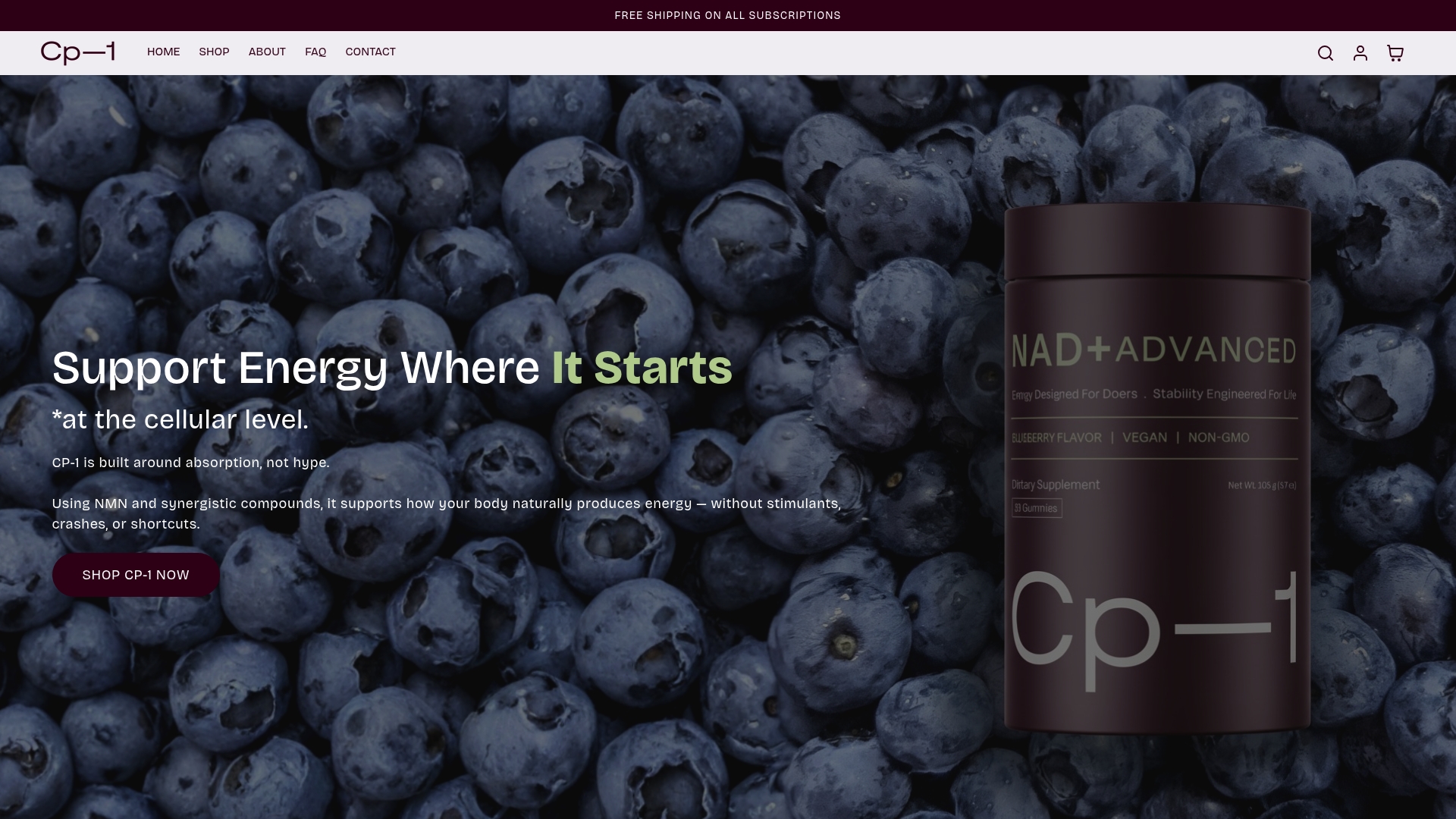
Cp-1 is a chewable gummy containing NMN (Nicotinamide Mononucleotide), Lion’s Mane mushroom extract, Reishi, Turkey Tail, and CoQ10. These ingredients are included for their roles in supporting NAD+ production, mitochondrial energy, cognitive clarity, and immune function — areas that directly underpin your capacity to handle stress day after day. The formula is vegan, non-GMO, GMP-certified, and manufactured in the United States.
This is not a substitute for therapy, professional care, or the behavioral practices in this article. If you’re in crisis, use the resources in the section above. But if your foundations are solid and you want to support the cellular energy that makes those foundations easier to maintain, learn more about Cp-1 here.

Pro Tip: Pair Cp-1 with your morning baseline routine. Taking it at the same time each day, alongside your breathing practice and water, builds the habit automatically and supports the role of supplements in stress management without adding friction to your morning.
Sources
These are the primary U.S. and international resources referenced in this article. All are free to access.
- Building your resilience - American Psychological Association (APA)
- 7 Steps to Manage Stress and Build Resilience (ORWH) - NIH
- Bouncing back from stress - Harvard Health
- Managing stress and building resilience - Mind UK
- Findtreatment
How to use SAMHSA’s finder: Go to Findtreatment, enter your zip code, select “Mental Health” under service type, and filter by insurance. Call the listed provider and ask two questions: availability within two weeks, and whether they accept your insurance. That’s the fastest path to care.
Crisis lines: Call or text 988 for the Suicide and Crisis Lifeline. Text HOME to 741741 for the Crisis Text Line. Both are available 24/7 and are not limited to suicidal crises.
This article is for general informational purposes only and is not a substitute for professional medical or mental health advice. Confirm current resources and treatment options with a qualified clinician or primary care provider.