
Immune supplements are defined as micronutrient or botanical preparations that support normal immune function, primarily by correcting deficiencies that impair the body’s defense systems. The role of immune supplements is not to universally “boost” immunity in healthy people. It is to restore the specific nutrients, like vitamin D, zinc, and vitamin C, that your immune system needs to function at baseline. Most people buying immune supplements are solving a real problem. The issue is that most products on the market are formulated for a marketing deck, not for the person swallowing them. This guide cuts through that and gives you what the research actually says.
Which immune supplements have the strongest scientific evidence?
The evidence is not equal across all supplements. Three stand out with consistent clinical backing: vitamin D, zinc, and vitamin C. Each works differently, and each has clear limits.
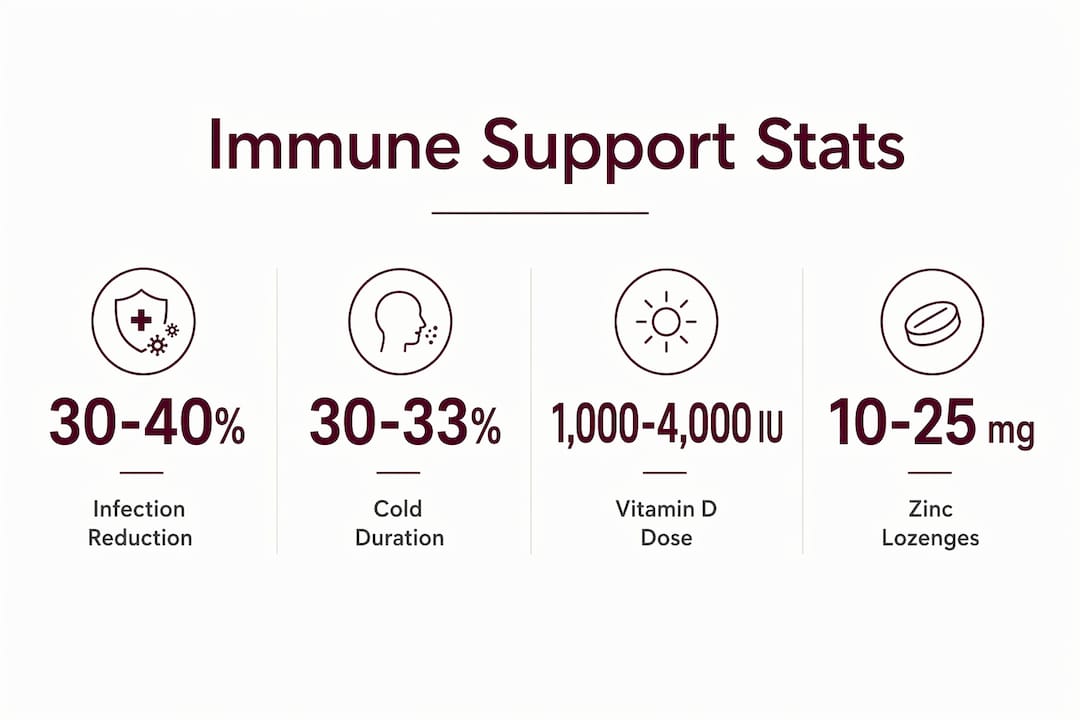
Vitamin D is the most well-supported. Vitamin D reduces respiratory infections by 30–40% in people who are deficient, defined as blood levels below 20–30 ng/mL. That benefit disappears almost entirely in people with adequate levels. The takeaway: vitamin D supplementation is a correction tool, not a performance enhancer.

Zinc works best acutely. Zinc lozenges containing 10–25 mg can cut the duration of a common cold by roughly 30–33%, but only if you take them within 24 hours of symptom onset. Zinc gluconate and zinc acetate are the studied forms. Daily zinc for prevention in healthy people shows no benefit.
Vitamin C is the most overhyped of the three. High-dose vitamin C does not prevent colds in the general population. It may reduce cold incidence by around 8% in athletes under heavy physical stress. That is a narrow benefit for a specific group, not a reason for everyone to megadose.
Beyond these three, a few emerging options show moderate or limited evidence:
- Quercetin: A plant flavonoid with antiviral and anti-inflammatory properties in early research, but human trial data is still thin.
- Elderberry (Sambucus nigra): Some studies show modest reductions in cold duration, but effect sizes are small and study quality varies.
- Bovine colostrum: Contains immunoglobulins and growth factors; preliminary data suggests benefits for gut-associated immunity, but large-scale trials are lacking.
| Supplement | Evidence Level | Primary Benefit | Key Limitation |
|---|---|---|---|
| Vitamin D | Strong | Reduces respiratory infections in deficient individuals | No benefit in non-deficient people |
| Zinc | Strong (acute use) | Shortens cold duration by ~30% | Must be taken within 24 hours of symptoms |
| Vitamin C | Moderate (limited groups) | Modest benefit in high-stress athletes | No general population cold prevention effect |
| Elderberry | Moderate | May shorten cold duration slightly | Inconsistent study quality |
| Quercetin | Emerging | Anti-inflammatory, antiviral potential | Limited human trial data |
| Bovine colostrum | Emerging | Gut-associated immune support | Needs larger trials |
Pro Tip: Before buying any immune supplement, get a blood panel. Knowing your actual vitamin D and zinc levels takes the guesswork out and tells you whether you need to supplement at all.
How do immune supplements biologically support immune function?
The science here is specific, and it matters. These are not vague “wellness” effects. Each key micronutrient has a defined role in immune cell biology.
Vitamin D, zinc, and vitamin C each support distinct immune pathways. Vitamin D regulates immune cell activation and controls inflammatory responses. Without adequate vitamin D, your immune system can overreact or underreact, neither of which is good. Zinc is critical for T-lymphocyte development and cytokine production. T-cells are the immune system’s targeted strike force, and zinc is required to build and deploy them. Vitamin C supports leukocyte chemotaxis, which is the process by which white blood cells move toward infection sites, and it reinforces the epithelial barriers that stop pathogens from entering in the first place.
The concept that ties all of this together is called nutritional immunity. Nutritional immunity describes precise, systems-level regulation of immune function through micronutrients, with the goal of supporting homeostasis rather than overstimulation. Your immune system is not designed to run at maximum capacity all the time. It needs to be calibrated. Micronutrients are part of that calibration system.
Here is what that looks like in practice:
- Vitamin D binds to receptors on macrophages and T-cells, modulating both innate and adaptive immunity.
- Zinc acts as a cofactor for over 300 enzymes, many of which are involved in immune signaling.
- Vitamin C is concentrated in leukocytes at levels 50 times higher than in plasma, showing how actively the immune system uses it.
“The goal of supplementation is immune homeostasis, not immune hyper-activation. More is not better. Correct is better.” — Frontiers in Immunology, 2026
The risk of ignoring this is real. High-dose supplementation can disrupt immune balance and aggravate autoimmune or inflammatory conditions. This is not a theoretical concern. It is a documented outcome in people who supplement without knowing their baseline levels.
What are the limitations and safety considerations?
This is where most supplement articles go soft. They list the benefits and bury the risks. The risks matter, and you deserve the full picture.
Nearly 23,000 emergency room visits annually in the U.S. are linked to supplement use. Most involve drug-supplement interactions or adverse events in people with underlying health conditions. That number should make anyone pause before treating supplements as consequence-free.
Here are the four most important safety principles:
- Test before you supplement. High-dose supplementation offers little benefit in people with adequate nutrient levels and carries real risks of toxicity and immune dysregulation. A simple blood panel for vitamin D and zinc costs less than a month’s supply of most supplements.
- Respect drug interactions. Zinc can interfere with antibiotic absorption. High-dose vitamin C affects iron metabolism. Vitamin D at very high doses can cause hypercalcemia. These are not rare edge cases.
- Avoid the “immune boosting” myth. No supplement boosts a healthy immune system. The phrase is a marketing invention. What supplements can do is restore function in people who are deficient. That is a meaningful but narrower claim.
- Know which populations actually benefit. Older adults, people with limited sun exposure, individuals with malabsorption conditions, and those under chronic physical stress are the groups most likely to see real benefits from supplementation. Healthy adults in their 20s and 30s with a balanced diet are the least likely to notice any effect.
Pro Tip: If you are on any prescription medication, check for interactions at a resource like the NIH Office of Dietary Supplements before adding any new supplement to your routine. This takes five minutes and can prevent a serious problem.
For a deeper look at safety and interaction risks, the immune supplement safety guide from Align Integrated Medical Clinic covers practical protocols worth reviewing.
How to practically integrate immune supplements into your routine
Getting this right comes down to three things: knowing your deficiencies, using the right doses, and not expecting supplements to do the work that lifestyle should be doing.
Start with confirmed deficiencies. This is the single most important step. If your vitamin D is below 20 ng/mL, supplementing at 1,000–4,000 IU per day is well-supported. If your zinc is low, correcting it matters. If your levels are normal, adding more of either provides no measurable immune benefit.
Dosing reference by supplement:
| Supplement | Typical Immune Support Dose | Notes |
|---|---|---|
| Vitamin D | 1,000–4,000 IU/day | Deficiency defined as below 20–30 ng/mL |
| Zinc (daily) | 8–11 mg/day (RDA) | Higher doses not supported for prevention |
| Zinc (acute cold) | 10–25 mg lozenge, every 2 hours | Start within 24 hours of symptom onset |
| Vitamin C | 200–500 mg/day | Higher doses not beneficial for most people |
Timing matters more than dose for zinc. The timing of zinc lozenges is more critical than the total daily dose. Taking zinc 48 hours after symptoms start produces no measurable benefit. This is one of the most misunderstood facts in immune supplementation.
Supplements work best when the rest of your routine supports them. Sleep deprivation suppresses T-cell activity. Chronic stress elevates cortisol, which directly inhibits immune function. A diet low in whole foods creates the deficiencies that supplements are trying to fix. Supplementing on top of poor habits is like patching a tire that keeps going flat.
For mushroom-based immune support, including reishi, lion’s mane, and turkey tail, the evidence on mushroom extracts shows real biological activity worth understanding before you buy.
How do immune supplements fit into a broader immune health strategy?
Supplements are one tool. They are not the foundation. The foundation is built from vaccines, diet, sleep, physical activity, and stress management. Supplements fill gaps in that foundation. They do not replace it.
Micronutrient supplementation in older adults significantly improves immune function, reduces systemic inflammation, and enhances immune cell activity, with vitamin E showing particular effects on cellular immunity in a meta-analysis of 665 older adults. This is the population where supplementation has the clearest, most consistent payoff.
For everyone else, the priority order looks like this:
- Get vaccinated. No supplement replaces the targeted immune memory that vaccines create.
- Eat a diet rich in whole foods, particularly vegetables, legumes, and lean proteins, which provide the micronutrients your immune system needs naturally.
- Sleep 7–9 hours. Sleep is when immune memory consolidates and cytokine production peaks.
- Exercise regularly at moderate intensity. Intense overtraining actually suppresses immune function temporarily.
- Supplement to correct confirmed deficiencies, particularly vitamin D in winter months or low-sun climates, and zinc if dietary intake is consistently low.
Vulnerable populations, including adults over 65, people with autoimmune conditions, those with limited sun exposure, and individuals with gut malabsorption issues, should work with a healthcare provider to identify and correct deficiencies systematically. For a structured approach to this, the longevity supplements checklist from Cp-1 covers micronutrient strategies for long-term immune and cellular health.
The natural supplement space also includes products that address immune health through mechanisms beyond single micronutrients. Understanding how natural immune support products interact with your body’s systems is worth the time before committing to a stack.
Key takeaways
Immune supplements work best as targeted corrections for confirmed deficiencies, not as universal immune boosters for healthy individuals.
| Point | Details |
|---|---|
| Deficiency correction is the goal | Vitamin D, zinc, and vitamin C only show clear benefits when correcting an actual deficiency. |
| Timing determines zinc’s effectiveness | Zinc lozenges must be taken within 24 hours of symptom onset to reduce cold duration. |
| Safety risks are real | Nearly 23,000 annual U.S. ER visits are linked to supplement use, mostly from interactions and misuse. |
| Vulnerable populations benefit most | Older adults, people with low sun exposure, and those under chronic stress see the clearest gains. |
| Lifestyle is the foundation | Supplements cannot compensate for poor sleep, chronic stress, or a nutrient-poor diet. |
My honest read on immune supplements after years of watching this space
I have spent a long time watching people buy immune supplements based on label claims that have no clinical backing. It frustrates me, because the real story is actually useful. The problem is that “corrects a deficiency in people who are deficient” does not sell as well as “supercharges your immune system.”
Here is what I have seen work: people who test their levels, find a real deficiency, correct it with an appropriate dose, and build the rest of their routine around sleep, food, and movement. Those people feel a genuine difference. The people who buy a $40 bottle of mixed immune herbs because they are scared of getting sick in winter? Most of them are wasting money.
The supplement industry has a serious credibility problem. Too many products are designed to exploit anxiety, not to solve a biological problem. I built Cp-1 specifically because I was tired of that pattern. Every ingredient in our formula has a reason to be there, and that reason is not “it sounds good on a label.”
My advice: get a blood panel before you buy anything. If your vitamin D is low, fix it. If your zinc is adequate, do not add more. Respect the biology. Your immune system is not a machine you can overclock. It is a calibrated system that needs the right inputs, not more inputs.
— Hugo
Support your immune health with Cp-1
If you are serious about immune health, the place to start is with products that are built on real science, not marketing copy. Cp-1 formulates every product with ingredients that have documented biological activity, third-party testing, and transparent dosing. No proprietary blends hiding underdosed ingredients. No hype. If you want to understand exactly what you are putting in your body and why, explore the Cp-1 immune health products and the evidence-based guidance behind them. You can also read the full practical immune health guide to build a supplement strategy that actually fits your biology.
FAQ
What are immune supplements exactly?
Immune supplements are vitamins, minerals, or botanical extracts taken to support normal immune function. The most evidence-backed examples include vitamin D, zinc, and vitamin C.
Do immune supplements work for healthy people?
High-dose supplementation offers little benefit in people with adequate baseline nutrient levels. The benefits are clearest in individuals with confirmed deficiencies or those under significant physical stress.
How does vitamin D support the immune system?
Vitamin D regulates immune cell activation and inflammatory responses. It reduces respiratory infection risk by 30–40% in deficient individuals but provides no measurable benefit in those with normal levels.
When should I take zinc for a cold?
Zinc lozenges containing 10–25 mg are most effective when taken within 24 hours of symptom onset. Waiting longer than that eliminates most of the benefit.
Are immune supplements safe to take daily?
Most are safe at recommended doses, but nearly 23,000 ER visits annually in the U.S. are linked to supplement misuse. Always check for drug interactions and confirm your baseline levels before starting any daily supplement routine.