
Supplement transparency is defined as the full, accurate disclosure of every ingredient, its source, its amount, and the testing it has undergone, giving you a complete picture of what you are actually putting in your body. The industry term for this practice is “label transparency,” and it covers everything from FDA-mandated Supplement Facts panels to third-party Certificates of Analysis. Most supplement labels tell you just enough to stay legal. Transparent ones tell you enough to make a real decision. That gap is exactly what this guide addresses.
What is supplement transparency and why does it matter?
Supplement transparency means a brand openly reveals every ingredient by name and amount, discloses sourcing and processing methods, provides third-party testing results, and makes all of that information easy to find and verify. It is not a marketing buzzword. It is a measurable standard, and in 2026, the FDA’s labeling requirements under 21 CFR Part 101 set the legal floor for what must appear on every dietary supplement label.
Those mandatory elements include a statement of identity, net quantity of contents, a Supplement Facts panel, a full ingredient list, and manufacturer contact information. Meeting those five requirements makes a product legal. It does not make it transparent. True transparency goes further: it tells you where the lion’s mane mushroom extract was grown, what extraction ratio was used, which independent lab tested the batch, and what that lab actually found.

The importance of label transparency comes down to safety and trust. You cannot evaluate a product you cannot understand. And with the supplement market flooded with proprietary blends, vague claims, and recycled formulas designed for a marketing deck rather than the person swallowing them, transparency is the single most reliable signal that a brand takes quality seriously.
Core elements of a truly transparent supplement label
A compliant label is the starting point, not the finish line. Here is what genuine transparency looks like in practice:
- Statement of identity: The product name must clearly describe what it is, not just what it is called. “Cognitive support blend” tells you nothing. “Lion’s mane mushroom extract (Hericium erinaceus, 8:1)” tells you everything.
- Supplement Facts panel: Every ingredient must be listed with its serving amount in milligrams or micrograms. Vague entries like “mushroom complex 500 mg” without individual breakdowns are a red flag.
- Full ingredient list: This includes fillers, binders, capsule materials, and flow agents. A transparent brand lists them all.
- Manufacturer information: Name, address, and contact details must appear. If a brand is hard to reach, that tells you something.
- Structure-function claim disclaimers: Any claim like “supports memory” must be followed by the FDA disclaimer that the statement has not been evaluated by the FDA. This is required by law, but honest brands also back those claims with citations.
Beyond the label itself, a Certificate of Analysis (COA) is the document that proves what is on the label actually matches what is in the bottle. A legitimate COA is batch-specific with lot codes, includes the testing lab’s name and accreditation, shows the date of analysis, and lists results for potency, heavy metals, microbial contamination, and any relevant adulterants. Generic COAs with no lot number or lab identification are marketing documents, not quality proof.
Pro Tip: When you receive a supplement, find the lot number printed on the bottle and cross-reference it with the COA the brand provides. If the numbers do not match, the COA is not for your product.
| Label element | What to look for |
|---|---|
| Ingredient amounts | Exact milligrams per ingredient, not blended totals |
| COA lot number | Must match the number printed on your bottle |
| Testing lab identity | Named, accredited third-party lab, not in-house testing |
| Claim disclaimers | FDA disclaimer present on all structure-function claims |
| Sourcing details | Country of origin and extraction method where applicable |
How does supplement transparency influence consumer trust?
58% of shoppers read ingredient labels all or most of the time, and that number climbs to 87% among health-focused consumers. That means the people most likely to buy a quality supplement are also the people most likely to scrutinize what is on the label. Brands that hide behind proprietary blends are actively alienating their best customers.
The purchasing impact is direct. Nearly half of buying decisions are directly influenced by product labeling information. That is not a soft preference. It is a hard driver of revenue, and it means that unclear or incomplete labels are not just an ethical problem. They are a business problem.
“Information transparency is a more powerful driver of consumer trust than the absolute hazard magnitude of a product.” — peer-reviewed research on brand trust
That finding reframes how you should think about supplement labels. A product with a minor risk that is fully disclosed earns more trust than a product with a lower risk that is hidden behind vague language. Consumers are not just reading for safety. They are reading for honesty. Ingredient listings have become shorthand for a brand’s ethics, values, and overall trustworthiness, not just its formula.
Ambiguous labeling actively works against you as a consumer. When a label uses terms like “proprietary blend,” “natural flavors,” or “herbal matrix” without further detail, it creates skepticism. That skepticism is rational, and it compounds over time into a general distrust of the supplement category as a whole.
Common barriers to real transparency and how to spot them
The supplement industry has developed several reliable ways to look transparent without actually being transparent. Knowing these patterns protects you.
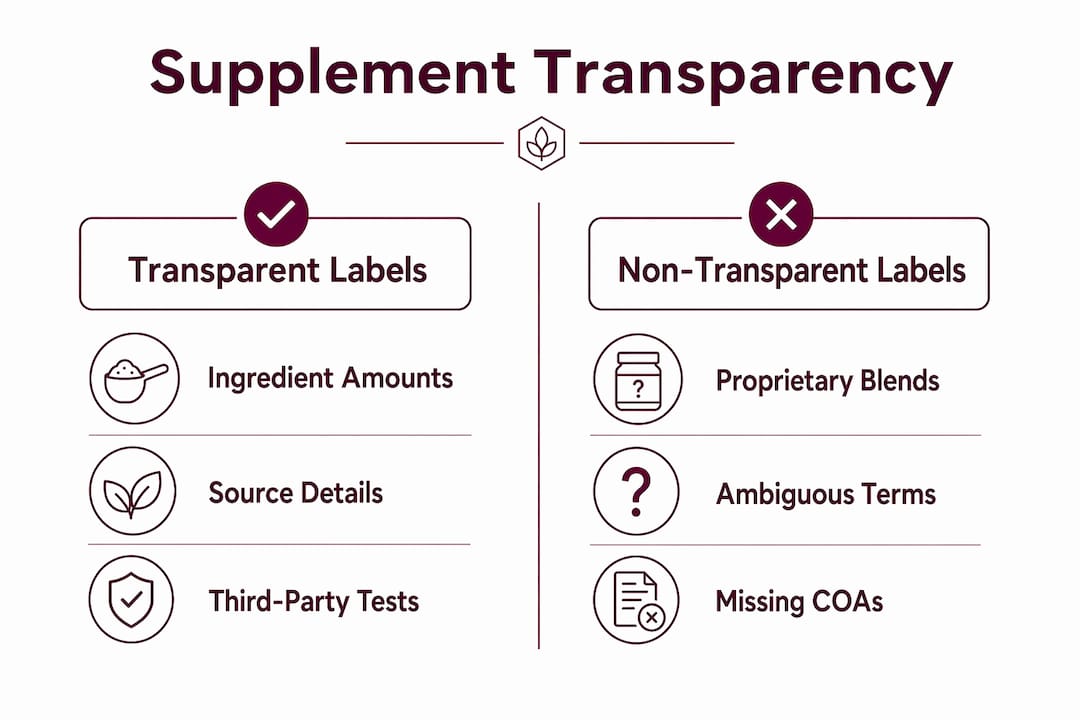
Proprietary blends are the most common tactic. A brand lists a group of ingredients under a single blend name with one total weight, say 750 mg, but never tells you how much of each ingredient is actually in that 750 mg. You might be getting a clinical dose of one ingredient and a trace amount of everything else. There is no way to know, and that is the point.
Vague or unverifiable claims are the second pattern. Phrases like “clinically studied ingredients” or “scientifically formulated” sound authoritative but carry no legal weight and no verifiable meaning. A transparent brand cites the specific study, the specific dose used in that study, and whether their product matches it.
COA manipulation is a real risk. Generic or undated COAs are often created once and reused across multiple batches, or they test a raw ingredient rather than the finished product. A COA for a raw material tells you nothing about what ended up in the capsule after blending, filling, and storage.
- Red flags on a COA: No lot number, no testing date, no named lab, results that only show “pass/fail” without actual values, or a lab you cannot verify independently.
- Red flags on a label: Proprietary blends, missing serving size context, no manufacturer address, structure-function claims with no disclaimer, or ingredient names so vague they could mean anything.
Complex regulatory disclosures increase cognitive burden and reduce effective transparency. When a brand buries critical information in dense legal language or spreads it across multiple documents that are hard to find, the practical effect is the same as not disclosing it at all.
Pro Tip: Search the testing lab named on a COA using the ISO 17025 accreditation database. Accredited labs are publicly listed. If the lab does not appear, treat the COA as unverified.
How to read supplement labels and transparency documents
Reading a supplement label well takes about two minutes once you know what to look for. Here is a practical sequence:
- Start with the Supplement Facts panel. Check that every active ingredient is listed individually with its amount in milligrams or micrograms. If you see a blend with a single weight, that is your first concern.
- Check the “other ingredients” section. This lists fillers, capsule materials, and additives. Unnecessary fillers like magnesium stearate or silicon dioxide are not dangerous in small amounts, but their presence in large quantities can signal a low-quality manufacturing process.
- Locate the manufacturer name and address. Cross-reference it with the FDA’s registered facility database if you want to go deep. US-based manufacturing under cGMP standards is a meaningful quality signal.
- Find the lot number on the bottle. Then request or locate the COA for that specific lot. Match the numbers. Check the lab name. Look for actual numerical results, not just pass/fail stamps.
- Look for third-party certifications. NSF International, USP, Informed Sport, and similar organizations test finished products independently. Their seals on a label mean the product was verified by someone with no financial stake in the outcome. You can read more about what these certifications mean in this supplement buyer’s guide to third-party testing.
- Use QR codes and brand websites. Many transparent brands now link directly to COAs, sourcing pages, and testing summaries via QR codes on the label. If a brand provides this and makes it easy to verify, that is a strong positive signal.
| Transparent label | Non-transparent label |
|---|---|
| Individual ingredient amounts listed | Proprietary blend with single total weight |
| Named, accredited third-party lab COA | Generic or undated COA, no lab name |
| Lot-specific testing results with values | Pass/fail only, no numerical data |
| US cGMP manufacturing disclosed | No manufacturing information provided |
| QR code linking to live COA | No supporting documentation available |
What does the future of supplement transparency look like?
AI shopping agents are changing how supplements get discovered and filtered. These tools scan product pages, structured data, and ingredient lists to match products to user queries. Brands hiding information in images or burying it in vague language lose visibility entirely in AI-driven search environments. Structured, machine-readable transparency data is no longer optional for brands that want to compete in 2026 and beyond.
Consumer demand is also shifting toward clean, functional, and ethically sourced ingredients. Shoppers are not just asking “does this work?” They are asking “where did this come from, how was it made, and who verified it?” Brands that answer those questions clearly, on the label and online, build the kind of trust that survives a competitive market.
Social media has accelerated this shift. When a brand posts its COA publicly, shares its manufacturing facility, or names the specific farm where its reishi mushroom extract was grown, that level of disclosure creates a feedback loop of credibility. Consumers share it. They trust it. They come back. The brands that treat transparency as a cost are being replaced by the brands that treat it as a competitive advantage.
Key takeaways
Supplement transparency requires batch-specific COAs, individual ingredient amounts, named third-party testing, and honest claims that match the actual science behind the formula.
| Point | Details |
|---|---|
| Transparency goes beyond compliance | FDA label requirements are the legal minimum, not the standard for genuine transparency. |
| COAs must be batch-specific | Match the lot number on your bottle to the COA; generic COAs are not reliable quality proof. |
| Proprietary blends obscure dosing | Without individual ingredient amounts, you cannot verify whether a product contains effective doses. |
| Trust follows transparency | Research shows transparency disclosure correlates more strongly with brand trust than product risk level. |
| AI demands structured data | Brands hiding ingredient info in images or vague text lose visibility in AI-powered supplement searches. |
Why I think most supplement labels are still failing consumers
I have spent years reading supplement labels, and the honest truth is that most of them are still designed to impress rather than inform. The Supplement Facts panel exists, the disclaimer is there, and the lot number is printed somewhere on the bottom. But the information that actually matters, the dose per ingredient, the lab that tested it, the specific batch results, is either missing or buried.
What frustrates me most is the COA situation. Brands post a single COA on their website and call it transparency. That document might be two years old, tested on a raw material, and have no connection to the bottle you just bought. Real transparency means every batch gets tested, every result gets published, and every consumer can verify their specific product. That is not a high bar. It is just honesty.
The brands doing this right are building something the others cannot fake: a track record. When you can go back through months of batch-specific COAs and see consistent results from an accredited lab, that is a brand worth trusting. Everything else is marketing dressed up as quality. My advice is to demand the lot number match, look up the lab, and treat any brand that resists that level of scrutiny as a brand with something to hide.
— Hugo
See what transparent supplementation actually looks like
If reading this made you realize how much you have been taking on faith with your current supplements, you are not alone. Most people have never seen a batch-specific COA or verified a lab’s accreditation. Cp-1 was built around the idea that you deserve better than that.
At Cp-1, every product is manufactured in the US under cGMP standards, tested by third-party labs, and formulated with individual ingredient amounts you can actually verify. Ingredients like NMN, lion’s mane mushroom extract, and CoQ10 are listed with exact doses, not hidden inside a proprietary blend. If you want to understand what genuine transparency looks like in a finished product, start here.
FAQ
What is supplement transparency in simple terms?
Supplement transparency is the full disclosure of every ingredient, its amount, its source, and the testing results for a specific product batch, giving consumers the information needed to verify what they are buying.
What must a supplement label include by law?
Per 21 CFR Part 101, every dietary supplement label must include a statement of identity, net quantity, a Supplement Facts panel, a full ingredient list, and manufacturer contact information.
How do I verify a Certificate of Analysis is real?
Match the lot number on the COA to the lot number printed on your bottle, confirm the testing lab is ISO 17025 accredited, and check that the COA includes actual numerical results rather than just pass/fail stamps.
Why do proprietary blends reduce transparency?
Proprietary blends list multiple ingredients under a single combined weight, making it impossible to know whether each ingredient is present at a clinically relevant dose or just a trace amount added for label appeal.
Does third-party testing guarantee supplement quality?
Third-party testing from organizations like NSF International or USP verifies that a finished product matches its label claims and is free from contaminants. It is the strongest independent quality signal available, though it should be evaluated alongside sourcing and manufacturing standards for a complete picture.