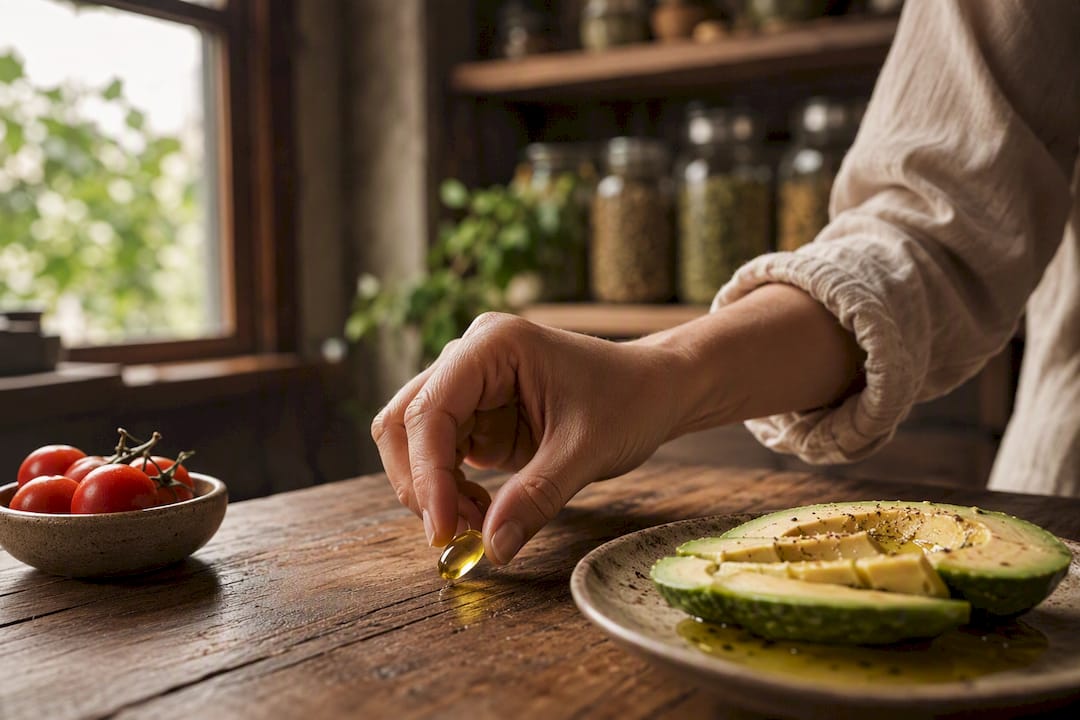
Take CoQ10 with a meal that contains some fat, and do it in the morning or early afternoon. That combination gives your gut the fat it needs to absorb this notoriously hard-to-absorb nutrient, and it sidesteps the mild stimulating effect some people feel that can mess with sleep if taken too late.
Here’s your quick-start checklist:
- Take it with breakfast or lunch, not on an empty stomach.
- Pair it with a food that has some fat in it. Eggs, nut butter, or avocado all work.
- If you take a larger daily dose, split it into two smaller doses.
- On blood thinners, thyroid medication, or a statin? Talk to your doctor first.
Key Takeaways
CoQ10 absorbs best with dietary fat, and taking it in the morning or early afternoon avoids the sleep disruption some people notice with later doses.
| Point | Details |
|---|---|
| Pair with fat | Take CoQ10 with a meal containing 3 to 10 grams of fat for meaningfully better absorption. |
| Time it early | Morning or early afternoon dosing avoids the mild stimulating effect some people feel at night. |
| Split larger doses | Doses above 100 to 200 mg daily are often split into two servings for steadier blood levels. |
| Check interactions | Talk to a doctor first if you take blood thinners, statins, or thyroid medication. |
| Consider a formulated option | CP-1’s chewable gummy combines CoQ10 with NMN and medicinal mushrooms in a single daily dose. |
This article is general information, not a substitute for advice from a qualified doctor. Consult a qualified healthcare professional about your own circumstances before acting on anything here.
Table of Contents
- When to Take CoQ10: Why Timing and Meals Actually Matter
- Morning, Midday, or Night: Picking the Best Time to Take CoQ10
- Getting the Most Out of Your CoQ10 Dose
- CoQ10 Dosing Ranges and How Long Results Take
- CoQ10 Interactions: What to Check Before You Start
- Your Daily CoQ10 Timing Checklist
- When to Talk to Your Doctor About CoQ10
- An Editorial Note on This Guidance
- A CoQ10 Formula Built for Real-World Absorption
- Sources
When to Take CoQ10: Why Timing and Meals Actually Matter
CoQ10 is fat-soluble, meaning your body absorbs it the same way it absorbs vitamin D or omega-3s: poorly on an empty stomach, much better alongside dietary fat. Fat triggers bile acid release, and bile acids form tiny transport structures called micelles that ferry CoQ10 across the intestinal wall. Research has repeatedly shown food intake substantially increases intestinal absorption of CoQ10, boosting peak blood concentrations well beyond what you’d get taking it fasted.
Clock time itself doesn’t change how much your gut absorbs. What clock time changes is how you feel afterward. Some people report a subtle energizing effect from CoQ10, similar to a mild jolt, and taking it too close to bedtime can translate into a rougher night’s sleep for that smaller group.
Morning, Midday, or Night: Picking the Best Time to Take CoQ10
For most people, morning or early afternoon is the sweet spot. You get the absorption benefit from your first real meal of the day, and you avoid any chance of the stimulating effect lingering into bedtime. The Cleveland Clinic notes there’s no single scientifically defined “best” hour for CoQ10 efficacy. The timing advice exists to manage side effects, not to chase some magic absorption window.

Evening dosing isn’t off the table. If you’ve taken CoQ10 for weeks without any sleep issues, there’s no strong reason to switch. Some people even prefer it with dinner simply because that’s their biggest, fattiest meal.
Do:
- Take it with breakfast if you exercise in the morning.
- Take it with lunch if breakfast is usually light or skipped.
Don’t:
- Take it right before bed if you’re prone to restlessness.
- Take it on a completely empty stomach, ever.
Getting the Most Out of Your CoQ10 Dose
Form matters as much as timing. CoQ10 comes as ubiquinone (the oxidized form) or ubiquinol (the reduced, “active” form). Ubiquinol is often marketed as more bioavailable, and while some smaller studies support that claim, both forms work when paired correctly with fat. A detailed comparison from NutraSmarts breaks down the practical differences if you want to go deeper.
Formulation matters too. Oil-based softgels and emulsified liquid formulas outperform dry powder tablets for absorption, because the CoQ10 is already suspended in the fat it needs.
You don’t need a heavy meal, either. A modest 3 to 10 grams of fat, an egg, a spoonful of peanut butter, a splash of olive oil on toast, is enough to trigger meaningful absorption. For more on stacking supplements correctly, our guide to optimizing supplement absorption covers the same fat-pairing principle across other fat-soluble nutrients.
Pro Tip: Took your CoQ10 dose on an empty stomach by accident? Eat a small fat-containing snack within the next hour. You’ll still capture most of the absorption benefit rather than losing the dose entirely.
CoQ10 Dosing Ranges and How Long Results Take
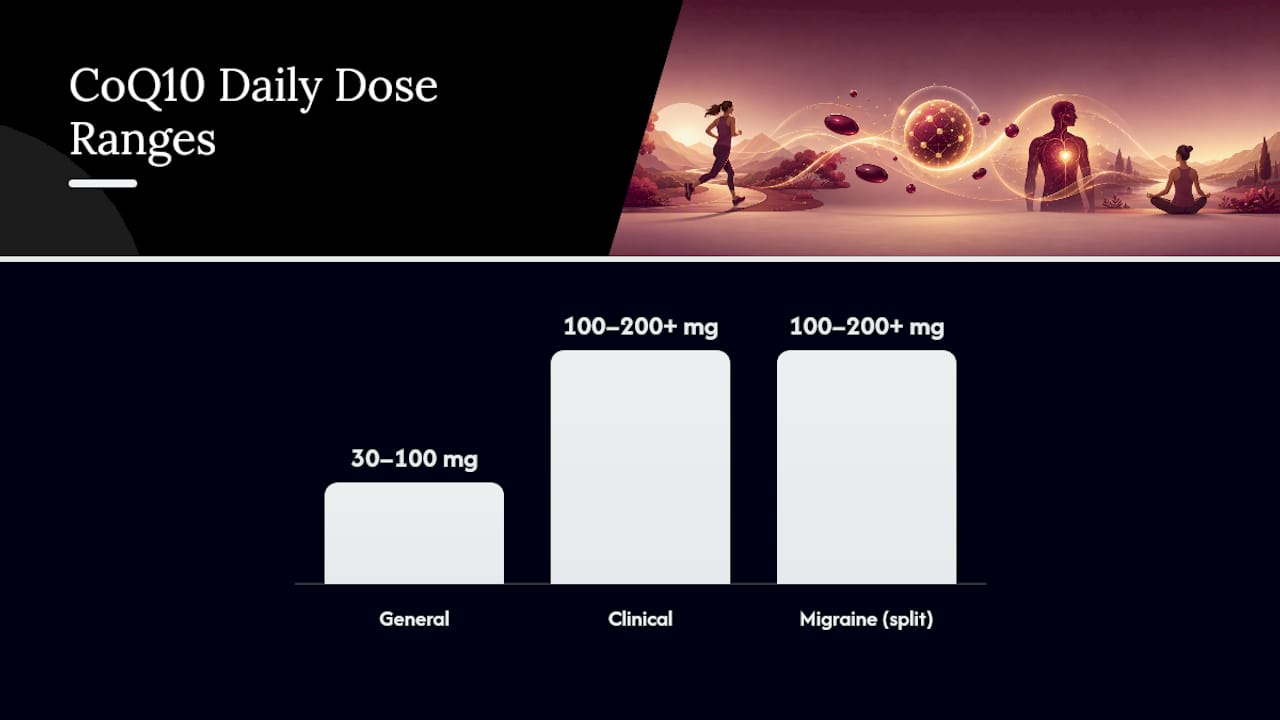
Most people supplementing for general wellness land somewhere in the 30 to 200 mg daily range, with some clinical trials using higher amounts under medical supervision. Splitting a dose above 100 to 200 mg into two smaller servings, one in the morning and one in the early afternoon, helps keep blood levels steadier and tends to be gentler on the stomach.
| Use Case | Typical Daily Range | Timeline to Notice Effects |
|---|---|---|
| General energy support | 30 to 100 mg | Several weeks |
| Higher clinical doses | 100 to 200 mg+ | Weeks to a few months |
| Migraine prevention (studied) | Higher clinical doses, split | Often several months of consistent use |
Migraine prevention trials indexed on PubMed commonly run for several months before researchers assess whether the frequency dropped, so patience matters more than most people expect. Our breakdown of CoQ10 dosage walks through how to figure out your own starting point.
CoQ10 Interactions: What to Check Before You Start
CoQ10 is generally well tolerated, but it isn’t automatically safe to stack with everything in your medicine cabinet. Check with your doctor if you’re taking:
- Blood thinners like warfarin, since CoQ10 has a chemical structure related to vitamin K and can theoretically reduce their effectiveness.
- Statins, since some people take CoQ10 specifically to offset statin-related muscle aches, but it’s worth confirming with your prescriber.
- Thyroid medications or blood pressure drugs, where dosing adjustments sometimes matter.
Mild side effects, including stomach upset or a rash, are the most commonly reported issues. Pregnant or breastfeeding people, and children, should only use CoQ10 under a doctor’s guidance since safety data for those groups is limited.
Clinicians consistently advise checking in before starting CoQ10, particularly for people on blood thinners, thyroid medications, or statins, because the interaction risk is real even if it’s uncommon.
Your Daily CoQ10 Timing Checklist
- Take your dose with the first meal that contains fat, ideally breakfast or lunch.
- Stick to morning or early afternoon unless you already know evening works fine for you.
- Split doses above 100 to 200 mg into two smaller servings.
- Store the bottle in a cool, dry place, away from direct sunlight, to protect potency.
Sample routines: Breakfast eaters take it with eggs and toast. Intermittent fasters take it with their first meal, even if that’s 1 p.m., rather than during the fasting window. Gym-goers often take it with a pre-workout snack that includes some fat, like a handful of almonds.
Pro Tip: Traveling or dealing with irregular meals? Keep a small fat source, like a nut butter packet, in your bag so you’re never stuck taking CoQ10 on an empty stomach.
When to Talk to Your Doctor About CoQ10
Reach out to a healthcare provider before starting CoQ10 if you’re on anticoagulants, have surgery scheduled soon, or notice unexplained side effects after starting. Bring your current medication list, the CoQ10 bottle itself so they can see the exact dose and form, and the reason you’re taking it. If you plan to use it long-term, ask whether periodic lab monitoring makes sense for your situation.
An Editorial Note on This Guidance
We built this guide around clinical sources like Mayo Clinic and Cleveland Clinic, not marketing claims, because CoQ10 timing questions deserve real answers, not guesswork dressed up as science. That same standard shapes how CP-1 formulates its own supplements: third-party tested, vegan, non-GMO, and manufactured in the US. Good information and honest formulation should go hand in hand.
A CoQ10 Formula Built for Real-World Absorption
If you’re already thinking about meal pairings and fat content just to get a decent dose of CoQ10 into your system, a formulated supplement that accounts for absorption from the start saves you the mental math. CP-1’s NAD+ Advanced Supplement combines CoQ10 with NMN, lion’s mane, reishi, and turkey tail in a chewable format designed around real-world dosing, not lab-ideal conditions nobody actually lives in.
Every batch is third-party tested, and the formula is vegan and non-GMO, manufactured here in the US under GMP-certified standards. If you’re also wondering about when to take lion’s mane or when to take reishi alongside your CoQ10, the short answer is the same principle: consistency and a meal with some fat cover most of what matters. You can check out the full ingredient breakdown and subscription options on the CP-1 landing page and decide if a single daily gummy fits better than juggling three separate bottles.