

Amino Acid Bodybuilding: Your Science-Based 2026 Guide
Amino acids are the molecular building blocks of every muscle fiber in your body, and getting them right is the difference between real growth and spinning your wheels. For anyone serious about amino acid bodybuilding, the science is clear: not all amino acids work the same way, and most supplement labels are designed to confuse you rather than help you. Essential amino acids (EAAs) and branched-chain amino acids (BCAAs) are the two categories you hear most, but they are not interchangeable. This guide cuts through the noise, explains what the research actually says, and gives you a practical framework for using amino acids to build muscle, recover faster, and perform better.
What are EAAs vs. BCAAs, and which one actually builds muscle?
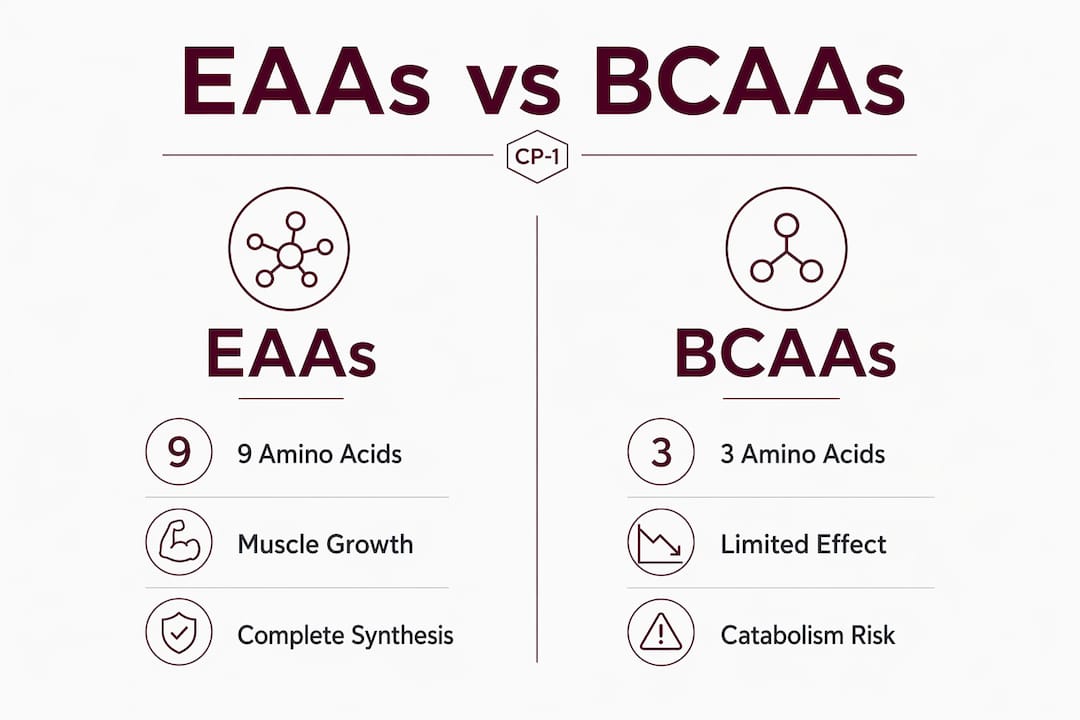
Essential amino acids are the nine amino acids your body cannot produce on its own: leucine, isoleucine, valine, lysine, methionine, phenylalanine, threonine, tryptophan, and histidine. Your body must get all nine from food or supplements. Branched-chain amino acids are a subset of three EAAs: leucine, isoleucine, and valine. BCAAs get most of the marketing attention, but the science tells a different story.
EAAs outperform BCAAs for muscle protein synthesis by a wide margin. Isolated BCAA use results in roughly 50% lower synthesis rates compared to a full EAA blend. The reason is straightforward: your body needs all nine EAAs to build new muscle tissue. BCAAs supply only three, so the remaining six must come from somewhere.

Here is where it gets counterproductive. Isolated BCAAs can trigger catabolism in under-fueled states. When leucine fires the anabolic signal but the other EAAs are missing, your body pulls them from existing muscle tissue to complete the synthesis process. You are essentially breaking down muscle to build muscle, which defeats the purpose entirely.
| Factor | EAAs | BCAAs |
|---|---|---|
| Amino acid count | All 9 essential amino acids | 3 (leucine, isoleucine, valine) |
| Muscle protein synthesis | Full anabolic response | Roughly 50% lower rate |
| Risk of catabolism | Low | High in under-fueled states |
| Best use case | Intra-workout, fasted training | Limited standalone value |
| Recommended for bodybuilders | Yes | Only within a complete EAA blend |
Pro Tip: If your current supplement is BCAA-only, swap it for a full EAA product. You will get the leucine signal plus all the building blocks your muscles need to actually complete the job.
How much amino acid intake do you need for muscle growth?
The research on optimal intake is more specific than most gym conversations suggest. Muscle hypertrophy requires a total daily protein intake of 1.4–2.0 g per kilogram of body weight, split across 3–4 meals with 20–40 g of protein each. That per-meal structure matters as much as the daily total.
The reason meal distribution matters comes down to leucine. The leucine threshold sits at roughly 2–3 g per meal to effectively trigger the mTOR pathway, which is the primary signaling route for muscle protein synthesis. Hit that threshold and the anabolic switch flips. Miss it and the signal stays quiet, regardless of how much protein you ate earlier in the day.
Plant proteins require higher doses than animal proteins to hit the same leucine threshold. Whey protein delivers leucine efficiently at standard serving sizes. Pea protein, rice protein, and soy protein contain less leucine per gram, so plant-based athletes need to eat more total protein or combine sources to reach the threshold consistently.
| Body weight | Daily protein target | Leucine per meal | Meals per day |
|---|---|---|---|
| 70 kg (154 lbs) | 98–140 g | 2–3 g | 3–4 |
| 85 kg (187 lbs) | 119–170 g | 2–3 g | 3–4 |
| 100 kg (220 lbs) | 140–200 g | 2–3 g | 3–4 |
One thing the supplement industry rarely tells you: exceeding the leucine threshold with extra doses shows no additional muscle protein synthesis benefit. The threshold is a binary trigger, not a dial you can turn up. More leucine beyond 2.5 g per meal does not produce more muscle. It just costs you more money.
Pro Tip: Track your leucine intake for one week using a food logging app like Cronometer. Most people are surprised to find they are hitting the threshold at breakfast and lunch but falling short at dinner, where protein portions tend to shrink.
When and how should bodybuilders use amino acid supplements?
Amino acid supplements are tools that work within a complete nutrition plan, not replacements for it. Insufficient total protein intake negates any potential benefit from supplementation. Get your daily protein target from whole foods first. Then use supplements to fill specific gaps.
The scenarios where EAA supplements genuinely earn their place:
- Intra-workout nutrition: Free-form EAAs absorb faster than intact protein because they skip the digestion step. During a long training session, sipping an EAA drink keeps synthesis signals active without taxing your gut.
- Fasted training: If you train first thing in the morning without eating, EAAs prevent the catabolic state that comes from training on empty. A 10–15 g EAA dose before or during the session covers you.
- Calorie deficits: When cutting, total protein intake often drops. EAA supplements help preserve lean muscle mass when food volume is restricted.
- GI sensitivity: Some athletes struggle to digest whole protein sources quickly around training. Free-form EAAs sidestep that problem entirely.
Carbohydrates play a bigger role in recovery than most amino acid marketing suggests. Amino acids combined with carbohydrates during intense, long-duration exercise produce better tissue repair outcomes than amino acids alone. Carbs restore glycogen and create an insulin response that drives amino acids into muscle cells more efficiently. Pairing your post-workout EAA supplement with a carbohydrate source is not optional if recovery speed matters to you.
Common mistakes to avoid:
- Taking BCAA-only products and expecting full muscle protein synthesis
- Doubling your leucine dose thinking more is better
- Using amino acid supplements as a substitute for hitting your daily protein target
- Ignoring carbohydrate intake around training while focusing only on amino acids
Pro Tip: For intra-workout use, mix 10 g of a full EAA product with 20–30 g of fast-digesting carbohydrates like Gatorade powder or dextrose. That combination covers both the signaling and the fuel side of recovery.
What are the proven benefits of amino acids for bodybuilding?
The physiological benefits of EAA supplementation in bodybuilding are well-documented and specific. Over 50% of EAAs in a standardized blend achieve intestinal absorption and activate mTORC1 signaling within 24 hours. mTORC1 is the master regulator of muscle protein synthesis, and activating it consistently is the core mechanism behind muscle growth.
The benefits extend beyond just building new tissue. Here is what the research supports:
- Reduced muscle protein breakdown: EAAs suppress catabolism during calorie deficits, helping you hold onto lean mass while losing fat. This is one of the most underrated benefits for athletes in a cutting phase.
- Faster recovery between sessions: Adequate EAA availability reduces perceived fatigue and accelerates muscle repair after high-volume training. You can train harder, more frequently, with less downtime.
- Preserved lean muscle during dieting: Amino acid supplements support lean mass retention when total calorie intake drops, making them particularly valuable during contest prep or weight-class sports.
- Improved training quality: When your muscles have the amino acids they need before and during training, output stays higher for longer. You get more productive reps from the same session.
The key word across all of these benefits is “adequate.” The benefits show up when you meet the threshold requirements. They do not stack indefinitely with higher doses. Understanding that distinction separates smart supplementation from expensive urine.
Key Takeaways
Amino acids build muscle only when total protein intake, leucine thresholds, and meal timing all work together as a complete system.
| Point | Details |
|---|---|
| EAAs beat BCAAs | Full EAA blends produce roughly double the muscle protein synthesis rate of isolated BCAAs. |
| Leucine threshold matters | Hit 2–3 g of leucine per meal to trigger mTOR; exceeding this adds no extra benefit. |
| Daily protein target | Aim for 1.4–2.0 g per kilogram of body weight, spread across 3–4 meals daily. |
| Carbs amplify recovery | Pairing EAAs with carbohydrates after training improves tissue repair more than amino acids alone. |
| Supplements are accessory | Amino acid supplements support but cannot replace consistent daily protein intake from whole foods. |
What I’ve learned from watching bodybuilders get amino acids wrong
I’ve watched a lot of people spend serious money on amino acid supplements and get almost nothing back. Not because the science is wrong. Because they skipped the foundation.
The pattern is always the same. Someone reads about leucine and mTOR, buys a BCAA product with extra leucine, and starts sipping it through every workout. Their total daily protein is sitting at 100 g when they weigh 90 kg. The supplement does nothing meaningful because the baseline is broken. The leucine signal fires, but there is no raw material to build with. It is like pressing the gas pedal in a car with no fuel.
What actually works is boring but reliable. Hit your daily protein target from real food first. Distribute it across meals with enough leucine per sitting. Then, and only then, use EAA supplements to cover the gaps: fasted training, long sessions, travel days when food quality drops. That is the honest framework.
The supplement industry sells you the signal molecule and hopes you do not notice that the building blocks are missing. I have seen this play out too many times. The athletes who make consistent progress are the ones who treat amino acid supplements as a precision tool, not a shortcut. They understand how protein absorption works at the cellular level and build their nutrition around that reality.
If you take one thing from this: choose a full EAA product over a BCAA product, every single time. The science on this is not close.
— Hugo
Cp-1 and science-based supplementation for serious athletes
Cp-1 was built for people who want real results backed by real science, not flashy labels and underdosed formulas.
If you are serious about sports nutrition that works, Cp-1 approaches supplementation the same way this article does: with transparency, third-party testing, and formulas built for the person training hard, not for a marketing deck. Every product Cp-1 makes is vegan, non-GMO, and manufactured in the US to strict quality standards. When you are ready to build a supplement stack that actually complements your protein intake and training, visit Cp-1 to see what science-based supplementation looks like in practice.
FAQ
What is the difference between EAAs and BCAAs for muscle growth?
EAAs provide all nine essential amino acids needed for complete muscle protein synthesis, while BCAAs supply only three. Isolated BCAA use produces roughly 50% lower synthesis rates and can cause muscle breakdown in under-fueled states.
How much leucine do I need per meal to build muscle?
The leucine threshold for triggering muscle protein synthesis sits at 2–3 g per meal. Exceeding this amount does not produce additional muscle growth, as the mTOR signal operates as a binary trigger, not a sliding scale.
Should I take amino acid supplements if I already eat enough protein?
Amino acid supplements add value in specific scenarios: fasted training, intra-workout nutrition, calorie deficits, or when GI issues limit whole protein intake. If your daily protein target is consistently met from food, standalone EAA supplements offer limited additional benefit.
Do amino acids help with recovery after training?
Yes, particularly when combined with carbohydrates. EAAs activate mTORC1 signaling and reduce muscle protein breakdown, while carbohydrates restore glycogen and drive amino acids into muscle cells more efficiently after intense sessions.
Are plant-based athletes at a disadvantage with amino acid intake?
Plant proteins contain less leucine per gram than animal proteins like whey, so plant-based athletes need higher total protein intake or strategic source combining to consistently hit the 2–3 g leucine threshold per meal.