

David Sinclair on Aging, Longevity, and What Works
Most people assume aging is largely out of their hands. You inherit your parents’ genes, and that’s mostly the story. David Sinclair, professor of genetics at Harvard Medical School and one of the most cited researchers in his field, has spent decades dismantling that assumption. His work argues that genes account for only about 50% of how fast you age. The other half is lifestyle. That single idea has reshaped how millions of people think about health, and it’s the foundation everything else in Sinclair’s work builds on.
Table of Contents
- Key Takeaways
- What David Sinclair is known for
- The information theory of aging
- 2026 research breakthroughs from Sinclair’s lab
- Biological age vs chronological age
- Sinclair’s personal supplement stack
- My honest take on Sinclair’s work
- What Cp-1 can do for your longevity goals
- FAQ
Key Takeaways
| Point | Details |
|---|---|
| Aging is not fixed | Lifestyle factors account for roughly half of your aging rate, giving you real leverage over your health span. |
| Aging is a software problem | Sinclair’s Information Theory frames aging as epigenetic data loss, not irreversible physical breakdown. |
| AI is accelerating discovery | Sinclair’s lab screened 8 billion molecules using AI to find potential age-reversal compounds. |
| Biological age is malleable | Exercise, diet, and targeted supplementation can measurably shift your biological age. |
| Supplements follow the science | Sinclair takes NMN, resveratrol, and vitamin D3 daily, each tied to specific cellular mechanisms. |
What David Sinclair is known for
David Sinclair built his reputation on a few foundational ideas that cut against the medical mainstream. Where most doctors treated the diseases of old age, Sinclair argued we were solving the wrong problem. He made the case that aging should be classified as a disease and treated as a root cause rather than an inevitable backdrop. That framing changes everything. Instead of managing diabetes, cardiovascular disease, or neurodegeneration one at a time, you target the underlying process driving all of them.
His David Sinclair research spans sirtuins, NAD+ biology, caloric restriction mimetics, and epigenetic reprogramming. He co-founded several biotech companies, authored the bestselling book Lifespan: Why We Age and Why We Don’t Have To, and hosts content and appearances through various media channels. His David Sinclair podcast appearances, particularly on high-profile shows, have introduced complex longevity science to millions of listeners who had never heard terms like “epigenome” or “NAD+” before.
What makes Sinclair different from a typical academic is that he applies his own research to himself. He shares his personal supplement protocols publicly, discusses his biological age results, and treats himself as an ongoing experiment. That level of transparency is unusual in science, and it’s a big part of why his work connects with the biohacking and health optimization community so strongly.
The information theory of aging
The most intellectually significant piece of David Sinclair anti-aging research is his Information Theory of Aging. The core idea is that your DNA is like the hardware of a computer. It stays mostly intact over time. What degrades is the software: the epigenetic instructions that tell each cell which genes to activate and which to silence.
“Aging is not the wearing out of a machine. It’s the corruption of the operating system. The hardware is still there. The software just can’t read it properly anymore.” — David Sinclair
Sirtuins are proteins that play a central role in this process. They act as gene regulators, helping cells maintain the correct epigenetic program. The problem is that sirtuins depend on NAD+ to function. As you age, NAD+ levels decline significantly in tissues, and sirtuin activity drops with it. When sirtuins can’t do their job, the epigenetic program starts to slip. Cells begin reading the wrong instructions. Tissues start to malfunction.
This is why Sinclair describes aging as software corruption rather than hardware damage. The distinction matters enormously. Hardware damage is permanent. Software can potentially be rewritten. If that analogy holds, aging could be partially reversible. You’re not breaking the machine beyond repair. You’re restoring a corrupted file.
Key concepts from this framework worth understanding:
- Epigenome: The layer of chemical instructions on top of your DNA that controls gene expression without changing the genetic code itself
- Sirtuins: A family of proteins (SIRT1 through SIRT7) that regulate cellular health and require NAD+ to function
- NAD+ (Nicotinamide Adenine Dinucleotide): A molecule found in every cell, critical for energy production and sirtuin activation
- Epigenetic drift: The gradual loss of accurate gene-reading patterns that Sinclair identifies as the primary driver of aging
The reason this theory matters beyond academia is that it reframes longevity interventions. Instead of trying to fix individual age-related diseases after they appear, you focus on preserving or restoring epigenetic integrity before damage accumulates.
2026 research breakthroughs from Sinclair’s lab
David Sinclair longevity research has picked up serious momentum in 2026, moving from theory toward practical therapeutics faster than most people realize.
The most striking recent development involves AI-driven drug discovery. Sinclair’s lab used AI to screen 8 billion molecules for age-reversal potential. To put that in context, traditional drug screening might cover a few million compounds over years of lab work. Expanding that to 8 billion through virtual screening changes the timeline and scale of what’s discoverable. The goal is to identify small molecules that could trigger epigenetic reprogramming without the need for gene therapy, essentially putting age-reversal potential into a daily pill.
| Research Area | Current Status | Goal |
|---|---|---|
| AI molecule screening | 8 billion molecules screened virtually | Identify oral age-reversal compounds |
| OSK gene therapy | Animal models showing age reversal | Expand to human clinical trials |
| Eye and liver therapy | Adeno-associated virus trials underway | Treat disease while proving safety |
| Small molecule pills | Pre-clinical development | Replace viral vector delivery entirely |
The gene therapy work deserves special attention. Sinclair’s lab identified that using the full set of Yamanaka factors, which are proteins that can reprogram adult cells back to a stem-cell-like state, caused rapid death in animal models. His lab narrowed the approach to a safer subset called OSK (Oct4, Sox2, Klf4). OSK reprogramming has shown genuine age reversal in animal tissues, particularly in the eye, without triggering uncontrolled cell growth.
Current human-facing work uses adeno-associated viral vectors to deliver these genes to targeted tissues. The eye and liver are the current focus because they are accessible and relatively well-understood for gene delivery. The longer-term vision is to skip the viral delivery system entirely and achieve the same cellular reprogramming with small molecules you take orally.
Pro Tip: If you follow David Sinclair’s podcast appearances and research updates, look specifically for his discussions on OSK reprogramming and AI-assisted molecule screening. These two threads represent where his lab’s most consequential near-term advances are happening.
Biological age vs chronological age
Your chronological age is the number of candles on your birthday cake. Your biological age is the number that actually matters. Sinclair’s position is direct: biological age is malleable, and lifestyle choices are the lever.

The practical tool for measuring this is DNA methylation clocks, sometimes called epigenetic clocks. These tests measure chemical markers on your DNA that change predictably with age, giving a biological age estimate that can differ meaningfully from your calendar age. Some people in their 50s test biologically younger than people in their late 30s. That gap is not random. It reflects accumulated lifestyle choices, stress load, sleep quality, and cellular repair capacity.
Here is how to think about the modifiable variables Sinclair highlights:
- Exercise: High-intensity interval training and resistance exercise both activate AMPK and sirtuins, signaling pathways associated with cellular repair and longevity. Sinclair’s longevity support in 2026 research makes exercise one of the highest-leverage interventions available.
- Diet: Sinclair practices intermittent fasting and limits red meat. The mechanism is mTOR suppression and sirtuin activation. Eating less frequently gives your cells more time in repair mode.
- Stress management: Chronic stress accelerates epigenetic drift. Sleep quality, in particular, is closely tied to biological aging rate.
- Supplementation: NAD+ precursors, antioxidants, and compounds like resveratrol work at the cellular level to support the same pathways exercise and fasting activate.
- Biological age tracking: Tracking your DNA methylation score over time gives you actual data on whether your interventions are working.
Pro Tip: Before buying supplements or restructuring your diet based on Sinclair’s protocols, get a baseline biological age test. Without a starting point, you have no way to know if what you’re doing is actually moving the needle.
Sinclair’s personal supplement stack
David Sinclair does not just theorize about supplementation. He shares what he takes daily, and each choice is tied to a specific mechanism rooted in his research.
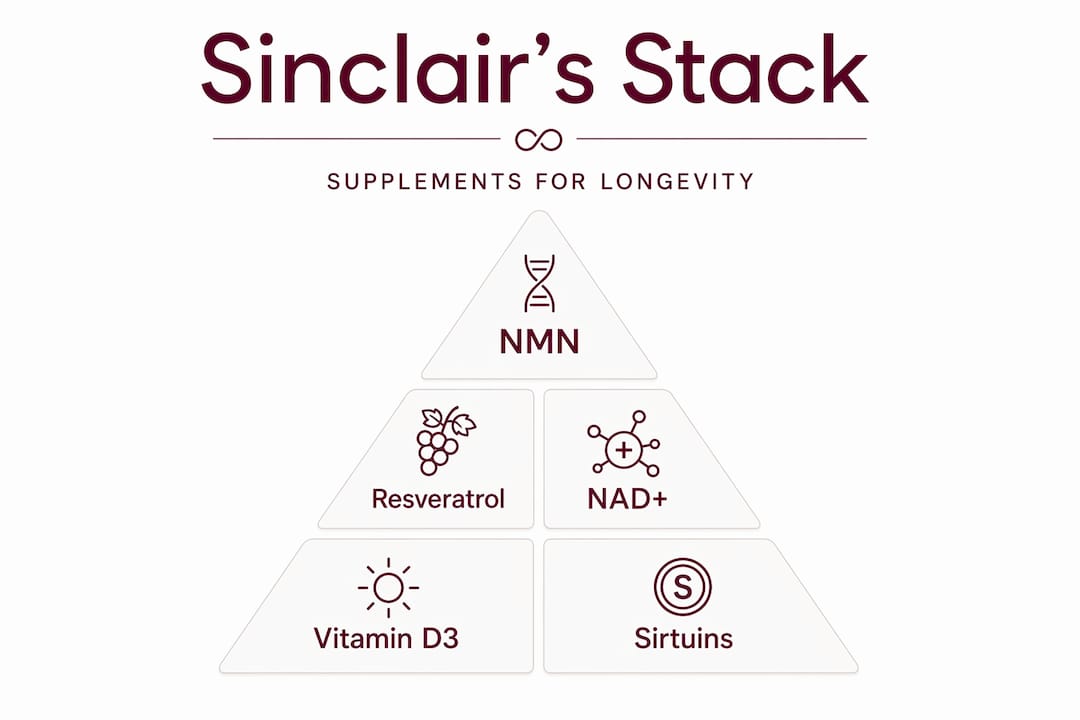
His publicly stated daily protocol includes:
- NMN (Nicotinamide Mononucleotide) at 1 gram: NMN is a direct NAD+ precursor. Taking it supports sirtuin activity by replenishing the NAD+ that naturally declines with age. Sinclair takes 1 gram of NMN daily alongside resveratrol.
- Resveratrol at 1 gram with fat: Resveratrol is a sirtuin activator found in red wine in trace amounts. Sinclair takes a concentrated dose with a fat source to improve absorption. The goal is to directly activate SIRT1, the primary sirtuin involved in epigenetic maintenance.
- Vitamin D3 adjusted to blood levels: Sinclair monitors his vitamin D3 status through blood testing and adjusts his dose accordingly. Vitamin D3 deficiency is linked to accelerated aging markers, immune dysfunction, and a range of chronic conditions.
- Metformin (prescription): Worth noting as context, Sinclair takes metformin, a diabetes drug shown in research to activate AMPK and mimic some effects of caloric restriction. This is prescription-only and not a supplement, but it appears in his protocol.
The rationale connecting this stack is consistency. NMN feeds NAD+. NAD+ powers sirtuins. Resveratrol activates sirtuins directly. D3 supports the broader cellular environment. The combination is designed to work on multiple points in the same pathway rather than scattering across unrelated mechanisms. For anyone exploring supplement strategies for cognitive and cellular performance, this systems-level thinking is worth adopting regardless of which specific compounds you use.
My honest take on Sinclair’s work
I’ll be straight with you. When I first came across David Sinclair’s research, I was skeptical. The longevity space is full of hype, and “reversing aging” sounds like a sales pitch more than a scientific claim. But the more time I spent with the actual research, the more I realized the skepticism was pointed in the wrong direction.
The frustrating part isn’t Sinclair’s science. It’s the gap between what the research shows and what reaches consumers. Most supplements on the market use longevity language while stuffing products with underdosed, poorly absorbed ingredients that wouldn’t move the needle in any serious study. They’re riding the wave of Sinclair’s credibility without doing the work.
What I’ve found actually matters is mechanism specificity. Sinclair doesn’t take NMN because it’s trendy. He takes it because it directly addresses NAD+ decline, which is mechanistically tied to sirtuin dysfunction and epigenetic drift. That’s a clean causal chain. When you apply that same standard to any supplement, you cut through a lot of noise quickly.
The other thing I think most people miss is that Sinclair’s protocols are not a shortcut. The supplements support the cellular machinery. Exercise and fasting activate the same pathways. Sleep gives the system time to repair. These things work together. You can’t skip the lifestyle fundamentals and expect a pill to compensate. Anyone telling you otherwise is selling something that belongs in the trash.
The honest position in 2026 is this: the science behind treating aging as a disease is real, reproducible, and accelerating. The practical applications available to consumers right now are meaningful but incomplete. The gap will close. In the meantime, the best strategy combines evidence-grounded supplementation with the lifestyle changes Sinclair himself prioritizes.
— Hugo
What Cp-1 can do for your longevity goals
If Sinclair’s research has you thinking seriously about cellular energy and NAD+ support, you’re asking the right questions. Cp-1 was built for exactly this. The CP-1 formula includes NMN alongside lion’s mane, reishi, turkey tail mushroom extracts, and CoQ10, each selected for their roles in mitochondrial energy, cognitive clarity, and immune resilience. No filler, no underdosed marketing ingredients. Just what the research actually points to. If you’re ready to act on what you’ve read here, explore the full CP-1 supplement formula and see how it maps to Sinclair’s longevity framework.
FAQ
What is David Sinclair known for?
David Sinclair is best known for his research on the biology of aging, particularly the Information Theory of Aging, sirtuin activation, and the argument that aging should be treated as a disease rather than an inevitability.
What supplements does David Sinclair take daily?
Sinclair’s publicly shared protocol includes 1 gram of NMN, 1 gram of resveratrol taken with fat, and vitamin D3 dosed according to blood levels, all aimed at supporting NAD+ production and sirtuin function.
What is the Information Theory of Aging?
It’s Sinclair’s framework proposing that aging results from the loss of epigenetic information, where cells gradually lose the ability to correctly read their own genes, similar to software corruption rather than hardware failure.
How does David Sinclair measure biological age?
Sinclair uses DNA methylation clocks, also called epigenetic clocks, which measure chemical markers on DNA to estimate biological age separately from chronological age.
Where can I follow David Sinclair’s latest research?
Sinclair shares updates through his David Sinclair podcast appearances, his Harvard lab publications, and social media. His book Lifespan remains the best single-source overview of his foundational David Sinclair longevity research and the David Sinclair anti-aging framework.