

How Long Does It Take for Caffeine to Work?
Caffeine starts working in as little as 15 minutes. Most people feel the effects within a short time after consuming it, peak blood levels typically arrive within a variable window ranging from quarter of an hour to a couple of hours, and the half-life averages a few hours, but varies widely between individuals depending on many factors. If you need sleep by 11 p.m., stopping caffeine by 5 p.m. is a reasonable rule of thumb.
- Onset: 15–45 minutes after consumption
- Time to peak: 15 minutes to 2 hours (often around 45 minutes)
- Half-life: 1.5–9.5 hours, with a mean of roughly 5 hours
- Practical sleep cutoff: at least 6 hours before bedtime
Quick stat: NIOSH/CDC data places onset at 15–45 minutes and half-life at approximately 5–6 hours for most adults.
Table of Contents
- How caffeine actually works in your body
- What the research actually says about onset, peak, and half-life
- Why caffeine timing varies so much between people
- How long common doses typically last
- When to drink caffeine for workouts, focus, and sleep
- Can you make caffeine wear off faster?
- What experts say about tolerance, withdrawal, and individual differences
- Key Takeaways
- The part most caffeine guides skip
- A non-stimulant option for steady energy without the timing math
- Sources and further reading
How caffeine actually works in your body
Caffeine’s speed comes from its chemistry. Once swallowed, it crosses the gut lining and enters the bloodstream fast, then crosses the blood-brain barrier and binds to adenosine receptors. Adenosine is the molecule that builds up while you’re awake and makes you feel sleepy. Caffeine blocks those receptors reversibly, so the drowsiness signal gets muted rather than cleared. A metabolite called paraxanthine also contributes to the stimulant effect as your liver breaks caffeine down.
The sequence looks like this: you drink coffee → caffeine absorbs through the small intestine → enters the bloodstream → reaches the brain → adenosine receptors get blocked → you feel alert. According to NCBI pharmacology data, 99% of caffeine is absorbed within 45 minutes. Liver enzymes (primarily CYP1A2) then metabolize it gradually, which is why effects taper rather than cut off sharply.
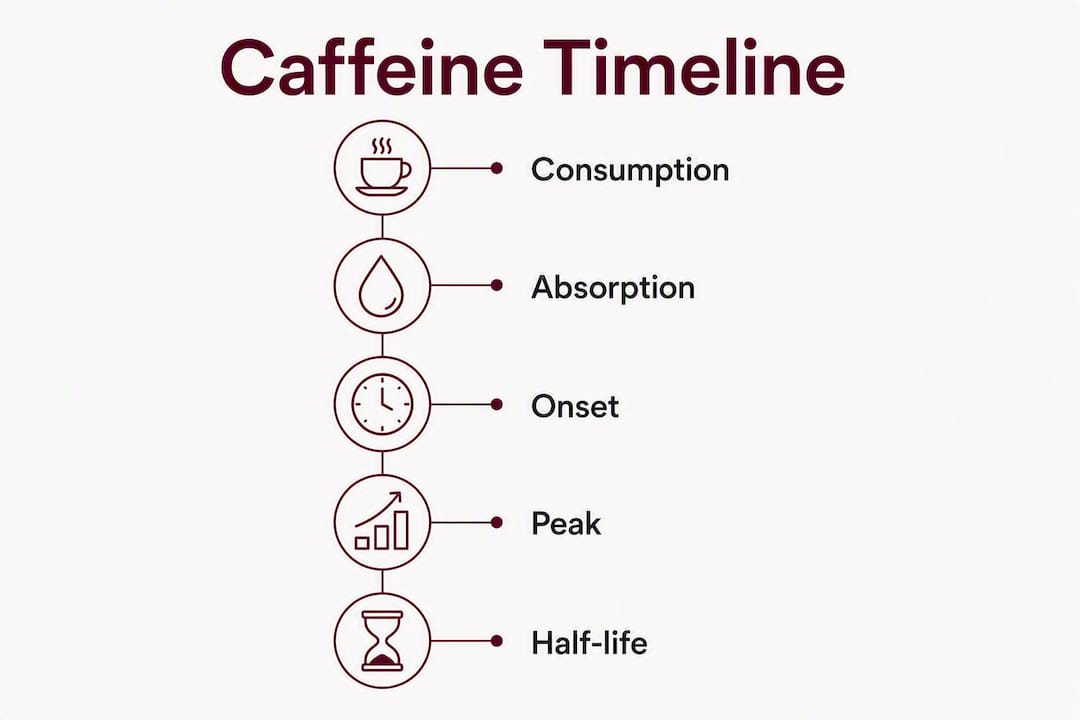
Half-life is the key concept here. If you consume 200 mg, roughly 100 mg is still circulating five hours later. That residual amount is enough to interfere with sleep quality even when you don’t feel “wired.”
What the research actually says about onset, peak, and half-life
The consensus across pharmacology literature and health agencies is tighter than most people expect. Onset is fast, peak is variable, and half-life is where individual differences really show up.
| Metric | Range | Source |
|---|---|---|
| Onset (first noticeable effects) generally occurs within 15–45 minutes | NIOSH/CDC | |
| Time to peak plasma concentration occurs between 15 minutes and 2 hours, most often around 45 minutes | NCBI Pharmacology & Harvard Nutrition Source | |
| Mean half-life is approximately 5 hours, but the individual range is 1.5–9.5 hours | Harvard Nutrition Source | |
| Some rapid-onset cases show effects noticeable within about ten to fifteen minutes | Science Focus |
The gap between 15 minutes and 2 hours for time-to-peak isn’t a data quality problem. It reflects real differences in formulation and gastric emptying. A caffeine chew absorbed through the oral mucosa can hit faster than a tablet swallowed with a full meal. Science Focus notes that effects can appear in as little as 10–15 minutes in some cases, while Harvard places full absorption at around 45 minutes. Both are correct for different conditions.
Key figure: Harvard’s Nutrition Source puts the half-life range at 1.5–9.5 hours, which means one person’s caffeine could clear in under two hours while another’s is still active nine hours later.
Why caffeine timing varies so much between people
Individual factors shift onset and half-life substantially, sometimes by several hours. Knowing which ones apply to you is more useful than memorizing a single average number.
- Form of caffeine: Chewing caffeine-containing products enables faster absorption through the oral mucosa, bypassing some gastrointestinal delay, per NCBI pharmacology research. Liquids absorb faster than tablets; tablets faster than food-based sources.
- Food in the stomach: An empty stomach speeds time-to-peak. Foods high in fiber slow gastric emptying and delay when blood levels rise, according to Harvard’s Nutrition Source.
- Smoking: Smokers metabolize caffeine roughly twice as fast. NCBI data shows smoking can reduce caffeine half-life by up to ~50%, meaning effects wear off faster.
- Pregnancy: The third trimester can notably extend caffeine half-life to a much longer duration, a clinically meaningful change that requires real dosing caution.
- Oral contraceptives: These slow CYP1A2 activity, extending half-life and prolonging stimulant effects.
- Age: Older adults generally clear caffeine more slowly than younger adults.
- Genetics (CYP1A2): Your liver’s CYP1A2 enzyme is the primary caffeine metabolizer. Genetic variants make some people fast metabolizers and others slow ones, with real-world differences in how long caffeine stays active.
- Liver function: Any condition that impairs liver function extends half-life.
- Tolerance: Regular users often feel less effect at the same dose, not because caffeine clears faster, but because adenosine receptor sensitivity adapts.
Pro Tip: Track a consistent 100–200 mg dose (one cup of coffee or a single caffeine chew) on an empty stomach across three to five mornings. Note when you first feel alert, when you feel peak focus, and when the effect fades. That personal data is more reliable than any population average.

How long common doses typically last
A standard 8-oz brewed coffee contains roughly 95 mg of caffeine, according to the FDA. Here’s how that translates into real timing for common sources:
- Brewed coffee (8 oz, ~95 mg): Onset in 15–45 min, peak around 45 min, effects noticeable for 3–5 hours.
- Espresso shot (~63 mg): Faster onset due to concentration and small volume; peak in 30–45 min; shorter effective window of 2–4 hours.
- Cola (12 oz, ~34 mg): Slower onset due to carbonation and sugar load; effects mild and lasting roughly 2–3 hours.
- Energy drink (8–16 oz, 80–160 mg): Onset 15–45 min; peak around 45–60 min; effects can persist 4–6 hours at higher doses.
- Caffeine pill or chew (200 mg): Per The Seattle Times, a 200 mg dose can continue to work for four hours or more, with peak effectiveness around 30–60 minutes. Chews that dissolve in the mouth may kick in faster than swallowed tablets.
The variability caveat is real. Two people drinking the same coffee at the same time can have meaningfully different experiences based on the genetic and behavioral factors covered above. If you want to dial in your personal caffeine timing, tracking your own response across a few consistent trials beats guessing.
When to drink caffeine for workouts, focus, and sleep
The research gives clear windows. Here’s how to use them:
- Pre-workout (30–60 minutes before): Caffeine’s ergogenic effects on endurance and strength are well-documented. Timing your dose 30–60 minutes before exercise aligns with the typical onset-to-peak window, so you’re at or near peak blood levels when you start.
- Focus sessions (15–60 minutes before): For cognitive work, the alertness effect arrives within 15–45 minutes. Drinking coffee right before you sit down to work is reasonable; drinking it 30 minutes before is slightly better for most people.
- Afternoon use: If your half-life is average (~5 hours), a 2 p.m. coffee still has roughly half its caffeine active at 7 p.m. For daily focus strategies that don’t compromise sleep, afternoon timing matters more than most people realize.
- Sleep cutoff: Experts commonly advise stopping caffeine at least six hours before bedtime because significant amounts remain in circulation and can degrade sleep quality. For a 10 p.m. bedtime, that means no caffeine after 4 p.m. For an 11 p.m. bedtime, stop by 5 p.m.
Sleep note: The 6-hour cutoff is a minimum for average metabolizers. If you’re a slow metabolizer (half-life closer to 9 hours), you may need to stop 8–9 hours before bed to avoid sleep disruption.
Can you make caffeine wear off faster?
Honestly, not by much. You can modestly influence how you feel, but the pharmacokinetics are largely fixed once caffeine is in your bloodstream.
What actually helps:
- Time is the only real solution. Your liver clears caffeine at its own pace.
- Hydration supports kidney function and general metabolic processes, but does not meaningfully accelerate caffeine clearance.
- Light physical activity can reduce the jittery, anxious feeling by burning off some of the adrenaline caffeine triggers, without changing how fast caffeine itself clears.
- A short nap (10–20 minutes) can reduce the perception of fatigue even while caffeine is still active, a strategy sometimes called a “nap-a-ccino” in sleep research.
What doesn’t work:
Activated charcoal is sometimes suggested online as a way to bind caffeine. This is ineffective once caffeine has already been absorbed into the bloodstream, and activated charcoal carries real risks if misused. Extreme measures like induced vomiting are dangerous and pointless after absorption is complete.
When to seek medical attention: If you experience chest pain, a racing or irregular heartbeat, severe anxiety, vomiting, or confusion after caffeine, those are signs of caffeine toxicity. Seek medical care immediately. The FDA notes that pure powdered caffeine is particularly dangerous because doses are difficult to measure accurately.
What experts say about tolerance, withdrawal, and individual differences
Tolerance develops with regular use, and that changes the whole picture. Once tolerance sets in, the same dose produces less noticeable alertness, not because caffeine clears faster, but because adenosine receptors adapt. You’re still getting the pharmacokinetic effects; you just feel them less.
“Caffeine starts to work very quickly, about 15 minutes after consumption, and reaches maximal effectiveness in about 30 to 60 minutes. A 200 mg dose can continue to work for four hours or more.” — The Seattle Times
Withdrawal is real and follows a predictable pattern. According to Harvard’s Nutrition Source, withdrawal symptoms including fatigue, headache, and irritability typically peak within a few days of stopping and generally subside after about one week. This timeline is useful to know if you’re planning a tolerance reset.
Practical steps for managing tolerance:
- Taper gradually rather than stopping cold. Cutting your dose by 25% every few days reduces withdrawal severity.
- Track your daily intake using a tool like Cronometer or a simple notes app so you know exactly what you’re consuming.
- Consider substituting lower-caffeine options (green tea, ~30–50 mg per cup) during a taper rather than going straight to zero.
- Take periodic breaks of 1–2 weeks to restore sensitivity. Many regular users find that even a short break makes their first cup after the break noticeably more effective.
Clinical modifiers like oral contraceptives, pregnancy, and liver conditions produce meaningful changes in half-life that go beyond lifestyle tweaks. If any of these apply to you, the standard timing advice may not fit your situation, and it’s worth discussing caffeine use with a clinician.
Key Takeaways
Caffeine typically kicks in within 15–45 minutes, peaks around 45 minutes for most people, and its half-life averages 5 hours but can range from 1.5 to 9.5 hours depending on genetics, medications, and habits.
| Point | Details |
|---|---|
| Onset window | Caffeine starts working in 15–45 minutes; some people notice effects in as little as 10–15 minutes. |
| Time to peak | Peak blood levels arrive between 15 minutes and 2 hours, most often around 45 minutes. |
| Half-life range | Mean half-life is ~5 hours for most adults, with a broad individual range of 1.5–9.5 hours based on genetics and other factors. |
| Sleep cutoff | Stop caffeine at least 6 hours before bedtime; slow metabolizers may need 8–9 hours. |
| Cp-1 as an alternative | Cp-1 offers a non-stimulant cellular energy option for those who want steady support without caffeine timing concerns. |
The part most caffeine guides skip
There’s a gap between knowing caffeine’s pharmacokinetics and actually using that knowledge well. Most guides give you the average numbers and leave it there. But the 1.5–9.5 hour half-life range isn’t a footnote. It’s the whole story for a meaningful portion of people.
If you’re a slow metabolizer, the standard “stop at 2 p.m.” advice is genuinely wrong for you. You might need to stop at noon. If you’re a smoker, you might clear caffeine so fast that a single cup barely lasts two hours, which explains why some people drink five cups a day and still feel tired. Neither situation is a character flaw. It’s pharmacology.
The other thing worth saying plainly: tolerance is a trap that most people don’t notice until they’re deep in it. You start with one cup working well. Then it takes two. Then three. And at some point you’re not drinking coffee for energy. You’re drinking it to feel normal. That’s not a caffeine problem specifically. It’s a dependency pattern that applies to any substance that works through receptor adaptation. The fix is a tolerance break, not a stronger dose.
For anyone who’s tired of managing caffeine timing, dealing with the afternoon crash, or trying to figure out why sleep is still bad despite stopping coffee at 3 p.m., there are non-stimulant approaches worth knowing about. That’s exactly where Cp-1 sits.
A non-stimulant option for steady energy without the timing math
If you’ve read this far, you probably care about your energy and cognitive performance more than the average person. Caffeine works, but it comes with a timing puzzle, a tolerance ceiling, and a sleep cost that compounds over time.
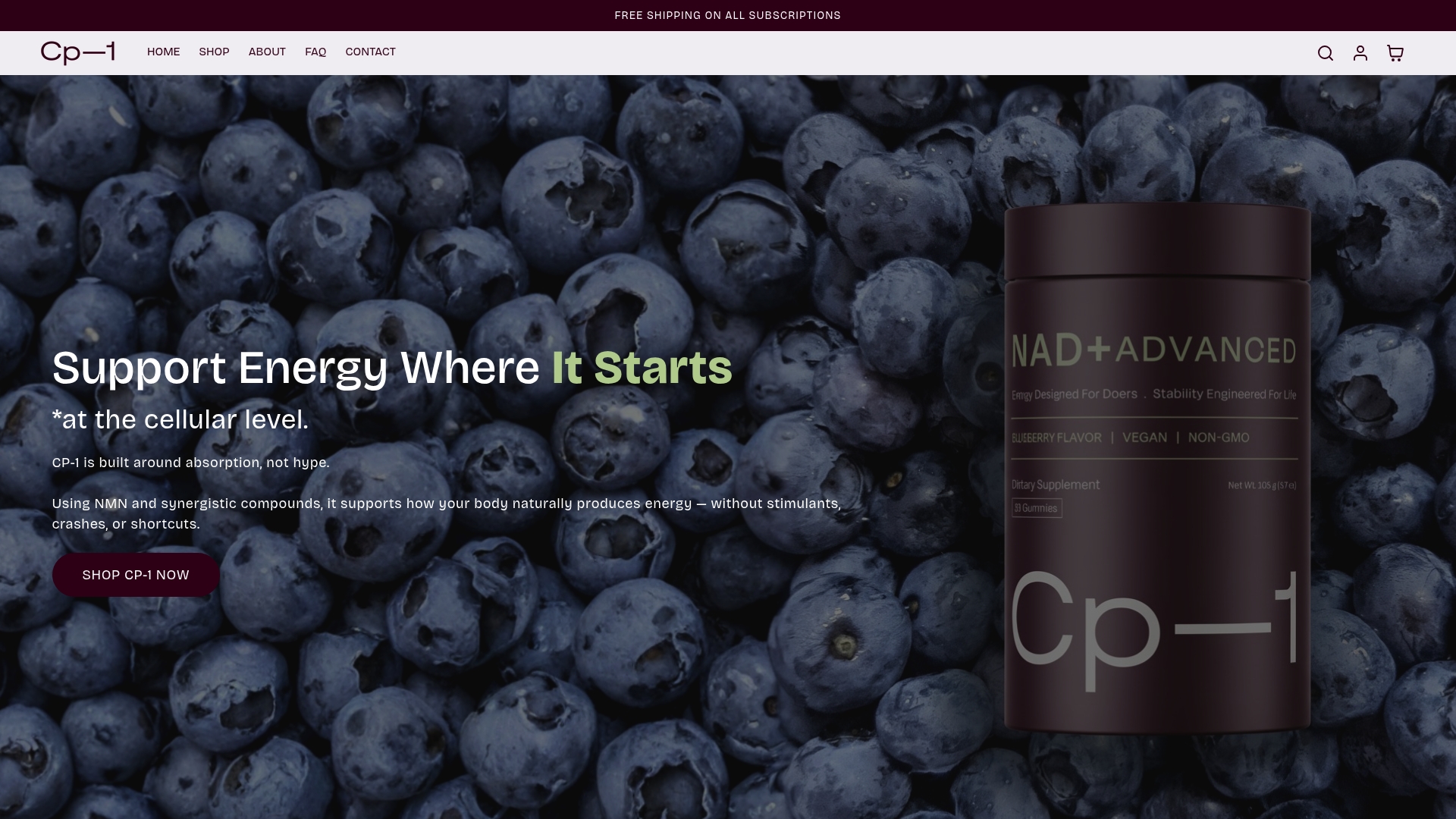
Cp-1 is built for people who want cellular energy support without those tradeoffs. The formula combines NMN (Nicotinamide Mononucleotide) to support NAD+ production, Lion’s Mane for cognitive function, Reishi and Turkey Tail for stress resilience and immune health, and CoQ10 for mitochondrial energy. No stimulants, no crash, no 6-hour bedtime math. It’s vegan, non-GMO, manufactured in the US under GMP-certified conditions, and third-party tested. For readers who want to explore natural energy support as a complement or alternative to caffeine, Cp-1 is worth a look. Visit cp-1.com to see the full formula and order directly.
This article is general information, not medical advice. Consult a qualified healthcare professional before making changes to your caffeine intake, especially if you are pregnant, taking medications, or managing a health condition.
Sources and further reading
- Caffeine & Long Work Hours — NIOSH/CDC
- Caffeine — The Nutrition Source, Harvard T.H. Chan School of Public Health
- Pharmacology of Caffeine — NCBI Bookshelf
- Caffeine Metabolism Modifiers — NCBI Bookshelf
- How long does caffeine take to kick in? — Science Focus
- How to use caffeine to boost alertness — The Seattle Times
- How long does caffeine last? — Healthline
- Spilling the Beans: How Much Caffeine Is Too Much? — FDA
- Caffeine half-life and sleep — Caffeine.exe
- PMC — Caffeine pharmacokinetics review
- USDA FoodData Central