

L-Carnitine for Bodybuilding: What the Science Says
L-carnitine is defined as a naturally occurring compound that transports long-chain fatty acids into the mitochondria, where they are burned for energy. For bodybuilders, the most clinically supported benefits are reduced muscle damage after training and modest assistance with fat metabolism, not dramatic performance gains. Understanding the difference between what the marketing says and what the research actually shows is the only way to use l carnitine bodybuilding protocols that deliver real results.
How does l carnitine work in the body for muscle and fat metabolism?
L-carnitine acts as a shuttle. It binds to fatty acids and carries them across the inner mitochondrial membrane, where beta-oxidation converts those fats into usable energy. Without adequate carnitine, long-chain fats cannot enter the mitochondria at all. That bottleneck is the core reason athletes became interested in supplementation.

The recovery side of the equation is where the evidence gets genuinely interesting. Carnitine reduces creatine kinase levels after intense training. Creatine kinase is a marker of muscle cell damage, so lower levels mean less structural breakdown from your workouts. L-carnitine reduces muscle damage and soreness without improving raw performance in healthy individuals. That distinction matters enormously for how you should think about this compound.
Here is what l carnitine actually does inside your body during a training cycle:
- Transports fatty acids into mitochondria for energy conversion
- Reduces oxidative stress markers after high-intensity exercise
- Lowers creatine kinase levels, signaling less muscle fiber damage
- Supports faster recovery between sessions by reducing soreness
- Assists fat metabolism when carnitine levels are below optimal
Pro Tip: L-carnitine only works as a fat transport agent if your mitochondria are functioning well. Compounds that support mitochondrial health, like CoQ10 and NMN, create the environment where carnitine can do its job most effectively.
The physiological limit here is real. If your body already has sufficient carnitine stores, adding more through supplementation does not automatically increase fat burning. The benefit is conditional on your baseline status and your dosing strategy.
What does the research say about l carnitine’s effectiveness?
The science on l carnitine supplements is more nuanced than most product labels suggest. A 24-week clinical protocol combining 2g of L-Carnitine L-Tartrate with 80g carbohydrates twice daily increased muscle carnitine by 21% compared to control. That is a meaningful increase. It also took six months to achieve, which tells you this is not a one-week fix.
On fat loss, a meta-analysis found that l carnitine supplementation produces a mean weight reduction of 1.21 kg across trials, primarily when combined with exercise and diet. That is roughly 2.66 pounds. Modest, yes. But it is a real, measurable effect when the protocol is followed correctly.
“L-carnitine does not improve exercise capacity in healthy, carnitine-replete individuals, but it does reduce exercise-induced muscle damage and soreness.” — Examine.com
The table below summarizes what the research actually supports versus what it does not:
| Goal | Evidence Strength | Notes |
|---|---|---|
| Muscle recovery and reduced soreness | Strong | Creatine kinase reduction confirmed in multiple trials |
| Modest fat loss | Moderate | ~1.21 kg mean reduction, requires diet and exercise |
| Muscle carnitine loading | Strong | Requires carbohydrate co-ingestion protocol |
| Acute exercise performance | Weak | No benefit in healthy, replete individuals |
| Muscle mass gains | Weak | Not a primary mechanism for hypertrophy |
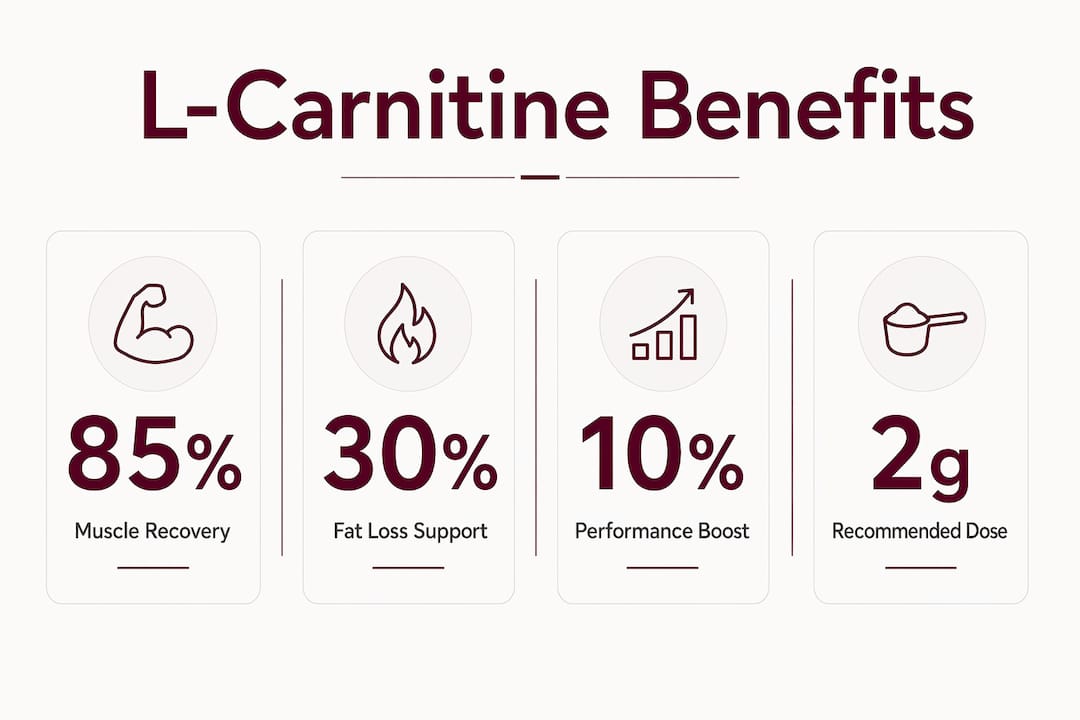
The strongest evidence is for recovery. The weakest is for performance enhancement. If you are buying l carnitine expecting to lift more weight next week, you are going to be disappointed. If you are buying it to recover faster and support a fat loss phase over several months, the research is on your side.
Which forms and dosages work best for bodybuilding?
Not all l carnitine supplements are the same compound. L-Carnitine L-Tartrate (LCLT) is the form studied for exercise performance and recovery. Acetyl-L-Carnitine (ALCAR) crosses the blood-brain barrier and is better suited for cognitive support. Buying the wrong form is one of the most common mistakes bodybuilders make.
For muscle carnitine loading, the carbohydrate co-ingestion protocol is non-negotiable. The mechanism is insulin-dependent. Carbohydrates spike insulin, and insulin drives carnitine into muscle tissue. Without that insulin response, most of the carnitine you swallow stays in circulation and gets excreted. The protocol that produced a 21% muscle carnitine increase used 2g of LCLT with approximately 80g of carbohydrates, taken twice daily.
Practical dosing guidelines for bodybuilders:
- Form: Use L-Carnitine L-Tartrate for training and recovery goals
- Dose: 2g per serving, twice daily
- Timing: Take with carbohydrate-containing meals to drive muscle uptake
- Duration: Allow at least 12 weeks before evaluating results
- Side effects: High doses above 3g can cause fishy body odor due to gut microbial metabolism; titrate up slowly
Pro Tip: Take your first dose with breakfast and your second dose with your post-workout meal. Both meals typically contain carbohydrates, which gives you the insulin spike needed for effective muscle loading.
Most people who say l carnitine did nothing for them were either underdosing, skipping carbohydrates, or expecting results in two weeks. The compound is not broken. The protocol was.
How does l carnitine compare to creatine and thermogenics?
Bodybuilders often stack supplements without understanding how they differ mechanically. L-carnitine, creatine, and thermogenics all affect body composition, but through completely different pathways.
Creatine is better for muscle mass gains and cellular hydration. It works by replenishing ATP during high-intensity efforts, which directly supports strength output and hypertrophy. L-carnitine does not do this. Its contribution is fat transport and recovery, not raw power output. Comparing them as if they are interchangeable is a category error.
Thermogenics work by raising core body temperature and stimulating the central nervous system. They can increase calorie burn in the short term, but they carry stimulant-related side effects and are not sustainable for long cycles. L-carnitine has no stimulant effect. It works through a metabolic pathway, not a hormonal or neurological one. For bodybuilders who are sensitive to stimulants or who are in a longer fat loss phase, l carnitine is the more practical choice. You can also learn more about thermogenic versus metabolic fat loss approaches to decide what fits your program.
The right scenario for l carnitine is a cutting phase where you want to support fat metabolism, reduce muscle damage, and recover faster between sessions. It stacks well with creatine because the two compounds do not compete. Creatine handles strength and hydration. L-carnitine handles fat transport and recovery.
What are the biggest misconceptions about l carnitine for bodybuilding?
The supplement industry has oversold l carnitine for decades. The “fat burner” label is the most damaging myth. Supplementation in replete individuals does not significantly increase the rate of fat burning. If your carnitine levels are already adequate, adding more does not open a new metabolic door.
Here are the most common misconceptions, corrected:
- “L-carnitine burns fat fast.” The mean weight loss across trials is 1.21 kg, achieved over weeks to months with diet and exercise. It is not a rapid fat burner.
- “More is better.” Doses above 3g daily increase side effect risk without proportional benefit. Two grams twice daily is the evidence-based ceiling.
- “It works without carbohydrates.” Muscle carnitine uptake is insulin-dependent. Skipping carbs with your dose wastes most of the supplement.
- “Results come quickly.” The 21% muscle carnitine increase took 24 weeks. Patience is part of the protocol.
- “It replaces diet and training.” L-carnitine is a support compound. Diet and training are the primary drivers of fat loss and muscle development.
Realistic expectations matter. If you go in expecting a modest recovery benefit and gradual support for fat metabolism over a 12-to-24-week cycle, you will not be disappointed. If you expect transformation in a month, you will write it off as useless and miss the actual benefit.
Key Takeaways
L-carnitine supports bodybuilding goals primarily through muscle recovery and modest fat metabolism assistance, not through direct performance enhancement, and only works as intended when dosed correctly with carbohydrate co-ingestion.
| Point | Details |
|---|---|
| Best use case | Use L-carnitine for recovery support and fat metabolism during cutting phases. |
| Correct form matters | Choose L-Carnitine L-Tartrate for exercise goals, not Acetyl-L-Carnitine. |
| Carbs are required | Take 2g with ~80g of carbohydrates twice daily to drive muscle uptake. |
| Realistic fat loss | Expect modest results (~1.21 kg) over weeks to months, not rapid transformation. |
| Performance limits | L-carnitine does not improve strength or endurance in healthy, replete individuals. |
My honest assessment after years of watching people use this wrong
I have watched a lot of people cycle through l carnitine and walk away convinced it does nothing. Almost every time, the protocol was the problem, not the compound. They were taking it on an empty stomach, using the wrong form, or expecting results in two weeks. That is not a supplement failure. That is a knowledge failure, and the industry profits from keeping you in the dark.
What I find genuinely useful about l carnitine is the recovery angle. When you are training hard and eating in a caloric deficit, muscle damage accumulates fast. Anything that measurably reduces creatine kinase levels and soreness between sessions is worth taking seriously. The fat loss effect is real but modest. Treat it as a supporting role in a well-structured program, not the lead.
The carbohydrate co-ingestion piece is the detail most people miss, and it is the one that separates results from wasted money. If you are serious about sports nutrition that actually works, you need to understand the mechanism behind every compound you put in your body. L-carnitine is not magic. It is a transport molecule that needs the right conditions to do its job. Give it those conditions and it delivers. Skip them and you are just expensive urine.
The other thing worth saying: l carnitine works best when your mitochondria are healthy. If your cellular energy production is compromised, carnitine has less to work with. That is why I think about mitochondrial support as foundational, not optional, for anyone serious about body composition and recovery.
— Hugo
Why Cp-1 takes supplement quality seriously
Most supplements on the market are dosed for a marketing deck, not for the person swallowing them. Cp-1 was built on a different premise: every ingredient at a dose that actually does something, backed by research, not just label decoration. If you are serious about mitochondrial support and cellular energy production, the Cp-1 formula includes NMN, CoQ10, lion’s mane, reishi, and turkey tail mushroom extracts. These compounds support the mitochondrial environment where l carnitine does its work. Third-party tested, vegan, non-GMO, and made in the US. Explore the full Cp-1 product range at cp-1.com.
FAQ
What is the best form of l carnitine for bodybuilding?
L-Carnitine L-Tartrate (LCLT) is the form with the strongest evidence for exercise recovery and muscle damage reduction. Acetyl-L-Carnitine is better suited for cognitive support, not training goals.
Does l carnitine actually help with fat loss?
Research shows a mean weight reduction of approximately 1.21 kg across trials, primarily when combined with exercise and a caloric deficit. It is a modest effect, not a dramatic fat-burning result.
How much l carnitine should athletes take per day?
The evidence-backed dose is 2g of L-Carnitine L-Tartrate taken twice daily with approximately 80g of carbohydrates per serving. This protocol produced a 21% increase in muscle carnitine over 24 weeks.
Does l carnitine boost energy during workouts?
L-carnitine does not act as a stimulant and does not improve acute exercise performance in healthy individuals. Its energy-related benefit comes from supporting fat transport into mitochondria over time, not from a pre-workout stimulant effect.
Can you stack l carnitine with creatine?
Yes. Creatine supports muscle mass and ATP replenishment, while l carnitine supports fat transport and recovery. The two compounds work through different pathways and do not compete with each other.