

Longevity Defined: What It Really Means for Your Health
Most people think of longevity as simply living to an old age. Get to 90, and you’ve won. But that framing misses the point entirely, and modern science agrees. Longevity defined in today’s research is about living better for longer, not just clocking more years on the calendar. This article breaks down what longevity actually means, how it differs from lifespan and healthspan, what biology tells us about aging, and what you can realistically do to extend your healthy, functional years.
Table of Contents
- Key takeaways
- Longevity defined: more than just a long life
- The biology of aging and why it’s complicated
- Measuring longevity: HALE, QALYs, and why they matter
- Practical strategies to extend healthy years
- Common misconceptions about longevity
- My take on longevity after years in this space
- Support your longevity goals with Cp-1
- FAQ
Key takeaways
| Point | Details |
|---|---|
| Longevity is not just lifespan | True longevity means maximizing healthy, functional years, not just surviving longer. |
| Healthspan is the real target | Experts now define success as extending the years you live free from disease and disability. |
| Aging is multifactorial | Genetics, environment, inflammation, and metabolism all shape how you age, not a single switch. |
| Better metrics exist | HALE and QALYs measure longevity success by combining years lived with quality of health. |
| Lifestyle changes come first | Consistent daily habits in diet, movement, and sleep outperform any supplement or quick fix. |
Longevity defined: more than just a long life
The Oxford dictionary defines longevity as “the fact of lasting a long time,” with no direct mention of health or quality of life. That definition is accurate as far as it goes, but it leaves out everything that actually matters to you as a person who wants to live well.
Modern health science tells a different story. NYU Langone experts now define longevity as living better for longer, placing the emphasis squarely on healthy, active years rather than raw survival time. That shift in framing changes everything about how you should think about aging.
To understand longevity fully, you need three distinct definitions working together:
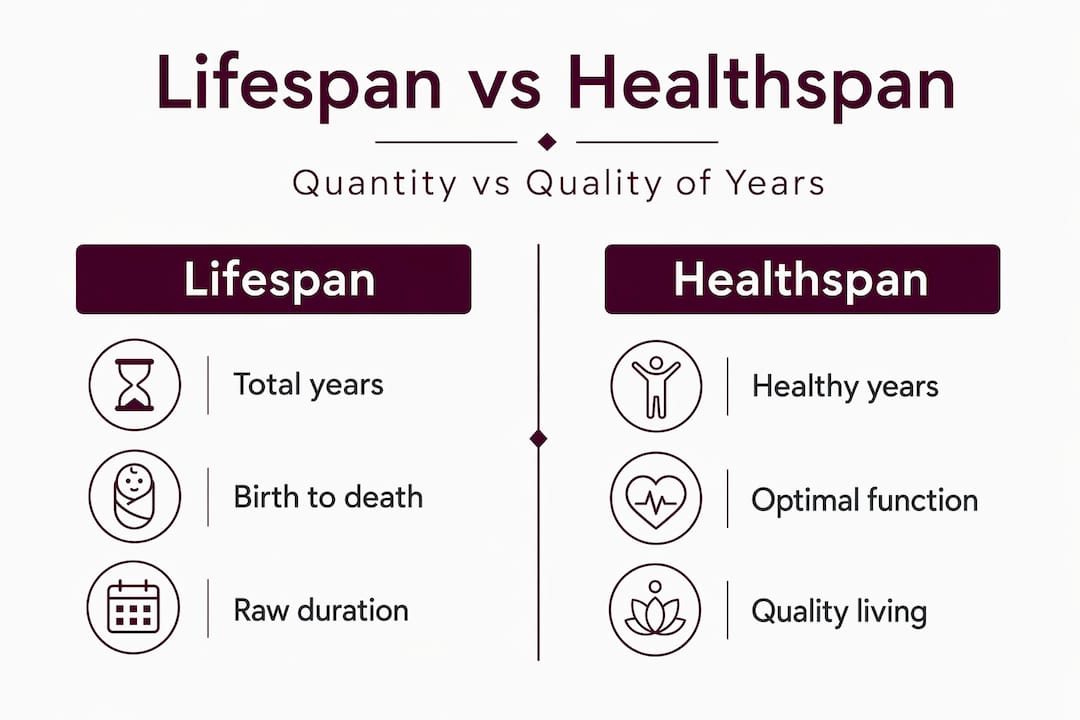
- Lifespan: The purely chronological time from birth to death. It’s a number. It tells you nothing about what those years looked like.
- Healthspan: The period of life spent free from major chronic disease, disability, or significant functional decline. This is what most people actually care about.
- Longevity: The combination of both. Living long and living well. Extending the years when you are cognitively sharp, physically capable, and socially engaged.
| Term | What it measures | What it misses |
|---|---|---|
| Lifespan | Years from birth to death | Quality of those years |
| Healthspan | Years lived in good health | Total length of life |
| Longevity | Long life, ideally healthy | Varies by definition used |
The gap between lifespan and healthspan is not trivial. Medical advances have extended how long people survive, but roughly 9.6 years are spent in poor health or disability on average. That is nearly a decade of survival without real quality of life. If you’re optimizing for longevity, you’re optimizing to close that gap.
Pro Tip: When you hear claims about “extending your life,” ask whether the intervention targets lifespan, healthspan, or both. The answer tells you a lot about whether it’s worth your attention.
The biology of aging and why it’s complicated
Aging is not a single process with a single off switch. This is one of the most important things longevity science has clarified in the last decade. Biological aging involves multifactorial resilience mechanisms spanning inflammation, metabolism, epigenetic regulation, and cellular repair systems, all interacting simultaneously.
What does that mean practically? It means no pill, no hormone, and no supplement alone can “stop aging.” Longevity is the product of how well multiple biological systems maintain their function under stress over time. Researchers call this resilience, and it’s measurable through biomarkers like inflammatory markers, metabolic panels, and epigenetic age clocks.
Here’s what the research identifies as the primary biological drivers of how well you age:
- Inflammation: Chronic low-grade inflammation, sometimes called “inflammaging,” accelerates cellular damage across tissues.
- Mitochondrial function: Your cells’ energy production declines with age, affecting everything from muscle strength to cognitive clarity.
- Epigenetic changes: Gene expression patterns shift with age and lifestyle, either protecting or accelerating cellular decline.
- Metabolic regulation: Blood glucose control, insulin sensitivity, and lipid metabolism all influence biological aging rate.
- Cellular senescence: Aging cells that stop dividing but refuse to die accumulate and release inflammatory signals that harm surrounding tissue.
“Longevity science targets biological aging and multimorbidity rather than immortality or quick product fixes.” — Longevity Science Research
Understanding this biology is not about overwhelming you with science. It’s about recognizing that your daily choices affect multiple systems at once. Diet, sleep, movement, and stress management each touch several of these mechanisms. That’s why consistent habits are so much more powerful than any single targeted intervention.
Genetics do play a role in exceptional longevity. Families with many centenarians show specific variants in genes tied to inflammation and lipid metabolism. But genetics account for a smaller portion of longevity outcomes than most people assume. Lifestyle and environment carry significantly more weight for the majority of people.

Measuring longevity: HALE, QALYs, and why they matter
For most of medical history, longevity research measured success by one number: how long did people live? That metric is useful but deeply incomplete. A person who lives to 85 while spending the last 15 years with dementia or severe mobility limitations has a very different experience than someone who remains independent and functional until 83.
Two modern metrics fix this problem, and understanding them helps you evaluate longevity claims with much more clarity.
Health-Adjusted Life Expectancy (HALE) weights years of life by health status. A year lived with a serious disability counts as less than one full year in the calculation. HALE gives a more realistic picture of what populations actually gain from health interventions. Geroscience researchers measure longevity success using HALE alongside raw lifespan because survival time alone does not capture what matters.
Quality-Adjusted Life Years (QALYs) work similarly. They assess the value of a year of life based on functional status and wellbeing. Health economists use QALYs to evaluate whether medical treatments actually improve meaningful health outcomes, not just survival statistics.
| Metric | What it captures | Why it’s useful |
|---|---|---|
| Lifespan | Years alive | Simple, universal baseline |
| HALE | Years alive in good health | Accounts for disability and disease burden |
| QALYs | Years weighted by functional quality | Evaluates interventions on meaningful outcomes |
These metrics matter to you because they reframe the goal. You’re not trying to maximize years on paper. You’re trying to maximize health-adjusted life extension, the years when you can do the things that make life worth living.
Pro Tip: Ask your doctor about biomarkers tied to healthspan, not just disease screening. Metrics like HbA1c, hs-CRP (high-sensitivity C-reactive protein), and grip strength give you early signals about your biological trajectory.
Practical strategies to extend healthy years
Now that you know what longevity actually means, here’s how to work toward it. These strategies are grounded in current research, not marketing hype. None of them are magic. All of them work when applied consistently.
-
Prioritize sleep without negotiation. Sleep is when your brain clears metabolic waste, your cells repair, and your immune system consolidates. Chronic sleep deprivation accelerates nearly every biological aging mechanism. Seven to nine hours for most adults is not optional if longevity is the goal.
-
Build a diet around whole foods and adequate protein. No single eating pattern has a monopoly on longevity outcomes, but the consistent theme across research is minimally processed foods, plenty of fiber, and sufficient protein to preserve muscle mass. Muscle mass is one of the strongest predictors of functional independence in later life.
-
Move your body daily, with resistance training included. Aerobic exercise supports cardiovascular and metabolic health. Resistance training preserves muscle and bone density. Antioxidants from movement and nutrition support healthy aging at the cellular level. Both forms of exercise belong in your weekly routine.
-
Manage metabolic and inflammatory risk proactively. Get regular blood work. Track your fasting glucose, triglycerides, blood pressure, and inflammatory markers. Catching metabolic drift early gives you the most options to correct it before it drives disease.
-
Engage socially and protect mental health. Social isolation is a genuine mortality risk factor, with effect sizes comparable to smoking in some studies. Strong relationships and purpose protect both cognitive function and immune resilience.
-
Approach supplements and therapies with clear eyes. Supplements and hormone therapies should support a solid lifestyle foundation, not replace one. Clinical hormone therapy is appropriate when medically indicated. Evidence-backed supplements, particularly those supporting cellular energy and NAD+ production, can fill real nutritional gaps. But lifestyle changes come first, always.
Pro Tip: Think of longevity strategies as a portfolio, not a product. You’re managing risk across multiple biological systems simultaneously. One great supplement does less than six consistent daily habits.
Common misconceptions about longevity
A lot of what gets marketed as “longevity” is either incomplete or outright misleading. Knowing the difference protects your time, your money, and your health decisions.
- Longevity is not about immortality. Longevity science does not pursue endless life. It pursues compressing the period of decline at the end of life and extending the healthy years before it.
- “Anti-aging” products almost never deliver what they promise. The term “anti-aging” is a marketing category, not a scientific one. Most products in that space lack credible clinical evidence for meaningful longevity outcomes.
- Healthspan definitions vary, which breeds confusion. Healthspan definitions vary widely across researchers, making it hard to compare claims. The most practical focus is on functional independence and freedom from major disease.
- More years does not automatically mean better years. Medical advances have extended survival for many conditions. But without a parallel focus on healthspan, those extra years can mean more time living with chronic disease, not less.
“The debate between lifespan and healthspan is obsolete. Meaningful longevity is health-adjusted life extension combining both.” — Geroscience Research
Viewing longevity as comprehensive risk management is the most honest framing available. You’re not chasing one outcome. You’re maintaining the conditions that allow multiple systems to function well together, for as long as possible.
My take on longevity after years in this space
I’ll be direct with you: the moment I stopped thinking about longevity as an age target and started thinking about it as functional independence, everything clicked differently.
I’ve seen people obsess over supplements, optimize their sleep scores obsessively, and track every biomarker available, while ignoring the chronic stress, social isolation, and sedentary hours that were quietly accelerating their biological aging. That’s the trap. Longevity is not a checklist you complete. It’s a set of conditions you maintain.
What I’ve learned from working in this space is that the people doing it well are not doing anything exotic. They move consistently. They sleep seriously. They eat food that was actually food at some point. They manage their metabolic risk before it becomes disease. And they don’t expect any one product to carry the weight of their entire health practice.
My experience with cellular energy strategies reinforced this. Supporting mitochondrial function matters, but it matters most when the rest of your foundation is solid. No amount of NMN fixes a diet full of processed food and chronic sleep debt.
The goal is not to live forever. The goal is to be sharp, capable, and engaged for as long as you’re here. That’s what longevity actually means when you strip away the marketing noise.
— Hugo
Support your longevity goals with Cp-1
If this article changed how you think about longevity, the next step is applying that thinking to your daily wellness practice. Cp-1 was built for people who take this seriously. Not supplement hype. Real, evidence-backed formulas with ingredients like NMN, CoQ10, lion’s mane, and reishi mushroom that target the biological systems longevity research actually points to. You can explore the full breakdown of how supplements support healthy aging and find out why Cp-1 approaches each ingredient with function in mind, not marketing copy. When you’re ready to see what that looks like in practice, visit Cp-1 and start with the science.
FAQ
What does longevity mean in health science?
In health science, longevity means living better for longer, prioritizing healthy, active years rather than raw survival time. Modern experts define it as extending healthspan alongside lifespan.
What is the difference between lifespan and healthspan?
Lifespan is the total number of years from birth to death. Healthspan is the portion of those years lived free from major chronic disease, disability, or significant functional decline.
What factors most affect longevity?
Biological aging involves multiple interacting systems including inflammation, mitochondrial function, metabolism, and epigenetic changes. Lifestyle factors like diet, sleep, movement, and stress management influence these systems significantly.
How is longevity measured scientifically?
Researchers use Health-Adjusted Life Expectancy (HALE) and Quality-Adjusted Life Years (QALYs) to measure longevity outcomes, combining years lived with the quality of health during those years.
Are anti-aging supplements proven to extend longevity?
Most products marketed as “anti-aging” lack strong clinical evidence for meaningful longevity outcomes. Evidence-backed supplements targeting cellular energy and NAD+ production can support a solid lifestyle foundation, but they work best alongside consistent daily habits rather than as a replacement for them.