
A peptide is defined as a short chain of amino acids, typically between 2 and 50 residues, linked together by peptide bonds. These molecules are not exotic lab creations. They exist in every cell of your body, in the food you eat, and increasingly in the supplements and drugs being marketed to you. If you are researching peptides for muscle growth, cognitive support, or anti-aging, the single most important thing to understand is this: not all peptides are the same category, and confusing them is where most people go wrong.
What are peptides and how do they work in the body?
Peptides function as biological messengers, structural components, and enzymatic regulators throughout the human body. Insulin is a peptide. So is oxytocin. So is the collagen fragment in your morning protein shake. The amino acid sequence determines everything about what a peptide does, which means a peptide that supports skin hydration operates through completely different mechanisms than one that stimulates growth hormone release.
The connection between peptides and proteins is direct. Proteins are simply longer chains, typically above 50 amino acid residues. When your digestive system breaks down a protein from food, it produces shorter fragments. Many of those fragments are bioactive peptides with measurable physiological effects. This is why the food you eat genuinely influences peptide activity in your body, not just the supplements you buy.
Peptide bonds are the covalent chemical links that hold amino acids together in these chains. Understanding that structure matters because it explains why delivery method is so critical. Many peptides are broken down in the gut before reaching target tissues, which is why some formulations require injection while others are engineered for oral bioavailability.
How do food-derived, therapeutic, and research peptides differ?
This is the distinction that most supplement marketing deliberately blurs, and it costs people money and sometimes their health.
Food-derived and bioactive peptides
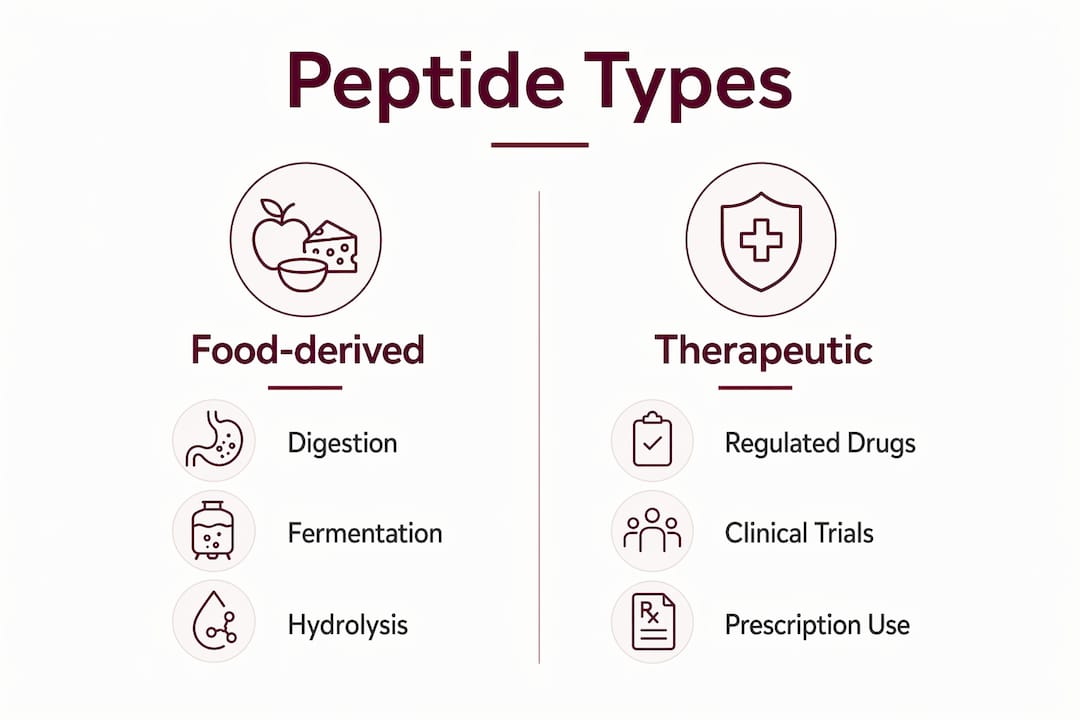
Food-derived peptides are generated through digestion, fermentation, and hydrolysis of dietary proteins. They have documented bioactivities including antioxidant, antihypertensive, and neuroprotective functions. Collagen peptides fall into this category. So do casein-derived peptides from dairy and bioactive fragments from fermented soy. These are generally recognized as safe, widely studied, and available without a prescription.
Approved therapeutic peptide drugs
Therapeutic peptide drugs are pharmaceutical compounds that have passed clinical trials and received regulatory approval. Examples include semaglutide (the active compound in Ozempic and Wegovy), insulin analogs, and oxytocin. These are prescribed by physicians, manufactured to pharmaceutical-grade standards, and carry known safety profiles. They are not supplements.
Unapproved research peptides
Research peptides are synthetic compounds sold online, often with labels reading “for research use only” or “not for human consumption.” Products like BPC-157, TB-500, and various growth hormone releasing peptides fall here. The FDA has not approved them for human use. The FDA issued warning letters in April 2026 against online sellers of these compounds, making clear that “research use only” disclaimers provide no legal protection when marketing implies therapeutic use.
| Category | Regulatory Status | Evidence Base | Typical Form |
|---|---|---|---|
| Food-derived peptides | Generally recognized as safe | Strong for specific functions | Oral supplements |
| Approved therapeutic peptides | Drugs approved by the FDA | Robust clinical trial data | Prescription only |
| Research peptides | Unapproved, unregulated | Weak or absent for humans | Injectable, online sales |
Here is what the table above actually means for you: the category determines the evidence, the risk, and the legal status. Mixing them up is not just a semantic error. It is a safety issue.
- Food-derived peptides like collagen are studied for skin, joints, and muscle support
- Therapeutic peptide drugs require a prescription and physician oversight
- Research peptides carry unknown long-term risks and active FDA enforcement in 2026
- Misattributing benefits across categories is a documented source of consumer confusion and harm
Pro Tip: When you see a peptide supplement marketed for muscle growth or fat loss without a prescription requirement, check whether the active compound is a food-derived peptide or an unapproved research compound. The marketing language rarely tells you which one it is.
What are the scientifically backed health benefits of peptides?
The evidence is real but uneven. Some peptide applications have solid clinical backing. Others are built almost entirely on animal studies and anecdote.
Muscle support and collagen peptides
Collagen peptides are the most studied food-derived peptide supplement for physical performance. Research supports their role in joint health and connective tissue repair, particularly when combined with resistance training and vitamin C. What collagen peptides do not do is replicate the effects of growth hormone releasing peptides or anabolic compounds. The mechanisms are entirely different. Collagen peptides provide amino acid substrates for tissue repair. Growth hormone pathway agonists manipulate endocrine signaling. Treating these as interchangeable is a mistake that peptide category distinctions make clear.

Cognitive enhancement and the diet-brain connection
The cognitive angle on peptides is genuinely interesting and underreported. Food-derived neuropeptides generated through digestion interact with the gut-brain axis and have shown potential to mitigate cognitive impairment and neurodegeneration in research models. This is not the same as injecting a synthetic nootropic peptide. It means that fermented foods, protein-rich diets, and functional food ingredients can influence peptide activity in ways that support brain health. The mechanism runs through the microbiome, not a syringe.
Anti-aging and skin health
This is where the clinical data is most concrete for oral supplementation. A 2026 systematic review of 19 RCTs found that peptides, especially oral formulations, improve skin hydration, brightness, and modestly reduce wrinkles, with good tolerance across participants. The meta-analysis showed oral polypeptides produced a significant wrinkle reduction effect with a mean difference of 1.5 at p=0.01. That is a real finding. It is also a modest one.
“Bigger doses did not produce proportionally greater wrinkle reduction.” The meta-analysis on skin peptides found that higher doses or stacking peptides does not correlate with stronger anti-aging effects. Formulation matters more than quantity.
Here is a summary of where the evidence actually stands:
- Skin hydration and brightness: Supported by multiple RCTs, particularly for oral collagen peptides
- Wrinkle reduction: Modest but statistically significant in meta-analysis; not dramatic
- Joint and connective tissue support: Supported for collagen peptides combined with exercise
- Cognitive protection: Promising in research models via diet-gut-brain axis; not yet proven in large human trials
- Muscle hypertrophy via research peptides: Largely unproven in rigorous human studies
Oral peptide supplements are generally well tolerated with minimal adverse events reported across clinical trials. That is genuinely reassuring for anyone considering food-derived or oral peptide products.
What safety concerns exist around peptide use?
The honest answer is that the risks are not evenly distributed. Oral food-derived peptides carry a very different risk profile than self-injected research compounds.
Self-injection of unregulated synthetic peptides carries documented risks including infections, abscesses, and unknown long-term safety consequences. Many products sold online lack pharmaceutical-grade quality and accurate labeling. You genuinely do not know what you are injecting. That is not a hypothetical concern. It is the reason the FDA moved aggressively in 2026.
The FDA’s regulatory approach focuses on marketing language and intended use, not just product labels. A disclaimer reading “not for human use” fails the moment the seller includes injection supplies, dosing guides, or language implying therapeutic benefit. Sellers found this out the hard way in April 2026.
Key risks to understand before using any peptide product:
- Infection risk: Reusing needles or using non-sterile preparations causes abscesses and systemic infections
- Unknown long-term effects: Most research peptides have no long-term human safety data
- Dosing inconsistency: Unregulated products frequently mislabel concentration and purity
- Legal exposure: Purchasing unapproved drugs for personal use exists in a gray area that is narrowing
- Interaction risks: Peptides that influence hormone pathways can disrupt endocrine function unpredictably
Pro Tip: If a peptide product comes with a vial, a syringe, and a “research use only” label, that combination is a red flag. Legitimate food-derived peptide supplements do not require injection at home.
Harm reduction, if you choose to use injectable peptides, means sterile preparation and sourcing, never reusing needles, and doing so only under medical supervision. The risks in this space come primarily from poor quality and administration practices, not from peptide pharmacology alone.
How to approach peptide use responsibly
Most people researching peptides are not reckless. They are trying to make informed decisions in a market that makes that genuinely difficult. Here is a practical framework.
- Define your goal first. Skin health, joint support, and cognitive function each point to different peptide categories with different evidence bases. Do not let marketing collapse those distinctions.
- Match your goal to the right category. Oral collagen peptides for skin and joints. Dietary protein and fermented foods for gut-brain peptide activity. Prescription peptide drugs only through a physician.
- Read labels with skepticism. Any product making dramatic claims about muscle growth, fat loss, or cognitive enhancement without prescription status deserves scrutiny. Check whether the active compound is a recognized food-derived ingredient or an unapproved research compound.
- Prioritize third-party tested products. Third-party testing confirms that what is on the label is actually in the product at the stated concentration. This matters more for peptides than almost any other supplement category because the market is so poorly regulated.
- Choose US-made products where possible. US-manufactured supplements operate under stricter manufacturing standards than products sourced from unregulated overseas facilities.
- Consult a healthcare professional before use. This is especially true for any peptide that influences hormone pathways, metabolic function, or neurological activity.
The rigorous clinical evidence for many injected peptides marketed for muscle growth, weight loss, or cognitive enhancement is weak or absent. That does not mean peptides are useless. It means the hype has outrun the data, and your job as a consumer is to close that gap.
Key takeaways
Peptides deliver real but category-specific benefits, and the evidence for oral food-derived peptides is far stronger than for most injectable research compounds.
| Point | Details |
|---|---|
| Peptide definition | A peptide is a chain of 2 to 50 amino acids; sequence and delivery form determine its effects. |
| Three distinct categories | Food-derived, therapeutic drugs, and research peptides carry completely different evidence and risk profiles. |
| Skin anti-aging evidence | A 2026 meta-analysis of 19 RCTs confirms modest but real wrinkle reduction and hydration improvements from oral peptides. |
| Research peptide risks | Self-injection of unregulated compounds carries infection risk, dosing uncertainty, and active FDA enforcement in 2026. |
| Responsible sourcing | Third-party testing and US-based manufacturing are the minimum standards for any peptide supplement you consider. |
Why the peptide hype machine frustrates me
I have spent years watching the supplement industry take legitimate science and stretch it past the breaking point. Peptides are the latest example. The underlying biology is real and genuinely exciting. The marketing built on top of it is often garbage.
Here is what bothers me most: the people getting hurt are not reckless. They are health-conscious individuals who read the research, saw the clinical data on collagen peptides or skin formulations, and then got sold something completely different under the same label. A compound that manipulates growth hormone signaling is not the same thing as a food-derived peptide. Treating them as equivalent because both are “peptides” is like saying aspirin and fentanyl are the same because both are “pain medications.”
The 2026 FDA enforcement actions were overdue. But they will not fix the underlying problem, which is that most consumers do not have the tools to distinguish a well-studied oral supplement from an unapproved injectable compound with a “research use only” sticker on it.
My honest take: start with what the evidence actually supports. Oral collagen peptides for skin and joints. Dietary strategies that support gut-brain peptide activity. Prescription options through a physician if your goals require them. Skip the injectable gray market entirely unless you are under direct medical supervision with pharmaceutical-grade compounds. The potential upside does not justify the risk when the evidence base is this thin.
Skepticism is not cynicism here. It is the only rational response to a market where the science is real but the products are often not.
— Hugo
Support your health goals with supplements you can actually trust
If the peptide space has taught you anything, it should be that sourcing and transparency matter more than marketing claims.
Cp-1 is built on exactly that principle. Every product is manufactured in the US, third-party tested, and formulated around ingredients with real evidence behind them. NMN, lion’s mane, reishi, turkey tail, and CoQ10 are not trendy additions. They are chosen because the research on cellular energy, cognitive function, and immune resilience is solid. If you are serious about health optimization and tired of formulas designed for a marketing deck rather than the person swallowing them, explore Cp-1’s approach to supplementation. No hype. No shortcuts. Just what actually works.
FAQ
What are peptides in simple terms?
A peptide is a short chain of amino acids, typically 2 to 50 residues, linked by peptide bonds. They function as biological messengers, structural components, and enzymatic regulators throughout the body.
Are peptides safe to take as supplements?
Oral food-derived peptides are generally well tolerated with minimal adverse events reported in clinical trials. Injectable research peptides carry significantly higher risks including infection, dosing inconsistency, and unknown long-term effects.
Do peptides actually work for anti-aging?
A 2026 systematic review of 19 RCTs found oral peptides produce modest but statistically significant improvements in skin hydration, brightness, and wrinkle reduction. Higher doses do not produce proportionally stronger results.
What is the difference between peptides and proteins?
Peptides are chains of 2 to 50 amino acids. Proteins are longer chains, typically above 50 residues. When proteins are digested, they break down into shorter peptide fragments, many of which have distinct bioactive functions.
Are research peptides legal to buy?
Research peptides occupy a regulatory gray area that is narrowing. The FDA issued warning letters in April 2026 against sellers marketing unapproved peptides for human use, and “research use only” disclaimers do not protect sellers when marketing implies therapeutic intent.