
A proprietary blend is a group of dietary ingredients listed together on a Supplement Facts panel that shows only the combined total weight, not each ingredient’s individual amount. That means you can’t tell from the label whether the ingredient you’re paying for is dosed at a level that actually does anything. Before you buy, check the total blend weight, count the ingredients, and look for third-party testing.
TL;DR:
- Proprietary blends only list the total weight and ingredient order, making it impossible to determine if key ingredients are dosed effectively.
- The legal framework allows the use of blends to protect formulas, but FDA inspections can reveal exact ingredient amounts during manufacturing checks.
- Many supplements hide under-dosed or trace amounts of ingredients, especially those with well-known effective doses, labeled as “Pixie dusting.”
- Checking total blend weight, ingredient count, and whether the studied doses match the label limits helps evaluate the product’s transparency.
- Certifications like NSF and USP verify manufacturing quality and contamination but do not confirm individual ingredient doses inside proprietary blends.
Table of Contents
- What Proprietary Blends Look Like on a Label
- What Legal Rule Allows Proprietary Blends?
- Why Do Supplement Brands Use Proprietary Blends?
- What Are the Real Risks of Proprietary Blends?
- How Do You Evaluate a Proprietary Blend on a Bottle?
- What Do NSF, USP, and Informed-Sport Certifications Actually Verify?
- How CP-1 Approaches Ingredient Disclosure
- A Publisher’s Take on Transparency Versus Protection
- Want a Supplement That Shows Its Work?
- Where to Verify This Yourself
- Sources
What Proprietary Blends Look Like on a Label
Open a bottle and flip to the Supplement Facts panel. If you see a bolded name like “Energy Complex,” “Focus Matrix,” or “Adaptogen Blend” followed by a single milligram number and then a list of ingredient names underneath it with no numbers next to them, you’re looking at a proprietary blend. Compare that to a fully disclosed label, where every ingredient gets its own line and its own dose.
The rule that governs what you’re seeing is simple. Ingredients inside a blend must be listed by common name in descending order of weight, heaviest first. That ordering is the only clue you get.
Here’s what the label structure actually tells you, and what it hides:
- What it shows: the total combined weight of everything in the blend, per serving.
- What it implies: the first-listed ingredient weighs the most, the last-listed weighs the least.
- What it doesn’t show: whether the second ingredient is 40% of the blend or 0.4% of it.
- What it can’t tell you: whether the “hero” ingredient on the front label is present at a meaningful dose or just enough to legally claim it’s in there.
That gap between “listed” and “dosed appropriately” is the entire reason proprietary blends generate so much confusion.
What Legal Rule Allows Proprietary Blends?
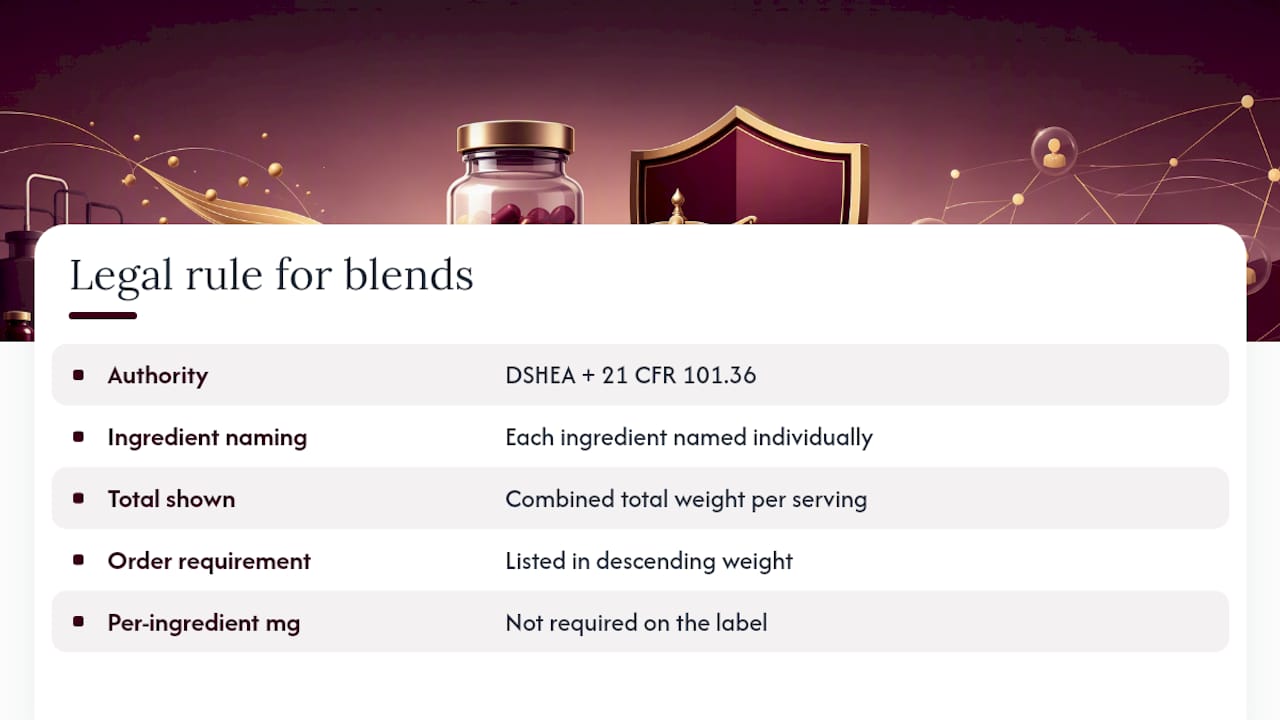
The Dietary Supplement Health and Education Act (DSHEA), paired with FDA’s labeling regulation 21 CFR 101.36, is what makes this legal. Manufacturers can group ingredients under a blend name and disclose only the total weight per serving, as long as each ingredient is still named individually and listed in descending order by weight. That’s the whole obligation: identify what’s inside, disclose the combined total, and rank by weight. Nothing in the rule requires per-ingredient milligram counts.
The proprietary blend allowance exists as a deliberate regulatory trade-off. It protects formulation intellectual property while opening a transparency gap for the person reading the label, and enforcement generally targets false claims rather than the blend format itself.
Here’s the part most shoppers never learn: FDA inspectors can see the exact formula. During Good Manufacturing Practice (GMP) inspections, the FDA can request the precise breakdown of a proprietary blend, even though that same information never reaches the label. Regulators get transparency you don’t.
That distinction matters for how you think about “safe” versus “informed.” A blend passing FDA inspection means the company had to show its formula to someone. It does not mean you, standing in a store aisle, have any way to verify the dose of the ingredient you actually want.
Why Do Supplement Brands Use Proprietary Blends?
Ask an industry trade group and you’ll get a coherent answer: protecting trade secrets. The Council for Responsible Nutrition (CRN) argues that formulators invest real money figuring out ratios that work, and disclosing exact amounts on a label hands that recipe to every competitor with a lab and a copier. CRN frames the exception as intellectual property protection under DSHEA, not a safety loophole, and has published detailed reasoning defending that position.
There’s also a less flattering explanation, and it’s worth naming plainly. Hiding individual amounts makes it cheaper to under-dose an expensive ingredient while still printing its name in bold on the front of the bottle. Ask yourself two questions before you trust the “innovation” explanation:
- Is the formula genuinely novel, with a ratio that would be hard to reverse-engineer from a total weight alone?
- Or is the “hero” ingredient one everyone already knows the effective dose for, meaning the only thing a blend hides is whether that dose was actually met?
The second scenario is where garbage products hide. The first is where trade-secret protection has an actual argument.
What Are the Real Risks of Proprietary Blends?
The core problem, according to peer-reviewed analysis on supplement transparency, is that consumers can’t verify whether a headline ingredient is present at a research-backed amount. Everything else flows from that one gap.
- You can’t confirm clinical relevance. If a study used 500 mg of an ingredient and your blend’s total weight is 400 mg for six ingredients combined, the math already tells you something.
- Stacking risk goes invisible. If you’re taking two supplements with overlapping ingredients, hidden inside two different blends, you have no reliable way to add up your real daily total.
- Stimulants can hide in plain sight. Consumer safety groups have flagged that proprietary blends can mask stimulant-like ingredients, and lab testing is the only way to confirm exact contents.
- “Pixie dusting” is common. This is the industry’s own term for sprinkling a trace amount of an expensive, trendy ingredient into a blend just so it can appear on the front label.
Pro Tip: If a blend lists multiple ingredients under a modest total amount, do the mental math before you buy. Many ingredients sharing that total leaves very little room for any single one to hit a dose that matches the studies you’d find backing that ingredient.
How Do You Evaluate a Proprietary Blend on a Bottle?
Work through this in the order given. Each step narrows down whether the product is worth trusting or worth walking away from.
- Find the total blend weight and serving size. This is your ceiling. Nothing inside the blend can exceed this number, combined.
- Count the ingredients listed inside the blend. More ingredients sharing the same ceiling means less room for each one.
- Estimate a floor for the first-listed ingredient. Since ingredients are ranked by weight, the top one must be at least roughly 1/n of the total when n ingredients are present, according to evaluation methods used by supplement analysts. That gives you a rough minimum, not an exact number, but it’s often enough to expose an implausibly small “hero” dose.
- Check whether the featured ingredient’s studied dose is public. Ingredients like caffeine, creatine, and melatonin have well-documented effective ranges. If the blend’s total weight can’t plausibly cover that range once split among everything else listed, the marketing claim on the front of the bottle is doing more work than the formula.
- Scan for stimulant-class ingredients you didn’t expect. Names like “extract,” synephrine variants, or unnamed “energy complex” components deserve a search before you swallow anything.
- Look for a certification seal, and then verify it. A seal is a starting point, not proof, so check the certifying body’s own database if one exists.
- Search for a full-formula disclosure page. Some brands voluntarily publish exact milligram amounts for every ingredient even inside a named blend. That single choice tells you more about a company’s confidence in its formula than any other signal on the bottle.
Our supplement label reading checklist walks through this same process with printable steps, if you want something to keep on your phone.
What Do NSF, USP, and Informed-Sport Certifications Actually Verify?
Third-party testing programs like NSF, USP, and Informed-Sport check that what’s on the label matches what’s in the bottle and that the product isn’t contaminated with banned substances, heavy metals, or microbial contamination. That’s real, valuable verification, and the FDA itself points to certification as one of the few consumer-side tools available for catching label inaccuracy.
Here’s the limit almost nobody mentions: most certification programs verify overall label accuracy, not the individual milligram amount of each ingredient buried inside a proprietary blend. A certified product can still legally hide the exact split of ingredients within a blend.
- NSF and USP certification confirms manufacturing quality and screens for contamination.
- Informed-Sport specifically screens for substances banned in competitive sport.
- None of the three routinely publish a full breakdown of proprietary blend ratios.
Pro Tip: When a brand cites a certification, look up the certification number in the certifying body’s public database rather than trusting the logo alone. Anyone can print a seal on packaging.
Our guide on what third-party testing actually verifies breaks down how to read a lab report once you find one.
How CP-1 Approaches Ingredient Disclosure
Here’s why this topic isn’t abstract for us. A certain NAD+ Advanced Supplement features NMN, lion’s mane, reishi, turkey tail, and CoQ10, with ingredients manufactured in the US under GMP-certified facilities, using vegan and non-GMO sourcing. We test through third parties because “trust us” has never been good enough in this industry, and it shouldn’t be good enough for you either.
Voluntary disclosure is the piece most brands skip. When a company shows you its lab reports and formula reasoning instead of hiding behind a blend name, that’s a choice, not a legal requirement. Our supplement transparency guide walks through exactly what real disclosure looks like versus marketing dressed up as it.
A Publisher’s Take on Transparency Versus Protection
The law permits proprietary blends, and CRN’s trade-secret argument isn’t nothing. Formulators do lose real competitive ground when they publish exact ratios. But that argument only holds up when the blend is genuinely novel. When the headline ingredient is something with a well-known effective dose, hiding the amount protects the company’s margin, not its research.
My honest read: default to skepticism, then let the evidence upgrade the product. Run the checklist above. Favor brands that publish lab reports voluntarily, not just brands that pass the legal minimum.
— Hugo
Want a Supplement That Shows Its Work?
CP-1 built its NAD+ Advanced Supplement for people who’ve read one too many labels that hide behind a blend name. Some supplements are manufactured in the US under GMP certification, tested by third parties, and formulated with vegan, non-GMO ingredients including NMN, lion’s mane, reishi, turkey tail, and CoQ10, and avoid undisclosed proprietary blends.
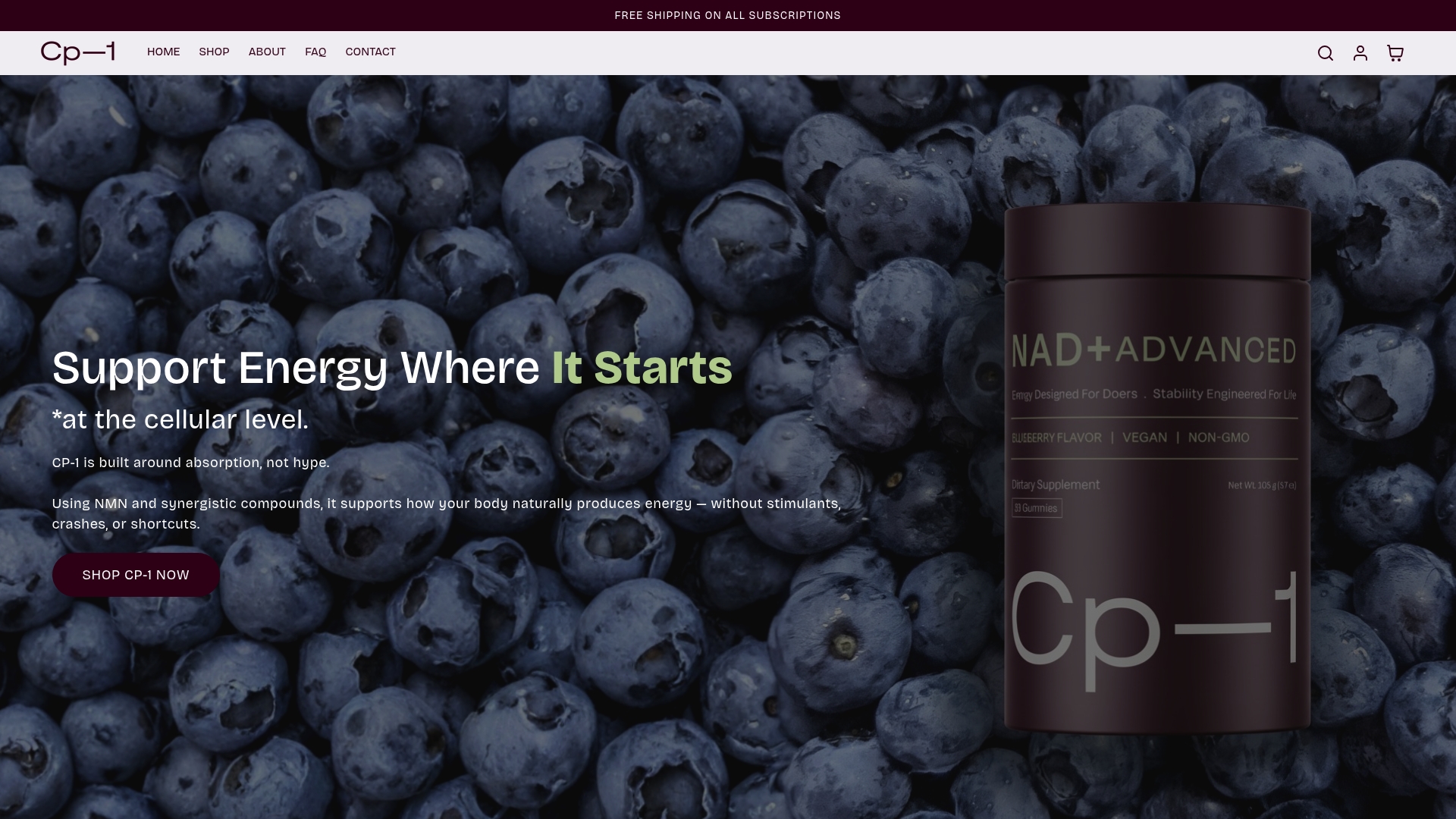
Instead of a bolded blend name and a single number, you get a product built by people who’d rather earn your trust than obscure a formula. If dose transparency matters to you as much as it matters to us, visit the CP-1 product page to see how the formula is put together and what testing backs it up. Check ingredient sourcing, review the manufacturing standards, and decide for yourself whether this is the kind of label you’ve been looking for.
Where to Verify This Yourself
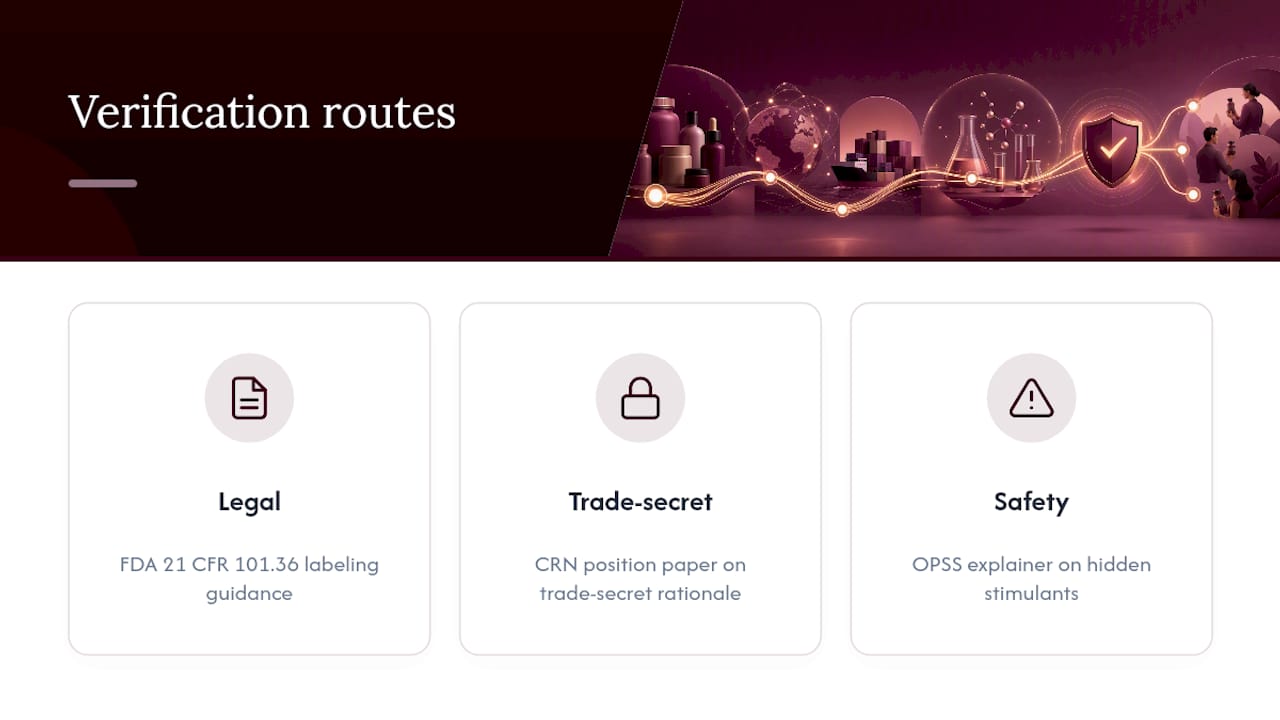
For the legal framework, read FDA’s labeling guidance under 21 CFR 101.36. For the industry’s trade-secret rationale, see CRN’s position paper. For the consumer-safety angle on hidden stimulants, check OPSS’s explainer.
This article is general information, not a substitute for advice from a qualified doctor. Consult a qualified healthcare professional about your own circumstances before acting on anything here.