
Step by step focus improvement is the deliberate, incremental process of building your concentration capacity through consistent behavioral and environmental changes. This is not about grinding harder or white-knuckling your way through distractions. The research is clear: methods for better focus work when they are applied gradually, layer by layer, over weeks. This guide walks you through each stage, from setting up your environment to managing interruptions, using the latest 2026 cognitive science to give you a real, working system.
How do you prepare your environment and mind for better focus?
The single most effective focus enhancement technique is not a mental trick. It is physical removal of distractions before you sit down to work. Stanford Medicine experts confirm that proactive distraction removal preserves far more attention capacity than relying on willpower to resist temptation. Willpower is a finite resource, and every time you resist checking your phone, you spend some of it. Move the phone to another room. Block distracting apps with tools like Freedom or Cold Turkey before your session starts.
Your workspace setup matters just as much. A cluttered desk creates visual noise that competes for your attention. Position your monitor at eye level, keep only the materials relevant to your current task on the desk, and use noise-canceling headphones or a white noise app like Noisli if your environment is loud. These are not luxuries. They are load-bearing parts of your focus system.

Mental readiness is the third layer. Before starting a work session, spend 60 to 90 seconds on a simple grounding practice. The “Be here now” mantra, developed in cognitive behavioral contexts, involves noticing when your mind drifts and gently returning attention to the present task without self-criticism. This primes your brain for the focused state you are about to enter.
Two foundational factors that most people ignore are sleep and hydration. Even mild dehydration impairs cognitive performance, and a single night of poor sleep reduces working memory capacity measurably. These are not soft lifestyle tips. They are prerequisites for any focus training to actually work.
- Move your smartphone out of arm’s reach or into another room entirely
- Use app blockers like Freedom, Cold Turkey, or Focus@Will before sessions
- Clear your desk to only what the current task requires
- Set room temperature between 68 and 77 degrees Fahrenheit for optimal alertness
- Drink at least 16 ounces of water before starting a focused work block
Pro Tip: Set a two-minute “launch ritual” before every work session: close unnecessary browser tabs, silence notifications, place your phone face-down in a drawer, and write your single task for the session on a sticky note. This ritual signals your brain that focused work is starting.
What is the step-by-step process to train your focus?
Concentration is a trainable skill, not a fixed trait. Noticeable improvements can appear within days of consistent practice, with significant gains emerging over four to six weeks. That timeline is realistic and worth committing to. The mistake most people make is expecting instant results and quitting before the compounding effects kick in.
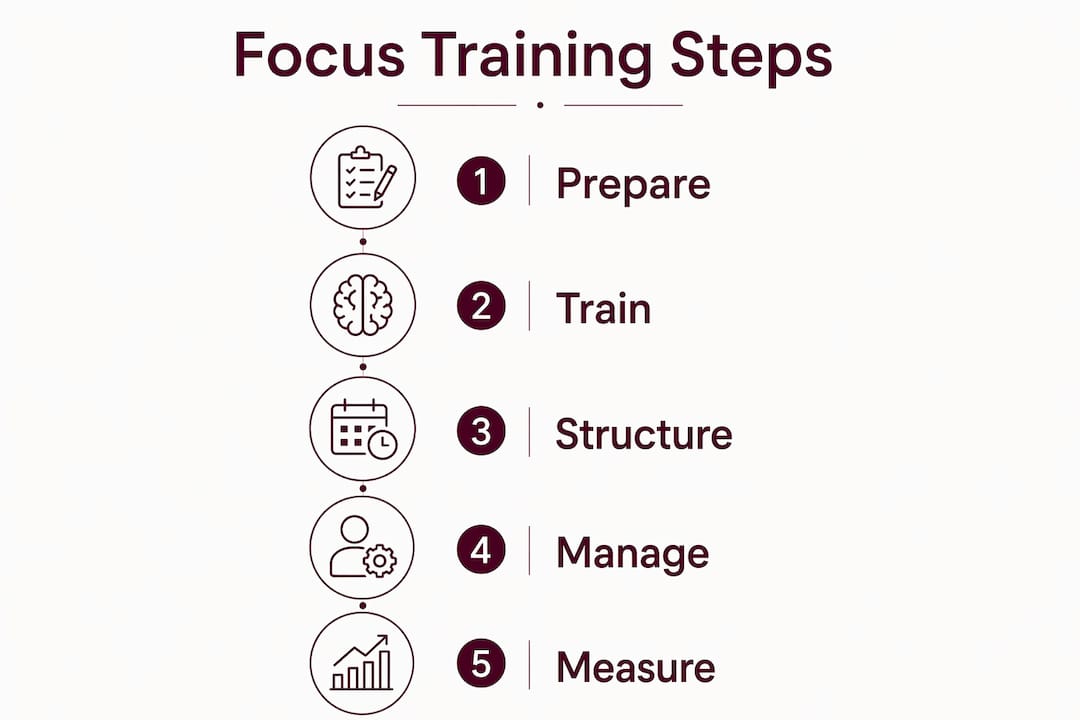
Here is a practical, incremental focus training protocol you can start today:
- Start with five-minute focused sessions. Choose one task. Set a timer for five minutes. Work on nothing else. When your mind wanders, note it without judgment and return. This is the core of all concentration drills.
- Apply the “Be here now” technique. Every time you catch yourself drifting, silently say “Be here now” and redirect. This is not meditation in the traditional sense. It is a micro-reset that interrupts the wandering pattern.
- Try the spider technique. Lightly touch a table or your desk and notice the sensation. This grounds your attention in the physical present and interrupts rumination or mental drift during low-stimulation tasks.
- Schedule “worry time.” Set aside 15 minutes each day, ideally mid-afternoon, to process anxious thoughts or to-do list anxiety. This prevents those thoughts from hijacking your focus sessions throughout the day.
- Increase session length gradually. Add two to three minutes per week to your focused work intervals. By week six, most people can sustain 25 to 45 minutes of uninterrupted concentration without significant effort.
- Track your mind wanders with a tally card. Each time your attention drifts during a session, make a tally mark. Over days and weeks, tracking distractions this way makes your improvement visible and keeps you motivated.
A meta-analysis of 30 trials covering over 24,000 participants found that mindfulness-based interventions produce moderate, measurable improvements in attention-related performance when practiced consistently over 8 to 12 weeks. That pooled effect size of Hedges’ g ≈ 0.45 is not trivial. It means the average person who commits to this protocol ends up performing noticeably better on attention tasks than someone who does not.
Pro Tip: Do your focus training sessions at the same time each day. Habit formation research consistently shows that time-of-day consistency accelerates automaticity, meaning the practice becomes easier faster when it is anchored to a fixed slot in your schedule.
How to structure your work sessions and breaks for maximum focus
Deep work is not about working longer. It is about protecting blocks of time where your brain can operate at full cognitive capacity without interruption. Structured 90-minute focus blocks followed by 15 to 20 minute screen-free breaks represent the most well-supported framework for sustained high performance. This mirrors the ultradian rhythm, the natural 90-minute cycle your brain moves through during waking hours.
Single-tasking is the other non-negotiable. Harvard Health research confirms that doing one thing at a time during protected work periods improves focus and memory retention far more than multitasking. Multitasking is not a productivity strategy. It is a focus-destruction habit dressed up as efficiency.
| Work session structure | Recommended approach |
|---|---|
| Focus block length | 90 minutes of single-task deep work |
| Break duration | 15 to 20 minutes, screen-free |
| Break activity | Walk, stretch, or light physical movement |
| Session start ritual | Two-minute launch ritual, phone removed |
| Tasks per block | One primary task only |
Physical movement during breaks is not optional if you want to sustain this across a full day. A 10-minute walk increases cerebral blood flow and resets alertness more effectively than scrolling your phone. The break is doing real biological work. Treat it that way.
Schedule your hardest cognitive tasks during your peak alertness window, which for most people falls in the late morning between 9 a.m. and noon. Administrative work, email, and low-stakes decisions belong in the afternoon energy trough. This is not time management advice. It is chronobiology applied to your calendar.
- Reserve your first 90-minute block for your most cognitively demanding task
- Use a physical timer rather than a phone timer to avoid screen temptation
- Keep break activities screen-free: walking, stretching, or making tea
- Batch low-focus tasks like email into a single afternoon slot
What strategies help manage interruptions and attention residue?
Not all interruptions are equally damaging. A 2026 study published in Springer found that late, high-workload interruptions cause significantly stronger performance decreases than interruptions that occur early in a task or when cognitive load is low. This means the timing of when you allow interruptions matters as much as the frequency.
Attention residue is the real cost of task switching. When you switch from one task to another before completing a natural stopping point, part of your attention stays stuck on the previous task. This is not a metaphor. It is a measurable cognitive phenomenon that reduces performance on the new task. The solution is a two-stage focus reset.
- Stage one: Stop the residue. Before switching tasks, write down the exact next action for the task you are leaving. This offloads the mental loop that would otherwise keep running in the background.
- Stage two: Control re-entry. Before starting the new task, spend 30 seconds reviewing your written next action for it. This primes your working memory and reduces the ramp-up time.
The two-stage focus reset is the most underused focus tool in most people’s systems. Most people switch tasks reactively and pay the cognitive tax without realizing it.
Create buffers around your deep work blocks. A 10-minute “transition zone” before and after each major work session gives you time to capture loose ends, check messages, and mentally close out the previous context. This prevents the spillover that erodes your next session’s quality.
Pro Tip: When an interruption is unavoidable, finish the current micro-step before responding. Even completing one more sentence or one more calculation before switching reduces attention residue significantly compared to stopping mid-thought.
How can you measure progress and troubleshoot common sticking points?
Progress in focus training is real but subtle in the early weeks. The most reliable tracking method is the tally card system. Each session, mark a tally every time your attention wanders. After two weeks, compare your daily averages. Most people see a 20 to 40 percent reduction in mind-wander frequency within the first month of consistent practice.
Here is how to troubleshoot the most common sticking points:
- If you cannot sustain even five minutes: Your environment still has too many triggers. Audit your workspace again. The problem is almost always a phone within reach or an open browser tab.
- If you feel mentally exhausted after one session: Your sessions are too long for your current capacity. Drop back to ten minutes and rebuild. Fatigue is a signal, not a character flaw.
- If you see no improvement after two weeks: Check your sleep and hydration first. No focus technique compensates for chronic sleep debt. Then check whether you are actually doing single-task work or quietly multitasking.
- If motivation drops: Add a small reward after each completed session. This is not bribery. It is operant conditioning, and it works. A cup of good coffee, a five-minute walk outside, or even a checkmark on a paper tracker all reinforce the habit loop.
- If your mind races during sessions: Schedule your worry time earlier in the day and write a brain dump of all open loops before your first focus block. Getting thoughts out of your head and onto paper reduces the cognitive interference that makes racing thoughts so disruptive.
Realistic expectations matter here. Consistent short sessions over weeks produce stronger and more sustainable improvements than sporadic long ones. You are building a skill, not completing a sprint.
Key takeaways
Sustainable focus improvement requires removing distractions proactively, training attention incrementally through daily practice, and structuring work sessions around natural cognitive rhythms rather than willpower alone.
| Point | Details |
|---|---|
| Remove distractions first | Physical removal of phones and app blockers outperforms willpower every time. |
| Train in short daily sessions | Start with five minutes and add two to three minutes per week for lasting gains. |
| Use 90-minute focus blocks | Pair deep work intervals with screen-free breaks to sustain performance across the day. |
| Reset attention between tasks | Write your next action before switching tasks to eliminate attention residue. |
| Track with tally cards | Count mind wanders per session to make progress visible and maintain motivation. |
What I have actually learned about building focus that sticks
I spent years thinking focus was something you either had or you did not. I tried every productivity app, every morning routine, every “just be more disciplined” approach. None of it stuck. What finally changed things was accepting that focus is a skill you build the same way you build physical fitness: gradually, with structure, and with honest tracking.
The biggest shift for me was redesigning my environment instead of fighting my own impulses. Putting my phone in another room felt almost embarrassingly simple. But it worked better than any app or technique I had tried before. Stanford Medicine’s point about environment over willpower is not just research. It is something you feel immediately when you actually do it.
The second thing I got wrong for a long time was expecting linear progress. Some days your tally card looks worse than last week. That is normal. The trend over four to six weeks is what matters, not the day-to-day noise. If you are building a daily workflow for mental clarity, the focus training compounds with everything else you are doing for your cognitive health.
The hardest part is the patience. Eight to twelve weeks feels like a long time when you want results now. But the research is consistent, and so is my own experience: the people who stick with the incremental approach end up with a qualitatively different ability to concentrate than they had before. That is worth the wait.
— Hugo
Support your focus with the right foundation
The techniques in this guide work. They work even better when your brain has the cellular energy it needs to sustain deep work. At Cp-1, we built our supplement around ingredients like NMN, lion’s mane mushroom extract, and coenzyme Q10 because these compounds support NAD+ production, mitochondrial energy, and cognitive function at the cellular level. No stimulants, no crash, no garbage fillers. If you are serious about sustained cognitive performance, your focus training deserves a foundation that supports it. Explore how Cp-1 fits into a complete daily wellness workflow built for real, lasting mental clarity.
FAQ
How long does it take to see real focus improvement?
Noticeable changes can appear within days of consistent practice, with significant improvements typically emerging over four to six weeks of daily focus training.
What is attention residue and why does it matter?
Attention residue is the cognitive carryover that occurs when you switch tasks before reaching a natural stopping point, reducing your performance on the new task. Writing down your next action before switching is the most effective way to minimize it.
Is mindfulness the same as focus training?
Mindfulness practice is one of the most evidence-backed focus enhancement techniques, but it is not the only one. Concentration drills, environment design, and structured work sessions all contribute to how to improve concentration beyond what mindfulness alone provides.
Does multitasking really hurt focus?
Yes. Single-tasking during protected time consistently outperforms multitasking for both focus quality and memory retention, according to Harvard Health research.
When should I schedule my hardest tasks?
Schedule your most cognitively demanding work during your peak alertness window, typically late morning, and batch low-focus tasks like email into the afternoon to align with your natural energy cycle.