
Cellular energy is the usable chemical energy your cells generate to power every biological process in your body, from muscle contraction to building proteins. The primary form is adenosine triphosphate (ATP), a molecule that acts as the cell’s universal energy currency. Without a continuous supply of ATP, your cells cannot move ions across membranes, synthesize new molecules, or maintain body temperature. That’s not a metaphor. That’s biology.
Here’s the short version of how it works:
- ATP is synthesized from food-derived fuel through a series of enzyme-driven reactions and spent almost immediately to do cellular work.
- Mitochondria are the organelles where most ATP is made, using a process called oxidative phosphorylation.
- Three interconnected stages handle the conversion: glycolysis (in the cytosol), the citric acid cycle (in the mitochondrial matrix), and oxidative phosphorylation (at the inner mitochondrial membrane).
Key Takeaways
Cellular energy production is a continuous, tightly regulated process where mitochondria convert food-derived fuel into ATP through three sequential stages, yielding roughly 30–32 ATP per glucose molecule.
| Point | Details |
|---|---|
| ATP is the energy currency | Every cell uses ATP to power movement, biosynthesis, and ion transport; the body turns over 100–150 moles of it per day. |
| Three stages produce most ATP | Glycolysis (2 ATP), citric acid cycle (2 ATP), and oxidative phosphorylation (~26–28 ATP) together yield ~30–32 ATP per glucose. |
| Mitochondrial health drives capacity | Fusion, fission, and mitophagy maintain mitochondrial quality; dysfunction links to aging, metabolic disease, and neurodegeneration. |
| Key nutrients are non-negotiable | NAD+, CoQ10, B-vitamins, iron, and magnesium are required cofactors; deficiencies create real ATP bottlenecks. |
| Supplements: mixed evidence | CoQ10 and B-vitamins have the strongest evidence; NAD+ precursors are promising but still in early human trials for healthy adults. |
Table of Contents
- What is cellular energy, and why does ATP matter so much?
- How cells make ATP: the three-stage process
- Why mitochondria are more than just powerhouses
- Key molecules and nutrients that keep energy production running
- How cells store and move energy between compartments
- How cells regulate energy production to avoid waste
- When cellular energy problems show up as health issues
- What the evidence actually says about supplements and cellular energy
- Why mitochondrial dynamics are the frontier in cellular-energy research
- An honest take on what actually matters for your cellular energy
- Sources
What is cellular energy, and why does ATP matter so much?
ATP, adenosine triphosphate, is built from three components: an adenine base, a ribose sugar, and three phosphate groups chained together. The bond connecting the terminal phosphate group is where the action happens. When a cell breaks that bond through hydrolysis, it releases a large amount of free energy, roughly -12 kcal/mol under real cellular conditions, compared to -7.3 kcal/mol under standard lab conditions. That gap matters because it means ATP is far more powerful inside a living cell than textbook thermodynamics alone would suggest. Enzymes couple that release to energetically unfavorable reactions like building proteins or pumping sodium ions, making ATP the molecule that bridges food energy and biological work.
Cells cycle ATP through three states: ATP (fully charged), ADP (one phosphate removed), and AMP (two phosphates removed). When ATP is hydrolyzed to ADP, the cell captures the released energy to do work. Mitochondria then reattach a phosphate group to ADP, regenerating ATP. This cycling never stops.
The scale of this turnover is staggering. According to StatPearls via NCBI, the human body hydrolyzes and resynthesizes roughly 100–150 moles of ATP per day, yet intracellular ATP concentration stays at only about 1–10 μM at any moment. Your cells don’t stockpile ATP. They manufacture it on demand, continuously, every minute you’re alive.
That’s why persistent fatigue, brain fog, or exercise intolerance can sometimes trace back to a breakdown somewhere in this production chain. Understanding how the system works is the first step toward knowing when something is genuinely wrong.
How cells make ATP: the three-stage process
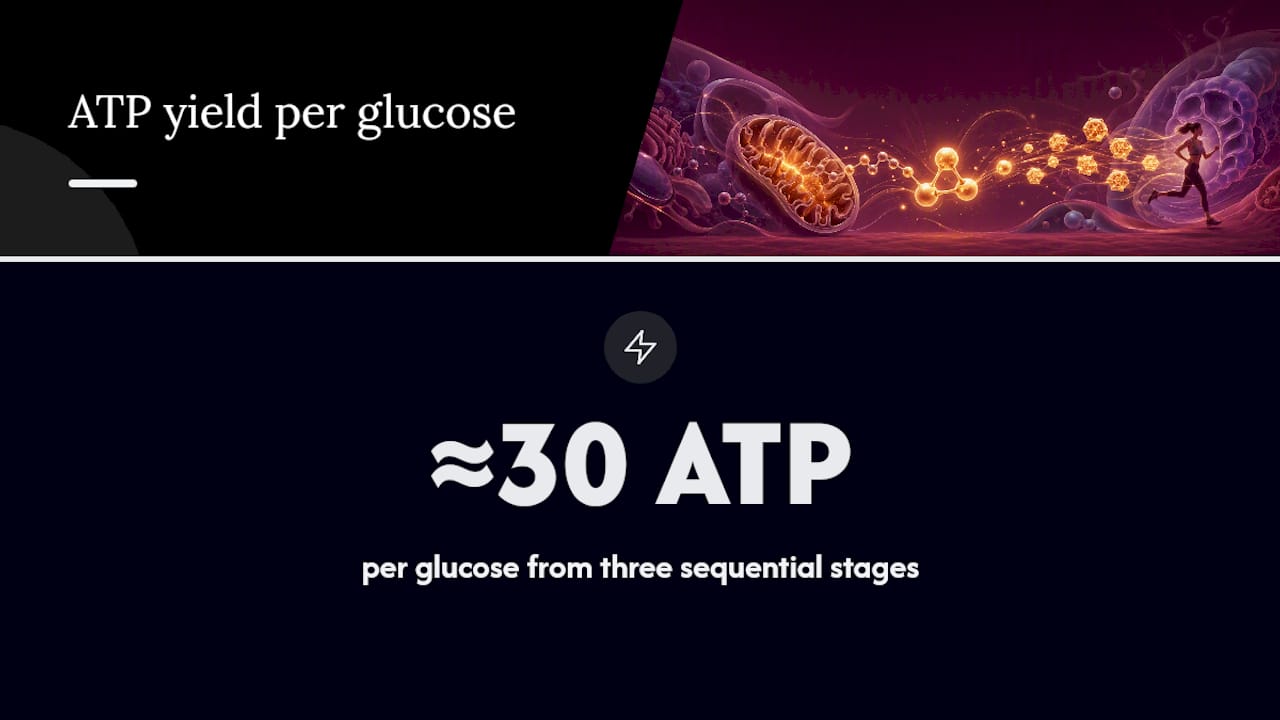
Cells generate ATP through three major, sequential stages. NCBI’s Molecular Biology of the Cell describes the combined process as yielding about thirty ATP molecules per glucose molecule under typical cellular conditions. Here’s how each stage contributes.
Stage 1: Glycolysis (cytosol)
Glycolysis splits one glucose molecule into two pyruvate molecules, netting a small number of ATP and NADH molecules in the cytosol. No oxygen is required. When oxygen is available, pyruvate enters the mitochondria for further oxidation. When oxygen is absent, cells convert pyruvate to lactate instead, regenerating NAD+ so glycolysis can keep running. That anaerobic route still yields only 2 net ATP per glucose, which is why sprinting at maximum effort is unsustainable for long.
Stage 2: The citric acid cycle (mitochondrial matrix)
Pyruvate is converted to acetyl-CoA, which enters the citric acid cycle (also called the Krebs cycle) in the mitochondrial matrix. Each turn of the cycle produces 3 NADH, 1 FADH2, and 1 GTP (equivalent to 1 ATP). The cycle runs twice per glucose molecule. Its primary function isn’t direct ATP production. It’s generating the high-energy electron carriers, NADH and FADH2, that feed the next stage.
Stage 3: Oxidative phosphorylation (inner mitochondrial membrane)
This is where the bulk of ATP is made. NADH and FADH2 donate electrons to protein complexes embedded in the inner mitochondrial membrane, collectively called the electron transport chain (ETC). As electrons move through the chain, protons (H+) are pumped from the mitochondrial matrix into the intermembrane space, building a steep electrochemical gradient. Those protons then flow back through ATP synthase, a molecular turbine that uses the gradient’s energy to attach a phosphate group to ADP, producing ATP. This mechanism is called chemiosmosis.
Osmosis notes that the theoretical yield around 36 to 38 ATP is adjusted downward to approximately thirty ATP under real cellular conditions, accounting for shuttle inefficiencies and membrane leakage.
| Stage | Location | Primary outputs | Approx. net ATP contribution |
|---|---|---|---|
| Glycolysis | Cytosol | Some ATP, NADH | A few ATP |
| Citric acid cycle | Mitochondrial matrix | Several NADH, FADH2, and GTP | A few ATP |
| Oxidative phosphorylation | Inner mitochondrial membrane | ATP (via ATP synthase) | The majority of ATP |
- Aerobic respiration (all three stages) yields roughly thirty ATP per glucose.
- Anaerobic glycolysis yields only 2 ATP per glucose and produces lactate.
- Fat oxidation (beta-oxidation) feeds acetyl-CoA into the citric acid cycle and yields significantly more ATP per carbon than glucose, though it requires more oxygen per ATP produced.
Pro Tip: The rate-limiting enzyme in glycolysis is phosphofructokinase-1 (PFK-1). When ATP is abundant, ATP itself allosterically inhibits PFK-1, slowing glucose breakdown. When energy demand rises and AMP accumulates, PFK-1 is activated again. Pyruvate dehydrogenase and isocitrate dehydrogenase serve similar regulatory roles at later stages.
Why mitochondria are more than just powerhouses
Mitochondria have a four-part architecture, each layer tied to function. The outer membrane is permeable to small molecules. The intermembrane space is where protons accumulate during ETC activity. The inner membrane is densely folded into cristae, maximizing surface area for ETC complexes and ATP synthase. The matrix houses the enzymes of the citric acid cycle and mitochondrial DNA.

ATP synthase itself is a two-part rotary motor. The F0 subunit spans the inner membrane and rotates as protons flow through it. That rotation drives the F1 subunit in the matrix to catalyze ADP + Pi → ATP. It’s one of the most conserved molecular machines in biology, present in nearly every living organism.
NIH research confirms that mitochondria supply the majority of cellular ATP and are dynamic organelles whose health directly affects metabolism, aging, and disease risk. They don’t just sit there producing energy. They fuse together to share resources when demand rises, divide (fission) to isolate damaged segments, and are selectively degraded through a process called mitophagy when they become dysfunctional. This quality-control system keeps the mitochondrial population healthy.
Neurons and muscle cells carry thousands of mitochondria precisely because their energy demands are so high. When mitochondrial quality control breaks down in these tissues, the consequences show up early and clearly: cognitive decline, muscle weakness, and metabolic dysfunction. For a deeper look at mitochondrial function and health, the connection between organelle dynamics and long-term wellness is worth understanding on its own terms.
Key molecules and nutrients that keep energy production running
ATP synthesis depends on a set of cofactors and micronutrients that most people never think about until something goes wrong.
- NAD+ (nicotinamide adenine dinucleotide): Accepts electrons from metabolic reactions, becoming NADH. NAD+ is the most critical electron carrier in cellular respiration. Without sufficient NAD+, the citric acid cycle and glycolysis both slow down. NAD+ levels decline with age, which is one reason this molecule gets significant attention in longevity research. For a detailed breakdown, see what NAD+ does in cellular energy.
- FAD (flavin adenine dinucleotide): Accepts electrons in the citric acid cycle (from succinate dehydrogenase), becoming FADH2, which feeds electrons into the ETC at Complex II.
- CoQ10 (coenzyme Q10): A mobile electron carrier in the inner mitochondrial membrane that shuttles electrons between ETC complexes. It also functions as an antioxidant within the membrane.
- B-vitamins (B1/thiamine, B2/riboflavin, B3/niacin, B5/pantothenic acid, B6, B12): These act as coenzymes in dehydrogenase reactions throughout glycolysis and the citric acid cycle. B12 deficiency, in particular, causes neurologic and energy-related symptoms because it impairs reactions that feed into the citric acid cycle.
- Iron: Required for the heme groups in ETC complexes I, II, and III, and for cytochrome c. Iron-deficiency anemia reduces ETC capacity directly.
- Magnesium: ATP exists in cells almost exclusively as Mg-ATP. Magnesium is required for ATP to be biologically active and for the function of dozens of enzymes in energy metabolism.
Deficiencies in any of these aren’t just inconvenient. They create real bottlenecks in ATP production. B-vitamin and iron deficiencies are common enough that they’re worth ruling out before attributing fatigue to anything more exotic.
How cells store and move energy between compartments
Cells don’t run on ATP reserves. They run on the ability to make ATP fast enough to meet demand. But they do store fuel in several forms.
Glycogen is the primary short-term carbohydrate store, held mainly in liver and skeletal muscle. The liver releases glucose into the bloodstream during fasting; muscle glycogen is used locally during exercise. When glycogen runs low, the body shifts toward fat oxidation.
Lipids stored in adipose tissue represent the body’s largest energy reserve. Fat yields more ATP per gram than carbohydrate, but fat oxidation requires more oxygen per ATP produced and cannot sustain maximum-intensity effort. Beta-oxidation breaks fatty acids into acetyl-CoA units that enter the citric acid cycle, feeding energy production from food into the same downstream pathway as glucose.
Creatine phosphate serves a different purpose entirely. In muscle and brain, creatine phosphate acts as a rapid ATP buffer. When ATP demand spikes suddenly, creatine kinase transfers a phosphate group from creatine phosphate to ADP, regenerating ATP within milliseconds. This system can sustain maximal effort for roughly 8–10 seconds before it depletes, which is why explosive movements rely on it so heavily.
Cytosolic NADH produced during glycolysis can’t cross the inner mitochondrial membrane directly. Cells use shuttle systems, primarily the malate-aspartate shuttle in heart and liver, to transfer those reducing equivalents into the mitochondrial matrix for oxidation. The glycerol-3-phosphate shuttle is less efficient and used in other tissues. The choice of shuttle affects the final ATP yield per glucose.
How cells regulate energy production to avoid waste
The cell doesn’t run its energy machinery at full speed all the time. It runs it at exactly the speed needed, and the control mechanisms are precise.
The central signal is the ATP/ADP ratio. When ATP is abundant, it allosterically inhibits PFK-1, slowing glycolysis. When energy demand rises and ADP and AMP accumulate, inhibition lifts and flux increases. This feedback loop, described in StatPearls, prevents the cell from burning fuel it doesn’t need.
AMP-activated protein kinase (AMPK) is the cell’s master energy sensor. When the AMP/ATP ratio rises (signaling low energy), AMPK activates pathways that generate ATP (glucose uptake, fatty acid oxidation) and suppresses pathways that consume it (protein synthesis, fat storage). Exercise activates AMPK strongly, which partly explains why physical activity improves metabolic efficiency over time.
Hormones layer on top of this cellular control. Insulin signals cells to take up glucose and store energy. Glucagon signals the liver to release glucose from glycogen and ramp up fat oxidation. During prolonged fasting or intense exercise, the shift from carbohydrate to fat oxidation is driven by both falling insulin and rising glucagon, with AMPK amplifying the cellular response.
When cellular energy problems show up as health issues
Most people never think about ATP until something in the production chain breaks down. Here are the warning signs that warrant a closer look.
Symptoms that may suggest impaired cellular energy:
- Persistent fatigue not explained by sleep or lifestyle
- Exercise intolerance or disproportionate muscle weakness
- Neurologic changes: cognitive slowing, sensory disturbances, coordination problems
- Recurrent nausea, vomiting, or unexplained metabolic crises in children
- Hearing loss or vision problems in combination with other symptoms
These symptoms overlap with many conditions, but when they cluster or resist obvious explanations, mitochondrial dysfunction is worth considering.
Conditions where cellular energy is central:
- Inherited mitochondrial disorders (e.g., MELAS, Leigh syndrome): caused by mutations in mitochondrial or nuclear DNA affecting ETC complexes directly.
- Acquired mitochondrial dysfunction: linked to aging, oxidative stress, certain medications (statins can reduce CoQ10 in some patients), and chronic disease.
- Type 2 diabetes and metabolic syndrome: characterized partly by impaired mitochondrial function in muscle and liver, reducing glucose oxidation capacity.
- Neurodegenerative diseases: Parkinson’s disease involves mitochondrial dysfunction in dopaminergic neurons; Alzheimer’s research increasingly focuses on impaired brain energy metabolism.
Pro Tip: If you or a clinician suspect a mitochondrial disorder, standard workup may include lactate/pyruvate ratios, organic acids in urine, plasma amino acids, and muscle biopsy with enzyme assays. Referral to a metabolic specialist or a center with mitochondrial disease expertise is worth pursuing early, since these conditions are underdiagnosed in adults. See the mitochondrial health checklist for lifestyle factors that support mitochondrial function in the meantime.
What the evidence actually says about supplements and cellular energy
This is where a lot of people get misled. The supplement industry loves to use cellular energy science as a marketing hook, and some of it is grounded in real biology. But mechanistic plausibility is not the same as clinical proof.
- NAD+ precursors (NMN, NR): NAD+ levels decline with age, and restoring them in animal models improves mitochondrial function. Human trials are ongoing and early results are promising, but large, long-term clinical trials confirming meaningful energy or health outcomes in healthy adults are not yet established. For a detailed breakdown of the research, see NMN’s role in energy and aging. NAD+/NMN sublingual formulations like those from PRYM Wellness represent one delivery format being explored for absorption.
- CoQ10: Has the strongest evidence base among mitochondrial supplements, particularly in people with heart failure, statin-induced myopathy, and certain mitochondrial diseases. Evidence in healthy adults for general energy improvement is weaker.
- B-vitamins: Proven effective when deficiency is present. Supplementing above adequate intake in people who are already replete produces no meaningful benefit. If you’re eating a varied diet, B-vitamin supplements are unlikely to change your energy levels.
- Magnesium: Deficiency is common and does impair ATP function. Correcting deficiency matters. Supplementing beyond sufficiency does not produce extra ATP.
The honest answer is that for most healthy adults, the biggest levers for cellular energy are the unsexy ones: adequate sleep, regular exercise, a nutrient-dense diet, and treating any deficiencies. Supplements can fill genuine gaps, but they can’t substitute for the fundamentals.
Why mitochondrial dynamics are the frontier in cellular-energy research
The old framing of mitochondria as static “powerhouses” has been replaced by something far more interesting. Researchers now understand that mitochondria are constantly moving, fusing, dividing, and being selectively degraded. This dynamic behavior is not incidental. It’s central to how cells maintain energy capacity under stress.
Fusion allows mitochondria to share proteins and membrane components, diluting damage and maintaining function. Fission isolates dysfunctional segments so they can be cleared by mitophagy. When this quality-control cycle breaks down, damaged mitochondria accumulate, ATP output drops, and reactive oxygen species increase. That combination is increasingly implicated in Parkinson’s disease, Alzheimer’s disease, and the metabolic decline associated with normal aging.
Clinical translation is still early. Most interventions targeting mitochondrial dynamics (specific PINK1/Parkin pathway modulators, urolithin A for mitophagy) are in preclinical or early-phase human trials. The science is compelling, but the therapeutic applications are not yet established for most conditions. For readers who want to go deeper, NIH Research Matters on mitochondria and the NCBI Bookshelf chapter on cell energy overview are the most authoritative starting points.
An honest take on what actually matters for your cellular energy
Here’s what I keep coming back to after going deep on this science: most of the cellular energy conversation gets hijacked by supplement marketing before people ever understand the actual biology. And that’s a problem, because the biology is genuinely fascinating and the practical priorities are pretty clear.
For the vast majority of people, the foundation is not a supplement stack. It’s sleep quality (mitochondrial repair happens during sleep), consistent physical activity (the single most reliable stimulus for mitochondrial biogenesis), a diet that covers B-vitamins, magnesium, and iron, and medical evaluation if fatigue is persistent and unexplained.
Practical priorities:
- Rule out deficiencies first. B12, iron, magnesium, and vitamin D deficiencies are common and directly impair energy metabolism. A basic blood panel covers most of them.
- Don’t conflate mechanism with outcome. NAD+ precursors and CoQ10 have real biological rationale. That doesn’t mean every product containing them will produce a noticeable effect in a healthy person.
- Be skeptical of dramatic claims. If a supplement promises to “supercharge your mitochondria” without citing human trial data, that’s a marketing deck, not a science brief.
Where supplements like CP-1 can genuinely fit is in supporting the specific cofactors (NAD+ precursors, CoQ10, functional mushrooms for immune and stress resilience) that have plausible mechanisms and are difficult to obtain in meaningful amounts from diet alone. The key is honest dosing and realistic expectations, not hype. For evidence-based strategies on supporting cellular energy, the fundamentals are worth reviewing before reaching for any supplement.
Sources
- Physiology, Adenosine Triphosphate - StatPearls - NCBI Bookshelf
- Mitochondria and health | National Institutes of Health (NIH)
- Cellular Respiration: Steps, Process, and Stages | Osmosis
- Cell Energy, Cell Functions | Learn Science at Scitable - Nature
This article is general information, not a substitute for advice from a qualified doctor. Consult a qualified healthcare professional about your own circumstances before acting on anything here.