

Beta Alanine Tingling: What Causes It and Is It Safe?
Beta alanine tingling, clinically called paresthesia, is a temporary, harmless skin sensation triggered by specific sensory nerve receptors shortly after you take a standard dose of beta alanine. 60–80% of users experience this effect at doses of 800mg or more, with the sensation peaking 20–40 minutes after ingestion and resolving within 90–120 minutes. The good news is that no long-term risks are associated with this response, and it has nothing to do with whether the supplement is actually working. Understanding the mechanism behind it changes how most athletes approach their dosing strategy entirely.
What causes beta alanine tingling?
The tingling sensation after taking beta alanine comes from one specific source: MrgprD receptor activation on sensory nerve fibers just beneath the skin. These receptors respond directly to beta alanine in the bloodstream, firing signals that your brain reads as a prickling or itching feeling. This is a pharmacological effect, not an allergic reaction. Your immune system is not involved at all.

The effect is dose-dependent. The more beta alanine floods your bloodstream at once, the stronger the signal to those receptors. That is why a single large dose hits harder than the same total amount spread across several smaller servings. The areas most commonly affected are the face, neck, hands, and upper back, where sensory nerve density is highest.
Here is what the tingling is not telling you:
- It does not mean the supplement is working right now
- It does not signal an allergic response or intolerance
- It does not indicate a higher or lower quality product
- It does not mean you took too much, at moderate doses
The tingling intensity does not correlate with beta alanine’s effectiveness. Athletes who feel intense paresthesia are not getting better results than those who feel nothing. That connection simply does not exist in the research.
Pro Tip: If you want to confirm the sensation is paresthesia and not an allergy, check whether it fades within two hours without any hives, swelling, or breathing changes. Paresthesia always resolves on its own. A true allergic reaction does not.
Is beta alanine safe, and what does research say?
Beta alanine has one of the cleaner safety profiles in sports supplementation. Clinical guidelines recommend 3.2–6.4g daily taken over four or more weeks, and studies at these doses show no serious adverse effects. The paresthesia is documented across trials as benign and self-limiting.
The long-term picture is equally reassuring. No evidence of neurotoxicity or adverse effects has emerged after 12 or more weeks of 6.4g daily supplementation. That is a meaningful data point. It means consistent, high-dose use over months does not damage nerves, alter receptor function, or create dependency.
“Paresthesia from beta alanine is a well-documented, dose-dependent pharmacological response. It is not a warning sign. It is simply your sensory nerves doing their job when plasma beta alanine rises quickly.”
Purity matters here more than most athletes realize. The safety data comes from trials using pharmaceutical-grade beta alanine. Products with fillers, undisclosed additives, or poor manufacturing controls introduce variables the research did not test. Third-party testing is the only way to confirm what is actually in your serving. Supplements that skip this step are asking you to trust a label, not a verified result.
The sports supplement safety conversation in 2026 keeps circling back to this point: the ingredient itself is not the risk. Contamination and mislabeling are. Choose products manufactured in certified facilities and tested by independent labs.
How can athletes reduce tingling without losing effectiveness?
The tingling is manageable. You do not have to choose between comfort and results. Two strategies work reliably: split dosing and sustained-release formulations.
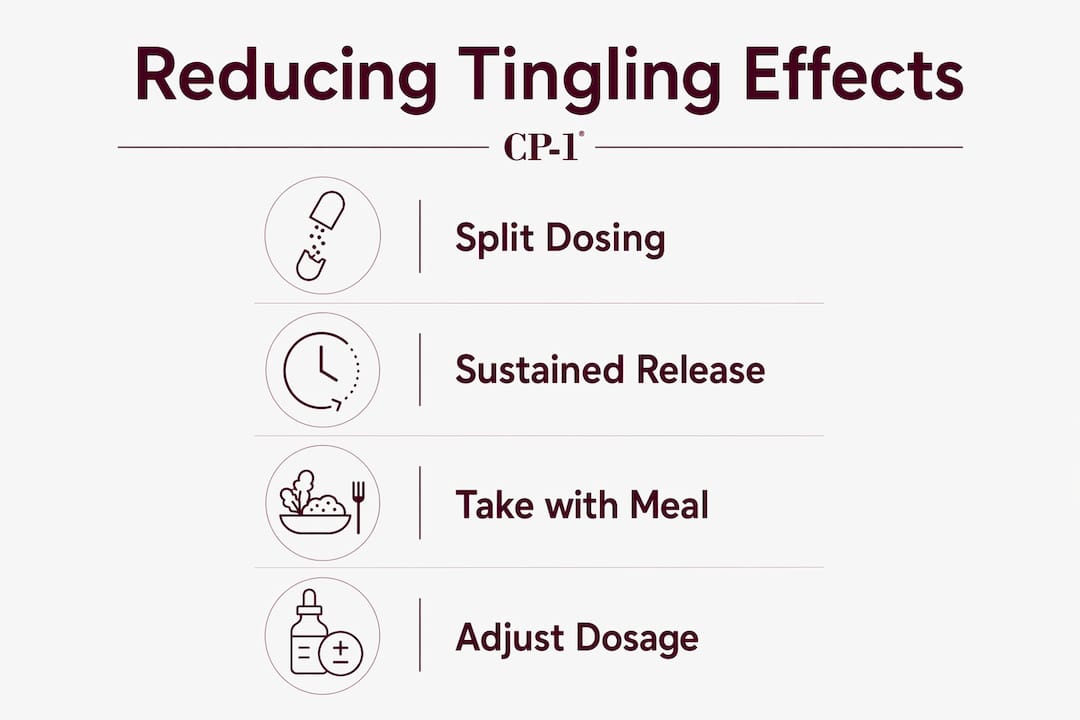
Split dosing
Experienced athletes break their total daily dose into 800mg–1,000mg portions taken multiple times throughout the day. This keeps plasma beta alanine levels from spiking high enough to trigger MrgprD receptors at full intensity. The total daily carnosine loading stays the same. Only the delivery curve changes.
A practical split-dose schedule for a 3.2g daily target looks like this:
- Take 800mg with breakfast
- Take 800mg mid-morning with a snack
- Take 800mg before your workout
- Take 800mg with dinner
This approach spreads the load evenly and keeps each individual dose below the threshold where tingling becomes noticeable for most people.
Sustained-release formulations
Sustained-release beta alanine drastically reduces paresthesia without compromising carnosine loading. These formulations slow the rate at which beta alanine enters the bloodstream, flattening the plasma curve so receptor activation stays below the tingling threshold. The carnosine accumulation in muscle tissue is identical to standard formulations over the same period.
Here is a direct comparison of the two delivery methods:
| Feature | Standard (immediate-release) | Sustained-release |
|---|---|---|
| Tingling intensity | High at doses above 800mg | Low to none |
| Carnosine loading | Full with consistent use | Full with consistent use |
| Dosing flexibility | Requires splitting | Single or split dose works |
| Best for | Athletes who tolerate tingling | Athletes sensitive to paresthesia |
Pro Tip: Taking beta alanine with a meal slows gastric emptying and naturally reduces the speed of absorption. This is a free, low-effort way to soften the tingling without switching products.
The industry is moving toward smarter dosing rather than accepting paresthesia as a fixed cost of supplementation. Flattening the plasma curve through either split dosing or sustained-release delivery is now the standard recommendation from sports nutrition researchers.
How does beta alanine actually improve performance?
Beta alanine does not work the moment you feel the tingle. The performance benefit comes from a completely separate process that takes weeks to build. Beta alanine is a precursor to carnosine, a dipeptide stored in muscle tissue that buffers acid during intense exercise.
Muscle carnosine increases 40–80% after four or more weeks of consistent daily dosing. That increase directly reduces fatigue during high-intensity efforts lasting 1–10 minutes. Sprint intervals, rowing pieces, CrossFit workouts, and combat sports rounds all fall in this window.
Key facts about how beta alanine builds its effect:
- Carnosine loading requires chronic daily supplementation, not single doses
- Beta alanine requires chronic loading similar to creatine, not acute dosing for same-day effects
- The tingling you feel on day one does not mean carnosine is accumulating faster
- Skipping doses slows the loading process and delays results
The practical takeaway is straightforward. Feeling a strong tingle does not mean you are getting a better workout today. It means your plasma beta alanine spiked. The actual benefit is building silently in your muscle tissue over weeks. Consistency matters far more than intensity of sensation. Athletes who understand this stick with the protocol long enough to see real results. Those who chase the tingle as a signal of efficacy often quit too early or dose erratically.
Understanding how amino acids support performance at the cellular level makes it easier to stay patient with the loading timeline.
Key Takeaways
Beta alanine tingling is a harmless, dose-dependent nerve response that has no connection to how well the supplement is working in your body.
| Point | Details |
|---|---|
| Tingling is paresthesia | MrgprD receptor activation causes the sensation; it is not an allergy or a warning sign. |
| Safety is well-established | No adverse effects appear after 12+ weeks at 6.4g daily in clinical studies. |
| Split dosing reduces tingling | Breaking the daily dose into 800–1,000mg portions keeps plasma levels below the trigger threshold. |
| Sustained-release works too | These formulations flatten the plasma curve and eliminate most tingling without reducing carnosine loading. |
| Performance takes weeks | Muscle carnosine builds over 4+ weeks of daily use; the tingle does not signal immediate gains. |
The tingle is not the point
I have talked to a lot of athletes who quit beta alanine after the first week because the tingling freaked them out. They thought something was wrong. Some assumed the product was low quality. A few thought they were having a reaction. None of them were right, but I get it. Nobody warns you about paresthesia when you buy a pre-workout, and a sudden full-face tingle is genuinely alarming the first time.
Educating users on harmless tingling improves adherence and reduces abandonment. That is not a marketing claim. That is a documented pattern. When athletes understand what is actually happening at the receptor level, they stop chasing the sensation as a signal and start focusing on what actually matters: consistent daily dosing over four or more weeks.
The athletes I respect most treat beta alanine the way they treat creatine. They take it every day, they do not obsess over how it feels, and they let the carnosine load quietly in the background. The results show up in their training, not in their skin. If the tingling bothers you, split your dose or switch to a sustained-release form. Problem solved. Do not let a temporary nerve response talk you out of a supplement with a genuinely strong evidence base.
— Hugo
What Cp-1 athletes should know about beta alanine quality
Cp-1 is built around one principle: the ingredient has to be real, pure, and dosed correctly. That applies to every compound we think about, including beta alanine.
If you are adding beta alanine to your stack, the quality of the product matters as much as the protocol. Impure formulations introduce variables that clean clinical data never tested. Cp-1’s commitment to US-made supplement quality and third-party verification means you know exactly what you are putting in your body. Pair that with a smart split-dose schedule, stay consistent for at least four weeks, and let the carnosine do its job. Visit cp-1.com to see how we approach supplementation without the noise.
FAQ
What is beta alanine tingling?
Beta alanine tingling, called paresthesia, is a temporary prickling or itching sensation caused by MrgprD sensory nerve receptor activation when plasma beta alanine rises quickly after a dose. It is harmless and typically resolves within 90–120 minutes.
How long does the tingling from beta alanine last?
The sensation peaks 20–40 minutes after ingestion and fully resolves within 90–120 minutes for most people. It does not persist between doses when taken on a consistent schedule.
Does the tingling mean beta alanine is working?
No. The tingling sensation does not correlate with supplement effectiveness. Carnosine loading in muscle tissue builds over four or more weeks of daily use, independent of whether you feel any skin sensation.
What is the safest beta alanine dosage to avoid tingling?
Split doses of 800–1,000mg taken multiple times daily keep plasma levels below the receptor activation threshold. Clinical guidelines support a total daily intake of 3.2–6.4g divided across the day or delivered through a sustained-release formulation.
Is beta alanine safe for long-term use?
Yes. Studies show no neurotoxicity or adverse effects after 12 or more weeks at 6.4g daily. The paresthesia is a benign pharmacological response, not a sign of tissue damage or accumulating harm.