
“GMP certified” means an accredited third-party auditor confirmed a facility follows Good Manufacturing Practice standards for quality systems, documentation, and contamination control. It’s a voluntary commercial certification, not automatically a government stamp of approval. Before you trust the label, check who certified the site, what scope they covered, and how recent the audit was.
TL;DR:
- GMP certification is voluntary and requires recent, verified audits from accredited certifiers; outdated certificates may not reflect current standards.
- Certification confirms manufacturing processes are controlled and documented but does not guarantee product efficacy or health claims.
- Verify GMP claims by checking the certifier’s accreditation, the scope of certification, and the audit and surveillance dates.
- Third-party audits include evaluating quality management, process validation, personnel hygiene, material traceability, and testing systems.
- Reputable manufacturers often provide detailed audit reports and testing documentation to prove compliance beyond just displaying a certification badge.
Table of Contents
- What GMP Certified Actually Means
- GMP Compliance vs. GMP Certification: They’re Not the Same Thing
- Core Elements Auditors Check Under GMP
- How Third-Party GMP Certification Audits Actually Work
- Benefits of GMP Certification, and Where It Stops Short
- How to Verify a GMP Certified Claim Before You Trust It
- Where CP-1 Fits Into This Picture
- What GMP Certification Can and Can’t Tell You
- See How CP-1 Documents Its Own Quality Standards
- Where to Verify GMP Standards Yourself
- Sources
What GMP Certified Actually Means
GMP stands for Good Manufacturing Practice, and the “c” you’ll often see in front of it, as in cGMP, stands for “current.” That single letter carries weight. The FDA defines cGMP as a system requiring manufacturers to produce and control products consistently, using up-to-date technologies and systems rather than whatever passed inspection a decade ago.
In the United States, cGMP is a legal requirement for drug manufacturers and applies to specific categories of food and medical devices. Outside those regulated lanes, plenty of manufacturers voluntarily adopt GMP frameworks because retailers and buyers expect it.
Globally, the World Health Organization publishes its own GMP guidance, and it has become the backbone for national regulations and procurement standards in dozens of countries. That’s why you’ll see GMP referenced the same way whether you’re reading FDA documentation or a supplement label manufactured overseas.
A few things stay consistent across markets:
- GMP covers how something is made, not just what’s in the final product.
- It applies to facilities and processes, not marketing claims.
- “Current” means the systems get reevaluated, not frozen in place.
GMP Compliance vs. GMP Certification: They’re Not the Same Thing
Compliance and certification sound interchangeable. They aren’t, and mixing them up is where a lot of confusion starts.
Compliance is a legal status. In regulated categories like pharmaceuticals, the FDA can inspect a facility and issue findings, and failing to meet cGMP regulations can trigger warning letters, recalls, or worse. That’s enforcement, not a certificate you hang on the wall.
Certification is different. It’s typically a voluntary process where a private, accredited body audits a facility and issues a certificate confirming the site meets a defined GMP standard. Some countries don’t even use the word “certificate” for regulatory purposes. In parts of the European regulatory system, competent authorities issue confirmations of GMP compliance rather than commercial certificates, which is a nuance most marketing copy glosses right over.
Watch for these common misuses:
- A brand claiming “GMP certified” without naming the certifier.
- Certification language applied to a product when only the facility was audited.
- No audit date listed anywhere, which makes the claim impossible to verify.
Core Elements Auditors Check Under GMP
Auditors aren’t skimming a checklist for show. They’re verifying that specific systems exist, work, and get documented. The ISPE notes that GMP regulations define outcomes and expectations while leaving implementation details to the manufacturer, so what an auditor confirms is whether your system actually functions, not whether it matches a template.
Here’s what typically gets inspected:
- Quality management system — written procedures covering every stage of production.
- Process and equipment validation — proof that machinery and methods produce consistent results batch after batch.
- Personnel training and hygiene — records showing staff are trained and facilities meet sanitation standards.
- Material control and traceability — the ability to trace every ingredient back to its source and forward to the finished batch.
- Testing, release, and complaint handling — documented systems for catching problems before shipment and responding when they surface after.
Pro Tip: Ask a supplier for their most recent corrective action report, not just their certificate. A clean cert with no corrective action history sometimes means the auditor found nothing worth flagging, or it means the audit was shallow. The report tells you which.
How Third-Party GMP Certification Audits Actually Work
The certification process for GMP certification generally follows a predictable sequence, and knowing the steps helps you judge how rigorous a given certificate is.
- Gap assessment. The facility reviews its current practices against the target standard and identifies weak spots.
- Remediation. Corrective actions get implemented, documented, and tracked before the formal audit begins.
- On-site audit. An accredited auditor inspects the facility in person and produces a detailed report of findings.
- Certification decision. If the facility meets the standard, the certifying body issues a certificate tied to a defined scope.
- Surveillance audits. Periodic follow-up audits, often annually, confirm the facility maintains its standards rather than backsliding after the initial pass.
Certifiers themselves need credibility too. Accreditation bodies like ANAB evaluate certifiers before their certificates carry weight, and organizations like NSF offer accredited GMP registration under standards such as NSF/ANSI 455 for supplements and OTC products. A certificate from an unaccredited certifier isn’t worthless, but it doesn’t carry the same evidentiary weight.
Benefits of GMP Certification, and Where It Stops Short
Certification earns manufacturers real advantages. Retailers frequently require it as a procurement safeguard, particularly in supplement categories that lack premarket FDA approval, since it gives buyers documented proof someone independently checked the manufacturing process.
The benefits show up in a few concrete ways:
- Fewer surprise recalls, because contamination and process failures get caught earlier.
- Faster retailer and distributor onboarding, since many buyers skip products without it.
- A documented paper trail if a quality dispute ever surfaces.
Here’s the limit that matters most: a GMP certificate confirms manufacturing controls were audited. It does not confirm that a product’s health claims are true or clinically effective. As one explainer on facility certification puts it plainly, “GMP certified” signals audited controls, not verified efficacy. That distinction matters most in supplement and cosmetic categories, where no agency evaluates label claims before the product hits shelves.
How to Verify a GMP Certified Claim Before You Trust It
A verification checklist saves you from taking a label at face value.
- Name the certifier. “GMP certified” alone tells you nothing. Ask which organization issued it.
- Check accreditation. Confirm the certifier is accredited by ANAB or an equivalent recognized body.
- Confirm scope. Was the facility certified, or a specific product line? Those aren’t interchangeable.
- Check the audit date. A certificate from four years ago with no surveillance record since is a red flag.
- Request the report. Reputable manufacturers will share audit summaries or corrective action evidence on request. Our checklist for reading supplement labels walks through exactly what to look for on packaging.
| What to check | Why it matters |
|---|---|
| Certifier name | Confirms who actually audited the site |
| Accreditation status | Verifies the certifier itself meets a recognized standard |
| Certification scope | Distinguishes facility-wide from product-specific claims |
| Audit and surveillance dates | Shows whether the certification is current |
Where CP-1 Fits Into This Picture
Manufacturing quality isn’t an abstract concept to us. Our product is produced in a facility that meets GMP standards, and batches undergo third-party testing before shipping, with attention to vegan and non-GMO standards. We’ve written more about why third-party testing matters for supplement buyers and how domestic manufacturing affects quality, because we think the paperwork behind a product deserves as much attention as the ingredient list.
What GMP Certification Can and Can’t Tell You
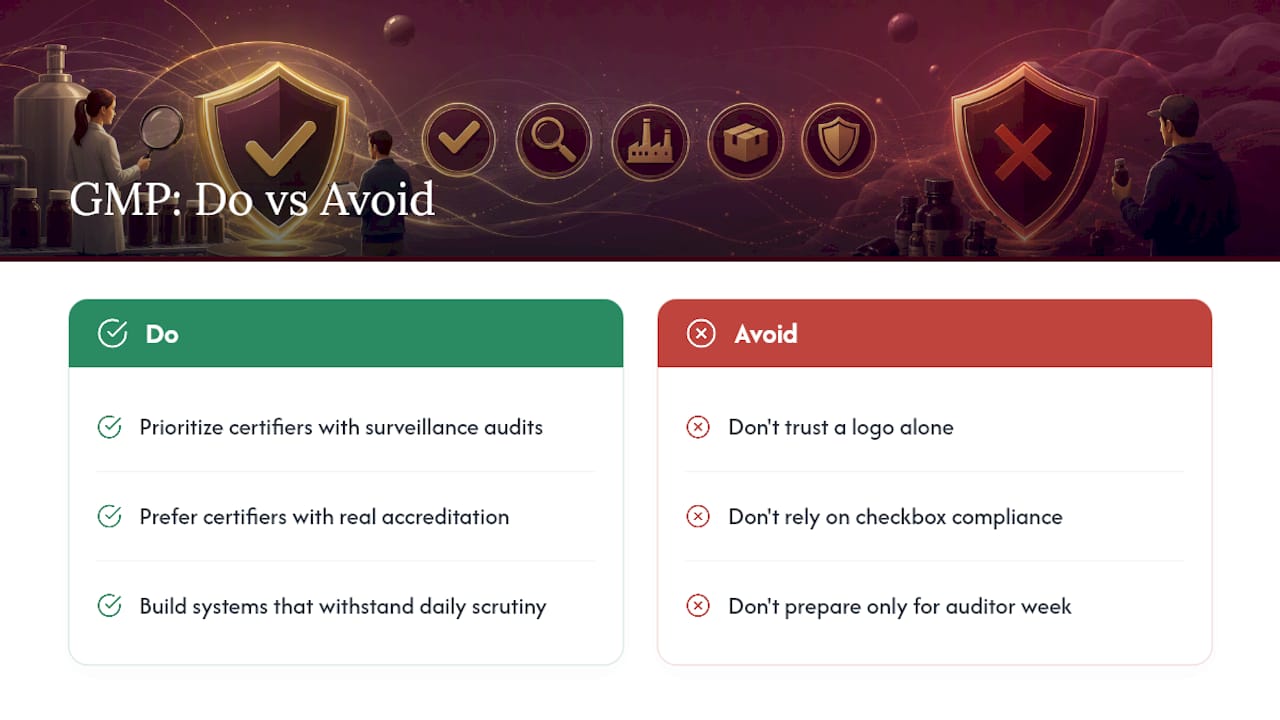
I’ve spent enough time in this industry to know that “GMP certified” gets slapped on packaging as a trust signal without much scrutiny behind it, and that’s the real problem. The certification itself is legitimate. The way it gets marketed usually isn’t.
If you’re buying, prioritize certifiers with recent surveillance audits and real accreditation over a logo with no context. If you’re manufacturing, build systems that hold up under scrutiny every day, not just the week an auditor shows up. Checkbox compliance fails the moment nobody’s watching. For more on what quality actually looks like inside a supplement, our piece on the real role of supplement quality in your health goes deeper than a badge ever could.
— Hugo
See How CP-1 Documents Its Own Quality Standards
Reading about GMP certification is useful right up until you want to see what it looks like applied to an actual product. CP-1 publishes its manufacturing and testing practices openly instead of burying them in fine print, because a supplement label should hold up to the same scrutiny you’d apply to any GMP claim.
Our product pages link directly to lab reports and ingredient sourcing details, and our blog breaks down what non-GMO actually means on a label if you want to cross-check that claim too. If you’re deciding whether NMN, lion’s mane, reishi, turkey tail, and CoQ10 belong in your daily routine, visit the CP-1 product page and see the sourcing and testing documentation for yourself before you order.
Where to Verify GMP Standards Yourself
- FDA cGMP regulations for the legal framework governing US drug manufacturers.
- WHO GMP guidance for the international standard many countries build regulations around.
- NSF’s GMP certification directory to confirm a certifier’s accreditation status.
This article is general information, not a substitute for advice from a qualified doctor. Consult a qualified healthcare professional about your own circumstances before acting on anything here.