

How much protein can your body absorb? A science-based guide
The question of how much protein can your body absorb is one of the most repeated and misunderstood topics in fitness nutrition. You have probably heard the “30 grams per meal” rule thrown around at the gym or seen it repeated in supplement marketing. The truth is more nuanced, more useful, and honestly, a little frustrating when you realize how much bad information has been shaping your eating habits. Here is what the research actually says, and how to use it to structure your protein intake in a way that actually moves the needle.
Table of Contents
- How your body absorbs and uses protein
- Muscle protein synthesis and the myth of the 30-gram limit
- How much protein do you really need daily and per meal?
- Protein quality, timing, and absorption factors that influence effectiveness
- Practical strategies for optimizing your protein intake
- Rethinking protein absorption myths: What experts want you to know
- Optimize your protein and wellness journey with CP-1 supplements
- Frequently asked questions
Key Takeaways
| Point | Details |
|---|---|
| No strict absorption limit | Your body effectively absorbs all protein you eat without a fixed upper limit per meal. |
| Muscle synthesis caps differ | Muscle growth uses about 25-40 grams of protein per meal, varying by age and activity. |
| Daily intake matters most | Aim for 1.2-2.2 grams of protein per kilogram daily, spread evenly across meals. |
| Protein quality counts | High-leucine, easily digestible proteins improve absorption and muscle-building outcomes. |
| Older adults need more | Aging causes anabolic resistance requiring higher protein per meal to stimulate muscle synthesis. |
How your body absorbs and uses protein
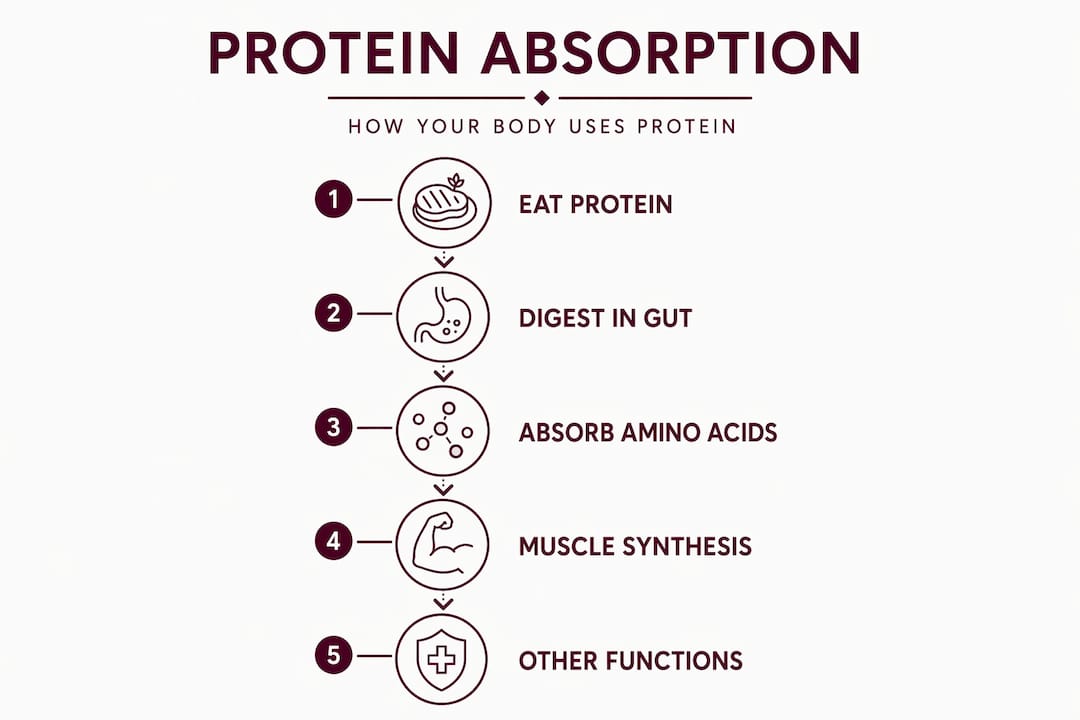
Your digestive system is remarkably good at its job. When you eat protein, whether it is a chicken breast, a shake, or a handful of nuts, your gut breaks it down into individual amino acids. Those amino acids get absorbed through your intestinal wall and circulate in your bloodstream. Here is the key point most people miss: your body absorbs virtually all the protein you eat, regardless of the meal size.
The confusion starts when people conflate absorption with muscle building. These are two completely different processes. Absorption is a mechanical function of your gut. Muscle protein synthesis (MPS), which is the process of actually building new muscle tissue, is where limits come into play. Harvard Health confirms that the body absorbs all dietary protein consumed but maximally uses 25 to 30 grams per meal for muscle building in trained bodybuilders.
What happens to the protein beyond what MPS can immediately use? It is not wasted. It gets directed toward other functions:
- Producing enzymes and hormones
- Supporting immune cell activity
- Fueling energy production through gluconeogenesis
- Maintaining organ tissue and skin integrity
Protein digestion rate does vary by source. How quickly your gut processes a protein affects the rate of amino acid delivery, not the total amount absorbed. Gut health also matters here. Poor intestinal integrity from things like chronic stress or inflammation can slow uptake. Understanding how quality supplements impact gut and overall health is one piece of the puzzle people overlook.
Now that you understand protein absorption basics, let us explore how muscle building relates to protein intake.
Muscle protein synthesis and the myth of the 30-gram limit
The 30-gram rule is not entirely wrong. It is just being applied to the wrong process. MPS does have a ceiling per meal, but that ceiling is higher than most gym lore suggests, and it shifts considerably based on who you are.
Research published through Verywell Health shows that MPS plateaus at 40 to 70 grams of high-quality protein in young adults per meal, and approximately 32 grams in older adults. So the 30-gram number underestimates younger adults and may actually be too high for older ones dealing with anabolic resistance.
Here is what actually determines your per-meal MPS ceiling:
- Age. Younger adults trigger MPS more efficiently, so they can capitalize on larger protein doses per meal.
- Training status. Resistance-trained individuals have a more responsive MPS system.
- Leucine content. Leucine is the amino acid that acts like a key in the ignition of MPS. Without enough leucine, the process does not fully activate, regardless of total protein consumed.
- Protein quality. A complete protein with all essential amino acids delivers far more MPS signal than an incomplete source at the same gram count.
“The 30-gram ceiling is not an absorption cap. It is an MPS threshold, and it varies meaningfully by age, training level, and protein quality. Treat it as a starting point, not a universal rule.”
| Factor | Young adults | Older adults (60+) |
|---|---|---|
| MPS per-meal threshold | 40 to 70g high-quality protein | 30 to 40g |
| Anabolic resistance | Low | Moderate to high |
| Leucine sensitivity | High | Lower (needs more) |
| Frequency benefit | Moderate | High |
Pro Tip: Instead of obsessing over a single meal’s protein dose, aim to hit multiple MPS peaks throughout the day by eating protein-rich meals every three to four hours. This approach builds more muscle over time than front-loading one massive protein meal.
Excess protein that exceeds your MPS threshold in a given meal still contributes to your net protein balance. It supports tissue repair, liver function, and can be oxidized for energy. Nothing is truly wasted. Understanding this changes how you look at supplements and wellness from a whole-body perspective.

With a clearer understanding of MPS limits versus absorption, we can compare protein needs across individuals and daily scenarios.
How much protein do you really need daily and per meal?
This is where things get actionable. Your daily protein needs depend on your body weight, activity level, and age. The 2026 USDA Dietary Guidelines have nearly doubled previous recommendations, with updated guidelines recommending 1.2 to 1.6 g/kg/day for general adult health. Active individuals aiming to build or maintain muscle should push that to 1.6 to 2.2 grams per kilogram of body weight per day.
Here is what that looks like in practice for a 68-kilogram (150-pound) adult:
| Goal | Daily protein target | Per meal (4 meals) |
|---|---|---|
| General health | 81 to 109g | 20 to 27g |
| Active maintenance | 109 to 130g | 27 to 33g |
| Muscle building | 130 to 150g | 33 to 37g |
| Older adult (60+) | 100 to 120g | 30 to 40g |
To put this into a practical plan, follow these steps:
- Calculate your baseline. Multiply your body weight in kilograms by 1.6 for a conservative starting target.
- Divide across meals. Split your total daily protein across three to four meals spaced three to four hours apart.
- Prioritize complete proteins. Choose sources like eggs, dairy, meat, fish, or high-quality protein supplements that contain all essential amino acids.
- Adjust for age. If you are over 60, bump each meal’s protein dose toward the higher end of the range to counteract anabolic resistance.
- Track for two to three weeks. Monitor recovery, energy, and strength before making adjustments. The numbers are a guide, not a law.
Supporting your daily wellness workflows with structured protein timing makes it dramatically easier to hit your targets without scrambling for protein at night.
Protein quality, timing, and absorption factors that influence effectiveness
Not all protein is created equal. And even within high-quality sources, the rate at which your gut processes them changes when and how your body gets the amino acids it needs.
Here is what you need to know about protein digestion rate by source:
- Whey protein: 8 to 10 grams per hour. Fast-digesting, ideal post-workout.
- Casein protein: Approximately 6 grams per hour. Slow release, useful before sleep.
- Whole eggs: Around 3 grams per hour. Slower absorption, sustained amino acid release.
- Plant proteins: Variable, often slower and lower in leucine, which matters for MPS activation.
The anabolic window, which fitness culture treats as a narrow 30-minute post-workout slot, is actually more like a 24-hour window. Timing matters, but consistency across the day matters more. That said, consuming protein within a couple of hours of training does support recovery and helps capitalize on elevated MPS signals after exercise.
Gut health is a factor most people ignore entirely. If you have compromised intestinal integrity from chronic inflammation, poor diet, or high stress, your amino acid uptake is reduced even if your protein intake looks great on paper. The quality of what you absorb matters as much as the quantity you consume.
Pro Tip: If you notice digestive discomfort with protein-heavy meals or have a history of gut issues, consider pairing your protein intake with digestive enzymes or a vitamin D supplement. Vitamin D supports intestinal barrier integrity, which directly affects protein utilization limits. This is not just supplemental theory. It is backed by research on gut-nutrient interaction.
Mixing protein sources throughout the day, such as a fast-digesting whey shake post-workout and a casein-rich cottage cheese before bed, creates a more sustained amino acid availability than relying on a single type.
Practical strategies for optimizing your protein intake
Knowing the science is one thing. Putting it into your actual life is where most people fall apart. These strategies close that gap.
- Set your daily target first. Use 1.6 to 2.2 g/kg as your range and pick a specific number to aim for each day. Ambiguity leads to under-eating protein.
- Build protein-anchored meals. Design each meal around a protein source first, then add carbohydrates and fats. This prevents protein from becoming an afterthought.
- Space meals three to four hours apart. This spacing maximizes multiple MPS peaks across the day, which is more effective for muscle building than spacing meals irregularly.
- Choose leucine-rich sources. Whey, eggs, beef, and dairy are all high in leucine. For plant-based eaters, soy protein and pea protein with added leucine are solid options.
- Track your gut response. If you feel bloated, sluggish, or gassy after high-protein meals, address gut health before scaling up protein further.
High-quality protein sources to include in your rotation:
- Chicken breast and turkey (lean, complete proteins)
- Salmon and tuna (complete protein with omega-3 support)
- Greek yogurt and cottage cheese (casein-heavy, slow-release)
- Eggs (versatile, great amino acid profile)
- High-quality whey or plant protein supplements with verified leucine content
Adjusting your intake around training type also helps. Full-body resistance sessions create a larger, whole-body MPS demand than isolation exercises. On heavier training days, push toward the higher end of your per-meal protein targets. On rest days, staying consistent with your daily total still matters for tissue repair and recovery.
Exploring supplement strategies that go beyond protein, including cellular energy support and cognitive health, can further elevate what your body does with the protein you are already eating.
Rethinking protein absorption myths: What experts want you to know
I want to be direct with you here, because I have seen this confusion cause real problems. People restrict their protein intake based on the 30-gram myth, thinking anything more is wasted. Others cram all their protein into one or two meals thinking absorption is the bottleneck. Both approaches leave results on the table.
The real frustration is that this myth persists because it gets repeated without the crucial distinction between absorption and muscle protein synthesis. Your gut does not cap protein absorption at 30 grams and then stop working. It processes whatever you give it. The limit is on how much of that protein your muscle tissue can immediately use for growth and repair in a given window.
Excess protein beyond MPS needs is not discarded. It supports metabolism, immune function, enzyme production, and energy. Your body is far more resourceful than the 30-gram rule gives it credit for.
Older adults get hit hardest by this misinformation. Anabolic resistance, which is the reduced sensitivity of aging muscle to protein-driven MPS signals, means seniors often need more protein per meal, not less. Mainstream advice, which still echoes the outdated 30-gram cap, points them in exactly the wrong direction.
The smarter approach, backed by current evidence and honestly not discussed enough in mainstream nutrition circles, is to focus on your total daily protein intake and the quality of your sources. Nail those two things, distribute them reasonably across the day, and stop agonizing over whether your 45-gram post-workout shake is “too much to absorb.” It is not. Choosing the right supplement quality plays into this too, because a supplement that is poorly formulated or poorly absorbed undoes all the planning in the world.
Consistency beats perfection every single time.
Optimize your protein and wellness journey with CP-1 supplements
Understanding protein absorption is step one. Supporting your body’s ability to actually use what you consume is step two. That is where product quality stops being a marketing phrase and starts being a real factor in your results.
At CP-1, we build supplements the way nutrition science says they should work — with ingredients that are third-party tested, US-manufactured, and formulated for real absorption, not just impressive label copy. Our CP-1 wellness supplements include NMN to support NAD+ production, lion’s mane for cognitive clarity, and CoQ10 for mitochondrial energy — all of which directly support the cellular environment where muscle recovery and protein utilization happen. When your cells are energized and your gut is functioning well, your protein works harder for you. That is not a marketing claim. That is physiology.
Frequently asked questions
Can my body absorb more than 30 grams of protein in one meal?
Yes, your body absorbs all consumed protein regardless of meal size. The 30-gram figure refers to muscle protein synthesis limits, not absorption capacity.
How much protein should I eat daily to build muscle effectively?
Active adults should target 1.6 to 2.2 grams per kilogram of body weight each day, distributed across three to four meals, to support muscle growth and recovery.
Does age affect how much protein my body can use per meal?
Yes. Older adults face anabolic resistance, meaning their muscles respond less efficiently to protein, so MPS in older adults requires 30 to 40 grams per meal rather than the lower amounts younger adults need.
Are all protein sources absorbed equally?
No. Whey absorbs at 8 to 10g/hr while eggs absorb at roughly 3g/hr, meaning the type of protein you choose affects how your body receives amino acids throughout the day.