
You can safely biohack your routine by fixing sleep first, running one controlled experiment at a time, and adding evidence-backed supplements like NMN, lion’s mane, and CoQ10 only after your foundations are solid. Start today by logging your baseline: write down your wake time, a subjective energy score from 1–10, and how many focused minutes you got. That single week of honest data is worth more than any supplement you could buy right now.
The foundation-first approach is not optional. High-performance habits run on systems, not willpower. Build in this order:
- Sleep: 7–9 hours, consistent timing, dark and cool room
- Movement: daily steps plus structured training
- Nutrition: protein-first meals, 10–12 hour eating window
- Morning anchor: light, hydration, delayed caffeine
- Measured supplementation: only after the above are running reliably
Table of Contents
- What does a practical daily biohacking routine look like?
- How to biohack your routine with a test-and-measure protocol
- What does the evidence say about cognition and energy supplements?
- How do you design habits so they happen automatically?
- What safety checks should you run before experimenting?
- Your 6-week biohacking experiment, week by week
- How do you know if a supplement is actually worth buying?
- Key Takeaways
- The honest truth about sustainable biohacking
- CP-1 is built for exactly this kind of routine
- Useful sources and further reading
What does a practical daily biohacking routine look like?
The goal here is a minimum viable morning you can actually run, not a cinematic ritual that collapses on a busy Tuesday.
| Time | Action | Why it works |
|---|---|---|
| Wake + 10–15 min | a glass of water with a pinch of sea salt | Rehydrates after sleep without food; supports cellular hydration |
| Wake + 10–15 min | several minutes of outdoor light exposure | Anchors circadian rhythm; improves afternoon energy without extra caffeine |
| Wake + 15–30 min | a brief cold shower | Norepinephrine boost sharpens alertness for hours |
| Wake + 90 min | First caffeine of the day | Lets your natural cortisol peak recede first; prevents the afternoon crash |
| Midday | 10-minute walk after a carb-containing meal | Flattens glucose response; clears post-lunch fog |
| Evening | Dim lights, finish eating 2–3 hours before bed | Protects melatonin onset and sleep architecture |
Shift workers and late chronotypes: anchor the sequence to your actual wake time, not a clock number. The biology is the same whether you wake at 6 AM or noon. What breaks the system is inconsistency, not the hour itself.
How to biohack your routine with a test-and-measure protocol
Most people fail at self-experimentation because they change three things at once and then have no idea what moved the needle. Fix that with a clean one-variable protocol.
- Measure your baseline for one full week. Log sleep duration, a 1–10 subjective energy score morning and evening, focused work minutes, and resting heart rate variability (HRV) if you have a wearable. A notebook works fine; you do not need an app.
- Choose one variable to test. Good beginner candidates: delaying caffeine by 90 minutes, pairing 200 mg L-theanine with your morning coffee, or adding a 2-minute cold shower.
- Run it for at least two weeks without changing anything else. Two weeks is the minimum to detect real signal versus noise. One week is almost always too short.
- Compare objective metrics, not feelings alone. Focus hours logged, HRV trend, and sleep efficiency from a tracker are harder to fool than “I feel better.”
- Decide: keep, drop, or modify. If the metric moved in the right direction, keep it and add it to your permanent stack. If nothing changed, drop it cleanly.
Pro Tip: To reduce placebo and confirmation bias, ask someone you trust to rate your mood and output for the test period without telling them what you changed. Even a rough external check cuts through self-serving interpretation.
What does the evidence say about cognition and energy supplements?
Add supplements only after your foundational habits are reliable. Supplements amplify a functioning foundation; they cannot replace it. With that caveat clear, here is what the human evidence actually supports.
| Ingredient | Primary mechanism | Typical dose | Timeline | Evidence strength |
|---|---|---|---|---|
| NMN (Nicotinamide Mononucleotide) | NAD+ precursor; supports cellular energy and mitochondrial function | dosage varies | weeks to months for effects | Emerging human trials; promising |
| Lion’s Mane (Hericium erinaceus) | Nerve growth factor (NGF) stimulation; supports cognition and focus | dosage varies with standardization | several weeks for cognitive clarity | Several small human RCTs; positive trend |
| Reishi (Ganoderma lucidum) | Adaptogenic; stress resilience, immune modulation, sleep quality | dosage varies | several weeks for stress and sleep effects | Moderate human evidence |
| Turkey Tail (Trametes versicolor) | Polysaccharopeptide (PSP); immune support, gut microbiome | dosage varies | weeks for immune markers | Strong for immune; limited cognitive data |
| CoQ10 (Coenzyme Q10) | Mitochondrial electron transport; antioxidant | dosage varies with form | several weeks for energy and HRV effects | Good human evidence, especially for older adults |
A few practical notes on form and sourcing:
- For lion’s mane, look for a standardized polysaccharide percentage (typically 30% or higher) on the label. A raw powder with no standardization is a gamble.
- CoQ10 as ubiquinol absorbs meaningfully better than ubiquinone, especially for adults over 40 whose conversion capacity declines.
- NMN is best taken in the morning; some users report sleep disruption from evening dosing.
Safety callouts: Reishi and turkey tail are immune-active. If you take immunosuppressant medications, talk to your prescribing clinician before adding either. Pregnant or breastfeeding? Skip the full stack until you have medical clearance. CoQ10 can mildly interact with warfarin; flag it with your pharmacist. For deeper context on cellular energy pathways behind NMN and CoQ10, the CP-1 blog covers the biochemistry in plain language.
How do you design habits so they happen automatically?
Environment does most of the work. The right setup makes the healthy choice the easy choice, and that matters more than motivation on a Wednesday when everything goes sideways.
Concrete moves that actually work:
- Put your water bottle on your desk the night before. Visible cues drive behavior without any decision-making.
- Lay out workout gear before bed. Removing the “find my shoes” step cuts friction enough to matter.
- Keep fruit and protein on the counter; move processed snacks to a high shelf or out of the house entirely.
- Block your first 90 minutes of work before checking email. Anchor deep work to a fixed time, not a feeling of readiness.
For scheduling, time-block ultradian work cycles of roughly 90 minutes followed by a genuine 10–15 minute break. Pair that with a mindfulness reset between blocks to lower cortisol before it compounds. Social environment matters too: tell one person what you are testing. Accountability does not require a coach; it just requires someone who will ask how it went.
Pro Tip: Design a minimum viable version of every habit for bad days. Your full morning routine is 30 minutes; your minimum version is 5 minutes of light exposure and one glass of water. Preserving the streak on hard days is what creates compounding.

What safety checks should you run before experimenting?
Stop an experiment and consult a clinician if you notice:
- A rash, hives, or any new skin reaction within days of starting a new supplement
- Heart palpitations or a sustained drop in HRV over several days
- Worsening sleep quality that persists beyond the first week of a new protocol
- New GI symptoms (nausea, cramping, loose stools) that do not resolve in 3–4 days
- Any new neurological symptom: headaches, brain fog that worsens, mood shifts
High-risk combinations to watch: stimulant-heavy pre-workouts stacked with multiple nootropics can push heart rate and blood pressure unpredictably. Immune-active mushrooms (reishi, turkey tail) paired with immunomodulatory drugs require medical sign-off. Check interactions at your pharmacy counter; a five-minute conversation with a pharmacist is free and often more useful than a search engine.
This article is general information, not medical advice. Confirm any supplement protocol with a qualified clinician for your specific situation.
Your 6-week biohacking experiment, week by week
Sequence matters. Launching everything at once is the most common mistake, and it guarantees you will not know what worked.
Weeks 1–2: Baseline and sleep foundation. Log daily metrics. Fix sleep timing before touching anything else. No new supplements yet.
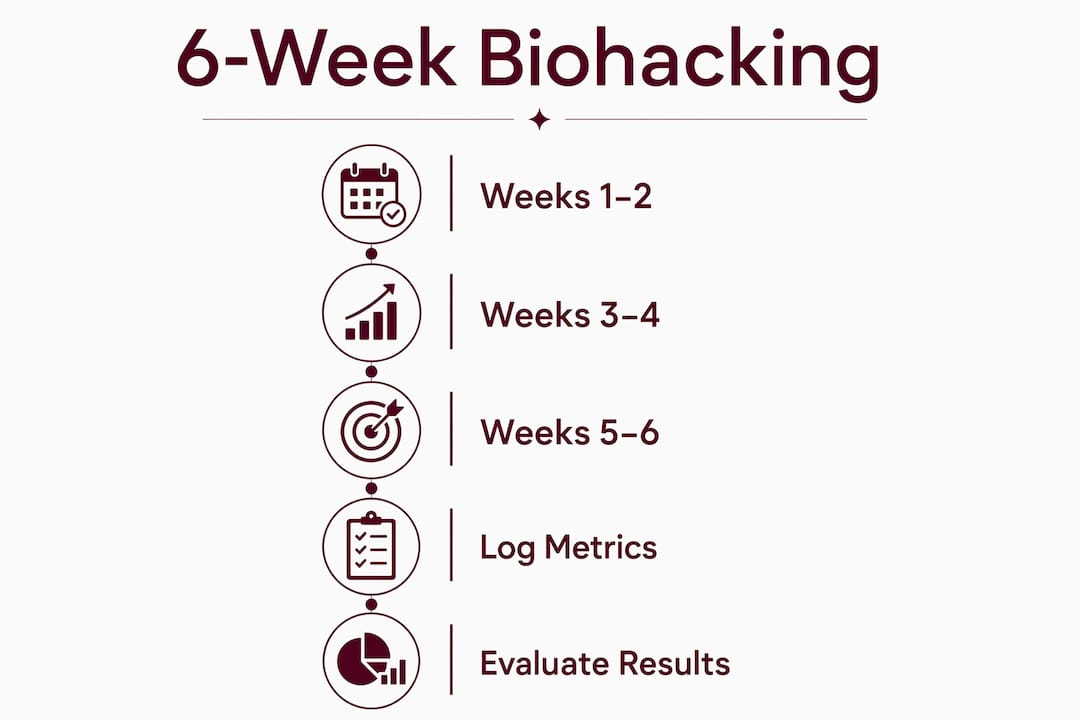
Weeks 3–4: Add one behavior or supplement. Choose a single variable from the evidence table above. Log adherence and watch your objective metrics.
Weeks 5–6: Evaluate and iterate. Compare your Week 5–6 averages against your Week 1–2 baseline. Decide keep, drop, or modify.
Use this daily tracking template:
| Metric | What to log |
|---|---|
| Wake time | Actual time out of bed |
| Sleep hours / quality | Hours logged; 1–10 quality score |
| HRV | Morning reading if using a wearable |
| Focused work minutes | Total deep-work minutes logged |
| Subjective energy (AM/PM) | 1–10 score, morning and evening |
| Supplement adherence | Yes / No / partial |
| Notes | Anything unusual: stress, illness, travel |
Set your success criteria before you start, not after. A useful target: a 10–15% improvement in focused minutes or a consistent HRV increase over the test period. Vague goals produce vague conclusions. For a more detailed step-by-step biohacking workflow, the CP-1 blog walks through the full experiment design.
How do you know if a supplement is actually worth buying?
Most supplements on the market are formulated for a marketing deck, not for the person swallowing them. Here is the checklist that cuts through the noise:
- Certificate of Analysis (CoA): A third-party lab tested the actual batch. No CoA, no purchase.
- GMP manufacturing: Current Good Manufacturing Practice certification means the facility meets FDA quality standards.
- Full ingredient label with doses: Every ingredient listed with its exact milligram amount. Proprietary blends that hide doses are a red flag.
- Vegan and non-GMO certifications: Signals cleaner sourcing and broader quality controls.
- Lot number and expiry date: Traceability. If a brand cannot tell you which batch you received, that is a problem.
- Extract standardization: Lion’s mane should list polysaccharide percentage. CoQ10 should specify ubiquinol vs. ubiquinone.
- U.S.-based manufacturing with traceability: Offshore production with no third-party verification is a sourcing gamble.
CP-1’s NAD+ Advanced Supplement checks each of these boxes: third-party tested, GMP-certified, vegan, non-GMO, US-manufactured, with a transparent full-ingredient label covering NMN, lion’s mane, reishi, turkey tail, and CoQ10.
Key Takeaways
Biohacking your routine works when you fix the foundations first, run one controlled experiment at a time, and choose supplements with verifiable quality signals.
| Point | Details |
|---|---|
| Foundation before supplements | Fix sleep, movement, and nutrition before adding any supplement stack. |
| One variable at a time | Run each change for at least two weeks and track objective metrics, not just feelings. |
| Realistic timelines | Expect energy shifts at 2–4 weeks; cognitive and HRV improvements at 6+ weeks. |
| Supplement quality checklist | Require a CoA, GMP certification, and a full transparent ingredient label before buying. |
| CP-1 as a vetted option | CP-1’s NAD+ Advanced Supplement covers NMN, lion’s mane, reishi, turkey tail, and CoQ10 with GMP and third-party testing. |
The honest truth about sustainable biohacking
The biohacking world has a consistency problem. Everyone wants the dramatic protocol, the 30-day transformation, the stack that changes everything overnight. What actually compounds is boring: a 15-minute morning anchor you run every single day, a sleep window you protect like a meeting you cannot miss, and one supplement you actually verified works for your body before adding the next one.
A 1% weekly improvement in focused work time or HRV is not exciting to post about. Over six months, it is a different person. That is the math that matters, and it is the math most extreme protocols ignore because it does not sell.
The other thing nobody talks about: self-experimentation has real limits. Placebo effects are strong, confirmation bias is stronger, and the supplement industry knows both. The test-and-measure framework in this article exists precisely because your subjective impression of a new supplement is almost always unreliable in the first two weeks. Measure first. Conclude later.
CP-1 is built for exactly this kind of routine
If you have done the work in this article, you know what to look for: a transparent ingredient list, third-party testing, GMP manufacturing, and a formula that covers the evidence-backed stack without filler. CP-1’s NAD+ Advanced Supplement delivers NMN, lion’s mane (Hericium erinaceus), reishi (Ganoderma lucidum), turkey tail (Trametes versicolor), and CoQ10 in a chewable gummy format, vegan and non-GMO, made in the US under GMP conditions.
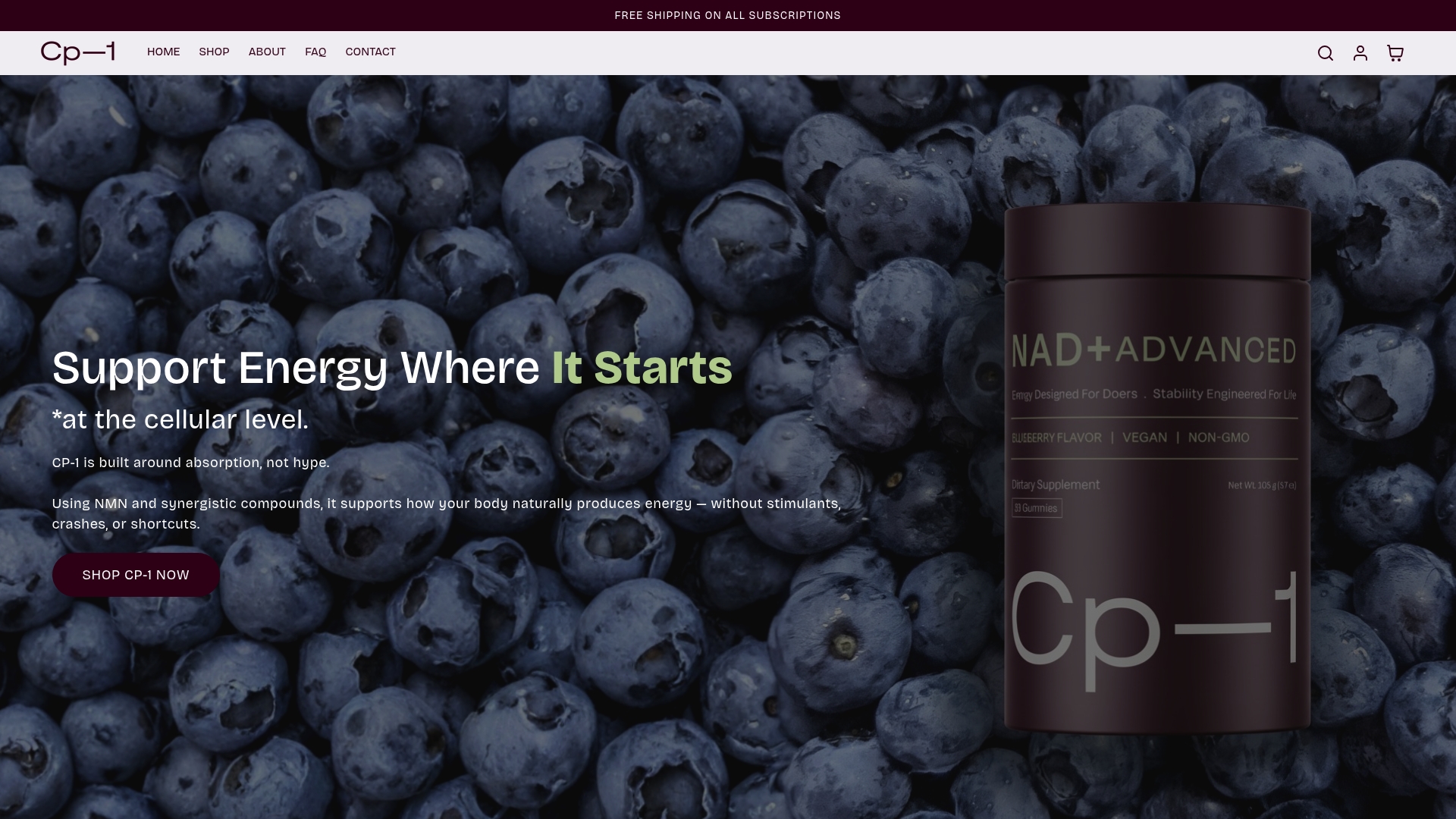
It fits cleanly into the 6-week protocol above: add it at Week 3 as your single test variable, log your metrics, and let the data tell you what it does for your body. No guesswork, no proprietary blend hiding doses. Order CP-1 and run the experiment properly.
Useful sources and further reading
- The Biohacker’s Guide to Daily Habits | VitalWhys
- Biohacking Productivity Routine | 10000Hours Blog
- Biohacking for Everyday Life | GabrielCaroprese.com
- Ethical Biohacking Guide | EthicalBiohacking
- Biohacking Techniques in Order | BAI
- Step-by-Step Cognitive Enhancement Guide | CP-1
- Daily Wellness Workflow for Energy and Focus | CP-1
- Relaxation Techniques for Wellness | Orchestral Meditations