
A step by step biohacking workflow is a sequential, evidence-based method for self-optimization that changes one variable at a time, tracks outcomes precisely, and builds lasting improvements in mental clarity, energy, and overall wellness. The practice itself is formally called N=1 self-experimentation, meaning you are both the researcher and the subject. The Biohacker Alliance defines true biohacking as evidence-oriented self-experimentation, not the purchase of devices or gadgets. That distinction matters. Most people buy a red light panel or a cold plunge tub before they have mastered sleep. That approach wastes money and produces noise, not data. A structured biohacking process fixes that by putting every intervention in its correct order.
What are the foundational elements of an effective biohacking workflow?
Sleep consistency is the non-negotiable first step in any personal optimization method. Sleep wins the largest effect size filter among all biohacking interventions, and experts recommend 30–60 days of consistency before adding advanced techniques. That means your bedtime and wake time should not drift more than 30 minutes in either direction, day after day.
The environment around your sleep matters just as much as the timing. Bedroom temperature of 65–67°F (18–19°C), complete darkness, and cutting off caffeine before 1–2 PM are the three environmental levers that protect sleep quality. Each one is free to implement. None requires a subscription.

Morning light exposure is the second pillar. Getting 10–15 minutes of direct sunlight within 30 minutes of waking sets your circadian clock, which governs cortisol timing, melatonin release, and energy patterns throughout the day. Skipping this step while adding supplements or cold exposure is like building a house on sand. The foundation will not hold.
Here is what the foundational checklist looks like before you move to anything else:
- Sleep timing: Keep your sleep window within ±30 minutes for at least 4–8 weeks
- Bedroom temperature: Set your room to 65–67°F at night
- Darkness: Use blackout curtains or a sleep mask; eliminate all light sources
- Caffeine cutoff: No caffeine after 1–2 PM to protect sleep architecture
- Morning sunlight: 10–15 minutes of outdoor light within 30 minutes of waking
Pro Tip: If you track only one thing during your foundation phase, track your wake time. Consistent wake time is the single most powerful anchor for your entire circadian system.
How to structure and track your biohacking interventions step by step?
A valid biohacking protocol requires more than good intentions. A proper protocol defines a single outcome, establishes a baseline, changes one variable, sets precise dosage and timing, and schedules a reassessment. Every step is deliberate. Every step is documented.
The structure below is the framework that separates real biohackers from people who just buy things:
- Define one clear outcome. Pick a specific, measurable target: improve HRV by 10%, extend deep sleep by 20 minutes, or sustain two hours of uninterrupted focus.
- Establish your baseline. Track your chosen metric for 7–14 days before changing anything. This is your control period.
- Introduce one variable. Change exactly one thing: a supplement, a meal timing shift, a cold shower protocol. Nothing else changes.
- Set precise parameters. Define the dose, the timing, and the frequency. “I’ll try magnesium” is not a protocol. “400mg magnesium glycinate at 9 PM nightly” is.
- Track for two weeks. One intervention per two-week period gives your biology enough time to respond without confounding the data.
- Review and decide. At the end of two weeks, decide to continue, adjust, or stop. Write down your reasoning.
- Apply a washout period. If stopping an intervention, wait 2–4 weeks before starting the next one to return to homeostasis and avoid carryover effects.
The tracking piece is where most people cut corners. Tracking output metrics like cognitive performance scores or HRV readings is far more valuable than tracking whether you completed a habit. Habit completion tells you what you did. Output metrics tell you whether it worked.
| Metric type | Examples | What it tells you |
|---|---|---|
| Subjective output | Focus session length, mood rating | Perceived cognitive and emotional state |
| Objective biomarker | HRV, resting heart rate, sleep stages | Physiological response to intervention |
| Habit completion | Supplement taken, workout done | Compliance only, not effectiveness |
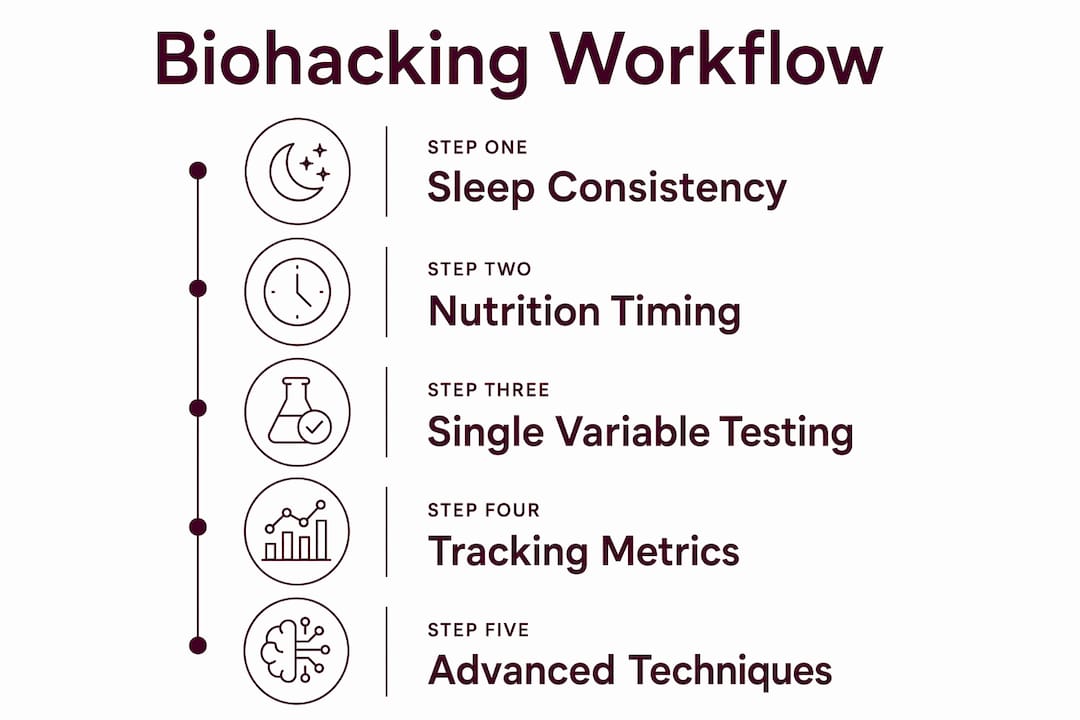
Pro Tip: Use a simple spreadsheet with date, intervention, dose, and one output metric per row. Complexity kills consistency. The simpler your tracking system, the longer you will actually use it.
What are common biohacking techniques and how to prioritize them?
The order in which you introduce biohacking techniques determines whether they work. Advanced techniques applied on an unstable biological foundation yield minimal benefits and can increase physiological stress. The hierarchy below reflects both effect size and dependency.
Nutrition timing comes first after sleep is locked in. Eating within 1–2 hours of waking and finishing meals 2–3 hours before bed aligns food intake with circadian rhythms. Targeting 30–50g of protein per meal stabilizes glucose and supports sustained energy without stimulants.
Cold exposure is a high-leverage technique once nutrition and sleep are stable. Cold showers starting at 15 seconds and progressing to 2–3 minutes over several weeks elevate norepinephrine, which sharpens alertness and builds stress resilience. The key word is progression. Jumping straight to a 3-minute cold plunge on day one is not a protocol. It is a stunt.
Strength training belongs before cardio or sauna in the priority order. Two to three sessions per week build the metabolic base that makes every other intervention more effective. Sauna and high-intensity cardio are recovery stressors. They work best on top of a body that is already structurally strong.
Mindfulness and stress management are not optional add-ons. Proactive stress management reduces cortisol load, which directly protects sleep quality and HRV. Techniques like box breathing, meditation, or structured journaling take less than 10 minutes per day and produce measurable physiological changes within weeks.
Here is the recommended priority order:
- Tier 1 (weeks 1–8): Sleep consistency, morning light, caffeine timing
- Tier 2 (weeks 9–16): Nutrition timing, protein targets, strength training 2–3x per week
- Tier 3 (weeks 17+): Cold exposure, mindfulness practice, targeted supplementation
- Tier 4 (advanced): Sauna, HRV-guided training, NAD+ precursors like NMN, adaptogens like lion’s mane or reishi
Supplements like NMN and coenzyme Q10 belong in Tier 4 because they support mitochondrial energy and NAD+ production most effectively when the body’s baseline systems are already functioning well. Cp-1 contains NMN alongside lion’s mane, reishi, turkey tail, and CoQ10 precisely because these compounds work synergistically on a prepared biological system. Throwing them at a sleep-deprived, stressed body is a waste.
How to identify and avoid common mistakes in a biohacking process?
The most common mistake in any biohacking process is changing multiple variables at once. Simultaneous variable changes make it impossible to assign causation. If you start cold showers, a new supplement, and intermittent fasting in the same week and you feel better, you have no idea what worked. If you feel worse, you have no idea what to stop.
The second mistake is tracking vanity metrics. Vanity metrics feel productive but do not measure meaningful biological improvements. Counting how many days you completed your morning routine is not the same as measuring whether your HRV improved or your focus sessions got longer. Track outputs, not rituals.
Other critical mistakes to avoid:
- Skipping washout periods. Jumping from one intervention to the next without a 2–4 week break creates confounded data. You cannot know what is working.
- Ignoring recovery signals. Declining HRV, persistent fatigue, or worsening mood are signs your recovery systems are overloaded. These signals mean you pull back, not push harder.
- Starting advanced hacks too early. Sauna, peptides, or high-dose supplementation on top of poor sleep is not biohacking. It is noise.
- Chasing protocols designed for someone else. Identifying your motivational strand, whether cognitive enhancement, longevity, or energy, shapes which interventions are relevant to you specifically.
“Biohacking safety lies in mastering foundational pillars like nutrition, sleep, and stress management rather than experimental extremes.” — Dr. Melissa Young, Cleveland Clinic
The discipline required here is real. Most people abandon a protocol after 10 days because they do not see dramatic results. Biological adaptation takes weeks, not days. Patience is not a soft skill in this context. It is a methodology requirement.
Key takeaways
A structured, hierarchical biohacking workflow built on sleep, nutrition, and single-variable testing produces measurable, attributable improvements in energy, mental clarity, and overall wellness.
| Point | Details |
|---|---|
| Foundation before advanced techniques | Lock in sleep consistency and morning light for 4–8 weeks before adding supplements or cold exposure. |
| One variable at a time | Change only one intervention per two-week period to isolate what is actually working. |
| Track outputs, not habits | Measure HRV, focus session length, or cognitive performance, not just whether you completed a routine. |
| Washout periods protect your data | Wait 2–4 weeks between interventions to return to baseline and avoid confounded results. |
| Supplements work best on a prepared system | NAD+ precursors, adaptogens, and CoQ10 deliver the most benefit when foundational habits are already stable. |
Why I think most biohackers are doing it backwards
I spent years watching people spend serious money on supplements, devices, and protocols while sleeping six broken hours a night. The results were predictably disappointing. Not because the interventions were bad, but because the foundation was not there to receive them.
The scientific method applied to yourself is genuinely powerful. But it only works if you respect the hierarchy. Sleep is not boring. It is the highest-leverage intervention available to you, and it costs nothing. Morning sunlight is not a wellness trend. It is a circadian signal your biology has depended on for millions of years.
What I have found, both personally and from watching others go through this process, is that the people who get real results are the ones who treat biohacking as a long game. They are not chasing a 10-day transformation. They are building a daily workflow for lasting energy that compounds over months. The data they collect becomes genuinely useful because they collected it correctly.
The hardest part is not the cold shower or the supplement stack. The hardest part is doing the same boring foundational things consistently for eight weeks before you add anything new. That discipline is what separates people who get results from people who have a drawer full of half-used supplements.
Personalize your workflow based on your actual goal. If you want cognitive performance, your Tier 3 looks different than someone chasing longevity. Identifying your motivational strand early saves you months of experimenting with the wrong interventions.
— Hugo
Cp-1 resources for your structured wellness workflow
Building a real biohacking workflow takes more than motivation. It takes reliable, evidence-grounded information at every stage of the process.
Cp-1 publishes practical, science-backed content designed for people who take their health seriously. Whether you are working on cellular energy support or building out your mitochondrial health checklist, the Cp-1 blog covers the foundational and advanced layers of personal optimization without the hype. Cp-1’s supplement formula, which includes NMN, lion’s mane, reishi, turkey tail, and CoQ10, is built for people who have already done the foundational work and want targeted cellular support. Explore the full resource library at cp-1.com to keep your workflow grounded in real science.
FAQ
What is biohacking in simple terms?
Biohacking is evidence-based self-experimentation where you systematically test lifestyle changes to improve your biology. It is not about gadgets. It is about applying a scientific method to your own health.
How do I start a biohacking workflow as a beginner?
Start with sleep consistency, keeping your sleep window within ±30 minutes for 4–8 weeks, before adding any other intervention. Morning sunlight and caffeine cutoff before 1–2 PM are the next two steps.
How long should I track each biohacking intervention?
Track each intervention for at least 14 days before drawing conclusions, and apply a 2–4 week washout period before starting the next one. This prevents confounded data and gives your biology time to respond.
What metrics should I track in a biohacking protocol?
Track output metrics like HRV, focus session length, or cognitive performance scores rather than habit completion alone. Output metrics show whether an intervention is producing real biological change.
When should I add supplements to my biohacking workflow?
Supplements belong in Tier 3 or Tier 4 of a structured workflow, after sleep, nutrition timing, and physical training are stable. Compounds like NMN and CoQ10 support mitochondrial energy most effectively when the body’s foundational systems are already functioning well.