

Cellular Energy Workflow: Optimize Your Performance Naturally
The cellular energy workflow is the biochemical sequence that converts glucose, fats, and amino acids into ATP, the molecule that powers every contraction, thought, and cellular repair process in your body. Most people know they need “more energy,” but few understand that ATP production in human cells depends on a tightly coordinated series of metabolic pathways centered in the mitochondria. Your muscles, brain, and organs run on roughly 100 to 150 moles of ATP hydrolysis daily. That number is not a rounding error. It means your cells are constantly cycling through ATP at a rate that demands every stage of the metabolic energy workflow to function without interruption. Understanding where that process breaks down, and how to support it, is the real foundation of physical and cognitive performance.
What are the main steps in the cellular energy workflow?
The metabolic energy workflow runs in three sequential stages, each building on the last. Together, they extract usable energy from food and transfer it into ATP.
Step 1: Glycolysis
Glycolysis occurs in the cytosol, outside the mitochondria. One glucose molecule is split into two pyruvate molecules, producing a net yield of just 2 ATP and 2 NADH. This stage requires no oxygen, which is why it can operate during sprints or other high-intensity bursts when oxygen supply lags behind demand.

Step 2: Pyruvate oxidation and the citric acid cycle
Pyruvate enters the mitochondria and is converted to acetyl-CoA, which feeds the citric acid cycle (also called the Krebs cycle or TCA cycle). This stage does not produce large amounts of ATP directly. Instead, it generates electron carriers, primarily NADH and FADH2, that carry high-energy electrons to the next stage.
Step 3: Oxidative phosphorylation
The electron transport chain (ETC) uses NADH and FADH2 to pump protons across the inner mitochondrial membrane. The resulting electrochemical gradient drives ATP synthase to produce ATP through chemiosmosis. Oxidative phosphorylation yields the vast majority of cellular ATP, approximately 28 of the roughly 32 ATP generated per glucose molecule under aerobic conditions.
Aerobic vs. anaerobic: why oxygen changes everything
| Condition | Pathway | ATP yield per glucose | Key byproduct |
|---|---|---|---|
| Aerobic | Glycolysis + TCA + ETC | ~32 ATP | CO2, water |
| Anaerobic | Glycolysis + lactate fermentation | 2 ATP | Lactate |
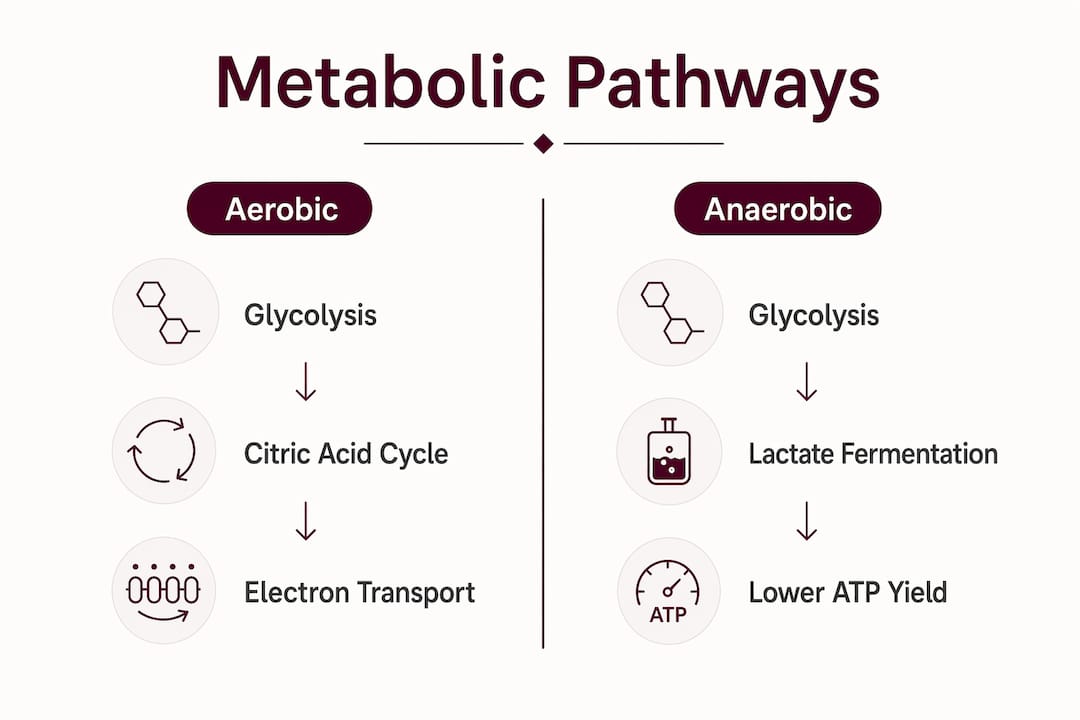
Under anaerobic conditions, lactate fermentation regenerates NAD+ so glycolysis can continue, but the ATP yield collapses to just 2 per glucose. This is why sustained high-intensity exercise without adequate oxygen delivery hits a wall fast. The aerobic pathway is not optional for lasting performance. It is the engine.
Which nutrients and strategies optimize each stage of the energy process?
Supporting energy production in cells is not about taking a handful of random supplements. It is about giving each stage of the workflow what it actually needs to run.
Substrate availability comes first. Glucose, fatty acids, and amino acids are the raw inputs. Without adequate carbohydrate and fat intake calibrated to your activity level, the upstream fuel supply simply is not there. No supplement fixes a substrate deficit.
Coenzymes and cofactors are the real bottlenecks. The TCA cycle and ETC depend on:
- NAD+ (derived from niacin and NMN, or Nicotinamide Mononucleotide) as the primary electron carrier. NAD+ levels decline with age, which directly slows the energy flow in cellular functions.
- FAD (from riboflavin, vitamin B2), which accepts electrons in the TCA cycle.
- CoQ10 (Coenzyme Q10), which shuttles electrons between ETC complexes. CoQ10 levels also decline with age and statin use.
- B vitamins (B1, B2, B3, B5) as cofactors for pyruvate dehydrogenase and TCA enzymes.
Antioxidants protect mitochondrial integrity. The ETC generates reactive oxygen species (ROS) as a byproduct. Chronic oxidative stress damages mitochondrial membranes and DNA, degrading the efficiency of cellular energy production over time. Antioxidants like vitamin C, vitamin E, and polyphenols from reishi and turkey tail mushroom extracts help neutralize ROS before they cause structural damage.
Exercise is the most validated mitochondrial stimulus. Aerobic training increases mitochondrial density, improves oxygen delivery, and upregulates ETC enzyme activity. Resistance training increases ATP demand, which signals cells to expand mitochondrial capacity. Both forms of exercise improve mitochondrial oxidative capacity more reliably than any supplement protocol tested in human trials.
Pro Tip: NMN supplementation supports NAD+ replenishment, but it works best when combined with adequate B vitamin intake and regular aerobic exercise. Treating NMN as a standalone fix misses the point. It is one input into a multi-step workflow.
How can you measure and assess cellular energy production?
You cannot optimize what you cannot measure. Fortunately, several validated tools exist for assessing how well your mitochondria are actually performing.
Oxygen consumption rate (OCR) is the gold-standard proxy for mitochondrial respiration. OCR measurement captures how fast cells consume oxygen, which directly reflects ETC activity and ATP synthesis rate. Higher OCR under controlled conditions generally indicates healthier mitochondrial function.
The ATP/ADP ratio reflects the energy charge of a cell. A high ratio means ATP supply is meeting demand. A falling ratio signals that the workflow is falling behind, which triggers ADP to accelerate oxidative phosphorylation as a feedback mechanism. This regulatory loop is one reason well-trained athletes can sustain higher output without metabolic collapse.
The Seahorse XF Mito Stress Test is the most detailed laboratory method for decomposing mitochondrial function. It uses sequential injections of oligomycin, FCCP, and rotenone/antimycin A to isolate basal respiration, ATP-linked respiration, maximal capacity, and proton leak. Seahorse XF assays provide a complete functional map of where the ETC is performing and where it is not.
| Assessment method | What it measures | Practical use |
|---|---|---|
| Oxygen consumption rate (OCR) | Mitochondrial respiration rate | Research and clinical labs |
| ATP/ADP ratio | Cellular energy charge | Metabolic research |
| Seahorse XF Mito Stress Test | Full ETC functional profile | Identifying specific dysfunction |
| Blood lactate testing | Anaerobic threshold | Athletic performance tracking |
Pro Tip: Standardized sample handling before any mitochondrial assay is critical. Biological variance from inconsistent cell counts or temperature fluctuations can invalidate results entirely. If you are working with a functional medicine provider, ask specifically about their measurement protocols.
What disrupts the cellular energy workflow and how do you fix it?
Several factors reliably degrade energy production in cells, and most of them are addressable without a prescription.
- Oxygen deficiency. Chronic shallow breathing, sedentary behavior, and poor cardiovascular fitness all reduce oxygen delivery to mitochondria. Without adequate oxygen, the ETC cannot run at full capacity and the cell defaults to anaerobic metabolism, producing far less ATP per glucose.
- Mitochondrial dysfunction from oxidative stress. Excess ROS from poor diet, chronic inflammation, or environmental toxins damages the inner mitochondrial membrane. This reduces the proton gradient that drives ATP synthase, directly cutting energy output.
- Nutrient deficiencies. Low B vitamin status impairs pyruvate dehydrogenase and TCA cycle enzymes. CoQ10 deficiency slows electron transfer between ETC complexes. NAD+ depletion, which accelerates with age, limits the electron carrier supply that the entire aerobic pathway depends on.
- Metabolic inflexibility. A healthy metabolic energy workflow switches efficiently between glucose and fat as fuel sources. Chronic high-carbohydrate diets with minimal physical activity can reduce fat oxidation capacity, narrowing the cell’s fuel options and making energy output less stable across different conditions.
- Chronic stress and poor sleep. Cortisol chronically elevated by stress increases ATP demand while simultaneously impairing mitochondrial biogenesis. Sleep deprivation reduces the cellular repair processes that maintain mitochondrial membrane integrity. Both factors compound over time.
The practical fixes are not complicated. Prioritize aerobic exercise, eat adequate protein and micronutrients, reduce processed food intake, and address sleep quality before adding any supplement. Reviewing a mitochondrial health checklist before spending money on supplements is a more rational starting point.
How does metabolite transport shape the overall cellular energy process?
Most discussions of cellular respiration stop at the ETC. The transport of metabolites across mitochondrial membranes is equally important and far less discussed.
- Pyruvate transport. Pyruvate produced in glycolysis must cross the inner mitochondrial membrane via the mitochondrial pyruvate carrier (MPC) to enter the TCA cycle. Impaired MPC activity reduces acetyl-CoA supply and slows the entire downstream workflow.
- Fumarate and malate shuttling. These TCA intermediates move between the mitochondria and cytosol through specific carrier proteins. Their transport connects the TCA cycle to gluconeogenesis and amino acid synthesis, meaning mitochondrial output affects far more than just ATP.
- Glutamine as an alternative substrate. Under conditions of glucose limitation, glutamine enters the TCA cycle via glutaminolysis. Mitochondrial metabolite trafficking including glutamine transport is a key regulator of energy output when primary substrates are scarce.
- PEP and mitochondrial pyruvate kinase. Phosphoenolpyruvate (PEP) produced inside mitochondria can be converted to pyruvate by mitochondrial pyruvate kinase, creating a localized ATP-generating loop that operates independently of cytosolic glycolysis.
- Implications for natural interventions. Supporting metabolic flexibility through varied fuel sources, adequate protein intake, and compounds that maintain mitochondrial membrane integrity (such as CoQ10 and omega-3 fatty acids) keeps these transport mechanisms functional and responsive.
Key takeaways
The cellular energy workflow produces ATP through three sequential stages, and optimizing each stage through targeted nutrition, exercise, and evidence-based supplementation is the most reliable path to sustained physical and cognitive performance.
| Point | Details |
|---|---|
| Three-stage ATP production | Glycolysis, TCA cycle, and oxidative phosphorylation each contribute to the ~32 ATP yield per glucose. |
| NAD+ and CoQ10 are rate-limiters | Both decline with age and directly constrain ETC output; targeted replenishment has research support. |
| Aerobic exercise is non-negotiable | Exercise increases mitochondrial density and ETC enzyme activity more reliably than any supplement. |
| Measure before you optimize | OCR and ATP/ADP ratio provide objective data; avoid protocol changes based on anecdote alone. |
| Metabolite transport matters | Pyruvate, fumarate, and glutamine trafficking across mitochondrial membranes regulates total energy output. |
Why I think most people are optimizing the wrong thing
I have spent years reading the research on mitochondrial function, and the pattern I keep seeing is the same. People fixate on the supplement layer and skip the infrastructure. They buy NMN or CoQ10 before they have addressed sleep, aerobic capacity, or B vitamin status. That is like upgrading the fuel injectors on an engine with a cracked block.
The science on mitochondrial support supplements is real, but it is conditional. NMN works better when NAD+ is genuinely depleted. CoQ10 matters most when statin use or age has reduced baseline levels. The supplements are not the foundation. They are the final layer on top of a foundation you have to build first.
What I find more useful than any single protocol is understanding where your personal bottleneck actually sits. Is it substrate availability? Oxygen delivery? Oxidative stress? Nutrient deficiency? The answer changes what you do. Chasing a generic “mitochondria protocol” without that clarity is how people spend two years and several hundred dollars and feel no different. Measure something real, address the actual gap, and then add targeted support. That sequence works. The reverse rarely does.
— Hugo
Support your cellular energy with Cp-1
If this article gave you a clearer picture of how energy production in cells actually works, the next step is applying it. Cp-1 was built specifically for people who want to support their mitochondrial function with ingredients that have a real scientific rationale, not a marketing story.
CP-1 contains NMN, CoQ10, lion’s mane, reishi, and turkey tail mushroom extracts, each selected to address specific points in the cellular energy workflow. Every batch is third-party tested, vegan, non-GMO, and manufactured in the US. If you are ready to move from understanding the science to actually supporting it, explore CP-1 and see what targeted mitochondrial support looks like when it is done right.
FAQ
What is the cellular energy workflow?
The cellular energy workflow is the sequence of metabolic pathways, glycolysis, the citric acid cycle, and oxidative phosphorylation, that convert nutrients into ATP. It produces approximately 32 ATP per glucose molecule under aerobic conditions.
How does NAD+ affect energy production in cells?
NAD+ is the primary electron carrier in the TCA cycle and ETC. When NAD+ levels fall, electron transfer slows and ATP output drops. NMN supplementation supports NAD+ replenishment, particularly in aging cells where natural synthesis declines.
What is the best way to measure mitochondrial energy output?
Oxygen consumption rate (OCR) is the most widely validated proxy for mitochondrial respiration. The Seahorse XF Mito Stress Test provides the most detailed functional breakdown by isolating basal respiration, ATP-linked respiration, and maximal ETC capacity.
Why does anaerobic metabolism produce so much less ATP?
Without oxygen, the electron transport chain cannot operate, so cells rely on lactate fermentation to regenerate NAD+. This yields only 2 ATP per glucose compared to roughly 32 ATP from the full aerobic pathway.
Can lifestyle changes genuinely improve cellular energy efficiency?
Aerobic exercise, adequate sleep, and targeted micronutrient intake each directly improve mitochondrial density and ETC function. These changes produce measurable improvements in OCR and ATP/ADP ratio, making them the most evidence-based interventions available.