

NMN Versus NAD: Which Supplement Actually Works?
NMN (nicotinamide mononucleotide) is the superior oral supplement for raising cellular NAD+ levels because it is a smaller precursor molecule that converts efficiently inside cells, while NAD+ itself breaks down in the gut before it can reach your bloodstream. The NMN versus NAD debate matters because both target the same biological goal: restoring nicotinamide adenine dinucleotide, the coenzyme your cells use for energy production, DNA repair, and cognitive function. NMN supplements have returned to full legal status in the U.S. market, and clinical dosing at 300–1,000 mg daily raises blood NAD+ within 14–30 days. If you are researching this for energy, brain health, or longevity, the answer is clear: NMN is the practical choice.
What is the difference between NMN and NAD?
NAD+ (nicotinamide adenine dinucleotide) is a coenzyme involved in 500+ cellular reactions, including ATP energy production, DNA repair, and the activation of sirtuins, the proteins most associated with longevity research. Your body cannot function without it. The problem is that NAD+ levels decline with age, and that decline correlates with reduced energy, slower recovery, and cognitive fog.
NMN (nicotinamide mononucleotide) sits one enzymatic step away from NAD+ in the biosynthesis pathway. Your body converts NMN into NAD+ using the enzyme NMNAT. This makes NMN a direct and efficient precursor, not a roundabout workaround.
The molecular size difference is the key factor here. NAD+ weighs 663.4 Da, while NMN weighs 334.2 Da. That size gap determines how well each molecule survives digestion and enters your cells. NMN also uses a dedicated cellular transporter called Slc12a8, which pulls it directly into intestinal cells intact. NAD+ has no equivalent transport mechanism for oral absorption.
| Feature | NAD+ | NMN |
|---|---|---|
| Molecular weight | 663.4 Da | 334.2 Da |
| Oral bioavailability | Under 5% | Absorbed effectively |
| Cellular transporter | None for oral use | Slc12a8 |
| Role in body | Active coenzyme | Direct NAD+ precursor |
| Supplement form | Oral capsule, IV infusion | Oral capsule, powder |
Pro Tip: If you see a supplement labeled “NAD+” in capsule form, read the label carefully. Many products actually contain NMN or NR (nicotinamide riboside) as the active ingredient, not NAD+ itself. The label can be misleading.
How do NMN and NAD supplements compare in absorption?
Oral NAD+ bioavailability is under 5% because digestive enzymes break the molecule apart before it reaches the bloodstream. What little survives is too large to cross cell membranes without a transporter. This is not a formulation problem that better manufacturing can fix. It is a fundamental biochemical limitation.
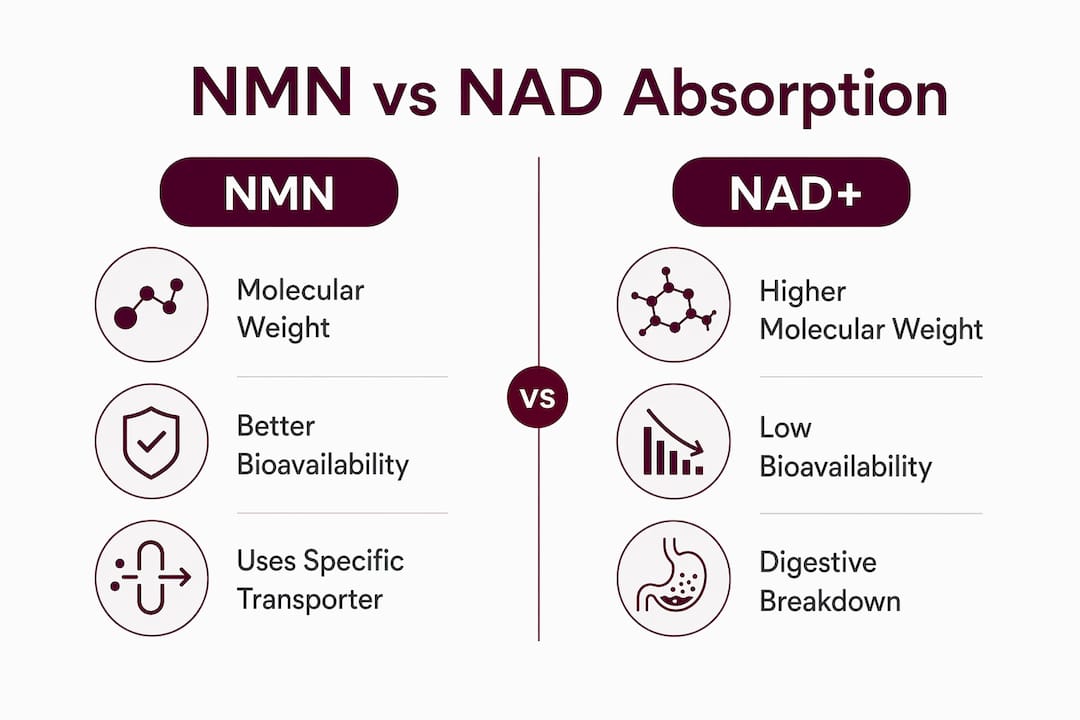
NMN does not share this problem. Because it is smaller and uses the Slc12a8 transporter, NMN is absorbed intact through the intestinal lining and converted to NAD+ inside cells. Multiple Phase 1–2 human trials confirm that NMN supplementation raises circulating NAD+ metabolites. The rise is measurable and consistent.
Here is what the clinical evidence shows for NMN dosing:
- 300 mg/day: Raises blood NAD+ levels within 14–30 days in healthy adults
- 600 mg/day: The most studied dose; clinical observations point to 600 mg as the optimal tested amount for NAD+ elevation
- 900–1,000 mg/day: Used in some trials without significant adverse effects, though incremental benefit over 600 mg is not yet conclusive
IV NAD+ therapy is a separate category entirely. It delivers NAD+ directly into the bloodstream, bypassing the gut entirely, and produces an immediate NAD+ spike. The tradeoff is cost and convenience. IV NAD+ sessions cost $250–$1,500, and the effects fade within days. For most people, this is not a sustainable long-term strategy.
Liposomal NMN formulations claim better absorption by wrapping the molecule in a fat-soluble shell, though rigorous clinical data confirming superiority over standard crystalline NMN is still developing. The practical gap between forms may be smaller than the marketing suggests.
Pro Tip: Whatever form you choose, third-party lab testing matters more than the delivery format. Look for certificates of analysis that verify purity and screen for heavy metals. A well-tested crystalline NMN is more reliable than a poorly tested liposomal product.
Cost and practicality: oral NMN versus IV NAD+
The cost difference between oral NMN and IV NAD+ therapy is not marginal. It is the difference between a daily supplement habit and a clinical procedure.
Oral NMN costs roughly $1.33–$6.35 per gram depending on brand, purity, and formulation. A standard 600 mg daily dose runs most users $30–$60 per month. That is a manageable, repeatable expense for anyone serious about long-term cellular health.
IV NAD+ therapy sits at $250–$1,500 per session at most clinics. Some protocols recommend weekly sessions initially, which puts the monthly cost at $1,000–$6,000. The effects also fade within days, meaning you need ongoing sessions to maintain elevated NAD+ levels. That model works for acute clinical use, not for daily longevity support.
| Factor | Oral NMN | IV NAD+ |
|---|---|---|
| Monthly cost | $30–$60 | $1,000–$6,000+ |
| Administration | Home, daily capsule | Clinic, IV infusion |
| Convenience | High | Low |
| Duration of effect | Sustained with daily use | Fades within days |
| Best use case | Long-term NAD+ support | Acute clinical need |
Consistency over 14–30 days is required to see measurable NAD+ elevation from oral NMN. Skipping days or dosing irregularly does not produce sustained cellular benefits. This is not a supplement you take once and feel. It is a protocol that rewards daily commitment.
Pro Tip: Do not take both NMN and NAD+ supplements simultaneously. Supplementing with multiple NAD+ precursors is redundant and costly. Pick one high-quality NMN product and stay consistent.
What does the research say about NMN for anti-aging and health?
NMN reliably raises NAD+ biomarkers in humans. That part is settled science. What remains genuinely uncertain is whether higher NAD+ levels translate into the dramatic anti-aging and cognitive benefits that supplement marketing promises.
No large randomized controlled trials have proven that NMN or NAD+ supplementation reverses aging in humans. The animal studies are compelling, particularly in mice, but human biology is more complex. Current Phase 1–2 trials confirm biochemical changes, not clinical outcomes like reduced disease risk or extended lifespan.
The safety picture is mostly positive for healthy adults, but not without nuance. NAD+ is fundamental to cellular energy production, including in cancer cells. NAD+ supplements may theoretically support cancer cell growth, and long-term safety data in humans is still limited. Anyone with a personal or family history of cancer should consult a physician before starting NMN supplementation.
What the research does support:
- Energy metabolism: NMN supplementation improves markers of mitochondrial function in clinical settings
- Muscle function: Some trials show improved muscle performance in older adults at 250–600 mg daily
- Cognitive markers: Early data on brain NAD+ and cognitive function is promising but not conclusive
- Inflammation: NAD+ precursors show anti-inflammatory effects in metabolic studies
“Lifestyle factors such as exercise, sleep, and nutrition have stronger evidence for longevity benefits than NAD+ supplementation alone, positioning NAD+ precursors as adjuncts rather than main drivers.” — NMN vs NAD: Expert Supplementation Insights
NMN is a support tool, not a replacement for the fundamentals. The science on NAD+ biology is real and growing. The hype around it often outpaces the evidence. Treat it accordingly.
Key Takeaways
NMN is the practical, evidence-backed oral supplement for raising cellular NAD+ levels, while direct oral NAD+ supplementation is biochemically ineffective and IV NAD+ is expensive and short-lived.
| Point | Details |
|---|---|
| NMN outperforms oral NAD+ | NMN’s smaller size and Slc12a8 transporter allow effective absorption; oral NAD+ bioavailability is under 5%. |
| Optimal NMN dose is 600 mg/day | Clinical trials identify 600 mg daily as the best-tested dose for measurable NAD+ elevation within 14–30 days. |
| IV NAD+ is not cost-effective long-term | At $250–$1,500 per session with effects fading within days, IV therapy is impractical for daily longevity support. |
| Anti-aging claims need more evidence | NMN raises NAD+ biomarkers reliably, but no large RCTs confirm reversal of aging or disease prevention in humans. |
| Quality and consistency are non-negotiable | Third-party tested NMN taken daily beats an expensive or poorly verified product taken irregularly. |
My honest take on NMN versus NAD after years of research
I have spent years reading the research, talking to formulators, and personally testing what actually moves the needle on energy and cognitive clarity. Here is what I have concluded.
The NMN versus NAD question has a clear answer biochemically. NMN wins for oral supplementation, and it is not close. Direct oral NAD+ in capsule form is largely a waste of money. The molecule does not survive digestion in meaningful amounts. If someone is selling you a NAD+ capsule and claiming it will raise your cellular NAD+, they are either misinformed or counting on you not reading the science.
IV NAD+ is a different story. It works. But it is a clinical tool, not a daily supplement. I would reserve it for specific recovery scenarios or acute needs, not as a substitute for a consistent oral NMN protocol.
What frustrates me most about this space is the gap between what the research actually shows and what supplement companies claim. NMN does raise NAD+ levels. That is real. But the leap from “raises NAD+” to “reverses aging” is a marketing move, not a scientific one. I take NMN because the cellular energy and mitochondrial support data is solid. I do not take it expecting to wake up ten years younger.
The other thing I see people get wrong is ignoring the basics. Sleep, resistance training, and a diet that is not garbage will do more for your NAD+ levels and longevity than any supplement. NMN works best as an addition to those habits, not a replacement for them. If you are not sleeping and you are sedentary, no amount of NMN will compensate.
Choose a product with verified purity, commit to a daily dose of 500–600 mg, and give it at least 30 days. That is the protocol that actually reflects what the NMN longevity research supports.
— Hugo
Why Cp-1 takes NMN supplementation seriously
If you have read this far, you already know that supplement quality is not optional. It is the whole game.
Cp-1 was built around that exact frustration with formulas designed for a marketing deck, not for the person swallowing them. The Cp-1 formula combines pure, third-party tested NMN with lion’s mane mushroom extract, reishi mushroom extract, turkey tail mushroom extract, and coenzyme Q10 for a complete cellular energy and cognitive support stack. Every batch is manufactured in the U.S., verified for purity, and free from GMOs and animal products. If you are ready to stop guessing and start supplementing with something real, explore Cp-1 and see what consistent, quality-verified NMN actually feels like.
FAQ
Does NMN actually increase NAD+ levels in the body?
Yes. Multiple human clinical trials confirm that NMN supplementation raises circulating NAD+ metabolites within 14–30 days at doses of 300–1,000 mg daily. The biochemical effect is well established; functional health outcomes require further large-scale study.
Is oral NAD+ supplementation worth taking?
No. Oral NAD+ bioavailability is under 5% due to digestive breakdown, making it largely ineffective as a standalone oral supplement. NMN or NR (nicotinamide riboside) are the validated oral precursors for raising cellular NAD+.
What is the best daily dose of NMN?
Clinical evidence points to 600 mg daily as the optimal tested dose for NAD+ elevation in healthy adults. Doses from 300–900 mg have been studied without significant adverse effects, but 600 mg is the most consistently supported target.
Can I take NMN and NAD+ supplements together?
There is no benefit to combining them. Taking multiple NAD+ precursors simultaneously is redundant and adds unnecessary cost. One high-quality NMN supplement taken consistently is more effective than stacking multiple precursors.
Are there any safety concerns with NMN supplementation?
NMN is generally well tolerated in healthy adults at studied doses. However, because NAD+ may theoretically support cancer cell growth, individuals with a cancer history or active cancer should consult a physician before starting. Long-term safety data in humans is still accumulating.