

What Is the Best Definition of Energy for Your Body?
Energy is the measurable capacity to do work. That’s the formal scientific definition, and it’s precise for a reason. In your body, that “work” is every heartbeat, every thought, every time you push through an afternoon without crashing. The bridge between physics and how you actually feel runs through your mitochondria, where chemical energy from food is converted into ATP, the molecule your cells spend like currency. NAD+ sits in the middle of that process as an essential electron carrier. When that conversion runs well, you feel it. When it doesn’t, no amount of caffeine covers the gap for long.
Table of Contents
- What scientists actually mean when they say “energy”
- Which forms of energy does your body actually use?
- How your cells actually make energy, step by step
- Why more input doesn’t always mean more energy
- Supplements and nutrients that support cellular energy
- How to evaluate any energy supplement before you buy
- When to expect changes, and what to watch for
- Key Takeaways
- Why the physics definition changed how I think about supplements
- Useful sources and recommended reading
What scientists actually mean when they say “energy”
Energy is a conserved quantity measured in joules. It cannot be created or destroyed, only converted from one form to another. That conservation principle is one of the most tested ideas in all of physics, and it has a direct implication for your health: you can’t manufacture energy out of nothing, but you can get dramatically more usable output from the same input by improving how your cells convert it.
The term itself has a long history. It traces back to Aristotle’s concept of energeia, meaning “activity” or “operation,” before evolving into a rigorous quantitative property in modern physics. That history explains why people conflate “feeling energetic” with “having energy” — the everyday word carries centuries of baggage the physics definition doesn’t.
The main categories of energy, each with a real-world anchor:
- Chemical energy: stored in molecular bonds; the form in food, ATP, and supplements
- Kinetic energy: energy of motion; muscle contractions, blood flow
- Thermal energy: heat; your body temperature is a byproduct of metabolic conversion
- Electrical energy: ion gradients across cell membranes; nerve signals, heart rhythm
- Potential energy: stored mechanical energy; gravitational, elastic
- Nuclear energy: atomic nucleus; not relevant to biology, but part of the full physics picture
“Energy is a fundamental entity of nature that is transferred between parts of a system in the production of physical change within the system and usually regarded as the capacity for doing work.” — Merriam-Webster
One important nuance from IUPAC’s thermodynamic framework: only changes in energy are directly measurable. You never measure a system’s total energy, only how much it gained or lost. That matters for biology because what your cells care about is the delta, the net ATP produced per cycle, not some abstract total.
Which forms of energy does your body actually use?
The body runs almost entirely on chemical energy. Food contains calories, which are units of stored chemical energy locked in molecular bonds. Your digestive system breaks those bonds down into simpler molecules, and your cells extract the energy through a series of controlled reactions.
A few key terms worth knowing before the supplement conversation makes sense:
ATP (adenosine triphosphate): The cell’s primary energy currency. When ATP breaks down to ADP, it releases energy that powers cellular work. Everything from muscle contraction to DNA repair runs on ATP.
NAD+ (nicotinamide adenine dinucleotide): An electron carrier that shuttles energy through the mitochondrial electron transport chain. NAD+ levels decline with age, which is one reason mitochondrial efficiency tends to drop over time.
CoQ10 (coenzyme Q10): Another electron carrier embedded in the inner mitochondrial membrane. It also acts as an antioxidant, protecting the membrane from oxidative damage during energy production.
Mitochondria: The organelles where most ATP is made. They contain the electron transport chain and are the site of oxidative phosphorylation.

Electron transport chain (ETC): A series of protein complexes in the mitochondrial membrane that transfer electrons from NAD+ and other carriers to oxygen, driving ATP synthesis.
Thermal and electrical energy also show up in physiology. The heat your body generates is a direct byproduct of metabolic inefficiency, and electrical gradients across cell membranes power nerve signals and cardiac function.
How your cells actually make energy, step by step
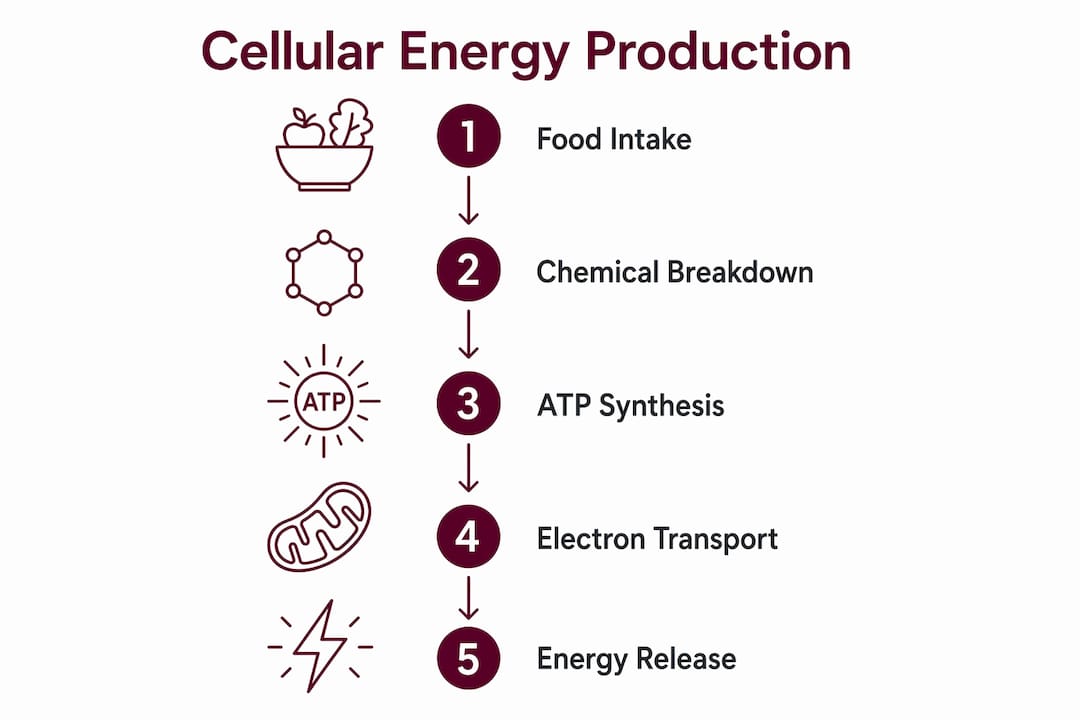
The cellular energy workflow runs from food to ATP through four main stages. Here’s the plain-language version:
- Digestion and nutrient uptake: Carbohydrates break into glucose, fats into fatty acids, proteins into amino acids. These enter the bloodstream and reach cells.
- Glycolysis: Glucose is split in the cell’s cytoplasm, producing a small amount of ATP and pyruvate. No oxygen required at this stage.
- TCA cycle (citric acid cycle): Pyruvate enters the mitochondria and is processed through the TCA cycle, generating electron carriers (NADH, FADH2) that feed the next stage.
- Electron transport chain and oxidative phosphorylation: NADH and FADH2 donate electrons to the ETC. As electrons move through the chain, they pump protons across the mitochondrial membrane, driving ATP synthase to produce the bulk of your ATP. CoQ10 is a critical carrier at this step.
- ATP use and regeneration: Cells spend ATP, regenerating ADP, which cycles back through the process. The body’s chemical energy stores are continuously recycled, not depleted in a single pass.
NAD+ is regenerated during this process and reused. When NAD+ pools run low, the entire chain slows down. That’s the mechanistic case for NAD+ precursor supplements, not a marketing claim.
Why more input doesn’t always mean more energy
Here’s the part most supplement marketing skips: energy conversion is never 100% efficient. Some energy is always lost as heat during each conversion step. This is entropy, and it’s non-negotiable physics. The practical implication is that your usable ATP output depends more on how efficiently your mitochondria convert substrates than on how much you eat or how many supplements you take.
Stanford’s energy research frames it clearly: optimizing conversion efficiency is the lever that actually moves the needle on cellular performance. Dumping more glucose into a poorly functioning mitochondrial chain doesn’t fix the chain. Supporting the electron carriers, protecting the membrane from oxidative damage, and maintaining NAD+ levels does.
There’s also a meaningful difference between energy and power. Energy is total capacity; power is the rate at which you use it. Sustained cognitive stamina requires consistent ATP production over hours, not a single spike. That distinction matters when you’re choosing between a stimulant and a mitochondrial support supplement.
Pro Tip: Instead of asking “what gives me more energy,” ask “what helps my cells convert energy more efficiently?” That reframe points you toward NAD+ precursors, CoQ10, and mitochondrial-protective antioxidants rather than stimulants that borrow from tomorrow.
Supplements and nutrients that support cellular energy
Start with the non-negotiable foundations before adding anything in a bottle:
- Sleep: The primary recovery window for mitochondrial repair. No supplement compensates for chronic sleep debt.
- Resistance training: Stimulates mitochondrial biogenesis. Well-established in human research.
- Protein and micronutrients: B vitamins (B2, B3, B5) are direct cofactors in the TCA cycle and ETC. Magnesium is required for ATP synthesis itself.
| Supplement | Mechanism | Evidence Level | Safety Note |
|---|---|---|---|
| NMN (Nicotinamide Mononucleotide) | NAD+ precursor; supports electron transfer | Small human trials | Generally well-tolerated; consult clinician if on medications |
| CoQ10 | Electron carrier; mitochondrial antioxidant | Established in human research | May interact with blood thinners; start low |
| Lion’s Mane mushroom | Supports nerve growth factor; cognitive function | Preclinical + small human trials | Well-tolerated; rare GI sensitivity |
| Reishi mushroom | Immune modulation; mitochondrial resilience | Preclinical + traditional use | Avoid with immunosuppressants |
| Turkey Tail mushroom | Immune support; gut microbiome | Preclinical + some human data | Generally safe; consult if immunocompromised |
| B vitamins | Cofactors for TCA cycle and ETC | Established | Water-soluble; excess B6 long-term warrants caution |
| Magnesium | Required for ATP synthesis | Established | High doses cause GI upset |
For evidence-backed mitochondrial supplements, the mechanisms above are the honest starting point. Preclinical data is promising for several of these; human trial data is thinner. That’s not a reason to dismiss them, but it is a reason to be skeptical of any brand claiming certainty.
How to evaluate any energy supplement before you buy
- Check ingredient transparency. Every active ingredient should be listed with its dose. Proprietary blends that hide individual amounts are a red flag.
- Look for third-party testing. Independent labs verify that what’s on the label is actually in the product at the stated dose. NSF, Informed Sport, and USP are recognized certifiers.
- Confirm GMP manufacturing. Good Manufacturing Practice certification means the facility meets FDA quality standards. US-manufactured products under GMP have a verifiable quality baseline.
- Assess the evidence citations. Does the brand link to actual studies, or just use scientific-sounding language? Check whether cited studies are human trials or only animal/cell data.
- Check for allergen and certification labeling. Vegan, non-GMO, and allergen-free labels matter if those factors affect you. They also signal a brand that sweats the details.
- Watch for overstated claims. “Clinically proven to triple your energy” with no linked trial is a marketing claim, not a fact. Real mechanisms are described precisely, not hyperbolically.
GMP certification means a facility follows documented processes for ingredient sourcing, manufacturing, and testing. Third-party testing means an independent lab confirmed the product’s contents. Neither guarantees a supplement works for you, but both meaningfully reduce the risk of getting something mislabeled or contaminated.
When to expect changes, and what to watch for
Realistic timelines matter. Some ingredients produce noticeable effects within hours to days, particularly those affecting alertness or sleep quality. Metabolic shifts, like improved mitochondrial efficiency or steadier energy across the day, typically take 2–8 weeks to become apparent. Measurable mitochondrial improvements from consistent supplementation and lifestyle changes generally require 3 months or more.
Safety considerations to keep in mind: CoQ10 can interact with blood thinners like warfarin. Adaptogenic mushrooms may affect immune function, which matters if you’re on immunosuppressants. Pregnant or nursing individuals and those with autoimmune conditions should consult a clinician before starting any new supplement protocol. Starting at a lower dose and assessing tolerance over two weeks is a reasonable approach for most people.
Third-party testing and GMP manufacturing reduce risk, but they don’t eliminate the need for a conversation with your doctor if you’re managing a health condition or taking prescription medications.
Key Takeaways
Energy is the measurable capacity to do work, and your body’s ability to feel energetic depends on how efficiently your mitochondria convert chemical energy into ATP.
| Point | Details |
|---|---|
| Formal definition | Energy is the capacity to do work, conserved and measured in joules. |
| Cellular bridge | ATP production in mitochondria, driven by NAD+ and CoQ10, is what “feeling energetic” actually reflects. |
| Efficiency over input | Improving mitochondrial conversion efficiency matters more than increasing substrate intake alone. |
| Top supplement priorities | NAD+ precursors (NMN), CoQ10, and adaptogenic mushrooms target the electron transfer pathway directly. |
| Quality signals | Third-party testing, GMP manufacturing, and transparent dosing are the minimum standards worth requiring. |
Why the physics definition changed how I think about supplements
Most people shopping for energy supplements are really shopping for a feeling. That’s not irrational. But the physics definition of energy, the one that says it’s a conserved quantity that can only be converted, not created, cuts through a lot of the noise in this industry. If energy can’t be manufactured from nothing, then a supplement that claims to “give you energy” is either supporting a conversion pathway or it’s doing nothing useful.
That’s the lens I used when building Cp-1. The formula targets the actual bottlenecks: NMN to support NAD+ pools, CoQ10 to keep electron transfer moving, and lion’s mane, reishi, and turkey tail to support the cognitive and immune resilience that mitochondrial health depends on. Every ingredient has a mechanistic rationale, not just a marketing story. Cp-1 is manufactured in the US under GMP standards, third-party tested, and certified vegan and non-GMO, because those aren’t nice-to-haves when you’re asking someone to swallow something every day.
My honest recommendation: pick a quality product, track how you feel over 4–8 weeks, and talk to your clinician if you’re managing any health conditions. The science points toward consistency and efficiency, not quick fixes.
Useful sources and recommended reading
- U.S. Energy Information Administration (EIA) — What Is Energy?: Clear, authoritative overview of the formal definition, conservation principle, and main energy forms. Good starting point.
- EIA — Forms of Energy: Breaks down chemical, electrical, thermal, and kinetic energy with real-world examples.
- Stanford University — Energy Basics (Understand Energy Learning Hub): Covers energy as a conserved scalar quantity and the efficiency framework; useful for understanding why conversion matters.
- Oregon State University — Introduction to Energy: Explains the gap between colloquial and scientific uses of “energy”; helpful for the vitality-to-physics bridge.
- IUPAC Gold Book — Energy (E02101): The chemist’s reference definition; covers thermodynamic measurability and internal energy changes.
- EnergyBasics.org — Energy Fundamentals: Maps dietary chemical energy to cellular ATP production; accessible and accurate.
- Encyclopaedia Britannica — Energy: Covers entropy, efficiency, and the historical development of the concept; strong on the thermodynamics side.
- Wikipedia — Energy: Broad historical and conceptual overview; useful for understanding how the term evolved from philosophy to physics.
- Cp-1 — CP-1 NAD+ Advanced Supplement: Product page for the chewable NMN, CoQ10, and mushroom extract supplement discussed in this article; includes ingredient details, quality certifications, and dosing information.
This article is general information, not medical advice. Confirm supplement choices and dosing with a qualified healthcare professional before starting, especially if you take prescription medications or have an existing health condition.