
Short answer: CoQ10 reliably raises blood levels, and it shows modest, context-dependent benefits for recovery and fatigue, but it does not consistently improve raw performance measures like VO2max or time-trial times. The size of any benefit depends heavily on dose, how long you take it, the formulation, and how well your body absorbs it. If you’re on a statin, that changes the calculus. Keep reading before you decide anything.
TL;DR:
- CoQ10 reliably increases blood levels but shows limited and inconsistent effects on actual exercise performance measures like VO2max and time-trials.
- Benefits are more evident in reducing biomarkers of muscle damage and oxidative stress post-exercise, rather than enhancing raw performance during workouts.
- Consistent daily supplementation over 4 to 6 weeks with a well-absorbed, fat-based formulation is necessary to see meaningful recovery or fatigue improvements.
- Higher-probability groups for benefit include statin users, older adults, and those with confirmed low CoQ10 levels, while casual recreational athletes may see little effect.
- Taking CoQ10 with a fat-containing meal and testing plasma levels can optimize absorption and help determine if supplementation is effective for individual needs.
Table of Contents
- What Do Systematic Reviews and Major Trials Say About CoQ10 and Exercise?
- How Does CoQ10 Actually Work in the Body During Exercise?
- Do RCTs Show CoQ10 Improves Endurance, Anaerobic Power, or Strength?
- Can CoQ10 Help With Recovery, Fatigue, and Muscle Damage?
- What Dose, Form, and Timing Actually Work for CoQ10?
- Who Actually Benefits From Taking CoQ10 for Exercise?
- What Are the Side Effects and Drug Interactions to Watch For?
- Building a Practical 4 to 8 Week CoQ10 Trial
- What the Research Really Tells Us About CoQ10 and Exercise
- Where CP-1 Fits If You’re Considering CoQ10
- Sources
- FAQ
What Do Systematic Reviews and Major Trials Say About CoQ10 and Exercise?
Here’s the pattern that shows up again and again once you look past the marketing claims: CoQ10 gets into your bloodstream just fine. What it does once it’s there, for athletic performance specifically, is a lot messier.
A systematic review and meta-analysis published in the British Journal of Nutrition confirmed that supplementation reliably increases circulating CoQ10 concentrations. Performance effects, though, came back limited and inconsistent across the pooled trials. Chronic supplementation showed a small benefit in some analyses, but that signal became unstable once researchers excluded outlier studies. That’s a technical way of saying: don’t bet the farm on it.
A separate 2026 review of 24 randomized controlled trials landed in the same place: supplemental CoQ10 produced little to no overall benefit for exercise performance, even though occasional subgroup signals popped up here and there. Subgroup signals are interesting, but they’re not the same thing as a reproducible effect you can count on.
Here’s what separates the acute trials from the chronic ones:
- Acute, single-dose studies (one dose before a workout) almost never show measurable performance gains. CoQ10 doesn’t act like caffeine or nitrate, where you feel something within the hour.
- Chronic protocols running several weeks show a more interesting picture. Some studies report small improvements in fatigue and biomarkers, even when raw performance metrics stay flat.
- Heterogeneity across trials in dose, training status, and supplement formulation makes it hard to draw one clean conclusion.
The number that matters: a meta-analysis of 14 randomized controlled trials covering 433 participants found that CoQ10 reduced two specific biomarkers of exercise stress, malondialdehyde and creatine kinase, without changing VO2max or blood lactate. That’s the clearest, most consistent finding in the entire literature: CoQ10 helps with the aftermath of hard training more reliably than it helps you perform better during it.
Researchers studying this topic consistently point to the same culprit for the mixed results: heterogeneity in dose, duration, and formulation across the trial pool. Different labs use different doses, different CoQ10 forms, and different training populations, then try to compare results as if they ran the same experiment. They didn’t.
How Does CoQ10 Actually Work in the Body During Exercise?
CoQ10 sits inside the mitochondrial electron transport chain, the machinery your cells use to generate ATP. Every muscle contraction during a workout draws on that ATP supply, so on paper, more efficient electron transport should translate to better endurance capacity. That’s the theory that gets CoQ10 marketed as an energy supplement in the first place.
The other job CoQ10 does is act as an antioxidant. Intense exercise generates reactive oxygen species, and those molecules can damage cell membranes and muscle tissue if left unchecked. CoQ10, particularly in its reduced form (ubiquinol), helps neutralize some of that oxidative load and protect lipid membranes from damage.
That antioxidant role is why the strongest data in this whole field is about muscle protection, not raw output:
- Reduced malondialdehyde (MDA), a marker of lipid peroxidation and oxidative cell damage.
- Reduced creatine kinase (CK), a marker released into the blood when muscle fibers are stressed or damaged.
- No consistent change in VO2max or blood lactate, the two most common markers of aerobic performance capacity.
So why doesn’t a mechanism that sounds this solid translate into faster times or higher power output? A few reasons. Mitochondrial electron transport is already tightly regulated. Adding more CoQ10 doesn’t necessarily speed up a process that isn’t being bottlenecked by CoQ10 availability in a well-fed, healthy athlete. Performance during exercise also depends on dozens of other variables, muscle fiber type, training history, glycogen stores, that a single antioxidant molecule can’t override. The mechanism is real. The leap from “protects cells” to “makes you faster” is where the science runs out of runway.
Do RCTs Show CoQ10 Improves Endurance, Anaerobic Power, or Strength?
Not reliably. Break it down by category and the picture stays consistent with the broader synthesis.
Endurance outcomes (VO2max, time-trial performance, critical power) show the weakest and least consistent signal. Most controlled trials measuring these specific endpoints found no meaningful difference between CoQ10 and placebo groups.
Anaerobic and strength outcomes are where things get more interesting, at least in a few newer trials. A 2025 to 2026 trial on post-workout CoQ10 combined with a sports drink found increased resistance exercise volume and improved critical power in some cohorts, including both normal weight and overweight male participants. That’s a genuinely intriguing result. It’s also a small trial that hasn’t been replicated at scale, so treat it as a lead worth watching rather than settled science.
Here’s what tends to separate the studies that find something from the ones that don’t:
- Protocol length. Chronic dosing over multiple weeks shows more signal than acute pre-workout doses.
- Combination with other nutrients. The post-workout trial above paired CoQ10 with a sports drink, which may have influenced absorption or added its own effect.
- Population. Some subgroup analyses hint that people under heavier training loads or with lower baseline CoQ10 respond differently than well-trained, well-nourished athletes.
- Outcome measurement. Studies measuring biomarkers alongside performance often find one moves and the other doesn’t, which muddies any single “CoQ10 works” or “CoQ10 doesn’t work” headline.
None of this adds up to a green light for CoQ10 as a direct performance enhancer. It adds up to a supplement whose clearest value shows up somewhere else entirely.
Can CoQ10 Help With Recovery, Fatigue, and Muscle Damage?
This is where the CoQ10 story gets genuinely useful, and it’s frankly the part most marketing pages skip past because it’s less flashy than “boosts performance.”
The meta-analysis of 14 RCTs and 433 participants found that oral CoQ10 lowered both malondialdehyde and creatine kinase after exercise. Translate that out of lab language: less oxidative stress marker in the blood, and less evidence of muscle fiber breakdown. That’s a real, measurable signal, and it’s more consistent across studies than anything found for direct performance metrics.

What this means in practice. Lower CK after hard training sessions is generally associated with less muscle damage and, anecdotally, less severe delayed onset muscle soreness (DOMS). Lower MDA points to reduced cellular stress from the oxidative load that intense exercise generates. Neither of these translates directly into “you’ll feel amazing tomorrow,” but they do support the idea that CoQ10’s real lane is protecting tissue during and after hard training blocks, not making the training itself easier.
Subjective fatigue reports also trend downward in several chronic-use trials, though this outcome is harder to measure cleanly than a blood test. Fatigue scales rely on self-report, and self-report is noisy by nature, influenced by sleep, mood, training load, and a dozen other factors that have nothing to do with CoQ10.
A few limitations keep this from being a slam-dunk conclusion. Sample sizes across the individual trials feeding into these meta-analyses were often small, sometimes a few dozen participants per study. Timing of outcome measurement varied too. Some studies checked CK and MDA at 24 hours post-exercise, others at 48 or 72 hours, and muscle damage markers follow their own timeline regardless of when a researcher decides to draw blood. That variation adds noise to an already modest effect.
Put plainly: if you’re chasing faster 5K times, CoQ10 probably isn’t your lever. If you’re trying to bounce back faster between hard sessions and blunt some of the cellular damage that comes with heavy training blocks, the evidence for CoQ10 is more encouraging than the performance data would suggest.
What Dose, Form, and Timing Actually Work for CoQ10?
This is where most people get it wrong, and it’s not really their fault. CoQ10 labels rarely explain why the number on the bottle matters, or why two “100 mg” products can behave completely differently in your body.
Dosing ranges used in research vary widely. Acute, single-dose studies typically used 200 to 300 mg. Chronic protocols ranged anywhere from 60 mg up to 500 mg per day, with several fatigue-focused trials landing in the 300 to 500 mg per day range. Clinical guidance from Cleveland Clinic notes that common everyday dosing sits closer to 100 mg per day, with higher doses reserved for specific clinical situations and only under a clinician’s guidance.
Formulation changes everything. CoQ10 comes in two main forms: ubiquinone (the oxidized form) and ubiquinol (the reduced, active form). Bioavailability research shows that carrier lipids and solubilization method matter as much as the milligram count on the label. Ubiquinol frequently reaches higher plasma levels at lower doses, particularly in older adults, and oil-based softgels and advanced delivery matrices like MCT-based carriers or self-emulsifying drug delivery systems (SEDDS) tend to outperform basic dry powder capsules. If you want a deeper breakdown of how the two forms compare head-to-head, our ubiquinol versus ubiquinone comparison covers the dosing math in more detail.
Here’s a practical framework for putting this into action:
- Pick a formulation with fat already built in. CoQ10 is fat-soluble, so a softgel taken alongside a meal containing fat absorbs far better than a dry capsule taken on an empty stomach. Our guide on timing CoQ10 for better absorption walks through this in practical terms.
- Choose chronic daily dosing over a pre-workout dose. The literature is fairly consistent that a single dose before training does close to nothing. Weeks of daily dosing is what shows up in the trials with positive recovery signals.
- Give it 4 to 6 weeks before judging results. This isn’t a same-day supplement. Plasma levels rise over weeks, not hours.
- If benefit is the goal, confirm absorption is happening. Clinical sources note that plasma CoQ10 can rise within 4 to 6 weeks, though blood levels don’t always perfectly mirror tissue concentration. Testing gives you a data point, not a guarantee.
Pro Tip: Take your CoQ10 dose with the fattiest meal of your day, not on an empty stomach first thing in the morning. Because CoQ10 is fat-soluble, pairing it with even a modest amount of dietary fat can meaningfully change how much actually makes it into your bloodstream.
For a deeper dive on how much to take based on your goals, see our full CoQ10 dosage guide.

Who Actually Benefits From Taking CoQ10 for Exercise?
Not everyone gets the same return from a CoQ10 supplement, and knowing where you fall on this spectrum saves you money and disappointment.
Higher-probability groups tend to include people already dealing with lower baseline CoQ10 or added physiological stress:
- Statin users, since statins are known to lower endogenous CoQ10 production as a side effect of how they work.
- Older adults, whose natural CoQ10 production tends to decline with age.
- People with confirmed low CoQ10 levels through testing, rather than an assumption.
- Athletes under intense, repeated-bout training loads, where oxidative stress and muscle damage accumulate session after session.
Lower-probability groups include young, well-nourished recreational athletes training at moderate volume. If your diet is solid, your recovery windows are reasonable, and you’re not stacking multiple hard sessions back to back, your body is likely producing what it needs already. For a broader look at who tends to notice CoQ10’s effects on daily energy, our piece on CoQ10 for energy breaks down the populations most likely to feel a difference.
A sensible decision path looks like this: get a baseline sense of your training load and any relevant health factors (statin use, age, known deficiency), run a 4 to 6 week trial at a chronic dose with a well-absorbed formulation, track both subjective fatigue and any recovery metrics you can measure, then decide whether to continue based on what actually changed. If nothing measurable shifted after 6 to 8 weeks, that’s useful information too.
What Are the Side Effects and Drug Interactions to Watch For?
CoQ10 has a good safety record at commonly studied doses. Clinical guidance describes it as generally well tolerated, with the most common complaints being mild gastrointestinal issues: nausea, upset stomach, or diarrhea, particularly at higher doses.
The interaction that matters most for this audience involves statins. Statins work partly by inhibiting an enzyme pathway that also produces CoQ10 naturally in the body, which is the rationale behind why statin users often show lower CoQ10 levels and why some clinicians recommend supplementation in that specific population. If you’re on a statin and considering CoQ10, that’s a conversation worth having with your prescriber, not a decision to make solo based on a supplement label. Our guide on what CoQ10 side effects actually look like at different doses covers this in more depth, including how dose scales with tolerability.
A few other things worth flagging:
- Potential interaction with blood thinners. CoQ10 has a chemical structure related to vitamin K, and some clinical sources note a theoretical interaction with anticoagulant medications. Anyone on blood thinners should loop in a clinician before adding CoQ10.
- High-dose protocols require oversight. Doses climbing toward or above 500 mg per day, sometimes used in specific clinical contexts, fall outside typical over-the-counter use and deserve medical supervision.
- Stacking supplements adds complexity. If you’re combining CoQ10 with other active compounds, including other supplements known for interactions such as those covered in research on maca and drug interactions, it’s worth reviewing the full stack with a professional rather than assuming each ingredient is independently harmless.
- Stop and seek care if you notice unusual bruising, gastrointestinal symptoms that don’t resolve, or any new symptom that started after adding a supplement, and mention it to your doctor at your next visit regardless of severity.
Building a Practical 4 to 8 Week CoQ10 Trial
If you’ve read this far, you already know the honest answer isn’t “take this and PR next week.” It’s “test it deliberately, over weeks, and measure what actually changes.” Here’s how that looks in practice.
- Week 0: Choose your formulation. Ubiquinol or an oil-based ubiquinone softgel with a fat-based delivery matrix will absorb more reliably than a basic dry capsule. Record your baseline: typical fatigue levels, recovery time between hard sessions, and, if accessible, a starting plasma CoQ10 reading.
- Weeks 1 through 4: Take your chosen dose daily with a meal containing fat. Keep the dose and timing consistent. Log training load and subjective recovery so you have something to compare against later.
- Weeks 4 through 6: This is the window where research suggests plasma levels have had time to rise meaningfully. If testing is available and clinically supported, checking plasma CoQ10 for at least a doubling from baseline is one way functional medicine practitioners confirm a formulation is actually being absorbed. No rise generally means switching form or dose is worth considering.
- Weeks 6 through 8: Compare your recovery notes and fatigue log against your baseline. If nothing changed and absorption was confirmed, CoQ10 likely isn’t your lever, and that’s a legitimate outcome, not a failure.
When choosing a product to run this protocol with, a few label details are worth checking regardless of brand: whether the product lists third-party testing, whether it’s manufactured domestically under GMP standards, and whether it’s free of unnecessary fillers or sweeteners that add nothing to the formula. CP-1 built its own NAD+ Advanced Supplement with those exact priorities in mind, alongside CoQ10 and other cellular energy ingredients, precisely because too many products on shelves treat labels as marketing copy rather than an honest ingredient list. If you’re weighing a statin-specific protocol, our guide on an 8-week NMN and CoQ10 protocol built for statin users walks through a mechanism-first version of this same approach.
| Trial phase | What to do | What to track |
|---|---|---|
| Week 0 | Pick formulation, record baseline | Fatigue score, recovery time, plasma CoQ10 (if testing) |
| Weeks 1 to 4 | Daily dose with fat-containing meal | Training load, consistency of dosing |
| Weeks 4 to 6 | Continue dosing, retest if possible | Plasma CoQ10 change, subjective fatigue trend |
| Weeks 6 to 8 | Evaluate results | Compare recovery and fatigue against baseline |
What the Research Really Tells Us About CoQ10 and Exercise
The gap between what CoQ10 promises on a supplement label and what the trials actually show is where most of the confusion in this space comes from. Marketing language leans hard on “energy” and “performance,” borrowing the drama of stimulant supplements, when the actual body of evidence points somewhere quieter: protection and recovery.
That’s not a knock against CoQ10. It’s a more honest use case than most brands are willing to lead with. The biomarker data on creatine kinase and malondialdehyde is genuinely more consistent than almost anything found for direct performance metrics, and for anyone training hard enough to care about cellular damage accumulating over a training block, that’s a legitimate reason to consider it. What CoQ10 is not is a stand-in for caffeine, creatine, or nitrate, the supplements with actual acute performance data behind them.
My honest recommendation: treat CoQ10 as a recovery-support tool you test deliberately over 4 to 8 weeks, not a pre-workout shortcut. Pick a well-absorbed formulation, take it consistently with fat, and measure something concrete, fatigue, recovery time, or plasma levels if you can access testing, rather than just waiting to “feel it.” If you’re on a statin or dealing with a confirmed deficiency, loop in your doctor before you start.
— Hugo
Where CP-1 Fits If You’re Considering CoQ10
If everything above has you leaning toward giving CoQ10 an honest trial, the next question is which product actually deserves a spot in your daily stack, and that’s where label reading gets tedious fast. CP-1’s NAD+ Advanced Supplement includes CoQ10 alongside NMN, lion’s mane, reishi, and turkey tail, built around the same absorption priorities this article just walked through: US manufacturing under GMP standards, third-party testing, and vegan, non-GMO ingredients without filler doses that look good on a label but do nothing in your body.
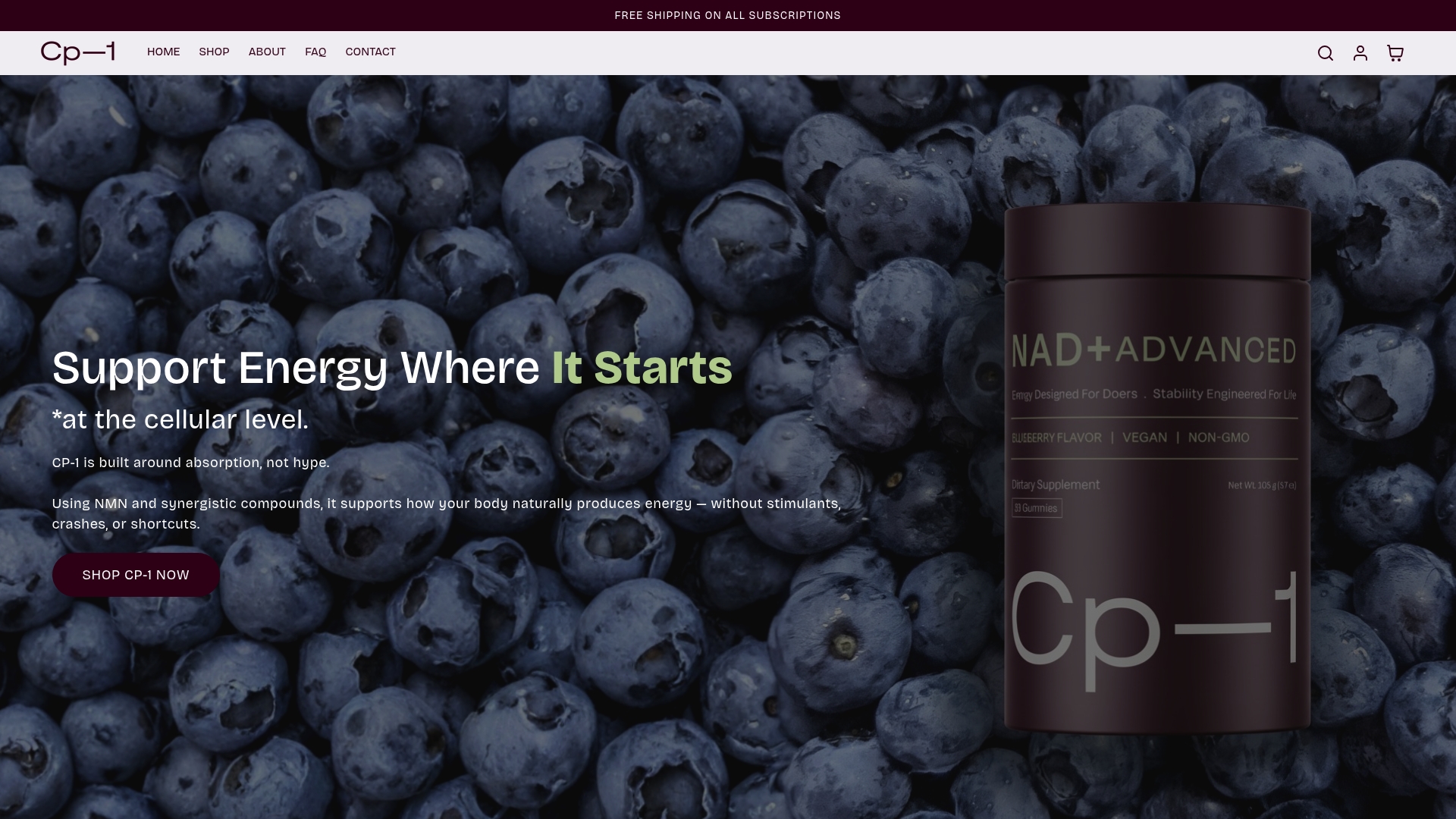
If you’re running the 4 to 8 week trial protocol outlined above, a gummy format solves the “did I actually take it with food today” problem that trips up a lot of capsule routines, since it’s easy to work into a meal without a second thought. The formula is built for consistency, not just a checklist of trendy ingredients. If you want to see exactly what’s in it and decide whether it fits your protocol, browse the full CP-1 collection and check the label against the absorption factors covered above before you commit to a bottle.
Sources
The claims in this article draw on a small set of high-quality sources worth reading directly if you want to dig deeper than a summary allows.
- Coenzyme Q10 supplementation increases blood concentrations but shows limited and inconsistent effects on exercise performance: a systematic review and meta-analysis
- Effects of coenzyme Q10 analogs on oxidative stress, muscle, and metabolism after exercise: A meta-analysis and systematic review
- CoQ10: What It Is, Benefits and Side Effects (Cleveland Clinic)
- Bioavailability of coenzyme Q10 supplements depends on carrier lipids and solubilization
- Can supplementation with coenzyme Q10 improve exercise performance? Original paper (Examine summary)
This article is general information, not a substitute for advice from a qualified doctor. Consult a qualified healthcare professional about your own circumstances before acting on anything here.
FAQ
Is It Better to Take CoQ10 Before or After a Workout?
Neither timing shows a reliable acute performance benefit, so the pre versus post question matters less than consistency. Take it daily with a meal containing fat, since absorption research shows fat improves how much CoQ10 actually gets into your bloodstream, and let chronic dosing over several weeks do the work rather than expecting a same-day effect.
What Should You Avoid While Taking CoQ10?
Avoid combining high-dose CoQ10 with anticoagulant medications without a clinician’s input, since CoQ10’s structure has a theoretical interaction with blood thinners. If you’re on a statin, don’t assume more CoQ10 automatically means better outcomes. Discuss dosing with your prescriber first, since statins and CoQ10 interact through a shared metabolic pathway.
What Are the Signs CoQ10 Is Working?
The most measurable sign is a change in recovery markers rather than a sudden performance jump. Reduced muscle soreness, faster bounce back between hard sessions, and, if you have access to testing, a rise in plasma CoQ10 after 4 to 6 weeks are the clearest indicators. Don’t expect a change in how fast or strong you feel during the workout itself.
What Does CoQ10 Do for Muscles?
CoQ10’s clearest documented effect on muscle is reducing oxidative stress and cellular damage after exercise, shown through lower malondialdehyde and creatine kinase levels in a meta-analysis of 14 trials. It does not reliably increase muscle strength or power output in controlled trials, so think of it as a protective agent for muscle tissue rather than a builder of new performance capacity.
How Long Does It Take to See Results From CoQ10?
Plan on a minimum of 4 to 6 weeks of consistent daily dosing before evaluating whether it’s doing anything. Single doses or short trials under two weeks are unlikely to show measurable change, based on how the chronic versus acute trial data breaks down across the research.