

Pre Workout Ingredients That Actually Work in 2026
Pre workout ingredients are specific compounds shown by clinical research to improve energy, focus, endurance, and muscle output during exercise. The four most evidence-based options are caffeine, creatine monohydrate, beta-alanine, and citrulline malate, each with clinically validated doses that separate real performance gains from placebo effects. Most commercial formulas bury these ingredients inside proprietary blends at doses too low to do anything. Knowing what works, at what dose, and why puts you in control of your results instead of a marketing team’s agenda.
What are the most effective pre workout ingredients?
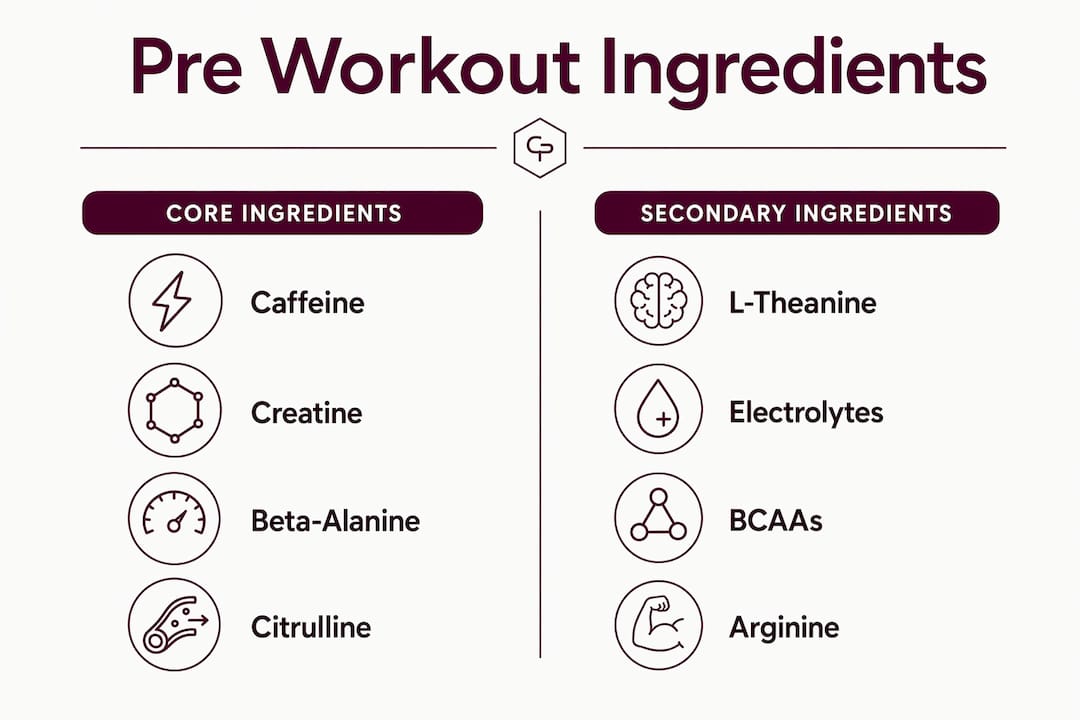
The four core pre workout ingredients each target a different performance bottleneck. Together they cover energy, strength, endurance, and blood flow. Here is what the research actually supports:
-
Caffeine is the most studied ergogenic compound in sports nutrition. At 3–6 mg per kilogram of body weight, it reduces perceived exertion and improves both endurance and peak power output. For a 180-pound athlete, that translates to roughly 245–490 mg. Caffeine works by blocking adenosine receptors in the brain, which delays the feeling of fatigue.
-
Creatine monohydrate is the benchmark ingredient in sports nutrition, backed by decades of research on strength and power gains. A daily dose of 3–5 g builds muscle creatine stores over time, which directly fuels short, explosive efforts like heavy lifts and sprints. Timing is flexible, but consistency matters far more than the exact hour you take it.
-
Beta-alanine buffers lactic acid buildup in muscle tissue, which delays the burning sensation that forces you to stop a set early. The effective range is 3.2–6.4 g per day. It does not need to be taken immediately before training since it works by raising baseline carnosine levels in muscle over days and weeks.
-
Citrulline malate drives nitric oxide production, which widens blood vessels and increases blood flow to working muscles. The result is a stronger pump, better nutrient delivery, and reduced muscle soreness after training. The clinically effective dose is 6–8 g of citrulline malate taken before your session.
Secondary ingredients like L-theanine and electrolytes have real but situational value. They support focus and hydration but do not replace the four core compounds above.
What are the right dosages and timing for pre workout supplements?
Getting the dose right is where most athletes fail. They buy a product with the right ingredients on the label, but the amounts are too small to produce any measurable effect. Here is a numbered breakdown of what the research supports:
-
Caffeine: 200–400 mg, taken 30–60 minutes before training. Caffeine peaks in the bloodstream roughly 45 minutes after ingestion. Taking it too early or too late shifts the performance window away from your actual workout. Athletes who train in the evening should cut caffeine by early afternoon to protect sleep quality.
-
Creatine monohydrate: 3–5 g daily, taken consistently. Many pre-workout products provide only 1–2 g of creatine, which is not enough to saturate muscle stores. Take creatine separately if your pre-workout formula underdoses it, and take it every day, including rest days.
-
Beta-alanine: 3.2–6.4 g daily, split into two doses. Splitting the daily dose reduces the tingling sensation, called paresthesia, that many people find uncomfortable. The tingling is harmless, but smaller divided doses make it easier to stay consistent.
-
Citrulline malate: 6–8 g, taken 30–45 minutes before training. This is one of the most underdosed ingredients in commercial products. Many formulas include only 1–2 g, which produces no measurable benefit. If your pre-workout label does not list at least 6 g, the citrulline in that product is decorative.
-
L-theanine: 200 mg paired with 100–150 mg caffeine for athletes who are sensitive to stimulants. This combination smooths out the jittery edge of caffeine while preserving its focus-enhancing effects. It is a practical solution for people who want caffeine’s performance benefits without the anxiety spike.
Pro Tip: If you are new to beta-alanine, start at 1.6 g twice daily and build up over two weeks. Your body adapts to the tingling, and the performance benefit accumulates regardless of whether you feel it.
How do you identify a quality pre workout and avoid underdosing?
The supplement industry is largely unregulated before products hit shelves. That means a company can list an ingredient on the label at any dose it chooses, including amounts too small to do anything. Here is what to look for when evaluating a formula:
-
Transparent labeling. A quality product lists the exact milligram amount for every ingredient. Proprietary blends hide individual doses behind a total blend weight, which makes it impossible to verify whether any single ingredient reaches a clinical dose. Avoid any product that uses this tactic.
-
Third-party testing. Pre-workout supplements are not reviewed by the FDA before sale. Third-party testing from organizations like NSF International or Informed Sport verifies that what is on the label is actually in the product, and that no banned substances are present. This matters for competitive athletes and anyone who cares about what they are actually swallowing.
-
Realistic ingredient counts. A formula with 20 ingredients almost always underdoses most of them. A product with four to six well-dosed core ingredients is more likely to deliver real results than one designed to impress on a marketing deck.
-
Dose benchmarks. Cross-reference the label against the clinical doses listed above. If citrulline malate is listed at 2 g, the formula fails the basic test. The same applies to creatine at 1 g or beta-alanine at 800 mg.
Pro Tip: Search for the product’s underdosed supplement warning signs before you buy. Checking a few data points takes five minutes and saves you from wasting money on a product that cannot work at the doses provided.
What are secondary pre workout ingredients and when do they matter?
Not every ingredient in a pre-workout formula carries the same level of evidence. The table below separates the core compounds from the situational ones, so you can evaluate any formula clearly.
| Ingredient | Evidence level | Best use case |
|---|---|---|
| Caffeine | Strong | All training types; energy and power |
| Creatine monohydrate | Strong | Strength, power, muscle mass |
| Beta-alanine | Strong | High-rep and endurance work |
| Citrulline malate | Strong | Pump, blood flow, endurance |
| L-theanine | Moderate | Paired with caffeine for sensitive users |
| Electrolytes | Moderate | Sessions over 60 minutes or in heat |
| L-tyrosine | Moderate | Focus support; supports neurotransmitter synthesis |
| Betaine | Limited | Possible strength benefit; inconsistent data |
| BCAAs | Weak | Redundant if protein intake is adequate |
| Arginine | Weak | Poor oral bioavailability; citrulline is superior |
Electrolytes like sodium, potassium, and magnesium support muscle contraction and fluid balance during long or intense sessions. They belong in a formula for endurance athletes or anyone training in hot conditions. For a standard 45-minute strength session, they add little.

BCAAs and arginine appear in many formulas but rarely justify their inclusion. BCAAs are redundant when total protein intake is sufficient, which it is for most athletes eating 0.7–1 g of protein per pound of body weight. Arginine has poor absorption when taken orally. Citrulline converts to arginine in the kidneys far more efficiently, which is why citrulline replaced arginine in well-designed formulas years ago.
The goal is not to find a formula with the longest ingredient list. The goal is to find one where every ingredient on the list earns its place at a dose that actually works. For athletes who want to skip caffeine entirely, non-caffeine pre workout options built around citrulline, creatine, and beta-alanine still deliver meaningful performance benefits.
Key Takeaways
The four clinically validated pre workout ingredients are caffeine, creatine monohydrate, beta-alanine, and citrulline malate. Every other ingredient is situational or lacks sufficient evidence to be considered core.
| Point | Details |
|---|---|
| Core four ingredients | Caffeine, creatine, beta-alanine, and citrulline malate have the strongest clinical evidence. |
| Dose determines results | Underdosed ingredients produce no benefit; verify every dose against clinical benchmarks before buying. |
| Proprietary blends hide problems | Transparent labels with exact milligram amounts are the only way to confirm a formula is effective. |
| Third-party testing matters | Independent verification confirms label accuracy and screens for banned substances. |
| Secondary ingredients are situational | L-theanine, electrolytes, and L-tyrosine add value in specific contexts but do not replace the core four. |
What I have learned from years of watching people waste money on pre-workouts
I have watched athletes spend serious money on pre-workout formulas that were essentially flavored caffeine powder with a long ingredient list designed to look impressive. The frustration is real. You read the label, see 15 ingredients, and assume the product is thorough. Then you realize most of those ingredients are dosed at a tenth of what research requires to produce any effect.
The science on this is not complicated. Four ingredients have strong, consistent evidence behind them. Everything else is either situational or noise. The supplement industry knows that a longer label sells better than a shorter one, so formulas keep getting more crowded while the doses of each ingredient keep shrinking. That is a formula designed for a marketing deck, not for the person swallowing it.
My honest recommendation is to build your own stack if you can. Buy creatine monohydrate separately, because almost no pre-workout formula doses it correctly. Pair it with a transparent pre-workout that lists at least 6 g of citrulline malate, 3.2 g of beta-alanine, and 200 mg or more of caffeine. Check the sports nutrition basics before adding anything else. Supplements are the final layer on top of solid training, real food, and enough sleep. They cannot fix a broken foundation, but when the foundation is solid, the right ingredients at the right doses genuinely move the needle.
— Hugo
Cp-1 resources for smarter supplement choices
Choosing the right formula gets easier when you know what to look for. Cp-1 publishes straightforward, research-backed guides on the ingredients that matter most for performance and energy.
Whether you want to understand creatine dosing protocols or learn how to spot a formula that actually delivers clinical doses, Cp-1 covers it without the industry hype. The goal is to help you spend money on supplements that work and skip the ones that do not. Visit cp-1.com to read the full library of evidence-based supplement guides built for athletes who want real answers.
FAQ
What are the best pre workout ingredients for energy?
Caffeine is the most effective ingredient for energy, with a clinical dose of 200–400 mg taken 30–60 minutes before training. Pairing it with 200 mg of L-theanine reduces jitters while preserving the focus and power benefits.
How much citrulline malate should a pre workout contain?
A pre-workout needs at least 6–8 g of citrulline malate to meaningfully increase nitric oxide and improve blood flow. Products listing 1–2 g are underdosed and will not produce a measurable pump or endurance benefit.
Is creatine better taken separately or in a pre-workout formula?
Most pre-workout formulas provide only 1–2 g of creatine, which is below the 3–5 g daily dose needed for muscle saturation. Taking creatine monohydrate separately every day, including rest days, is the more reliable approach.
What does beta-alanine do and why does it cause tingling?
Beta-alanine raises carnosine levels in muscle tissue, which buffers acid buildup and delays fatigue during high-rep or endurance work. The tingling sensation, called paresthesia, is harmless and can be reduced by splitting the daily dose into two smaller amounts.
Are proprietary blends in pre-workouts a problem?
Proprietary blends list a total blend weight without revealing individual ingredient doses, making it impossible to confirm whether any ingredient reaches a clinical threshold. Transparent labels with exact milligram amounts are the only reliable way to evaluate a formula.