

Stress Resilience: What It Is and How to Build It
Stress resilience is your capacity to respond to stressors and return to a healthy baseline — and the research is clear that it can be built, deliberately, starting today. The NIH Office of Research on Women’s Health puts it plainly: the most effective path forward moves beyond talking about stress and into changing your physiology. Here are three things you can do right now:
- 60-second breathing reset: Inhale for 4 counts, hold for 4, exhale for 6. Repeat 4 times. This activates your parasympathetic nervous system and starts shifting your body out of fight-or-flight within a single minute.
- 5–10 minute grounding action: Step outside for a short walk, do 10 slow bodyweight squats, or sit on the floor and stretch. Physical movement is one of the fastest routes back to calm.
- One values-aligned calendar change: Look at this week. Find one commitment that drains you without reflecting what actually matters to you, and either remove it or replace it with something that does.
Pro Tip: Try the breathing exercise before you read any further. The physiological shift it creates makes the rest of this article easier to apply — not just easier to read.
Table of Contents
- How does your stress response actually work?
- What are the signs that your resilience is running low?
- Why does stress resilience matter for your health and daily life?
- Evidence-based strategies to build stress resilience
- A 7-day starter routine you can follow this week
- How can you tell whether your resilience is actually improving?
- When should you seek professional help?
- How do early life experiences and genetics shape your resilience?
- Real-life examples of stress resilience in action
- Key Takeaways
- The honest truth about building resilience
- Useful sources for further reading
How does your stress response actually work?
Your nervous system has two main operating modes. The sympathetic system fires when you perceive a threat — heart rate climbs, muscles tense, digestion slows, and cortisol floods your bloodstream. That is the fight-or-flight response. The parasympathetic system does the opposite: it slows your heart, deepens your breath, and signals that the threat has passed. Resilience, at its core, is how quickly and completely you can shift from one to the other.

The HPA axis (hypothalamic-pituitary-adrenal axis) is the biological engine behind this. Under acute stress, it releases cortisol to mobilize energy and sharpen focus. That is healthy and necessary. The problem is chronic activation — when the HPA axis stays switched on for weeks or months, cortisol levels remain elevated, and the body never fully recovers. Sleep degrades, immune function drops, and mood regulation suffers.
A peer-reviewed PMC review frames resilience not as the absence of a stress response but as a trajectory: an initial reaction followed by efficient recovery back toward baseline. The goal is not to stop reacting. It is to recover faster.
| Feature | Sympathetic (fight/flight) | Parasympathetic (rest/digest) |
|---|---|---|
| Typical activation signs | Racing heart, shallow breath, muscle tension, hypervigilance | Slow heart rate, deep breathing, relaxed muscles, clear thinking |
| Recovery actions | Breathing exercises, cold water, movement | Slow exhale, nature exposure, sleep, social connection |
| Practical examples | Pre-presentation anxiety, traffic stress, conflict | Post-workout calm, meditation, a good night’s sleep |
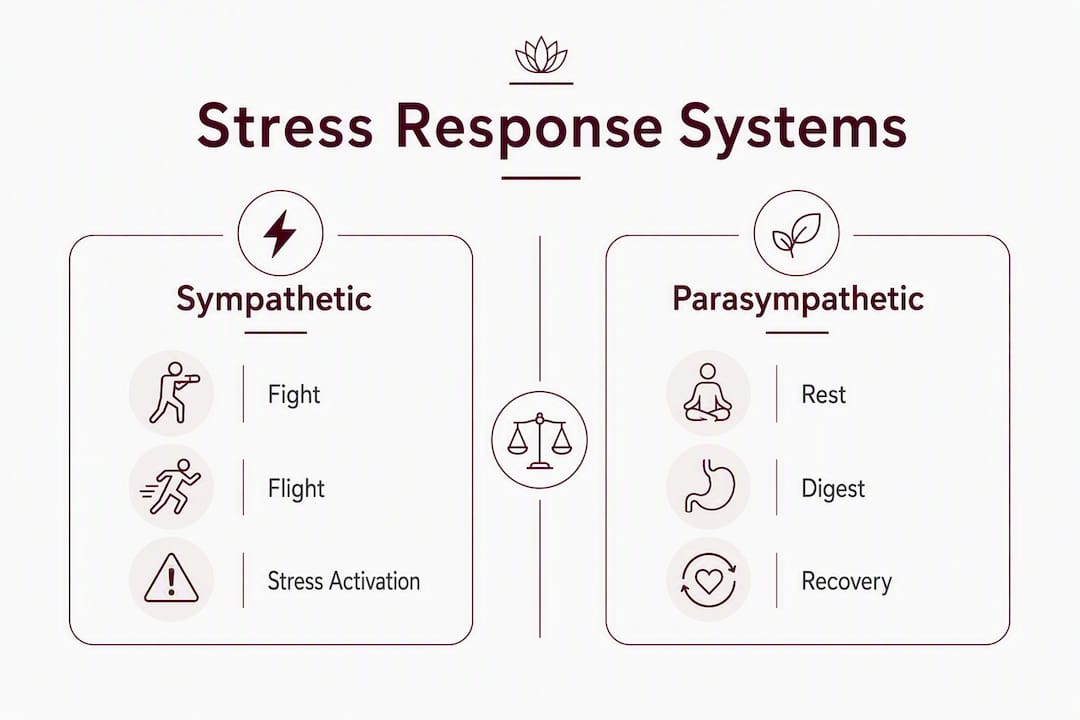
Interventions that directly change your physiology — controlled breathing, exercise, consistent sleep timing — work because they shorten the time your sympathetic system stays dominant. That shortening, practiced repeatedly, is what builds resilience over time.
What are the signs that your resilience is running low?
Chronic stress does not always announce itself loudly. More often it shows up as a slow erosion across four domains.
Physical signs
- Frequent headaches or muscle tension, especially in the neck and shoulders
- Disrupted sleep — trouble falling asleep, staying asleep, or waking unrefreshed
- Digestive issues, fatigue that does not improve with rest, or getting sick more often
Cognitive signs
- Difficulty concentrating or making simple decisions
- Racing thoughts or an inability to mentally “switch off”
- Forgetting things you would normally remember easily
Emotional signs
- Irritability or a shorter fuse than usual
- Feeling emotionally flat, detached, or overwhelmed by minor setbacks
- Persistent low mood that does not lift after a good day
Behavioral signs
- Withdrawing from friends, family, or activities you used to enjoy
- Increased reliance on alcohol, caffeine, or other substances to cope
- Procrastinating more, or losing motivation for work or personal goals
A normal stress reaction — a few days of tension before a big deadline — is not a resilience problem. When these patterns persist for weeks to months without a clear trigger or resolution, that is when the HPA axis is likely stuck in overdrive. Disrupted sleep is a particularly reliable signal: the HPA axis and sleep architecture are tightly linked, so poor sleep both causes and worsens elevated cortisol.
Why does stress resilience matter for your health and daily life?
Chronic stress is not just uncomfortable. It compounds. Sustained cortisol elevation is associated with increased cardiovascular risk, weakened immune response, and accelerated cognitive decline. At work, low resilience shows up as poor decision-making under pressure, conflict avoidance, and difficulty prioritizing. In relationships, it looks like emotional withdrawal or disproportionate reactions to small frustrations.
The flip side is real too. People with stronger coping capacity tend to recover faster from illness, maintain better relationships, and perform more consistently under pressure. The American Psychological Association defines resilience as mental, emotional, and behavioral flexibility — and emphasizes that the skills and social resources that support it can be cultivated at any age.
The numbers that matter: Harvard Health identifies 7–9 hours of sleep per night and at least 150 minutes of moderate physical activity per week as two of the most evidence-supported lifestyle factors for maintaining brain function and stress recovery capacity. Many adults fall short of these guidelines.
Falling short of those targets does not mean you are stuck. It means you have two of the highest-leverage levers available — and they cost nothing to start adjusting. For more on how long-term wellness practices compound over time, the connection between daily habits and sustained health is worth understanding.
Evidence-based strategies to build stress resilience
Resilience is a dynamic capacity, not a fixed trait. Practitioners treat it like a muscle: it strengthens with repeated, low-stakes practice, not only during crises. Here is a practical toolkit, ordered by physiological impact.
-
Breathing and HRV practices. Slow, extended exhales activate the vagus nerve and shift the body toward parasympathetic dominance. Try the 4-4-6 pattern (inhale 4, hold 4, exhale 6) for 5 minutes daily. For a deeper look at technique, breathing exercises for beginners covers the mechanics clearly. (NIH recommends deep breathing as a frontline stress management tool.)
-
Brief mindfulness and attention anchors. You do not need a 30-minute meditation session. A 2-minute body scan — noticing physical sensations from feet to head without judgment — interrupts rumination and resets attention. Do it at your desk, in your car, or before a difficult conversation. For more on focus improvement techniques that address cognitive stress symptoms, short attention anchors are a practical starting point.
-
Regular movement. Aim for 150 minutes of moderate activity per week — brisk walking counts. Break it into 10-minute blocks if a full session feels impossible. Movement clears cortisol, improves sleep quality, and directly supports mood regulation.
-
Consistent sleep rituals. The timing of sleep matters as much as duration. A fixed wake time, even on weekends, anchors your circadian rhythm and keeps cortisol patterns predictable. Dim lights 60 minutes before bed and avoid screens. For practical sleep and recovery routines, small bedtime rituals add up fast.
-
Social connection. Isolation amplifies stress. A 10-minute conversation with someone you trust — not venting, just connecting — activates oxytocin and buffers cortisol. Schedule it like any other appointment.
-
Values-aligned scheduling and small exposures. Harvard Health’s resilience research highlights a weekly calendar audit: look at your commitments and identify where your actions conflict with your actual values. That misalignment is a chronic low-grade stressor most people never name. Separately, deliberately doing one mildly uncomfortable thing each day — a cold shower, a difficult conversation, a new physical challenge — builds the antifragile mindset that Harvard Health associates with high-performing, resilient groups.
-
Nutrition basics. Regular meals stabilize blood sugar, which directly affects cortisol regulation. Limit alcohol — it disrupts sleep architecture and blunts emotional regulation. Magnesium-rich foods (leafy greens, nuts, seeds) support nervous system function. Before adding any supplement or pharmacological support, consult a clinician to confirm it fits your specific situation.
Pro Tip: Start with one strategy, not all seven. Pick the one that addresses your most obvious symptom — if sleep is the problem, start there. Adding too many habits at once is the fastest way to abandon all of them.
A 7-day starter routine you can follow this week
This plan applies one technique per day so you build habits without overwhelm. Each session is 5–15 minutes.
Day 1 — Breathing baseline. Morning: 5 minutes of 4-4-6 breathing before checking your phone. Evening: note your mood and energy on a scale of 0–10.
Day 2 — Nature walk. Midday or after work: 10–15 minutes outside, no headphones. Psychology Today cites studies showing brief nature exposure reduces anxiety and preserves positive mood.

Day 3 — Sleep ritual. Set a fixed wake time for the rest of the week. Dim lights at 9 PM and put your phone in another room. Track how you feel the next morning.
Day 4 — Social check-in. Reach out to one person — a text, a call, five minutes. No agenda required.
Day 5 — Movement micro-sessions. Three 10-minute walks or two short bodyweight circuits. No gym needed.
Day 6 — Values audit. Spend 10 minutes reviewing next week’s calendar. Remove or reschedule one commitment that does not reflect your priorities.
Day 7 — Review. Look at your 0–10 daily ratings. What moved? What did not? Adjust one element for the following week.
Limited time or mobility? Swap the nature walk for 5 minutes near a window. Replace bodyweight circuits with seated stretching. The structure matters more than the specific activity.
How can you tell whether your resilience is actually improving?
Tracking does not need to be complicated. Three questions, answered daily in a notes app or on paper, give you enough signal to see a real trend.
- Mood baseline: How would you rate your overall mood today? (0–10)
- Sleep quality: How rested did you feel this morning? (0–10)
- Recovery rating: When something stressful happened today, how quickly did you return to calm? (0–10)
A single day’s score means almost nothing. A consistent upward trend across 2–4 weeks is a meaningful signal. If you want a validated instrument, the Connor-Davidson Resilience Scale (CD-RISC) is a widely used clinical tool that measures resilience across multiple dimensions — it is available in research literature and can give you a structured baseline.
Weekly patterns are more informative than daily fluctuations. Look for the floor rising: even on hard days, does your lowest score stay higher than it did two weeks ago? That is the real measure.
When should you seek professional help?
Self-directed resilience work is genuinely effective for most people. But there are clear signals that professional support is the right next step.
- Thoughts of suicide or self-harm — seek help immediately via 988 (Suicide and Crisis Lifeline)
- Severe functional decline: unable to work, maintain relationships, or manage daily tasks
- Escalating substance use as a coping mechanism
- Symptoms that persist for months despite consistent self-care effort
- Panic attacks, severe dissociation, or symptoms that feel physically unmanageable
Your primary care physician is a reasonable first call — they can rule out medical contributors (thyroid issues, sleep apnea, vitamin deficiencies) and refer you onward. Telehealth platforms have made licensed therapists accessible without long wait times or commutes. When seeking a therapist, ask specifically about CBT (cognitive behavioral therapy) or exposure-based approaches: Harvard Health and the APA both identify these as clinically supported methods for improving coping and adaptive stress responses.
This article is general health information, not professional medical advice. Confirm any treatment decisions with a qualified clinician.
How do early life experiences and genetics shape your resilience?
Resilience is not distributed equally at birth, and that is worth saying plainly. Neurobiology research published in PMC shows that some people maintain mental health despite significant adversity while others show temporary impairment followed by recovery — and both genetic factors and early developmental experiences contribute to that difference.
Adverse childhood experiences (ACEs) — neglect, abuse, household instability — can alter HPA axis calibration in ways that persist into adulthood, making the stress response more reactive and recovery slower. Genetic variants affecting serotonin transport, cortisol receptor sensitivity, and neuroplasticity all influence baseline resilience capacity.
None of this is a ceiling. The same neuroplasticity that makes early adversity impactful also means the brain responds to new, repeated experiences. Resilience training works partly by creating new neural pathways through consistent practice. People with difficult early histories often need more time and, frequently, professional support — but the capacity to build resilience remains real.
Real-life examples of stress resilience in action
Resilience does not look like stoicism or the absence of struggle. It looks like recovery.
A nurse working through a high-demand hospital shift does not avoid stress — she manages her breathing between patient rooms, takes a 5-minute walk during a break, and calls a colleague after a hard case. Her resilience shows up in how quickly she resets, not in whether she feels the pressure.
A small business owner facing a slow quarter does not pretend the financial stress away. He schedules a weekly review of his priorities, cuts two commitments that were draining energy without producing results, and maintains his sleep schedule even when anxiety tempts him to work until midnight. The structure itself becomes the coping mechanism.
Navy SEALs — cited by Harvard Health as a high-resilience reference group — are trained to reframe acute stress as information rather than threat. That cognitive reappraisal, practiced under controlled conditions, becomes automatic under real pressure. The same principle applies to anyone: the antifragile mindset is trained, not inherited.
Key Takeaways
Stress resilience is a learnable capacity — built through consistent physiological practice, not willpower alone.
| Point | Details |
|---|---|
| Resilience is a trajectory | It means responding to stress and recovering efficiently, not avoiding the response entirely. |
| Physiology comes first | Breathing, movement, and sleep are the highest-leverage tools because they directly regulate the HPA axis and cortisol. |
| 7–9 hours and 150 minutes | Harvard Health identifies these sleep and activity targets as the core lifestyle supports for resilience. |
| Track weekly, not daily | A consistent upward trend in mood, sleep, and recovery scores over 2–4 weeks signals real improvement. |
| Start with one thing | Try the 4-4-6 breathing exercise today, then add one 10-minute grounding action to this week’s calendar. |
The honest truth about building resilience
Most people try to think their way out of stress. They analyze it, journal about it, talk about it — and then wonder why nothing shifts. The research keeps pointing to the same uncomfortable answer: the body has to move first.
That is not a knock on therapy or reflection. Both matter. But if you are stuck, the fastest route out is almost always physical: a walk, a breath, a cold splash of water on your face. The nervous system responds to action before it responds to insight.
What I find genuinely encouraging about the resilience research is that it does not require dramatic change. The 7-day plan above asks for 5–15 minutes a day. The breathing exercise takes 60 seconds. The values audit takes 10 minutes once a week. These are not heroic commitments. They are small, repeated signals to your nervous system that you are safe, capable, and in control.
Start there. Not with a supplement stack, not with a complete lifestyle overhaul. One breath, one walk, one honest look at your calendar. Resilience grows from the accumulation of those small acts — and it compounds faster than most people expect.
If you want support on the cellular side of recovery, Cp-1 was built for exactly that: honest ingredients, honest dosing, and a real commitment to what actually works. Explore Cp-1 when you are ready to add that layer.
Useful sources for further reading
- 7 Steps to Manage Stress and Build Resilience — NIH ORWH: Practical, government-backed steps covering breathing, mindfulness, and sleep as frontline resilience tools.
- Bouncing Back from Stress — Harvard Health: Evidence summaries on antifragility, CBT, and the mindset patterns of high-resilience groups.
- Build Your Own Resilience Plan — Harvard Health Blog: Specific lifestyle targets (sleep, activity) and the values-audit framework for reducing chronic baseline stress.
- Resilience — American Psychological Association: The APA’s definition of resilience as adaptive flexibility, with an overview of the social and cognitive factors that support it.
- Neurobiology and Systems Biology of Stress Resilience — PMC: A peer-reviewed neuroscience review covering the biological mechanisms behind resilience and why some people recover faster than others.