

How to Use Mass Gainer: A Controlled, Evidence-Backed Plan
A mass gainer is a targeted calorie-and-protein top-off. Use it to close the gap between what you eat and what your body needs to grow, then pair it with structured strength training and a clear dosing plan. That’s the whole formula. Everything below is just the math and the mechanics.
The short version:
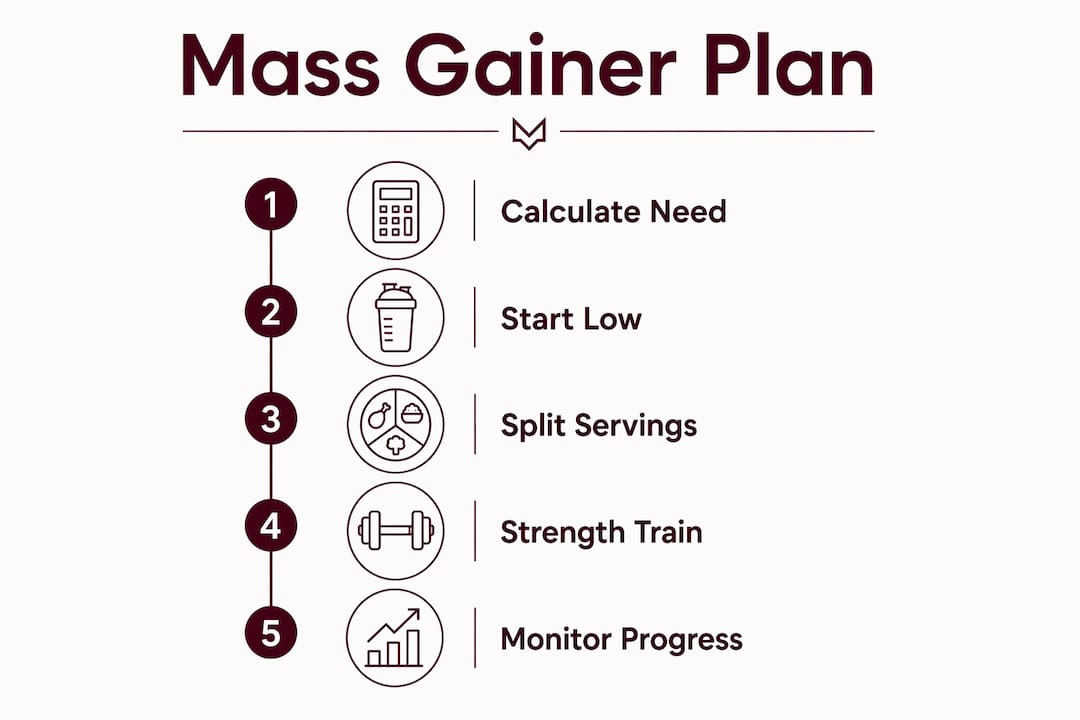
- Calculate your Total Daily Energy Expenditure (TDEE), then add a 250–500 kcal surplus
- Split your mass gainer into two smaller servings rather than one large shake
- Take it post-workout or between meals for the best digestive tolerance
- Start with half a serving for the first 5–7 days to let your gut adapt
- Pair every serving with a real training program and track your weight weekly
- Choose products with GMP certification and third-party testing on the label
Mass gainers supplement whole foods, not replace them. The Academy of Nutrition and Dietetics is clear on this: whole food variety provides micronutrients, fiber, and phytonutrients no shake can replicate.
Table of Contents
- Who actually benefits from a mass gainer?
- How to calculate how much mass gainer you actually need
- When to take it, how to blend it, and practical meal planning
- Why strength training isn’t optional when using a mass gainer
- Risks, side effects, and how to monitor your progress
- How to choose a mass gainer worth buying
- Two sample daily protocols you can use right now
- How a mass gainer fits with NAD+ and cellular energy supplements
- Cost, storage, and three quick recipes
- Key Takeaways
- A pragmatic take on mass gainers
- Useful sources for further reading
Who actually benefits from a mass gainer?
Not everyone needs one. The people who genuinely benefit are natural hardgainers with fast metabolisms, high-volume athletes burning thousands of calories daily, and anyone who physically cannot eat enough whole food to hit a caloric surplus. If you struggle to get through a large meal, a calorie-dense shake is a practical solution.
Who should skip it or use caution: people already eating in a surplus, anyone with poorly managed type 2 diabetes or blood sugar instability, those with lactose intolerance or known ingredient sensitivities, and anyone not following a resistance training program. Calories without a training stimulus favor fat gain, not muscle.
Pro Tip: If you’re on glucose-modifying medications or managing a metabolic condition, talk to your clinician before adding a high-carbohydrate supplement. Look for products with GMP certification and third-party testing regardless of your health status.
How to calculate how much mass gainer you actually need
The math here is straightforward. Work through these three steps before you open the bag.
- Estimate your TDEE. Use a calculator like the Mifflin-St Jeor equation or an online TDEE tool. Multiply your basal metabolic rate by your activity factor (sedentary = 1.2, moderately active = 1.55, very active = 1.725).
- Set your surplus. A 250 kcal/day surplus supports lean, controlled gain. A 400–500 kcal/day surplus suits aggressive mass building. Choose based on your goal and how quickly you want to gain.
- Translate surplus into servings. Check your product’s calories per serving. If one serving is 500 kcal and your target surplus is 250 kcal, use half a serving. If your surplus is 500 kcal, one full serving covers it. Adjust for protein: target 0.7–1.0 g per pound of bodyweight daily, and confirm the serving gets you there without blowing past your calorie ceiling.
| Bodyweight | Estimated TDEE (moderate activity) | Target surplus | Servings/day (500 kcal/serving product) |
|---|---|---|---|
| — | — | 250–500 kcal | 0.5 serving |
| — | — | 250–500 kcal | 0.5–1 serving |
| 200 lb | — | 400–500 kcal | 1 serving |
| — | — | 500 kcal | 1 serving |
Splitting servings across the day, rather than drinking one massive shake, consistently improves digestive tolerance and habit formation. Starting with half a serving for the first 5–7 days allows your gut to adapt and prevents digestive distress. For protein targets and amino acid context, the amino acid bodybuilding guide at Cp-1 breaks down the science clearly.
When to take it, how to blend it, and practical meal planning
Timing a mass gainer doesn’t unlock some magic anabolic window. What timing actually does is protect your daily caloric consistency. Miss the shake, miss the surplus. That’s the real risk.

Post-workout and between meals are the two primary windows. Post-workout replenishes glycogen and delivers protein when your muscles are primed for uptake. Between meals works well if your schedule makes post-workout timing impractical. Pre-workout use is fine in theory, but a large, thick shake right before heavy training can cause nausea or lethargy, especially for sensitive stomachs. If that’s you, delay the shake 60–90 minutes after training.
Mixing options and their calorie impact:
- Water: lightest on digestion, lowest calorie count, fastest absorption
- Dairy or fortified plant milk: adds roughly 150–200 kcal per cup plus extra protein
- Blender with oats and banana: adds fiber, micronutrients, and sustained energy from complex carbs
- Nut butter addition: adds healthy fats and bumps calories without increasing volume much
Pro Tip: Start with half a serving for the first 5–7 days. Your gut microbiome needs time to adapt to a concentrated macronutrient load. Jumping straight to full servings is the most common mistake, and it’s the fastest route to bloating and giving up.
Why strength training isn’t optional when using a mass gainer
Extra calories need a reason to become muscle. Without progressive resistance training, your body has no signal to partition that surplus toward lean tissue. The result is fat gain, not the physique you’re after. This isn’t a nuance; it’s the fundamental requirement every practitioner agrees on.
A simple, effective program template:
- Frequency: 3–5 sessions per week
- Exercise selection: compound lifts first (squat, deadlift, bench press, overhead press, barbell row)
- Rep ranges: 6–12 reps per set for hypertrophy; heavier sets of 3–5 for strength
- Progressive overload: add weight or reps every 1–2 weeks
- Sleep: 7–8 hours per night for recovery and hormonal support
- Hydration: 3–4 liters of water daily when using calorie-dense supplements
The best bodybuilding workouts guide at Cp-1 gives you exercise selections and program structures worth bookmarking.
Risks, side effects, and how to monitor your progress
The two most common problems are digestive and metabolic. Bloating, nausea, and GI discomfort usually come from starting too fast or drinking too large a shake at once. Excessive fat gain comes from calories exceeding actual needs, skipping training, or not tracking intake. Both are preventable.
Monitor weekly, not daily. Daily weight fluctuates with water, food volume, and sleep. A weekly average gives you a real signal.
Your monitoring checklist:
- Scale: weigh yourself once per week, same time, same conditions
- Body measurements or photos: every two weeks to catch fat gain early
- GI tolerance: note bloating, nausea, or discomfort and adjust serving size
- Energy and sleep quality: declining energy often signals caloric overshoot or poor sleep
If you’re gaining more than roughly 0.5–1% of your bodyweight per week, reduce by half a serving. If weight isn’t moving after 2–3 weeks, increase by 250–500 kcal or add half a serving. See a clinician if you experience persistent GI distress, rapid unexpected weight gain, or blood sugar instability. For context on avoiding excess fat gain, the body recomposition guide at Cp-1 is worth reading alongside this.
How to choose a mass gainer worth buying
Most products on the shelf are not garbage, but plenty are close. Here’s what to check on the label before you spend money.
- Calories per serving: does it match your surplus target?
- Protein grams per serving: aim for at least 25–50 g, depending on your daily protein goal
- Carbohydrate type: complex carbs (oats, maltodextrin) are preferable to products loaded with simple sugars
- Sugar grams: lower is better if metabolic health is a priority
- Fiber content: some fiber aids digestion; very high fiber in a shake can cause bloating
- Ingredient transparency: full label disclosure, no proprietary blends hiding doses
- Third-party testing: NSF Certified for Sport, USP Verified, or Informed Sport certification
- GMP facility: confirms manufacturing standards meet regulatory requirements
Mass gainers are not substitutes for a balanced diet. A clean label and verified manufacturing are the baseline, not a bonus. For a broader look at what actually works in sports nutrition, the sports nutrition supplements guide at Cp-1 cuts through the noise.
Two sample daily protocols you can use right now
Choose the plan that matches your goal, then follow the adaptation rules below.
Protocol A: Lean bulk (250 kcal surplus)
- Morning: whole food breakfast (eggs, oats, fruit)
- Post-workout: half serving of mass gainer mixed with water or plant milk
- Lunch and dinner: whole food meals hitting protein targets
- Adjust: if no weight gain after 2–3 weeks, add another quarter serving
Protocol B: Aggressive mass gain (400–500 kcal surplus)
- Morning: whole food breakfast
- Post-workout: one full serving mixed with milk (adds 150–200 kcal)
- Mid-afternoon: half serving between meals
- Adjust: if gaining faster than 1% bodyweight per week, drop to one serving total
| Daily surplus target | Servings (500 kcal/serving product) | Timing split |
|---|---|---|
| 250 kcal | 0.5 serving | Post-workout |
| 400 kcal | half to one serving | Post-workout + partial mid-afternoon |
| 500 kcal | 1 serving | Post-workout + between meals |
How a mass gainer fits with NAD+ and cellular energy supplements
Mass gainers and cellular energy supplements like Cp-1 solve different problems. A mass gainer delivers macronutrients and calories. Cp-1’s NAD+ formula, with NMN, Lion’s Mane, Reishi, Turkey Tail, and CoQ10, targets mitochondrial energy production, cognitive support, and cellular resilience. These aren’t competing goals.
The practical approach: use your mass gainer around training for caloric and protein delivery, and use Cp-1 daily for cellular energy and cognitive support. Avoid stacking stimulant-adjacent supplements close to sleep. The cognitive and cellular energy supplement guide at Cp-1 explains the coordination in more detail.
Pro Tip: NAD+ precursors like NMN support the metabolic machinery that processes the calories you’re consuming. Pairing macronutrient support with mitochondrial support isn’t biohacker overkill. It’s just good systems thinking.
Cost, storage, and three quick recipes
Mass gainer cost per serving varies widely depending on brand and serving size. Mixing with milk instead of water adds 150–200 kcal and roughly $0.30–$0.60 per serving in cost. Add-ins like oats and nut butter increase both calories and cost but also add real micronutrient value.
Storage: keep the container sealed, dry, and away from heat and humidity. Opened products typically stay fresh for 3–6 months when stored properly; check the manufacturer’s guidance for your specific product. Never store in a car or near a stove.
Three quick recipes:
- Oats and banana blend: one serving mass gainer + half cup rolled oats + one banana + water or milk. Adds fiber, potassium, and slow-release carbs.
- Nut butter shake: one serving mass gainer + two tablespoons peanut or almond butter + milk. Adds healthy fats and bumps calories by 180–200 kcal.
- Bedtime casein variant: half serving mass gainer + one cup whole milk + one tablespoon almond butter. Slow-digesting for overnight recovery. For sleep-friendly supplement stacking, the light sleeper supplement stack guide at Checked Out Wellness is a practical companion read.
Key Takeaways
A mass gainer works only when it’s paired with a real caloric surplus calculation, structured strength training, and consistent weekly monitoring.
| Point | Details |
|---|---|
| Calculate before you scoop | Estimate your TDEE, set a 250–500 kcal surplus, then match servings to that number. |
| Start at half a serving | Use half a serving for the first 5–7 days to avoid digestive distress and allow gut adaptation. |
| Split servings across the day | Two smaller shakes improve GI tolerance and daily compliance better than one large shake. |
| Train or the calories go to fat | Progressive resistance training 3–5 days per week is required to direct surplus calories toward muscle. |
| Monitor and adjust weekly | If weight stalls after 2–3 weeks, add 250–500 kcal; if gain exceeds ~1% bodyweight per week, reduce by half a serving. |
A pragmatic take on mass gainers
The supplement industry loves to make mass gainers sound like a shortcut. They’re not. They’re a convenience tool for people who genuinely can’t eat enough whole food to hit a surplus. That’s a real problem for a specific group of people, and for them, a well-formulated mass gainer is genuinely useful.
What frustrates me is how often the dosing math gets skipped entirely. People buy a product, dump a full serving into a shaker on day one, feel terrible, and quit. Or they drink two servings a day without training and wonder why they’re getting soft instead of strong. The math matters. The training matters. The monitoring matters.
The biohacker framing that Cp-1 operates from is actually the right lens here: treat your body as a system. Calories in, stimulus applied, recovery supported, output measured. A mass gainer is one input. Cp-1’s NAD+ and mushroom complex is another, targeting the cellular machinery that runs the whole operation. Neither one works in isolation, and neither one replaces the fundamentals.
Choose products with transparent labels and verified manufacturing. Start low. Track your results. Adjust based on what the scale and mirror actually tell you, not what you hoped would happen.
Useful sources for further reading
- MedicineNet: Is It Good to Take Mass Gainers? Dosage and Side Effects — clinical overview of safety, dosage ranges, and contraindications
- Optimum Nutrition: Mass Building Guide — manufacturer guidance on supplementing vs. replacing whole foods
- MuscleTech: How to Use Mass Gainer — practical guidance on training pairing, hydration, and common errors
- Fit Fuel Blog: How to Use a Mass Gainer for Weight Gain — titration protocol, serving splits, and adjustment rules
- ProteinDeals: Best Time to Take Mass Gainer — timing windows and digestive tolerance guidance
- MF Supplements: How to Use Mass Gainers — mixing options and calorie impact of liquid choices
- Cp-1: Natural Muscle Growth Science-Based Guide — evidence-based context for muscle growth and caloric surplus
This article is general information, not medical or nutritional advice. Confirm dosing, contraindications, and supplement choices with a qualified clinician or registered dietitian for your specific situation.