

What are nootropics? Safe ways to boost brainpower
Nootropics are everywhere right now. They’re on the shelves of every vitamin shop, plastered across social media feeds, and showing up in your morning coffee blend. But here’s the thing most brands won’t tell you: the word “nootropic” is not a regulated label, a guarantee of effectiveness, or a promise of safety. It’s a marketing umbrella that covers everything from well-studied prescription drugs to herbs with almost no human trial data. If you’re trying to think more clearly, focus longer, or protect your brain over the long haul, you need to know the difference.
Table of Contents
- Understanding nootropics: Definitions and distinctions
- What does the science say? Evidence for cognitive enhancement
- Risks, safety, and the ethics of nootropic use
- Approaching nootropics as a savvy consumer
- Why the search for a magic brain booster usually falls short
- Explore smarter, evidence-based approaches to cognitive health
- Frequently asked questions
Key Takeaways
| Point | Details |
|---|---|
| Nootropics vary widely | Not all substances marketed as nootropics have the same level of evidence or safety. |
| Evidence is often limited | Few supplements show strong, consistent support for cognitive enhancement in healthy adults. |
| Quality and dosing matter | Safety depends on reputable manufacturing, proper labeling, and avoiding megadoses. |
| Holistic approach is best | Lifestyle, sleep, and nutrition are foundational for brain performance. |
| Be a savvy consumer | Seek trustworthy research, question marketing claims, and prioritize safety above all. |
Understanding nootropics: Definitions and distinctions
Despite the buzz around brain supplements, there is significant confusion about what actually qualifies as a nootropic. The term gets applied to such a wide range of products that it has become nearly meaningless without context.
Technically, nootropics are substances used with the goal of enhancing cognitive functions, including learning, memory, and mental performance, and they are grouped as prescription drugs, dietary supplements, or other compounds. That grouping matters enormously because each category operates under completely different rules when it comes to evidence, regulation, and safety.
Think of it this way. Calling something a nootropic is like calling something a “health food.” It tells you almost nothing on its own. You need to know what category it falls into, what the evidence actually says, and who it was tested on. The information behind supplements and cognitive performance tells a more nuanced story than most product labels admit.
Here’s a simple breakdown of the three main groups:
| Category | Examples | Regulatory standard | Evidence level |
|---|---|---|---|
| Prescription drugs | Modafinil, Adderall, Ritalin | FDA-approved, strict controls | High (for specific conditions) |
| Over-the-counter supplements | Bacopa, ginkgo biloba, B vitamins | FDA does not pre-approve | Variable, often limited |
| Naturally derived compounds | Lion’s mane mushroom, ashwagandha, NMN | Treated as food or supplement | Emerging, early-stage to moderate |
What makes this complicated is that a lot of people buy supplements expecting the kind of evidence base that comes with prescription drugs. That’s not how it works. Supplement manufacturers are not required to prove their products work before selling them. That burden falls on you, the consumer, to do the homework.
Key distinctions to keep in mind:
- Prescription nootropics are tightly controlled, require a doctor’s approval, and carry real risks if misused outside their intended context.
- OTC supplement nootropics may or may not have clinical backing. Some have promising data; many do not.
- Natural compounds like functional mushrooms and NMN (Nicotinamide Mononucleotide) occupy a growing middle ground where early research is encouraging but long-term human trials are still catching up.
None of this means you should avoid all supplements. It means you should approach them with clear eyes.
What does the science say? Evidence for cognitive enhancement
Understanding which compounds actually work, and in what situations, requires an honest look at the current scientific evidence. And that evidence is messier than any supplement company’s marketing will admit.
Here’s the uncomfortable reality: evidence and safety vary widely across compounds marketed as nootropics. Some may be modestly beneficial for specific outcomes, while for many supplements the evidence for meaningful cognitive benefits is limited or inconsistent.
Let’s look at a few specific examples with actual data behind them:
| Compound | Studied outcome | Evidence quality | Notes |
|---|---|---|---|
| Bacopa monnieri | Memory free recall | Moderate (RCTs exist) | Limited to memory; not proven across other domains |
| Ginkgo biloba | Memory, dementia prevention | Weak to inconclusive | Large trials mostly negative for dementia prevention |
| Modafinil | Alertness, wakefulness | High (for sleep disorders) | Small effects outside sleep-deprived populations |
| Lion’s mane mushroom | Neuroprotection, focus | Emerging | Promising animal and early human data |
| NMN | Cellular energy, aging | Early to moderate | Human trials growing; supports NAD+ production |
| Omega-3 fatty acids | General brain health | Moderate | Strongest evidence for deficient populations |
Take Bacopa monnieri as a case study. It has randomized-trial evidence for memory, particularly memory free recall, but the evidence is limited for other cognitive domains. That means if a company is selling Bacopa as a general-purpose brain booster for focus, attention, and mood all at once, they’re extrapolating way beyond what the science actually says.
On the prescription side, modafinil is often cited as the gold standard of cognitive enhancement. But here’s what the research actually shows: its cognitive-enhancing effects outside sleep-deprived populations appear limited to small effects. So if you’re not operating on four hours of sleep, the boost may be far smaller than the hype suggests, and that’s before you factor in potential side effects and legal considerations.
“The strongest evidence for cognitive enhancement from any compound tends to be in populations that are deficient, impaired, or sleep-deprived. For healthy, well-rested adults, the actual benefit of most nootropics shrinks considerably.”
Looking at non-stimulant cognitive boosters is worth your time if you’re trying to avoid the crash and dependency cycle that comes with stimulant-based approaches.
Pro Tip: When evaluating any nootropic claim, ask which specific outcome was studied: memory, attention, wakefulness, or mood? Each of these is a different cognitive domain with different underlying biology. A supplement proven to support memory free recall may do nothing for your afternoon focus. Match the evidence to your actual goal.
You can also explore natural ways to boost focus through non-stimulant routes that support your brain’s foundational systems rather than forcing temporary chemical spikes.

Risks, safety, and the ethics of nootropic use
Having covered what works and what doesn’t, it’s crucial to recognize that pursuing cognitive enhancement is not risk-free. This is a conversation that doesn’t get nearly enough attention, especially in wellness spaces that celebrate optimization at all costs.
The safety and effectiveness of nootropics depend heavily on product quality, labeling accuracy, dosing, and individual risk factors. Using nootropics in healthy populations is also ethically contested, and for good reason.
Here are the most important practical risks to understand:
- Label inaccuracy. Third-party testing has repeatedly found that supplement labels don’t always match what’s actually inside the bottle. You could be getting less of an active ingredient than listed, or more, which changes the risk profile entirely.
- Overdosing on “safe” vitamins. This one surprises people. The NCCIH warns that too much vitamin B6 can cause serious side effects, including nerve damage. Even nutrients that sound harmless carry real risk at excessive doses.
- Drug and supplement interactions. If you’re taking any prescription medication, some supplements can interfere with how those drugs are processed in your body. This applies to things as common as blood thinners, antidepressants, and even birth control.
- Dependency and masking. Some stimulant-based nootropics create a cycle where you feel sharp while using them but foggy when you stop. This isn’t enhancement. It’s dependency with a cognitive performance veneer.
- Ethical concerns in competitive settings. Students using prescription nootropics to gain academic advantages, or professionals relying on them for productivity, raise real questions about fairness, authenticity, and long-term health trade-offs.
Pro Tip: Always check whether the supplement you’re considering has been third-party tested by an independent lab. This single step eliminates a huge amount of risk related to label inaccuracy and contamination. Knowing that what’s on the label is actually in the bottle is non-negotiable for anyone serious about their health.
When shopping for anything to support your brain, the manufacturing origin matters more than most people realize. Understanding why quality US-made supplements have higher safety baselines can change how you evaluate every product going forward.
Approaching nootropics as a savvy consumer
Given the complexities and risks, being an informed consumer is the best path to navigating the nootropics marketplace. Most people skip this step because it requires more effort than just reading a label or following a social media recommendation. But your brain is worth the extra ten minutes of research.
The “nootropic” label is a broad marketing umbrella, not a single regulatory category. When you’re evaluating a product, it matters whether it’s a prescription drug, a standardized supplement ingredient, or a food compound, and you need to know what specific outcome domain the evidence tested.
Here’s a practical checklist for approaching any nootropic product:
- Identify the category first. Is this a supplement, a prescription drug, or a natural food compound? Each requires a different level of scrutiny and has different legal and health implications.
- Find the actual studies. Not testimonials. Not case studies. Published, peer-reviewed trials. PubMed is free to search and gives you access to actual research data. If no trials exist, that tells you something important.
- Check the dose. Look up what dose was used in studies and compare it to what’s in the product. Some supplements are underdosed to the point of being inert. Others are overdosed in ways that introduce risk.
- Look for third-party testing. Certificates of analysis, NSF, Informed Sport, or USP verification are good signs. No third-party testing is a red flag.
- Know your own health context. Certain compounds that are safe for most healthy adults may be problematic if you have thyroid issues, cardiovascular concerns, autoimmune conditions, or take regular medications. Always check with your doctor first.
- Set realistic expectations. No supplement will give you a 30-point IQ boost or eliminate brain fog in 48 hours. What good, foundational support does is create better conditions for your brain to perform, consistently, over time.
Learning about antioxidants and cognition adds another layer to understanding how foundational cellular health connects to mental performance. And if you’re curious about specific compounds with solid emerging evidence, exploring functional mushrooms for brain health is a genuinely worthwhile direction.
Why the search for a magic brain booster usually falls short
Here’s something I’ve thought a lot about, having spent years in this space and watching people cycle through supplement after supplement chasing the perfect focus pill. The problem isn’t just that most nootropics underperform. The deeper problem is the mindset behind the search.
We’re wired to look for the single solution. One pill. One ingredient. One intervention that fixes everything. But the brain doesn’t work that way. Cognitive performance is the output of dozens of interconnected systems: sleep quality, inflammation levels, blood flow, mitochondrial function, neurotransmitter availability, and cellular energy production. No single nootropic addresses all of those at once, and anyone telling you otherwise is selling you something.
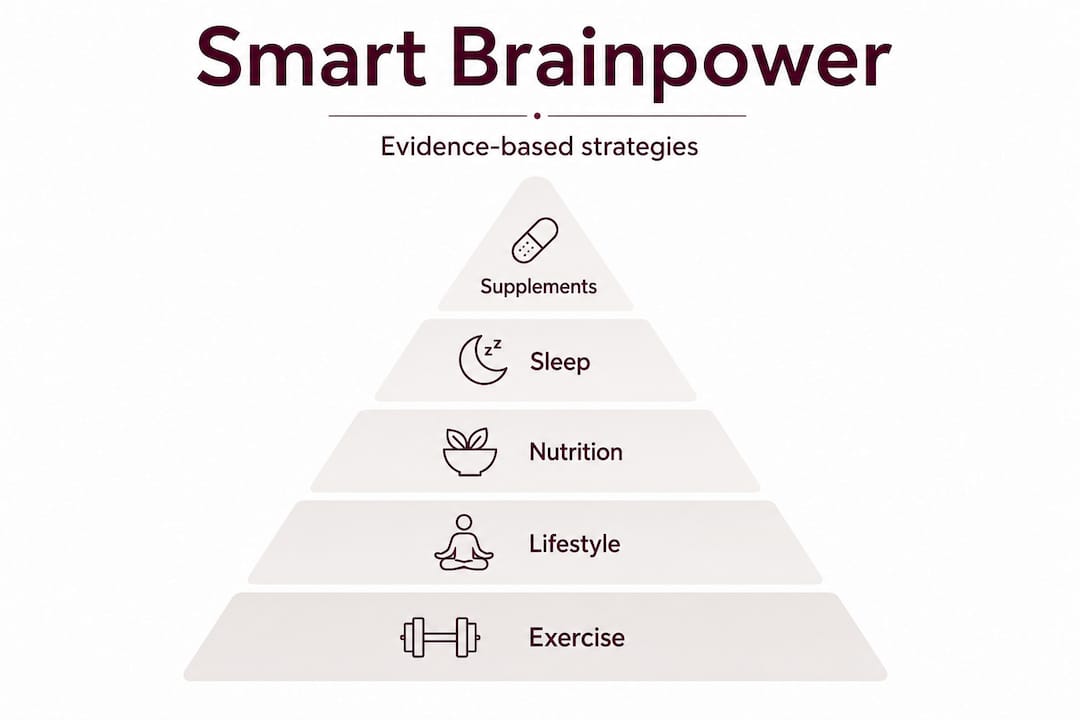
What actually moves the needle for most people isn’t a new supplement. It’s fixing the fundamentals first. Consistent sleep. Real food. Regular movement. Stress management. These interventions have stronger evidence for cognitive performance than most supplements ever will. But they’re not exciting. They don’t come in a bottle with a sleek label.
The other thing I’ve noticed is that overreliance on supplements often masks the real problem. If your focus is shot at 2 PM every day, maybe the answer isn’t a nootropic. Maybe it’s that you haven’t eaten real food since 7 AM, you’re mildly dehydrated, and you’ve been staring at a screen for six straight hours. A stimulant will get you through the next two hours, but it won’t fix the root cause.
That said, I do believe in the right supplements used for the right reasons. When foundational health is already solid, targeted support from compounds like NMN that feed NAD+ production, or lion’s mane mushroom that supports nerve growth factor, can make a real difference. The keyword is targeted. Understanding the connection between NAD+ and NMN helps you see exactly how cellular energy production connects to mental clarity, and why it matters for the long game rather than a one-day spike.
The honest answer is this: the best cognitive enhancement strategy combines evidence-based foundational habits with a small number of well-chosen, high-quality supplements that address real biological gaps. Not a drawer full of capsules. Not the latest trending stack. Just the right support, consistently applied, with realistic expectations.
Explore smarter, evidence-based approaches to cognitive health
If you’ve made it this far, you already think differently about nootropics than most people who buy them. That matters. Because making better choices about what you put in your body starts with understanding what you’re actually looking at.
At CP-1, we built our formula around ingredients with real biological rationale: NMN to support NAD+ production, lion’s mane mushroom for neuroprotective properties, reishi and turkey tail for immune resilience, and CoQ10 for mitochondrial energy. Everything is third-party tested, made in the US, and formulated for people who care about what’s actually in the bottle. If you’re ready to explore cognitive enhancement solutions that go beyond the hype, or want to dive deeper into the research behind proven supplement options, we’ve built the resources to help you make genuinely informed decisions.
Frequently asked questions
Are nootropics safe to use every day?
Daily safety depends on the specific type, dose, quality, and your personal health status; even seemingly safe supplements carry risk at excess doses, and B6 overdose is a documented example of how common nutrients can cause serious harm when overused.
Is there a natural nootropic proven to improve memory?
Bacopa monnieri has the strongest supplement-level evidence, with randomized trials showing benefits for memory free recall specifically, though the evidence does not clearly extend to attention, processing speed, or other cognitive domains.
Do prescription nootropics work better than supplements?
Prescription drugs like modafinil show small cognitive effects outside of sleep-deprived populations in meta-analytic reviews, meaning they are not reliably superior for healthy users and carry significant risks and legal considerations when used outside their prescribed purpose.
Are nootropics helpful for preventing dementia or Alzheimer’s?
No current supplement or nootropic has proven evidence for preventing dementia or Alzheimer’s disease; evidence for meaningful cognitive benefits across the category remains limited or inconsistent, particularly for long-term neurodegenerative protection.